
Plant-Based Leather vs. Traditional Hide: The Complete Material Trade-Off Analysis
As next-generation bio-leathers scale up, consumers face a complex choice between traditional durability, synthetic affordability, and plant-based sustainability.
By Factlen Editorial Team
- Bio-Material Innovators
- Advocates for scaling lab-grown and plant-based alternatives to replace animal agriculture.
- Traditional Leather Artisans
- Defenders of animal hide who prioritize generational durability and natural biodegradation.
- Sustainable Fashion Watchdogs
- Independent researchers demanding transparency regarding hidden plastics and lifecycle emissions.
What's not represented
- · Cattle Farmers
- · Waste Management Facilities
Why this matters
As the fashion industry shifts away from environmentally damaging materials, consumers are flooded with confusing claims about 'vegan' and 'plant-based' leathers. Understanding the hidden plastics, actual durability, and true carbon costs of these materials allows you to make purchasing decisions that genuinely align with your values and budget.
Key points
- Traditional animal leather offers unmatched durability and longevity but carries the highest carbon and water footprint.
- Synthetic PU leather is cheap and scalable but relies on fossil fuels and breaks down into microplastics.
- Next-generation bio-leathers drastically reduce carbon emissions by utilizing agricultural waste and fungi.
- Many plant-based leathers still rely on synthetic polyurethane coatings to achieve commercial durability.
- Bio-leathers currently excel in lightweight accessories but lack the tensile strength for heavy-duty applications.
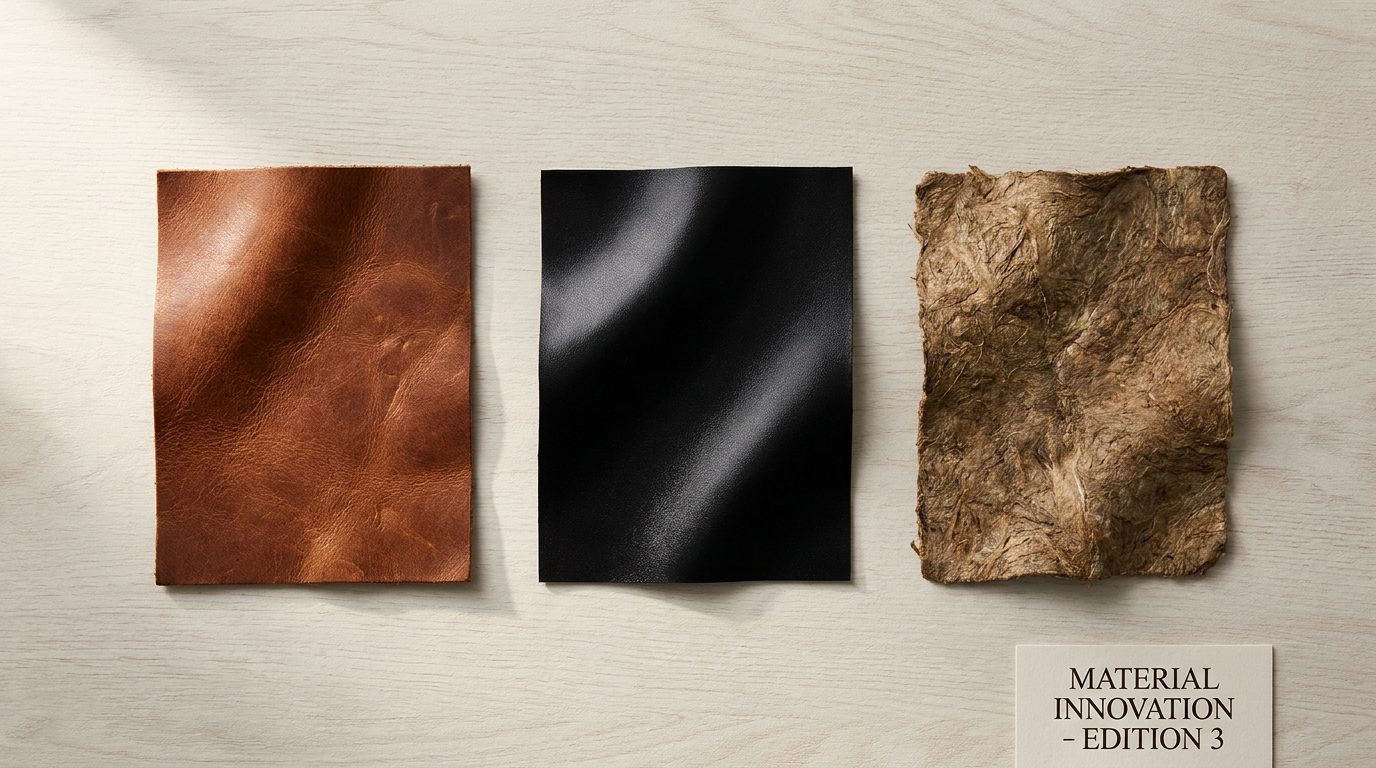
The global fashion industry is currently navigating its most significant material transformation since the invention of synthetic polymers. Driven by a shift away from the linear "take-make-waste" model, designers and consumers are actively seeking alternatives to traditional textiles. At the center of this revolution is the race to replace animal hide. Today, the market is defined by a complex three-way competition between traditional animal leather, petroleum-based synthetic leather, and a rapidly maturing class of next-generation bio-leathers made from mushrooms, apples, and pineapples.[6]
Evaluating these materials requires looking past marketing buzzwords to examine their genuine structural and ecological trade-offs. No single material offers a perfect solution for every application. Instead, each option presents a distinct profile of durability, cost, and environmental impact. By analyzing the explicit arguments for and against each material, alongside the empirical evidence governing their performance, consumers and manufacturers can make highly targeted, sustainable choices.[6]
For traditional animal leather, the primary argument centers on its historically unmatched durability and longevity. The evidence for this lies in the material's unique biological structure; the tightly interwoven collagen fibers of a full-grain buffalo or cow hide provide exceptional tensile strength. Real-world performance testing demonstrates that traditional leather effortlessly handles daily wear, heavy weight, and weather fluctuations. Rather than degrading or cracking over time, high-quality animal leather softens and develops a protective patina, allowing well-crafted boots or luggage to last for decades.[5]
Against traditional leather, the environmental and ethical toll provides the strongest counterargument. The evidence is starkly quantified by global environmental agencies: producing one square meter of cow leather generates approximately 110 kilograms of carbon dioxide equivalent. This massive footprint is driven primarily by the methane emissions and land-use requirements of cattle farming. Furthermore, conventional chromium tanning processes consume vast amounts of water and release toxic chemicals into local ecosystems, making traditional leather's upstream agricultural and processing impact the highest of all available options.[2][4]

For synthetic polyurethane and polyvinyl chloride leathers, the supporting argument rests on extreme cost-efficiency, versatility, and a surprisingly lower initial carbon footprint. The evidence shows that manufacturing synthetic leather produces only 7 to 15.8 kilograms of carbon dioxide equivalent per square meter—a fraction of the emissions associated with cattle farming. Because it is lightweight, easily dyed, and cheap to produce at a massive scale, synthetic leather has democratized the aesthetic of luxury goods, allowing mass-market fashion brands to offer consistent, animal-free products.[4]
Against synthetic leather, the argument focuses on its fossil-fuel origins and its disastrous end-of-life ecological profile. The evidence highlights that these materials are essentially plastics; they do not biodegrade and are highly susceptible to hydrolysis. Over a relatively short period, the polyurethane layers begin to peel, flake, and crack, rendering the garment unwearable. As these synthetic goods inevitably end up in landfills, they slowly break down into microplastics, contaminating waterways and soil systems indefinitely.[1][3]
For next-generation bio-leathers, the core argument is their ability to drastically reduce environmental impact while maintaining cruelty-free production methods. The evidence for this new class of materials—which includes mycelium grown from fungi, as well as textiles derived from pineapple leaves and apple peels—is highly promising. Lifecycle assessments reveal that bio-leathers generate a mere 0.8 to 8.8 kilograms of carbon dioxide equivalent per square meter. By utilizing agricultural waste and requiring a fraction of the water needed for traditional tanning, these materials represent a massive leap forward in circular manufacturing.[3][4]

For next-generation bio-leathers, the core argument is their ability to drastically reduce environmental impact while maintaining cruelty-free production methods.
Against current bio-leathers, the primary argument highlights the issue of "hidden plastics" and ongoing structural limitations. The evidence from independent sustainability audits reveals that many popular plant-based options still require synthetic binders to achieve commercial viability. For example, certain widely marketed cactus and apple leathers contain up to 65 percent polyurethane to bind the plant fibers and provide water resistance. This reliance on plastic coatings complicates their biodegradability, meaning that while they are bio-based, they are not always fully compostable.[1][3]
Furthermore, evidence regarding the physical performance of bio-leathers indicates that they have not yet achieved parity with animal hide. While mycelium and microbial leathers offer a beautifully soft, flexible feel that mimics calfskin, they generally lack the raw tensile strength of traditional leather. They require reinforcement to prevent tearing under stress, making them less suitable for heavy-duty applications and more appropriate for lightweight fashion pieces.[5]
When applying these trade-offs to real-world purchasing decisions, traditional leather fits well when maximum durability, longevity, and heavy load-bearing capacity are the absolute priorities. It is the optimal choice for heirloom luggage, heavy-duty work boots, motorcycle gear, or premium furniture that is explicitly intended to endure a lifetime of rigorous use without structural failure.[5][6]
Conversely, traditional leather does not fit when a brand or consumer is optimizing for a low carbon footprint, cruelty-free certifications, or water conservation. Its reliance on resource-intensive animal agriculture makes it fundamentally incompatible with strict corporate emission-reduction targets or vegan lifestyle principles.[2][4]
Synthetic polyurethane leather fits well when cost-efficiency and scalable mass-production are the primary goals. It is highly effective for fast-fashion accessories, entry-level automotive interiors, or seasonal trend pieces where the consumer prioritizes immediate aesthetics and affordability over decades of sustained wear.[1][6]

However, synthetic leather does not fit when the objective is true circularity, long-term environmental sustainability, or generational durability. Its inevitable degradation through hydrolysis and its contribution to global microplastic pollution make it a poor choice for anyone seeking to invest in lasting, eco-friendly goods.[3]
Next-generation bio-leather fits well when producing lightweight accessories, luxury fashion pieces, and environmentally conscious collections. It is the perfect material for consumers who are willing to pay a premium—often up to 30 percent more than synthetic options—to support innovative, low-carbon materials that actively divert agricultural waste from landfills.[4][6]

Finally, bio-leather does not fit when a manufacturer requires cheap, infinitely scalable raw materials for heavy-duty, high-stress applications. Because the supply chains for mycelium and agricultural-waste textiles are still maturing, production remains relatively expensive and volume-constrained, meaning it cannot yet replace traditional leather in environments that demand extreme, low-cost durability.[1][5]
How we got here
2018
Material science companies begin developing 100% plastic-free plant-based leathers, such as Mirum.
2021
Major global luxury houses begin introducing dedicated plant-based leather accessory lines to the public.
2024
Bio-based synthetic leathers see massive adoption in automotive interiors as car manufacturers seek to lower their scope-3 emissions.
2026
The global plant-based leather market surpasses $5.8 billion amid scaling production and improved material tensile strength.
Viewpoints in depth
Bio-Material Innovators
Advocates for scaling lab-grown and plant-based alternatives to replace animal agriculture.
This camp argues that the environmental cost of raising cattle makes traditional leather fundamentally unsustainable, regardless of its durability. They emphasize that next-generation materials like mycelium and apple leather are rapidly closing the performance gap. By utilizing agricultural waste and operating in closed-loop systems, innovators believe bio-leathers will soon achieve price parity with synthetics while offering a genuinely circular lifecycle.
Traditional Leather Artisans
Defenders of animal hide who prioritize generational durability and natural biodegradation.
Artisans and heritage brands argue that true sustainability means buying one item that lasts a lifetime, rather than replacing a degraded bio-leather bag every few years. They point out that animal hides are a natural byproduct of the food industry that would otherwise go to waste. Furthermore, they heavily criticize the 'greenwashing' of plant-based leathers, noting that a material coated in polyurethane is ultimately just another form of plastic that will never fully decompose.
Sustainable Fashion Watchdogs
Independent researchers demanding transparency regarding hidden plastics and lifecycle emissions.
This analytical camp focuses strictly on empirical lifecycle assessments. They acknowledge that bio-leathers drastically reduce carbon emissions compared to cattle farming, but they remain highly critical of the synthetic binders used to hold plant fibers together. Watchdogs demand that brands clearly label the polyurethane content in their 'vegan' products, arguing that a material cannot be considered truly sustainable if it sheds microplastics and cannot be safely composted at the end of its life.
What we don't know
- Whether bio-leathers can ever achieve the exact tensile strength of full-grain animal hide without relying on synthetic reinforcement.
- How quickly the production costs of mycelium and lab-grown leathers will drop to achieve true price parity with cheap synthetic PU.
Key terms
- Mycelium
- The vegetative, root-like structure of a fungus, consisting of a mass of branching, thread-like hyphae used to grow bio-leather.
- Polyurethane (PU)
- A synthetic polymer derived from fossil fuels, commonly used to coat synthetic and some plant-based leathers to provide flexibility and water resistance.
- Hydrolysis
- A chemical breakdown caused by a reaction with water, which causes synthetic PU leathers to peel, flake, and crack over time.
- Circularity
- An economic and manufacturing model aimed at eliminating waste by ensuring materials can be continuously reused, recycled, or safely composted.
- Chromium Tanning
- The most common method of processing animal hides into leather, utilizing chromium salts which can be highly toxic to local water systems if not strictly managed.
Frequently asked
What exactly is mycelium leather?
Mycelium leather is a material grown from the root-like structure of fungi. It is cultivated in vertical farming systems, requiring minimal water and land, and is processed to mimic the soft texture of calfskin.
Are plant-based leathers completely plastic-free?
Not always. While some innovations like Mirum are 100% plastic-free, many commercial plant-based leathers (like certain cactus or apple leathers) still use up to 65% polyurethane (PU) coatings to achieve durability and water resistance.
Why does traditional leather have a high carbon footprint?
The vast majority of traditional leather's carbon footprint comes from the methane emissions and land-use requirements associated with raising cattle, compounded by the energy-intensive chemical tanning process.
Is synthetic leather better for the environment?
Synthetic leather has a lower initial carbon footprint than cow leather, but it is derived from fossil fuels, does not biodegrade, and eventually breaks down into harmful microplastics.
Sources
Source coverage
6 outlets
3 viewpoints surfaced






[1]Technical University of MunichSustainable Fashion Watchdogs
Evaluating the Sustainability of Vegan and Synthetic Leather Alternatives
Read on Technical University of Munich →[2]UNIDOSustainable Fashion Watchdogs
Leather Carbon Footprint Review
Read on UNIDO →[3]COSH! Sustainable FashionSustainable Fashion Watchdogs
Is vegan leather better for the environment and animals?
Read on COSH! Sustainable Fashion →[4]SustamizeBio-Material Innovators
Plant-based leather: the most environmentally-friendly alternative
Read on Sustamize →[5]HesternTraditional Leather Artisans
Tomato Bio-Leather vs Traditional Leather: What You Should Know
Read on Hestern →[6]Factlen Editorial TeamSustainable Fashion Watchdogs
Synthesis by Factlen editorial team
Read on Factlen Editorial Team →
Every angle. Every day.
Get shopping stories with full source coverage and perspective breakdowns delivered to your inbox.