
Penn Researchers Develop Light-Based 'Hybrid Particle' to Drastically Cut AI Energy Use
Scientists at the University of Pennsylvania have successfully engineered a hybrid light-matter particle that processes AI calculations using photons instead of electrons. The breakthrough promises to dramatically accelerate computing speeds while slashing the massive energy demands of modern artificial intelligence.
By Factlen Editorial Team
- Hardware Physicists
- Scientists focused on the fundamental mechanics of light-matter interactions.
- Sustainability Advocates
- Groups concerned with the environmental impact of AI's energy consumption.
- Commercial AI Developers
- Tech companies looking for the next leap in processing power.
What's not represented
- · Silicon Manufacturing Industry
- · Quantum Computing Researchers
Why this matters
AI's explosive growth is currently constrained by the physical limits of electricity—specifically the immense heat and power consumption of traditional silicon chips. Shifting to light-based computing could prevent a looming global energy crisis while unlocking vastly more powerful AI models.
Key points
- Penn researchers engineered a hybrid light-matter particle to perform AI computing tasks.
- The 'exciton-polariton' combines the speed of light with matter's ability to switch states.
- Photonic computing generates virtually no heat, bypassing the thermal limits of silicon chips.
- The breakthrough could drastically reduce the massive energy consumption of AI data centers.
- Commercializing the technology will require significant investment to build a new manufacturing supply chain.
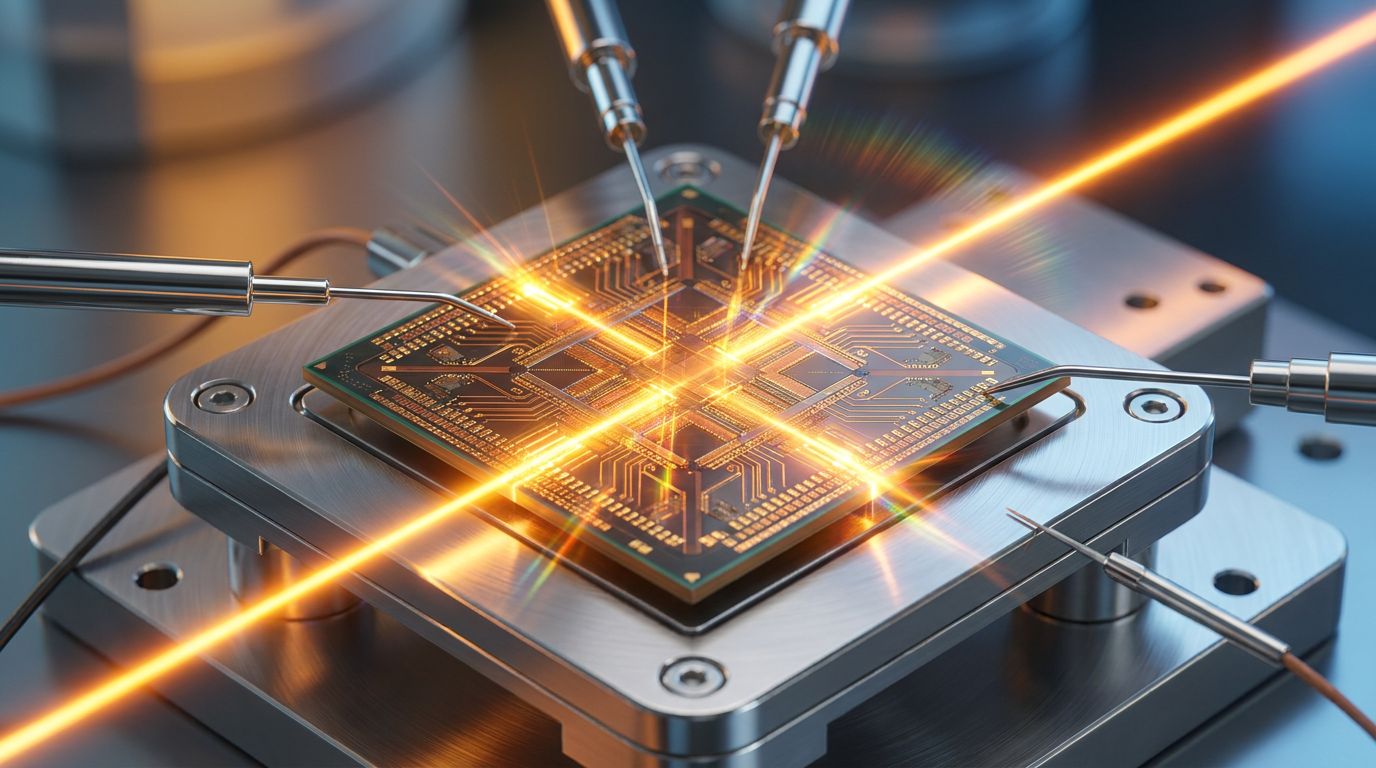
Eighty years after the University of Pennsylvania birthed the electronic computing era with the creation of ENIAC, researchers at the exact same institution are attempting to rewrite the fundamental rules of hardware. A team led by physicist Bo Zhen has successfully engineered a hybrid light-matter particle capable of performing the complex signal switching required for artificial intelligence. The breakthrough represents a critical step toward replacing traditional electron-based computing with ultra-efficient optical technology, potentially redefining how the world processes massive datasets.[1][2]
The innovation targets the primary physical bottleneck of modern computing: the electron itself. For decades, silicon chips have relied on electrons to carry electrical charges through microscopic pathways to execute logic operations. But as these particles move through solid materials, they face inherent physical resistance, generating massive amounts of heat and wasting energy in the process. This fundamental property of physics has become the ultimate speed limit for traditional semiconductor manufacturing, forcing engineers to design increasingly elaborate and expensive cooling systems just to keep processors from melting under heavy workloads.[2][6]
This thermal limit has escalated into a structural crisis for the technology sector. Training and operating frontier AI models requires vast data centers packed with tens of thousands of GPUs running continuously. These facilities consume enough electricity to power small cities, straining regional power grids and threatening corporate climate goals. The sheer energy cost of moving electrons is rapidly becoming the ceiling for AI advancement, prompting a desperate industry-wide search for alternative computing architectures that do not rely on brute-force electricity.[4][5]

To bypass this limitation, the Penn research team turned to photons—the fundamental particles of light. Photons travel exponentially faster than electrons and generate virtually no heat, making them an ideal candidate for high-speed data transmission. However, photons are notoriously difficult to control and manipulate for the precise, state-changing logic operations required in computer processing. Because light particles naturally pass through each other without interacting, forcing them to perform the "switching" behavior of a transistor has historically stumped physicists.[1][3]
The researchers overcame this hurdle by engineering a specialized quasiparticle known as an "exciton-polariton." By strongly linking photons with electrons inside an atomically thin semiconductor material, they forged a hybrid entity that bridges the gap between optics and electronics. This delicate coupling allows the particle to combine the blistering, frictionless speed of light with matter's unique ability to interact, pause, and switch states. By trapping the light in this hybrid state, the team successfully created a functional optical transistor capable of reliable logic operations.[1][3]
This delicate coupling allows the particle to combine the blistering, frictionless speed of light with matter's unique ability to interact, pause, and switch states.
This hybrid approach enables the particles to perform optical signal switching at room temperature, a massive leap over previous quantum computing efforts that required extreme supercooling. Consequently, the computing mechanism can execute the dense matrix multiplications central to AI neural networks at a fraction of the energy cost of traditional hardware. Early models suggest photonic chips could eventually operate with up to 100 times the energy efficiency of current silicon processors, fundamentally altering the economics of artificial intelligence.[3][4]
The implications for the broader tech ecosystem are profound and far-reaching. If scaled successfully, photonic AI chips could process information directly from optical sensors—such as cameras, LiDAR systems on autonomous vehicles, and fiber-optic internet networks—without the energy-intensive intermediate step of converting light into electrical signals and back again. This direct optical processing would virtually eliminate latency, enabling instantaneous, real-time AI decision-making in critical, split-second applications like robotic surgery, advanced manufacturing, and high-speed autonomous navigation. It represents a paradigm shift in how machines perceive and react to the physical world.[2]

Sustainability advocates and energy policymakers view the development as a necessary and urgent pivot. With global data center power consumption projected to double by the end of the decade, light-based computing offers a viable, physics-based path to decouple the exponential growth of artificial intelligence from grid strain and carbon emissions. Without a fundamental shift in hardware architecture, experts warn that the AI revolution could single-handedly derail international efforts to transition away from fossil fuels, making photonic efficiency a critical climate priority.[5][6]

However, transitioning from a laboratory breakthrough to commercial fabrication remains a formidable industrial challenge. The global semiconductor industry has invested trillions of dollars over half a century into electron-based silicon manufacturing, optimizing every step of the supply chain for traditional chips. Building an entirely new fabrication ecosystem for exciton-polariton hardware will require years of specialized engineering, massive capital investment, and the development of entirely new manufacturing tools that do not currently exist in commercial foundries. It is a monumental task akin to reinventing the printing press.[4]
Despite the immense manufacturing hurdles, the Penn lab's success marks a critical proof-of-concept for the future of hardware development. As the artificial intelligence sector collides with the hard physical limits of traditional physics, the transition from electricity to light is rapidly shifting from a theoretical academic ideal to an urgent industrial necessity. If the technology can be successfully commercialized over the coming decade, the next great era of computing will be defined not by the flow of electrons, but by the brilliant, frictionless speed of light.[1][6]
How we got here
1945
University of Pennsylvania researchers develop ENIAC, the world's first general-purpose electronic computer.
2010s
The rise of AI neural networks drives a massive resurgence in silicon GPU demand, pushing electrical limits.
2024-2025
Global data center power consumption surges, prompting an urgent search for alternative hardware architectures.
May 2026
Penn researchers successfully demonstrate optical signal switching using exciton-polaritons.
Viewpoints in depth
Hardware Physicists
Scientists focused on the fundamental mechanics of light-matter interactions.
For the physics community, the creation of room-temperature exciton-polaritons is a landmark achievement in quantum mechanics and materials science. Controlling photons has historically required bulky optical tables or extreme supercooling. By trapping light within atomically thin semiconductors, researchers have proven that optical logic gates can be miniaturized and stabilized, opening the door to entirely new classes of computing architecture.
Sustainability Advocates
Groups concerned with the environmental impact of AI's energy consumption.
Environmental researchers and energy departments argue that the current trajectory of AI development is ecologically unsustainable. With data centers increasingly relying on fossil fuels to meet their massive power demands, advocates see photonic computing not just as a speed upgrade, but as a critical climate technology. They emphasize that reducing the thermal waste of chips is the only way to scale AI without breaking the grid.
Commercial AI Developers
Tech companies looking for the next leap in processing power.
For the tech industry, the electron bottleneck is an existential threat to the scaling laws that have driven recent AI breakthroughs. Developers are eager for hardware that can process multimodal data—like live video feeds—without the latency of electrical conversion. While they acknowledge the long timeline for commercializing photonic chips, they view this research as the necessary foundation for the next generation of frontier models.
What we don't know
- How quickly the semiconductor industry can adapt its manufacturing processes to produce photonic chips at scale.
- The exact cost of fabricating exciton-polariton hardware compared to traditional silicon GPUs.
- Whether unforeseen physical limitations will emerge when linking billions of these optical gates together.
Key terms
- Exciton-polariton
- A hybrid particle that combines the properties of light and matter, enabling optical signals to be switched and controlled.
- Photonic computing
- A type of computing that uses photons (light) instead of electrons (electricity) to process and transmit data.
- Semiconductor
- A material, typically silicon, that can conduct electricity under certain conditions, forming the foundation of modern computer chips.
- Quasiparticle
- A disturbance or excitation in a material that behaves like a distinct particle, used by physicists to model complex interactions.
Frequently asked
What is an exciton-polariton?
It is a hybrid quasiparticle created by strongly linking light (photons) with matter (electrons) inside a semiconductor, allowing light to be controlled for computing logic.
Why is light better than electricity for AI?
Photons travel faster than electrons and do not generate heat from physical resistance, which drastically reduces the energy required to run massive AI calculations.
When will photonic chips be in computers?
The technology is currently in the laboratory proof-of-concept stage. It will likely take several years of specialized engineering to scale it for commercial manufacturing.
Sources
Source coverage
6 outlets
3 viewpoints surfaced






[1]ScienceDailyHardware Physicists
Light-Matter AI Breakthrough: Penn scientists power the future of AI with light
Read on ScienceDaily →[2]University of PennsylvaniaHardware Physicists
Eighty years after ENIAC, Penn researchers pioneer light-based computing for AI
Read on University of Pennsylvania →[3]Nature MaterialsHardware Physicists
Room-temperature optical signal switching via exciton-polaritons in atomically thin semiconductors
Read on Nature Materials →[4]TechRadar ProCommercial AI Developers
New light-based AI chips could make data centers 100x more efficient
Read on TechRadar Pro →[5]Department of EnergySustainability Advocates
ARPA-E Announces $40M for Ultra-Efficient Photonic AI Hardware
Read on Department of Energy →[6]Factlen Editorial TeamSustainability Advocates
Synthesis by Factlen editorial team
Read on Factlen Editorial Team →
More in ai
See all 6 stories →AI Drug Discovery
Open-Source AI Discovers Three New Classes of Antibiotics to Combat Drug-Resistant Superbugs
6 sources

Edge AI
How Local AI Models Work on Consumer Hardware in 2026
8 sources

Scientific Discovery
The Rise of Self-Driving Labs: How AI and Robotics Are Automating Scientific Discovery
8 sources
Medical AI
Autonomous AI Agents Match Human Physicians in End-to-End Patient Care Simulations
7 sources

Every angle. Every day.
Get ai stories with full source coverage and perspective breakdowns delivered to your inbox.