
Global Battery Storage Additions Cross 100-Gigawatt Milestone, Slashing Peak Power Prices
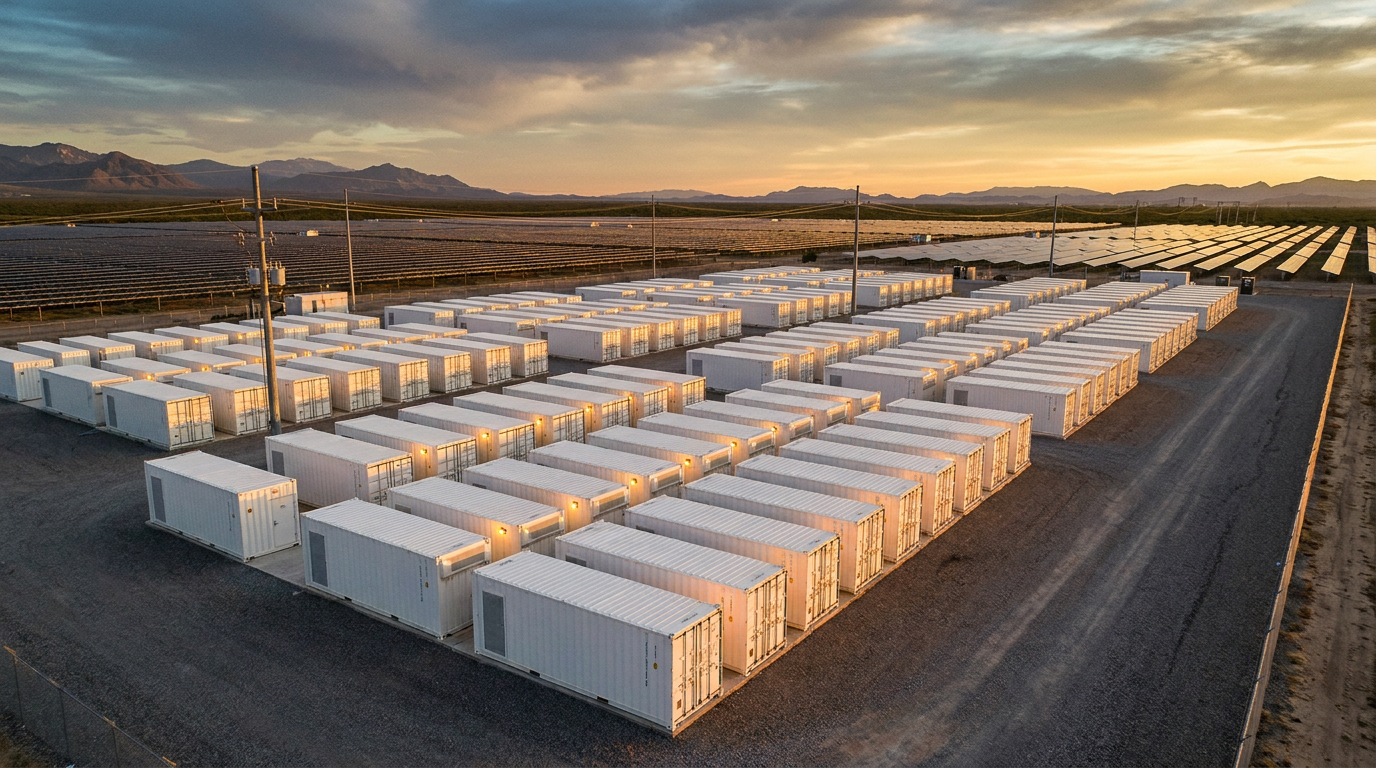
Driven by plummeting lithium-iron-phosphate costs and surging renewable generation, annual battery storage installations will surpass 100 gigawatts for the first time in 2026. The massive deployment is already stabilizing grids and driving down wholesale electricity costs across major global markets.
By Factlen Editorial Team
- Grid Operators & Utilities
- Prioritize grid reliability, frequency regulation, and managing the surge in AI-driven electricity demand.
- Renewable Energy Developers
- Focus on project bankability, hybridization, and maximizing the value of generated power.
- Industrial Power Consumers
- Tech giants and heavy industry seeking massive, reliable, and cost-effective clean energy to power operations.
What's not represented
- · Local communities facing land-use impacts from massive battery and solar installations.
- · Mining communities in regions extracting raw materials for alternative battery chemistries.
Why this matters
As AI and data centers push electricity demand to record highs, grid-scale batteries are proving they can replace expensive fossil-fuel peaker plants. For consumers, this translates to more reliable power and lower utility bills even as the grid faces unprecedented strain.
Key points
- Global annual battery storage additions are projected to surpass 100 gigawatts for the first time in 2026.
- Lithium-ion battery pack prices have plummeted 90% since 2010, hitting an average of $139 per kilowatt-hour.
- High renewable generation and battery deployment pushed Germany's Q1 2026 wholesale electricity prices below the EU average.
- Surging electricity demand from AI data centers is accelerating the deployment of hybrid solar-plus-storage projects.
- The industry is rapidly shifting toward cheaper, safer Lithium Iron Phosphate (LFP) and emerging sodium-ion chemistries.
For the first time in history, the global energy sector is on track to install more than 100 gigawatts of battery storage capacity in a single year. This 2026 milestone, forecast by major market analysts including BloombergNEF and Wood Mackenzie, marks a fundamental shift in how the world generates, stores, and consumes electricity. After years of being treated as an expensive experimental add-on, utility-scale battery systems have matured into the backbone of the modern grid. They are now deploying fast enough to absorb the massive influx of renewable energy and discharge it precisely when demand peaks, effectively neutralizing the volatility that has long plagued wind and solar power.[1][3]
The catalyst for this storage boom is a staggering collapse in manufacturing costs. Over the past fifteen years, the price of lithium-ion battery packs has plummeted by roughly 90 percent. In 2010, energy storage cost upwards of $1,200 per kilowatt-hour; today, the global benchmark has fallen to an average of $139 per kilowatt-hour. This dramatic price reduction has fundamentally altered the math of grid management, making it cheaper in many markets to build a massive battery array than to construct a new natural gas peaker plant.[4]
A quiet revolution in battery chemistry is driving these savings. The industry has aggressively pivoted away from traditional lithium-ion formulations that rely on expensive, ethically fraught metals like cobalt and nickel. Instead, the market is now dominated by Lithium Iron Phosphate (LFP) batteries. While slightly heavier, LFP cells are significantly cheaper to produce, boast a longer operational lifespan, and are far less prone to thermal runaway—making them ideal for stationary grid storage where weight is irrelevant but safety and cost are paramount.[4]

The impact of this storage capacity is already rippling through wholesale power markets, driving down costs for consumers. In Germany, renewable energy accounted for a record 53 percent of the country's electricity generation in the first quarter of 2026. Because grid operators now have the battery capacity to store excess midday solar and overnight wind generation, they can dispatch that cheap power during peak hours. As a result, Germany's average day-ahead wholesale electricity price dropped to €102 per megawatt-hour, falling below the average of neighboring European countries and insulating the domestic market from fossil fuel price shocks.[5]
Similar dynamics are playing out across Southern Europe and the United States. In Spain, wholesale electricity prices fell 32 percent below the European Union average in recent months, largely because solar and wind—backed by growing storage reserves—have systematically displaced more expensive gas and coal generation. In California and Texas, battery arrays are now routinely discharging gigawatts of power into the grid exactly as the sun sets, smoothing out the infamous 'duck curve' and preventing the evening price spikes that used to guarantee massive profits for fossil-fuel generators.[1][5]

This influx of storage arrives at a critical moment for global power grids, which are facing their most severe demand shock in decades. After years of flat or declining electricity consumption in developed nations, demand is suddenly surging. The primary culprit is the explosive growth of artificial intelligence and the massive data centers required to train and run large language models. Global data center capacity consumed roughly 500 terawatt-hours of electricity in 2025—nearly 2 percent of total global demand—and S&P Global projects that figure will grow by 14 percent annually through the end of the decade.[1][2]
This influx of storage arrives at a critical moment for global power grids, which are facing their most severe demand shock in decades.
Tech giants and utility operators quickly realized that traditional infrastructure cannot scale fast enough to meet this AI-driven load. Building a new nuclear facility or natural gas plant takes years of permitting, environmental reviews, and construction. In contrast, a utility-scale battery storage facility can be permitted and deployed in a fraction of the time. By pairing these batteries with rapidly built solar farms, grid operators can deliver the massive, reliable power injections that data centers require without waiting half a decade for new transmission lines or thermal plants to come online.[2][6]
Consequently, the standalone renewable energy project is becoming a relic of the past. The industry has entered the era of hybridization. In 2026, combining solar or wind generation with battery energy storage is no longer just a complementary option; it is the global operational standard. According to industry data, hybridization will account for nearly a third of all global renewable expansion by the end of the year. Developers are finding that large-scale battery integration is essential to ensure a project's financial viability, protecting them from 'price cannibalization'—the phenomenon where a flood of midday solar power drives wholesale prices to zero or even negative territory.[3][6]

The United States is accelerating this trend through aggressive federal policy. The 30 percent Investment Tax Credit (ITC) for standalone energy storage, preserved and expanded in recent years, has dramatically improved the return on investment for developers. In 2025 alone, the U.S. saw a record $115 billion invested in grid infrastructure and expansion, with 54 gigawatts of new utility-scale generation and storage capacity commissioned. This capital influx is transforming regional grids, particularly in the sun-drenched Southwest and the wind-swept plains of Texas, where storage is becoming the ultimate financial hedging tool.[4][6]
While the U.S. and Europe are deploying capital at record rates, China remains the undisputed heavyweight in both manufacturing and domestic installation. Chinese suppliers account for the vast majority of global battery cell production, and the country's domestic market is absorbing massive quantities of storage to balance its own unprecedented renewable energy buildout. However, escalating local content requirements and tariffs in Western markets are forcing a restructuring of the global supply chain. Chinese manufacturers are increasingly establishing facilities in South Asia, the Middle East, and Europe to maintain access to these booming export markets.[3]
Looking beyond 2026, the energy storage landscape is preparing for its next technological leap. While lithium-based systems currently dominate the four-hour storage market, grid operators are increasingly demanding longer-duration solutions capable of discharging power for eight to twelve hours. This requirement is opening the door for alternative chemistries. Sodium-ion batteries, which utilize abundant and cheap raw materials, are beginning to be deployed in commercial stationary applications. Though they possess a lower energy density than lithium, their superior thermal stability and immunity to lithium supply chain bottlenecks make them highly attractive for grid-scale use.[3][6]

Similarly, emerging technologies like iron-air batteries and advanced flow systems are moving from technical curiosities to commercial necessities. These systems are designed specifically for multi-day storage, promising to keep the lights on during extended periods of low wind or heavy cloud cover. As these non-lithium technologies achieve economies of scale, they will complement the existing lithium-ion fleet, creating a layered, highly resilient storage ecosystem.[3]
The transition from a fossil-fuel-dominated grid to a renewable-and-storage-led system is not without friction. Interconnection queues remain severely backlogged in many countries, with developers waiting years simply to plug their completed battery arrays into the transmission network. Furthermore, local opposition and permitting delays continue to slow down the deployment of necessary high-voltage transmission lines. The capital is abundant, and the technology is proven, but the physical and bureaucratic infrastructure of the 20th-century grid is struggling to accommodate the speed of the 21st-century energy transition.[3][6]
Despite these growing pains, the 100-gigawatt milestone of 2026 proves that the fundamental economics of energy have permanently shifted. The era of relying exclusively on burning molecules to balance the grid is drawing to a close. By mastering the chemistry of energy storage, the global power sector has finally unlocked the ability to capture the weather and dispatch it on demand, securing a cheaper, more resilient, and increasingly electrified future.[1][6]
How we got here
2010
Lithium-ion battery packs cost over $1,200 per kilowatt-hour, limiting them to niche applications.
2020
Lithium Iron Phosphate (LFP) chemistry begins to gain market share due to lower costs and higher safety.
2023
Global solar installations surge, exacerbating the 'duck curve' and creating urgent demand for grid-scale storage.
2025
Global data center power demand hits 500 TWh, straining grids and accelerating battery procurement.
2026
Annual battery storage additions surpass the historic 100-gigawatt milestone for the first time.
Viewpoints in depth
Grid Operators & Utilities
Focused on maintaining grid stability and meeting unprecedented demand growth.
For the organizations tasked with keeping the lights on, the battery boom is a desperately needed lifeline. Grid operators have spent the last decade struggling to balance the intermittent nature of wind and solar power. Now, facing an onslaught of new demand from AI data centers and widespread electrification, they view utility-scale storage as the only viable mechanism to maintain frequency regulation and prevent rolling blackouts. Their primary concern has shifted from technology validation to accelerating interconnection queues and upgrading transmission infrastructure to handle the new capacity.
Clean Energy Developers
Focused on project bankability and escaping the financial trap of negative wholesale prices.
Renewable energy developers are increasingly treating standalone solar or wind projects as financially unviable. As solar capacity has surged, the midday glut of electricity has led to severe 'price cannibalization,' where wholesale prices drop to zero or turn negative precisely when their panels are most productive. By natively integrating battery storage into their projects—a strategy known as hybridization—developers can store their generated power and sell it during the lucrative evening peak. This shift is essential for securing the long-term power purchase agreements required to finance new construction.
Fossil Fuel Generators
Facing the rapid erosion of their most profitable operating hours.
Operators of natural gas peaker plants are confronting an existential threat to their business model. Historically, these plants sat idle for most of the year, firing up only during periods of peak demand to sell electricity at massive premiums. However, battery storage systems are now undercutting them on price and response time, discharging cheap, stored solar power exactly when the peaker plants would traditionally operate. As a result, many fossil fuel generators are warning that retiring thermal plants too quickly could leave the grid vulnerable during multi-day weather events where solar and wind underperform.
What we don't know
- Whether global supply chains can scale fast enough to meet the surging demand for non-lithium battery chemistries like sodium-ion.
- How quickly regulatory bodies can clear the massive backlog of interconnection requests delaying completed storage projects.
Key terms
- Duck Curve
- A graph of power production that shows the timing imbalance between peak renewable generation (midday) and peak demand (evening).
- Clean Firming
- The practice of using battery storage to guarantee a steady, reliable output of electricity from intermittent sources like wind and solar.
- Lithium Iron Phosphate (LFP)
- A type of lithium-ion battery that avoids expensive cobalt and nickel, offering lower costs and higher safety for grid storage.
- Peaker Plant
- A power plant, usually burning natural gas, that only runs when there is high demand (peak hours) on the electrical grid.
- Price Cannibalization
- When a surge of renewable energy generation (like midday solar) drives wholesale electricity prices down to zero or negative, hurting generator profits.
Frequently asked
Why are battery storage installations growing so fast?
Battery costs have plummeted by roughly 90% over the last 15 years, making them a cheaper and faster alternative to building new natural gas peaker plants.
How do grid batteries lower electricity bills?
By storing cheap, abundant solar power generated during the day and discharging it during the evening peak, batteries prevent grid operators from having to buy expensive fossil-fuel power when demand is highest.
What role does AI play in the energy market?
The massive data centers required for AI are driving the highest electricity demand growth in decades. Batteries paired with renewables are the fastest way to stabilize the grid and meet this new load without causing blackouts.
Sources
Source coverage
6 outlets
3 viewpoints surfaced






[1]BloombergNEFGrid Operators & Utilities
New Energy Outlook 2026: Energy Market Shocks and the Transition
Read on BloombergNEF →[2]S&P GlobalGrid Operators & Utilities
Energy Horizons Top Trends 2026: AI Growth and Cleantech Markets
Read on S&P Global →[3]Wood MackenzieRenewable Energy Developers
Energy storage 2026 outlook: Restructuring in the global supply chain
Read on Wood Mackenzie →[4]Haisic StorageRenewable Energy Developers
Current battery storage price in 2026: A historic milestone
Read on Haisic Storage →[5]Renewable Energy IndustryRenewable Energy Developers
Germany's electricity market Q1 2026: renewables expand, wholesale prices drop
Read on Renewable Energy Industry →[6]Factlen Editorial TeamIndustrial Power Consumers
Synthesis by Factlen editorial team
Read on Factlen Editorial Team →
Every angle. Every day.
Get energy stories with full source coverage and perspective breakdowns delivered to your inbox.