
The Science of the Underwater Dolphin Kick: Swimming's 'Fifth Stroke' Explained
Elite swimmers are increasingly relying on the fluid dynamics of the underwater dolphin kick to shatter records. By minimizing wave drag and recycling water vortexes, the 'fifth stroke' has become the most critical phase of modern competitive swimming.
By Factlen Editorial Team
- Sports Biomechanists
- Argue that races are won through fluid dynamics, minimizing wave drag, and optimizing vortex generation.
- Elite Swim Coaches
- Emphasize that theoretical physics must be matched by immense core strength, breath control, and race-day execution.
- Swimming Regulators
- Maintain that while underwater speed is crucial, strict limits are necessary to ensure the sport remains a surface swimming competition.
What's not represented
- · Recreational Swimmers
- · Pool Engineers
Why this matters
Understanding the physics behind the underwater dolphin kick reveals how human athletes are pushing the absolute limits of biomechanics. It transforms how viewers watch the sport, shifting the focus from the surface splashing to the silent, high-speed chess match happening below.
Key points
- The underwater dolphin kick is the fastest phase of a swimming race, allowing athletes to bypass surface wave drag.
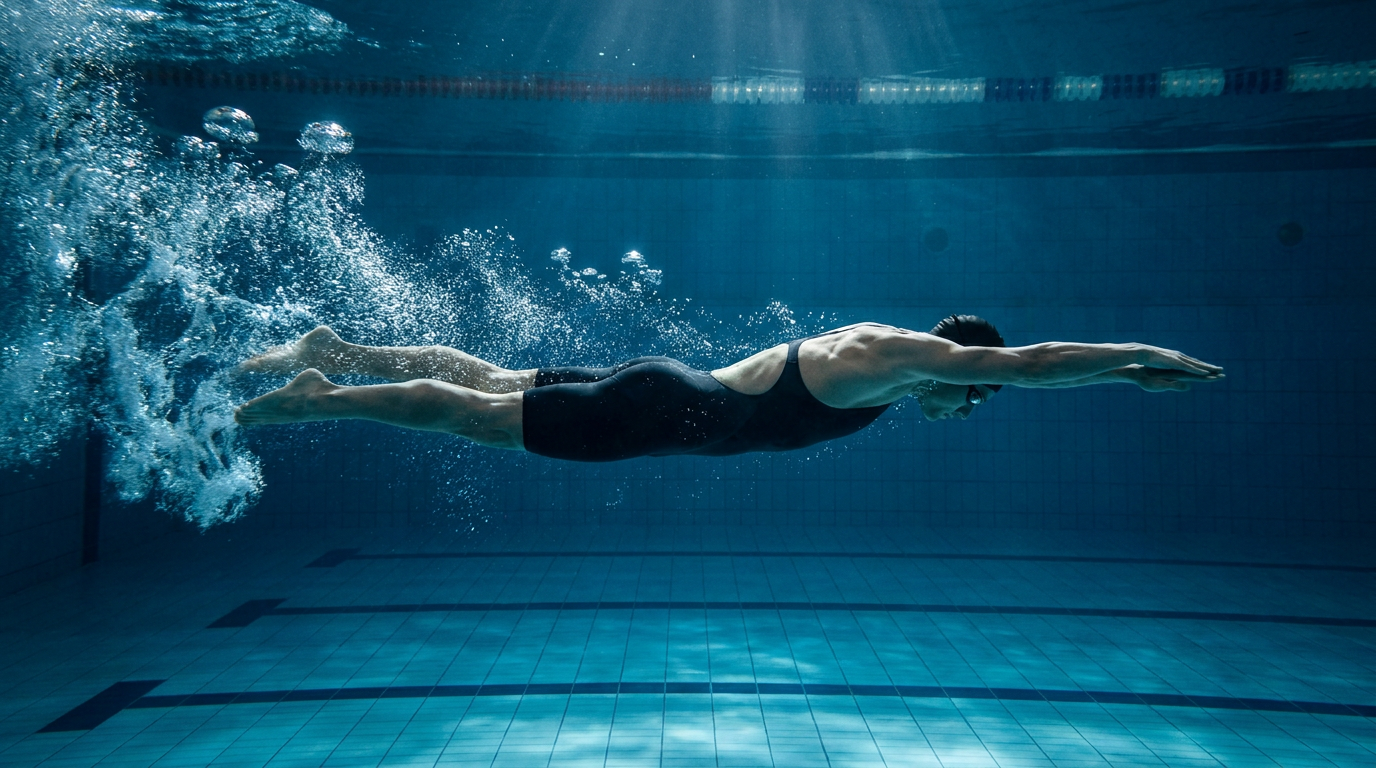
- Elite swimmers use a full-body wave motion to transfer momentum from their torso to their feet, acting like a whip.
- Recent fluid dynamics research shows that elite swimmers recycle water vortexes with their feet to generate extra propulsive force.
- To prevent swimming from becoming a purely underwater sport, FINA strictly limits submerged swimming to 15 meters per lap.
The fastest moment in any competitive swimming race does not happen when the athletes are fiercely churning the surface of the water. It happens in near-silence, completely submerged, immediately after the dive or a turn. When a swimmer pushes off the wall, they are traveling at roughly 10 to 12 miles per hour—a velocity significantly faster than humanly possible to sustain through standard surface swimming. The immediate challenge for the athlete is not to accelerate, but to delay the inevitable deceleration caused by the water's immense resistance. To do this, modern elite swimmers rely on a technique that has fundamentally rewritten the record books: the underwater dolphin kick.[4]
Universally recognized by coaches and biomechanists as swimming's "fifth stroke," the underwater dolphin kick—technically known as Undulatory Underwater Swimming (UUS)—is the great equalizer in the pool. It allows technically precise athletes to outpace stronger, taller competitors by exploiting the laws of fluid dynamics. In short-course racing, which takes place in 25-yard or 25-meter pools, this submerged phase can account for up to 60 percent of the total race distance. The race is no longer just about who has the most powerful freestyle or butterfly; it is heavily dictated by who can hold their breath and maintain a perfect hydrodynamic torpedo shape the longest.[1]
The physics dictating this advantage are rooted in the concept of wave drag. When a human swims on the surface, they must constantly fight surface tension and the bow wave their own body creates. This wave drag acts as an invisible wall, exponentially increasing resistance the faster the swimmer tries to move. By diving below the surface, swimmers bypass this turbulent boundary layer entirely. Research indicates that gliding at a depth of approximately 0.4 meters reduces total drag by 15 to 18 percent compared to moving at the exact same speed on the surface.[6]

But simply gliding is not enough to win gold medals; the swimmer must generate active propulsion without breaking their streamlined profile. This is where the biomechanics of the dolphin kick become critical. Novice swimmers often make the mistake of kicking from their knees, essentially pedaling a bicycle underwater, which creates massive drag. In contrast, the elite dolphin kick is a full-body, cephalocaudal wave—a ripple of kinetic energy that originates at the sternum, travels down through the hips, and snaps at the ankles.[1][6]
This undulatory motion mimics the biomechanics of marine mammals. By keeping the arms locked tightly ahead of the head and minimizing the frontal surface area, the swimmer transforms their body into a whip. Momentum is transferred sequentially from the larger, heavier segments of the torso down to the smaller, highly flexible joints of the feet. The resulting snap of the ankles acts as the crack of the whip, transferring maximum propulsive force into the water with minimal wasted energy.[6]
This undulatory motion mimics the biomechanics of marine mammals.
Recent advancements in fluid dynamics have allowed scientists to visualize exactly how this propulsion works. Using a technique called particle image velocimetry in circulating-water channels, researchers at the University of Tsukuba recently mapped the invisible currents generated by the dolphin kick. Because water is colorless and transparent, understanding the exact mechanism of thrust had long relied on theoretical models. By illuminating microscopic particles in the water, the researchers could finally see the wake left behind by the swimmer's feet.[2]

The Tsukuba study revealed that as swimmers increase their underwater speed, they generate powerful, structured vortexes during the downward phase of the kick. More importantly, elite swimmers are able to "recycle" the flow of water generated during this down-kick, using the swirling vortex to push off against during the subsequent upward-kick phase. This fluid recycling acts as a hydrodynamic multiplier, allowing the swimmer to extract more propulsive force from the water than muscle power alone could generate.[2]
Executing this highly technical movement while starved of oxygen requires immense physiological conditioning. The fifth stroke demands extraordinary core strength to initiate the wave, extreme ankle flexibility to finish it, and profound breath control to endure it. Swimmers are operating in a state of oxygen debt, their muscles screaming for air while their brains must remain calm enough to maintain a perfectly rigid streamline. A single dropped hip, a slightly lifted head to look forward, or a loose knee can instantly deploy a hydrodynamic parachute, killing the momentum generated off the wall.[1][4]
Because the underwater dolphin kick is so overwhelmingly efficient, it forced a crisis in the sport's governing bodies during the late 1980s and 1990s. At the 1988 Olympic Games, American backstroker David Berkoff stunned the world by swimming more than 30 meters of his 100-meter race completely underwater, utilizing the dolphin kick to shatter the world record. Realizing that swimming was on the verge of becoming a purely submarine sport, the International Swimming Federation (FINA) intervened to preserve the traditional strokes.[5]

FINA instituted a strict rule that remains the defining constraint of modern competitive swimming: athletes are limited to exactly 15 meters of underwater swimming per length of the pool. The moment a swimmer's head fails to break the surface by the 15-meter mark, they are instantly disqualified. This regulation preserved the traditional surface strokes while turning the 15-meter zone into the most fiercely contested real estate in aquatic sports.[5]
Today, the mastery of the 15-meter underwater zone is non-negotiable for anyone hoping to reach an Olympic podium. The transition from the submerged dolphin kick back to surface swimming—known as the breakout—is a delicate balancing act. If a swimmer breaks out too early, they waste the free speed generated off the wall. If they break out too late, they lose momentum and surface slower than their natural swimming speed. The perfect breakout requires the swimmer to breach the surface at the exact millisecond their underwater velocity matches their surface velocity.[1]

As the margins between gold and silver shrink to hundredths of a second, the scientific scrutiny applied to the fifth stroke will only intensify. Coaches and biomechanists are increasingly using wearable sensors, computational fluid dynamics, and AI-driven video analysis to shave millimeters off a swimmer's streamline and optimize their vortex generation. While the surface strokes will always provide the spectacle of the race, the silent, submerged physics of the dolphin kick will continue to determine the victor.[7]
How we got here
1988
American David Berkoff swims over 30 meters underwater in the 100m backstroke, prompting FINA to investigate the technique's dominance.
1996
FINA expands the 15-meter underwater limit to butterfly and freestyle events following the Atlanta Olympics.
2008
Michael Phelps utilizes a devastatingly efficient underwater dolphin kick to secure a historic eight gold medals in Beijing.
March 2024
University of Tsukuba researchers publish groundbreaking fluid dynamics data visualizing how elite swimmers recycle water vortexes.
Viewpoints in depth
Sports Biomechanists
Focusing on the fluid dynamics and mathematical optimization of the human body in water.
For biomechanists and fluid dynamics researchers, the pool is a laboratory of drag coefficients and propulsive efficiency. They view the human body as an imperfect submarine that must be optimized to slip through the water with minimal resistance. This camp relies heavily on computational fluid dynamics, wearable accelerometers, and particle image velocimetry to prove that races are won in the boundary layers of water. They argue that the traditional focus on arm-pull strength is outdated, and that the future of swimming lies in teaching athletes how to perfectly manipulate water vortexes with their feet to achieve 'free speed' off the walls.
Elite Swim Coaches
Focusing on the physiological toll and practical execution of the technique under extreme race fatigue.
While coaches acknowledge the undeniable physics of the fifth stroke, their primary concern is the human engine required to execute it. An optimal streamline looks great on a computer model, but maintaining it while operating in a severe oxygen deficit during the final turn of a 200-meter butterfly is a different reality. This camp emphasizes the grueling physical conditioning required—specifically immense core strength, ankle flexibility, and lung capacity. They argue that races are lost when a fatigued swimmer drops their hips or breaks out too early, proving that biomechanical theory is useless without the physiological endurance to back it up.
Swimming Regulators
Focusing on preserving the historical integrity and visual spectacle of the four traditional surface strokes.
The governing bodies of international swimming view the underwater dolphin kick as a highly effective technique that must be strictly contained. Historically, regulators watched athletes like David Berkoff turn backstroke events into submarine breath-holding contests, which threatened to make the actual surface strokes obsolete. By enforcing the 15-meter rule, this camp seeks to strike a balance: rewarding the athleticism and innovation of the fifth stroke while ensuring that swimming remains a sport defined by the distinct, recognizable styles of freestyle, backstroke, breaststroke, and butterfly.
What we don't know
- The absolute theoretical limit of human propulsive efficiency underwater.
- How varying individual body morphologies perfectly map to specific vortex generation patterns.
- Whether future wearable sensor technology will lead to real-time, mid-race adjustments in kick amplitude.
Key terms
- Undulatory Underwater Swimming (UUS)
- The technical biomechanical term for the dolphin kick, characterized by a wave-like motion through the body.
- Wave Drag
- The hydrodynamic resistance a swimmer faces on the surface caused by the displacement of water and the creation of a bow wave.
- Cephalocaudal Wave
- A movement that originates at the head or upper torso and travels down the body toward the feet.
- Particle Image Velocimetry
- A fluid dynamics technique that uses microscopic illuminated particles to visualize and measure the flow of water.
Frequently asked
Why is the underwater dolphin kick called the fifth stroke?
Because it is utilized across all four traditional competitive strokes (freestyle, backstroke, butterfly, and breaststroke) and is crucial enough to overall race time to be considered a stroke of its own.
Why is swimming underwater faster than swimming on the surface?
Submerged swimmers avoid wave drag—the resistance caused by creating waves and breaking surface tension—allowing them to maintain the high speed generated from diving or pushing off the wall.
Can a swimmer stay underwater for the whole race?
No. International rules strictly limit underwater swimming to 15 meters per lap after the start and each turn. Exceeding this limit results in immediate disqualification.
Do breaststrokers use the dolphin kick?
Yes, but under highly specific rules. Breaststrokers are allowed exactly one downward dolphin kick during their underwater pullout sequence before they must break the surface.
Sources
Source coverage
7 outlets
3 viewpoints surfaced







[1]Athletes UntappedElite Swim Coaches
The Fifth Stroke: Optimizing the Underwater Phase
Read on Athletes Untapped →[2]ScienceDailySports Biomechanists
Dolphin-kick swimming maximizes water-flow utilization with increasing speed
Read on ScienceDaily →[3]MDPISports Biomechanists
Hydrodynamic Characteristics of Undulatory Underwater Swimming
Read on MDPI →[4]Swim Like A FishElite Swim Coaches
Mastering the Physics of the Tuck and Fifth Stroke
Read on Swim Like A Fish →[5]University of SouthamptonSports Biomechanists
Understanding the Biomechanics of Underwater Undulatory Swimming
Read on University of Southampton →[6]Bond University ResearchSports Biomechanists
Performance determinants of the Undulatory Underwater Swimming
Read on Bond University Research →[7]Factlen Editorial TeamSwimming Regulators
Synthesis by Factlen editorial team
Read on Factlen Editorial Team →

More in sports
See all 6 stories →NBA Finals
New York Knicks Win 2026 NBA Finals, Ending 53-Year Championship Drought
6 sources

Women's Super League
Mary Earps Returns to Women's Super League in Statement Signing for London City Lionesses
7 sources

WSL Transfers
Mary Earps Returns to WSL in Statement Signing for London City Lionesses
7 sources

Combat Tech
The Science of the Strike: How Smart Gloves and Sensors Are Making Combat Sports Safer
9 sources

Every angle. Every day.
Get sports stories with full source coverage and perspective breakdowns delivered to your inbox.