
The Science of Biological Cleaning: How Enzymes and Probiotics Outperform Chemical Disinfectants
A shift from 'scorched earth' chemical disinfectants to biological cleaners is transforming surface hygiene. By using targeted enzymes and beneficial bacteria, these formulas provide a continuous, self-sustaining clean that prevents pathogen rebound.
By Factlen Editorial Team
- Microbial Ecologists
- Advocate for cultivating a balanced indoor microbiome to competitively exclude pathogens.
- Eco-Conscious Consumers
- Value biological cleaners for eliminating toxic VOCs and supporting immune health.
- Commercial Facility Managers
- Focus on the cost-efficiency, continuous cleaning action, and material safety of enzymatic products.
- Traditional Infection Control
- Maintain that acute outbreaks and sterile environments still require rapid-kill chemical disinfectants.
What's not represented
- · Traditional chemical cleaning manufacturers
Why this matters
Overusing harsh chemical disinfectants can breed resistant superbugs and worsen indoor air quality. Understanding how biological cleaners work allows you to permanently eliminate deep-set odors and maintain a healthier, longer-lasting clean without toxic residues.
Key points
- Biological cleaners use a combination of targeted enzymes and beneficial bacteria to digest organic waste at a molecular level.
- Unlike chemical disinfectants that stop working once dry, probiotic cleaners create a continuous cleaning cycle that lasts for days.
- Clinical trials show probiotic cleaning reduces surface pathogens by 89% over six months, preventing the rapid rebound seen with chemicals.
- Enzymatic formulas are uniquely effective at permanently eliminating pet odors by digesting uric acid crystals rather than masking them.
- Biological cleaners require 10 to 30 minutes of dwell time and cannot be used alongside harsh chemicals like bleach.
For decades, the gold standard of household and commercial cleaning has been a "scorched earth" campaign. Armed with bleach, ammonia, and quaternary ammonium compounds (quats), consumers have been trained to seek out products that promise to kill 99.9% of germs on contact. This chemical warfare effectively sterilizes countertops, floors, and bathrooms, leaving behind a sharp, clinical scent that society has come to associate with cleanliness. But microbial ecologists are increasingly warning that this approach is not only fleeting, but potentially counterproductive.[2][7]
The fundamental flaw in chemical disinfection is that nature abhors a vacuum. When a surface is entirely stripped of microscopic life, it becomes a barren, resource-rich landscape ripe for recolonization. Because chemical cleaners stop working the moment they dry, any new pathogen introduced to the surface—via a sneeze, a dirty hand, or a pet—faces zero competition. Within hours, harmful bacteria can reclaim the territory, often returning stronger than before.[1][7]
Enter the biological revolution in surface hygiene: enzymatic and probiotic cleaners. Rather than attempting to chemically annihilate all microscopic life, these formulas enlist nature's own mechanisms to dismantle dirt and outcompete pathogens. By deploying specific proteins and beneficial bacteria, biological cleaners transform the act of cleaning from a momentary chemical burn into a continuous, self-sustaining biological process.[4][7]
To understand how biological cleaning works, it is necessary to look at its two primary engines, starting with enzymes. Contrary to popular belief, enzymes are not alive. They are complex proteins that act as biological catalysts, accelerating chemical reactions without being consumed in the process. In a cleaning context, enzymes operate on a strict "lock-and-key" mechanism, meaning specific enzymes are required to dismantle specific types of organic waste.[4][6]

A high-quality biological cleaner contains a cocktail of these targeted proteins. Proteases are deployed to break down protein-based stains like blood, sweat, and urine. Lipases specifically target lipid molecules, making them highly effective against kitchen grease and oils. Amylases dismantle carbohydrate and starch-based residues like dried sauces, while cellulases help release particulate soil from fabric fibers. When sprayed onto a mess, these enzymes immediately begin cleaving the complex molecular bonds of the grime, shattering it into smaller, manageable fragments.[4]
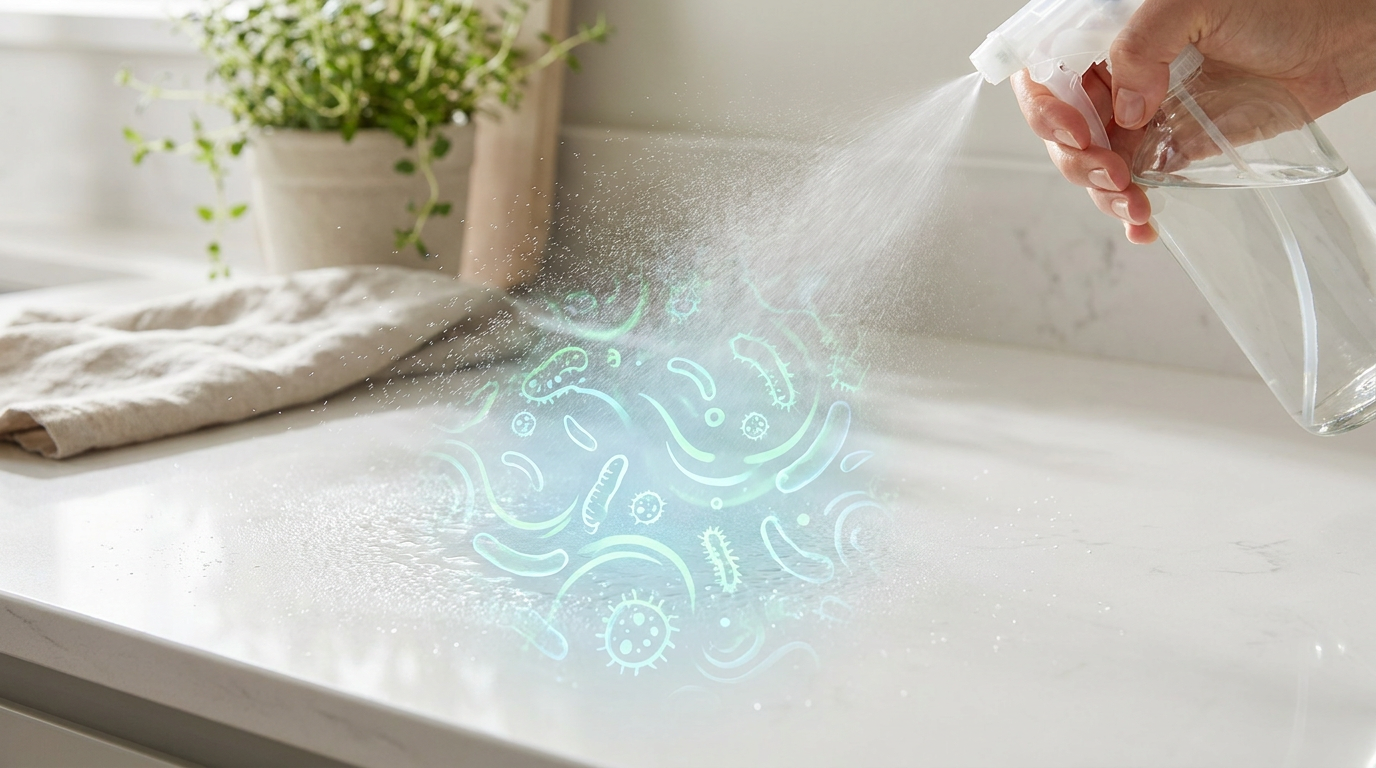
But breaking down the waste is only half the battle; the fragments must still be removed. This is where the second engine of biological cleaning—probiotics—comes into play. Probiotic cleaners contain dormant strains of beneficial, non-pathogenic bacteria, most commonly from the Bacillus family. When these bacteria make contact with the organic fragments left behind by the enzymes, they wake up and begin to feed.[3][4]
As the beneficial bacteria consume the broken-down soils, they convert the waste into harmless byproducts: carbon dioxide and water. Even more remarkably, as long as there is a "food source" (dirt, grease, or odor-causing compounds) present on the surface, the bacteria will continue to multiply and manufacture their own fresh enzymes. This creates a continuous, microscopic cleaning cycle that persists for days after the initial application, reaching deep into porous surfaces where chemical wipes cannot penetrate.[2][4]
As the beneficial bacteria consume the broken-down soils, they convert the waste into harmless byproducts: carbon dioxide and water.
This deep-penetrating action is why enzymatic cleaners are the only true solution for severe pet odors. When a pet urinates on a carpet or concrete patio, the urea breaks down into ammonia, while uric acid crystallizes as it dries. Traditional chemical deodorizers merely mask the smell or clean the surface layer, leaving the uric acid crystals embedded in the material. When the air becomes humid, those crystals reactivate, and the odor returns. Enzymatic formulas, however, physically digest the uric acid at a molecular level, permanently eliminating the source of the smell.[6]
The efficacy of this biological approach extends far beyond household pet stains; it is currently triggering a paradigm shift in healthcare infection control. A landmark six-month trial conducted in an Italian hospital and published in PLOS ONE compared traditional chemical disinfection against a Bacillus-based probiotic cleaning protocol. The results challenged decades of established hospital hygiene practices.[1][3]
The study found that while chemical disinfectants initially wiped out surface pathogens, the harmful bacteria rebounded by 30% to 40% within just 48 hours of application. In stark contrast, the surfaces treated with probiotic cleaners saw an 89% reduction in total pathogenic bioburden over the six-month period. By establishing a dominant colony of beneficial bacteria, the probiotics engaged in "competitive exclusion"—starving out dangerous pathogens and preventing them from gaining a foothold.[1][2]

Perhaps the most vital finding from these clinical trials relates to the escalating global crisis of Antimicrobial Resistance (AMR), which public health officials consider one of the most pressing medical threats of the century. The relentless use of harsh chemical disinfectants in hospitals and homes actively pressures surviving bacteria to mutate, inadvertently breeding chemical-resistant superbugs that are increasingly difficult to treat. The Italian hospital study revealed a groundbreaking metric: surfaces cleaned with probiotics showed a staggering 99.9% reduction in antibiotic-resistant genes compared to chemically disinfected wards. By outcompeting the pathogens naturally rather than attacking them chemically, the probiotics sidestep the evolutionary arms race that drives resistance.[1][3]
This shift away from sterile environments also aligns with the "Hygiene Hypothesis," a growing body of immunological research. Scientists increasingly believe that the modern obsession with eradicating all microbes—driven by the overuse of antibacterial soaps and harsh household cleaners—is a primary driver behind the surging rates of childhood allergies, asthma, and autoimmune disorders. Early exposure to a diverse, balanced indoor microbiome is essential for training the human immune system.[5]
Despite their advantages, biological cleaners require a shift in consumer expectations. Because they rely on a natural digestive process rather than a caustic chemical burn, they are not instantaneous. Enzymes and bacteria require "dwell time"—typically 10 to 30 minutes—to fully break down and consume organic matter. Rinsing the surface too quickly halts the biological reaction before the job is done.[6]

Furthermore, biological cleaners are highly sensitive to their environment. They cannot be used in tandem with traditional chemical cleaners. Applying bleach or antibacterial sprays over an enzymatically treated surface will instantly kill the beneficial bacteria and denature the enzymes, rendering the biological product entirely useless.[4][7]
Chemical disinfectants will always have a necessary place in acute scenarios—such as cleaning up a biohazard spill, preparing a sterile surgical field, or managing an active viral outbreak. But for the daily maintenance of homes, offices, and public spaces, the science points in a different direction.[1][7]
By trading the illusion of a sterile, chemically scorched countertop for a balanced, biologically active ecosystem, consumers can achieve a deeper, longer-lasting clean. The future of hygiene is not about killing every microbe in sight; it is about cultivating the right ones to do the work for us.[2][7]
Viewpoints in depth
Microbial Ecologists
Advocate for cultivating a balanced indoor microbiome rather than attempting to sterilize surfaces.
Researchers in the field of built-environment microbiomes argue that the 'scorched earth' approach to cleaning is biologically unsustainable. By indiscriminately killing all microbes, chemical disinfectants clear the way for rapid recolonization by opportunistic pathogens. Ecologists point to clinical data showing that introducing beneficial Bacillus strains creates competitive exclusion, effectively starving out dangerous bacteria and significantly reducing the prevalence of antimicrobial-resistant genes.
Eco-Conscious Consumers
Value biological cleaners for eliminating toxic VOCs and aligning with the hygiene hypothesis.
For households focused on wellness and environmental impact, biological cleaners offer a way to maintain hygiene without introducing harsh volatile organic compounds (VOCs) into the air. This demographic is heavily influenced by the 'hygiene hypothesis,' which suggests that overly sterile environments contribute to rising rates of childhood allergies and asthma. By using plant-derived enzymes and probiotics, these consumers aim to foster a diverse, immune-supporting indoor microbiome while ensuring their cleaning products safely biodegrade in waterways.
Traditional Infection Control
Maintain that chemical disinfectants remain essential for acute biohazards and sterile environments.
While acknowledging the benefits of probiotics for daily maintenance, traditional infection control experts emphasize that biological cleaners are not a replacement for high-level disinfection. In scenarios involving active viral outbreaks, biohazard spills, or surgical environments, immediate pathogen eradication is non-negotiable. Because enzymatic cleaners require 10 to 30 minutes of dwell time to digest organic matter, they cannot provide the rapid, broad-spectrum kill required in acute medical or emergency situations.
What we don't know
- The long-term effects of aerosolized probiotic cleaning sprays on human respiratory microbiomes remain under-researched.
- It is not yet fully understood which specific bacterial strains are most effective for different indoor climates and humidity levels.
Key terms
- Enzyme
- A biological catalyst (protein) that speeds up chemical reactions, breaking down complex organic molecules into smaller fragments.
- Probiotic Cleaner
- A cleaning solution containing live, beneficial bacteria that consume organic waste and competitively exclude harmful pathogens.
- Competitive Exclusion
- A biological process where beneficial bacteria consume all available resources on a surface, starving out harmful pathogens and preventing them from colonizing.
- Microbiome of the Built Environment
- The invisible community of microorganisms (bacteria, fungi, viruses) that live on the surfaces and in the air of human-made structures.
- Antimicrobial Resistance (AMR)
- The ability of microorganisms to withstand antimicrobial treatments, often accelerated by the overuse of chemical disinfectants.
Frequently asked
Do probiotic cleaners leave bacteria all over my house?
Yes, but they are beneficial, non-pathogenic strains (like Bacillus) that safely outcompete harmful germs and degrade organic waste.
Can I use bleach and enzymatic cleaners together?
No. Harsh chemicals like bleach or antibacterial sprays will kill the beneficial bacteria and destroy the enzymes, rendering the biological cleaner useless.
Why do enzyme cleaners take longer to work?
Biological cleaning relies on a natural digestive process. The enzymes and bacteria need dwell time—usually 10 to 30 minutes—to fully break down and consume the organic matter.
Are biological cleaners safe for pets?
Yes. Because they use natural enzymes and bacteria rather than harsh synthetic chemicals, they do not leave behind toxic residues or harmful VOCs that pets might ingest or inhale.
Sources
Source coverage
7 outlets
4 viewpoints surfaced







[1]SanitifyMicrobial Ecologists
Probiotic Cleaning vs Chemical Disinfectants: A Scientific Comparison
Read on Sanitify →[2]National Institutes of HealthMicrobial Ecologists
Microbiome of the Built Environment and Cleaning Products
Read on National Institutes of Health →[3]Genesis BiosciencesTraditional Infection Control
Probiotic cleaners for hospitals - research studies
Read on Genesis Biosciences →[4]Nyco ProductsCommercial Facility Managers
Bacteria and Enzymes … Better Together
Read on Nyco Products →[5]Tiny HealthEco-Conscious Consumers
Are cleaning products bad for your health? The hygiene hypothesis
Read on Tiny Health →[6]Nature's FreedomEco-Conscious Consumers
What Is an Enzyme Cleaner? The Science Behind Enzymatic Odor Elimination
Read on Nature's Freedom →[7]Factlen Editorial TeamTraditional Infection Control
Synthesis by Factlen editorial team
Read on Factlen Editorial Team →
Every angle. Every day.
Get home stories with full source coverage and perspective breakdowns delivered to your inbox.