
Space-Based Solar Power Moves Closer to Reality Following Wireless Transmission Breakthroughs
Recent ground tests and commercial advancements in 2026 have accelerated the timeline for space-based solar power, proving that beaming limitless orbital energy to Earth is an engineering reality rather than science fiction.
By Factlen Editorial Team
- Orbital Energy Advocates
- Argue that space-based solar is the ultimate clean energy solution, providing constant baseload power without the intermittency of terrestrial renewables.
- Aerospace Engineers
- Focus on the immense technical hurdles, emphasizing that while the physics work, launch costs and orbital assembly at scale remain daunting.
- National Space Programs
- View orbital solar power as a strategic frontier for both energy independence and space dominance, heavily investing in long-term roadmaps.
What's not represented
- · Environmental groups concerned about the ecological impact of large-scale rectennas on land and sea.
- · Astronomers worried about light pollution and radio interference from massive orbital power stations.
Why this matters
Transitioning the world to clean energy requires power sources that do not turn off when the sun sets or the wind stops. Space-based solar power offers a limitless, zero-carbon baseload energy supply that could fundamentally solve the intermittency problem of terrestrial renewables.
Key points
- Chinese researchers successfully transmitted kilowatt-level power wirelessly to moving targets.
- Space-based solar power offers 24/7 clean energy, unaffected by weather or night cycles.
- Startups are developing ultra-lightweight solar panels to drastically reduce launch costs.
- Commercial gigawatt-scale orbital power stations are targeted for deployment by 2050.
For over half a century, the idea of harvesting solar energy in space and beaming it down to Earth lived strictly in the realm of science fiction. But in 2026, space-based solar power (SBSP) has officially transitioned from a theoretical dream into a funded, multi-national engineering race. Driven by plummeting launch costs, breakthroughs in ultra-lightweight materials, and an urgent global demand for clean baseload energy, researchers and commercial startups are rapidly solving the logistical hurdles that once made orbital power impossible.[4][6]
The fundamental appeal of space-based solar power is simple: it solves the greatest limitation of terrestrial renewable energy. Solar panels on Earth are at the mercy of the night cycle, cloud cover, and seasonal shifts, meaning they spend more than half their time waiting for sunlight. In orbit, however, there is no weather and no night. Satellites positioned above the Earth's atmosphere can collect intense, uninterrupted sunlight 24 hours a day, offering the holy grail of the energy transition: a zero-carbon power source that never turns off.[2][6][7]
The physics of wireless power transmission were proven in orbit in 2023 by the California Institute of Technology. Caltech's MAPLE (Microwave Array for Power-transfer Low-orbit Experiment) successfully beamed a detectable microwave signal from a satellite to a receiver on a Pasadena rooftop. While the amount of energy received was tiny, it confirmed that lightweight, flexible arrays could survive the violence of a rocket launch, deploy in the vacuum of space, and electronically steer energy toward a specific target on Earth without moving mechanical parts.[3][7]
Now, the challenge has shifted from proving the physics to scaling the engineering. In May 2026, Chinese researchers achieved a major milestone in this effort, successfully testing a ground-based system capable of wirelessly transmitting kilowatt-level power to multiple moving targets simultaneously. The "Sun Chasing" project, led by Xidian University, utilized a 75-meter-tall verification tower to simulate the energy transmission process before attempting orbital deployment.[1][2]

The Xidian University team successfully beamed 1,180 watts of power across a distance of roughly 100 meters, maintaining precise microwave beam control. Crucially, the system was able to track and power moving drones in mid-air, achieving an overall wireless power transmission efficiency of 20.8 percent. This dynamic targeting capability is essential for future orbital stations, which will need to maintain a continuous, pinpoint connection with receiving stations on Earth while hurtling through space at thousands of miles per hour.[1][2][5]
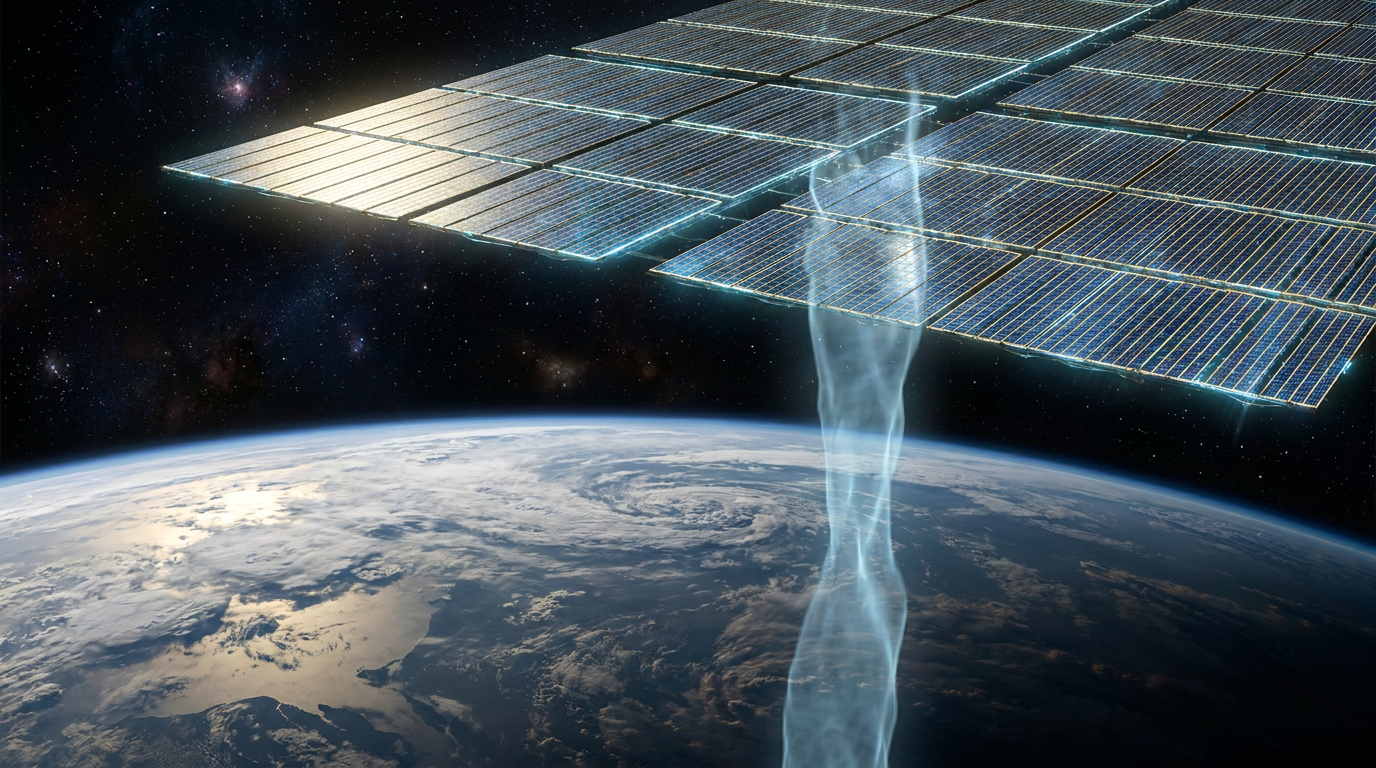
Understanding how this technology works requires looking at the three-step mechanism of an SBSP system. First, massive arrays of photovoltaic cells in orbit collect raw sunlight and convert it into direct current (DC) electricity. Because these panels sit outside the Earth's atmosphere, the solar radiation they intercept is significantly more intense than the sunlight that reaches the ground.[2][3][7]
Second, the spacecraft converts this DC electricity into microwaves. Microwaves are chosen specifically because they can pass through Earth's atmosphere, including heavy cloud cover and rain, with almost zero energy loss. The satellite uses a phased array—a grid of small transmitters—to electronically shape and steer the microwave beam toward the surface, ensuring the energy remains tightly focused over thousands of miles.[2][3][7]
Second, the spacecraft converts this DC electricity into microwaves.
Finally, the microwave beam reaches a ground-based receiver known as a "rectenna" (rectifying antenna). This vast net of simple, low-cost wire antennas captures the microwave energy and converts it back into DC electricity, which is then fed directly into the local power grid. Because the microwave beam is spread over a wide area, its energy density is low enough to be completely safe for humans, birds, and aircraft passing through it.[2][7]

While national space agencies are building long-term roadmaps, a new wave of commercial startups is aggressively pushing the timeline forward in 2026. Companies like Virtus Solis are taking a ground-first approach, analytically proving that their phased array technology can split a single beam to deliver power to multiple receivers, with plans for an orbital demonstrator by 2027.[4]
The most significant commercial bottleneck for SBSP is the sheer weight of the infrastructure. Launching thousands of tons of traditional solar panels into orbit would require an economically unviable number of heavy-lift rocket launches. To solve this, the industry is pivoting to radically new materials. In 2026, the startup Starpath introduced a line of ultra-thin space solar panels weighing just 73 grams per square meter—a dramatic reduction from conventional space-grade hardware.[4][7]
These ultra-lightweight, flexible panels are designed to be folded tightly into the fairing of a rocket, drastically increasing the amount of power-generating surface area that can be deployed in a single launch. By pairing these featherweight materials with the rapidly decreasing cost of reusable rockets, the economics of orbital assembly are beginning to align with commercial realities.[3][4][6]

Integrating this orbital power into the existing energy grid is another area of active development. A recent report by the UK government's Department for Energy Security and Net Zero suggested that space-based solar power could seamlessly plug into the national grid by utilizing the existing infrastructure of offshore wind farms. By building floating rectennas out at sea, nations could beam gigawatts of power down to the ocean and route it to cities using the high-capacity undersea cables already laid for wind energy.[4]
Despite this rapid progress, aerospace engineers caution that immense technical hurdles remain. Space is a brutally harsh environment. Solar arrays in high orbits are subjected to extreme temperature swings, micrometeoroid impacts, and intense cosmic radiation that degrades photovoltaic efficiency much faster than on Earth. Designing systems that can autonomously repair themselves or maintain efficiency over a 30-year lifespan is a monumental challenge.[3][7]
Furthermore, the scale of a commercial SBSP station is difficult to overstate. To generate a gigawatt of power—roughly equivalent to a large nuclear reactor—an orbital solar array would need to span several square miles. Assembling structures of this magnitude in the vacuum of space will likely require autonomous robotic construction fleets, a technology that is still in its infancy.[2]
Recognizing these challenges, the timeline for commercial deployment remains measured. China's 15th Five-Year Plan outlines a phased approach: low-Earth-orbit technology verification tests in the late 2020s, followed by a megawatt-scale in-orbit test around 2030. The ultimate goal is to construct a fully operational, gigawatt-scale commercial space solar power station by 2050.[2]

Other nations and commercial entities are targeting similar horizons, viewing orbital energy not just as a climate solution, but as a strategic asset. The ability to beam power anywhere on Earth could revolutionize disaster relief, power remote military outposts, and provide energy security to nations lacking domestic fossil fuel resources or the geography for terrestrial renewables.[4]
The successful ground tests and commercial investments of 2026 represent a critical inflection point. Space-based solar power is no longer a question of whether the physics work, but rather how quickly the engineering can scale. As the global demand for clean, uninterrupted energy continues to surge, the race to build the first power plant in the sky is officially underway.[7]
How we got here
1968
The concept of space-based solar power is first formally proposed by engineer Peter Glaser.
Jan 2023
Caltech launches the Space Solar Power Demonstrator (SSPD-1) to test orbital energy technologies.
May 2023
Caltech's MAPLE experiment successfully beams a detectable microwave signal from orbit to Earth.
May 2026
Chinese researchers successfully test dynamic wireless power transmission to multiple moving targets.
2030
Target date for a megawatt-scale orbital power transmission test.
Viewpoints in depth
Orbital Energy Advocates
Argue that space-based solar is the ultimate clean energy solution.
Proponents of space-based solar power emphasize that the technology solves the fundamental flaw of terrestrial renewables: intermittency. Because orbital arrays are exposed to constant sunlight, they can provide the steady, reliable baseload power that currently requires coal, gas, or nuclear plants. Advocates point to the rapidly falling costs of reusable rockets and the development of ultra-lightweight materials as proof that the economics of orbital assembly are finally aligning with the physics.
Aerospace Engineers
Focus on the immense technical and logistical hurdles of orbital assembly.
While engineers acknowledge that the physics of wireless power transmission are sound, they caution against underestimating the scale of the challenge. Building a gigawatt-scale power station in orbit requires launching thousands of tons of material, necessitating hundreds of heavy-lift rocket flights. Furthermore, these massive structures must be assembled autonomously in a vacuum and designed to withstand decades of extreme temperature fluctuations, cosmic radiation, and micrometeoroid impacts without severe degradation.
National Space Programs
View orbital solar power as a strategic frontier for energy independence.
For nations heavily investing in space infrastructure, orbital solar power is seen as a critical strategic asset. The ability to beam power to any location on Earth offers unparalleled energy security, particularly for countries lacking domestic fossil fuels or the geography for large-scale terrestrial renewables. Consequently, national space agencies are treating the development of SBSP as a modern space race, funding long-term roadmaps to secure orbital slots and technological dominance.
What we don't know
- How quickly the cost of heavy-lift rocket launches will fall to make gigawatt-scale orbital assembly economically viable.
- Whether ultra-lightweight solar arrays can withstand decades of cosmic radiation and micrometeoroid impacts without severe degradation.
- How international regulations will govern the allocation of orbital slots and microwave frequencies for commercial power beaming.
Key terms
- Space-Based Solar Power (SBSP)
- The concept of collecting solar energy in outer space and wirelessly transmitting it to Earth.
- Rectenna
- A specialized antenna used to receive and convert microwave energy back into direct current (DC) electricity.
- Microwave Power Transmission
- The wireless transfer of energy using radio frequencies, allowing power to pass through Earth's atmosphere and clouds without significant loss.
- Baseload Power
- The minimum amount of electric power needed to be supplied to the electrical grid at any given time, traditionally provided by coal or nuclear plants.
- Phased Array
- A computer-controlled array of antennas that creates a beam of radio waves that can be electronically steered to point in different directions without moving the antennas.
Frequently asked
Is it safe to beam microwaves from space to Earth?
Yes. The microwave frequencies used for power transmission are non-ionizing and spread over a wide area, meaning the energy density is low enough to be safe for birds, aircraft, and humans passing through the beam.
Why not just build more solar panels on Earth?
Terrestrial solar panels only generate power during the day and are affected by weather and seasons. Space-based solar panels are exposed to constant sunlight, generating reliable baseload power 24 hours a day.
How does the power get from the satellite to the grid?
The satellite converts solar energy into microwaves and beams them to a large ground-based receiver called a 'rectenna,' which converts the microwaves back into electricity and feeds it into the local power grid.
When will space-based solar power be commercially available?
While small-scale orbital tests are planned for the late 2020s and 2030, gigawatt-scale commercial power stations are not expected to be operational until the 2040s or 2050s.
Sources
Source coverage
7 outlets
3 viewpoints surfaced







[1]South China Morning PostNational Space Programs
China hails latest breakthrough on space solar power technology
Read on South China Morning Post →[2]China DailyNational Space Programs
Chinese scientists achieve breakthrough in space solar power transmission
Read on China Daily →[3]CaltechAerospace Engineers
Space Solar Power Prototype Demonstrates Wireless Power Transfer in Space
Read on Caltech →[4]Space Frontier FoundationOrbital Energy Advocates
Space-Based Solar Power: Commercial Momentum and Wireless Advances
Read on Space Frontier Foundation →[5]CGTNNational Space Programs
China makes breakthrough in space solar power and wireless energy transmission
Read on CGTN →[6]Energy SolutionsOrbital Energy Advocates
The Three Pillars of Solar 2026: Efficiency, Integration, and Space Power
Read on Energy Solutions →[7]Anca SolarAerospace Engineers
Space-based solar: what Caltech actually proved — and what the math still says
Read on Anca Solar →


Every angle. Every day.
Get technology stories with full source coverage and perspective breakdowns delivered to your inbox.