
How to Build a Local-First Smart Home (And Why You Should)
As cloud-dependent smart devices face server shutdowns and privacy concerns, a growing movement is shifting the smart home back to local networks. Here is how local control works, why it matters, and how to transition your devices.
By Factlen Editorial Team
- Open-Source & Privacy Advocates
- Argue that ambient computing must be strictly local to protect sensitive household data.
- Tech Media & Consumer Advocates
- Prioritize reliability and longevity, pushing back against hardware that can be bricked remotely.
- Industry Standards Bodies
- Focus on interoperability, creating frameworks like Matter to ensure devices communicate seamlessly.
What's not represented
- · Internet Service Providers
- · Legacy Hardware Manufacturers
Why this matters
Relying on the cloud for your home's infrastructure means a corporate server outage can break your light switches and thermostats. Moving to a local-first setup guarantees your home remains functional, fast, and private, regardless of your internet connection.
Key points
- Cloud-dependent smart homes suffer from latency and become useless during internet outages.
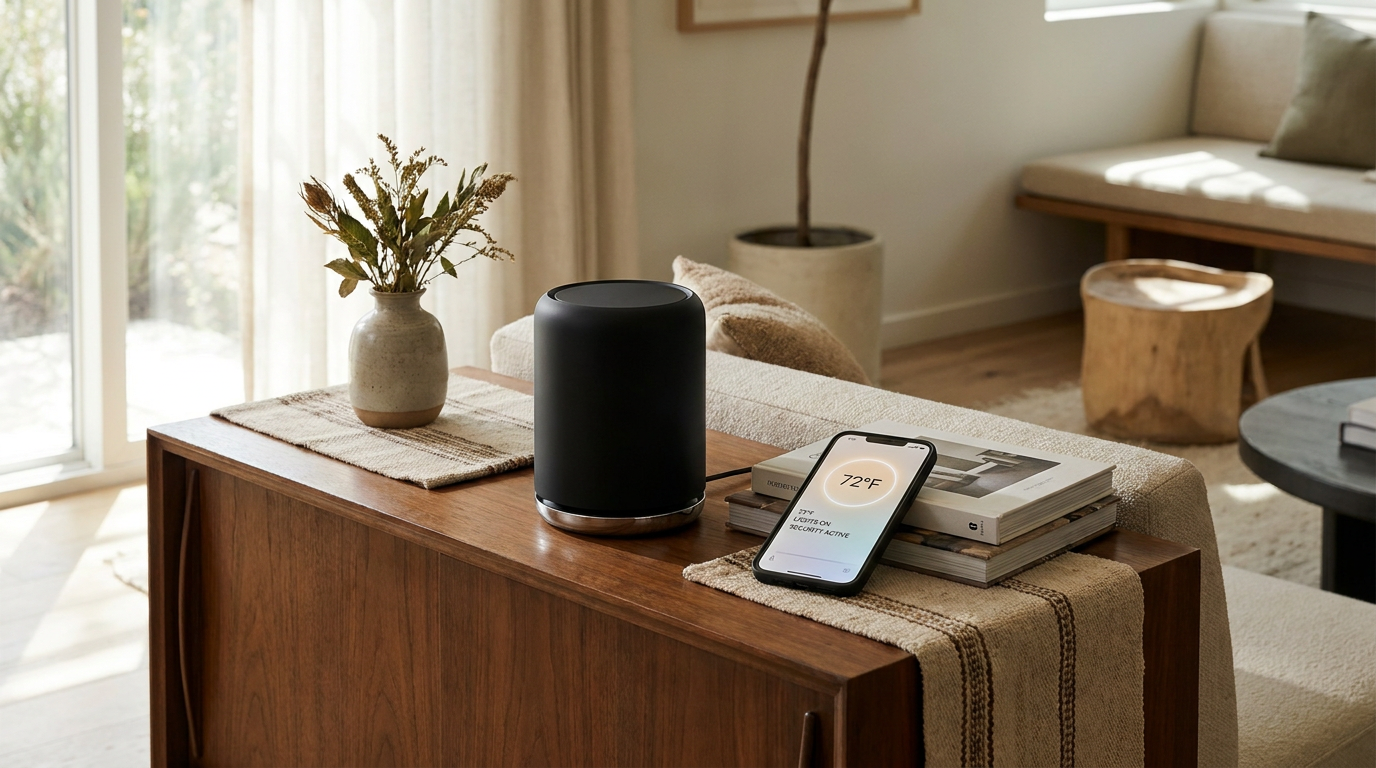
- The local-first movement shifts processing power to a hub inside the home.
- Local commands execute in under 100 milliseconds, compared to 1-3 seconds for cloud commands.
- Keeping data on the local network significantly improves household privacy.
- The Matter standard and Thread protocol are accelerating the shift to local control.
- Secure tunnels and relays allow for remote access without relying on third-party servers.
For years, the promise of the smart home has been tethered to an invisible, fragile thread: the internet. When you ask a voice assistant to turn on the living room lights, that command typically travels hundreds of miles to a corporate server, processes the request, and beams the signal back to a bulb sitting ten feet away.[4]
This cloud-dependent architecture introduced latency, but more importantly, it introduced a single point of failure. If your internet goes down, your light switches stop working. If the manufacturer's servers experience an outage, your thermostat becomes a plastic brick on the wall.[5]
Over the past decade, consumers have repeatedly learned this the hard way. When companies pivot, go bankrupt, or simply decide to deprecate older hardware, they shut down the servers that keep those devices alive. The result is perfectly good electronics destined for the landfill because their remote brain was turned off.[4]
In response, a quiet but powerful revolution has taken hold in consumer electronics: the local-first smart home. Rather than relying on distant data centers, this approach processes commands entirely within the walls of your own house, using your local area network.[6]
The mechanism behind local control is straightforward but represents a paradigm shift in how consumer tech is built. In a cloud-based system, devices communicate via the wide area network to the open internet. In a local-first system, devices talk directly to a central hub located inside the home, which acts as the primary brain.[3]

This shift dramatically reduces latency. A typical cloud roundtrip for a smart home command takes between one and three seconds, depending on network congestion. A local command, routed through a protocol like Zigbee or Thread, executes in under 100 milliseconds—making the digital action feel as instantaneous as flipping a physical switch.[2]

Beyond speed and reliability, the local-first movement is fundamentally about privacy. Smart homes are inherently intimate spaces, filled with sensors tracking occupancy, cameras recording footage, and microphones listening for wake words.[6]
When a home operates locally, that telemetry data never leaves the premises. For privacy advocates, this is the only acceptable architecture for ambient computing. It ensures that a compromised corporate server or a change in a company's privacy policy cannot retroactively expose a family's daily routines.[3]
When a home operates locally, that telemetry data never leaves the premises.
The transition to local control has been heavily accelerated by the rollout of the Matter standard. Developed by a consortium that includes Apple, Google, Amazon, and Samsung, Matter was designed from the ground up to support local communication.[1]
Under the Matter specification, devices are required to be controllable over the local network without needing an active internet connection. If you unplug your router from the modem, your Matter-certified light bulbs and smart plugs will continue to respond to local hub commands.[1]

Thread, a low-power wireless mesh networking protocol, operates alongside Matter to make this possible. Unlike Wi-Fi, which consumes significant power and requires a central router, Thread allows devices to talk directly to one another, creating a resilient web of connectivity that heals itself if one device goes offline.[4]
Historically, building a local-first smart home required significant technical expertise. Enthusiasts relied on open-source platforms like Home Assistant, which required flashing SD cards, configuring microcomputers, and writing custom code.[2]
Today, the barrier to entry has plummeted. Plug-and-play hubs offer consumer-friendly interfaces that automatically discover local devices on the network. Even mainstream hubs like the Apple TV and HomePod now process many commands locally by default.[5]
However, the local-first approach does come with trade-offs. The most significant challenge is remote access. If your home's brain isn't connected to a cloud server, how do you check your security cameras while on vacation?[6]
The solution involves creating secure tunnels into the home network. Advanced users might set up a virtual private network. For the average consumer, platforms offer end-to-end encrypted cloud relays that allow remote control without storing the data on external servers.[2]

Another uncertainty is the legacy hardware problem. Millions of older Wi-Fi smart devices were hardcoded to only accept commands from their manufacturer's cloud. Transitioning to a local-first setup often means replacing these older devices or relying on complex, community-built workarounds to intercept their traffic.[5]
Despite these hurdles, the momentum is clear. Manufacturers are increasingly advertising local API support as a premium feature, recognizing that power users and privacy-conscious consumers will no longer buy cloud-locked hardware.[6]
As the smart home matures from a novelty into foundational home infrastructure—managing critical systems like HVAC, water leak detection, and EV charging—the tolerance for cloud outages is dropping to zero. The house of the future will be smart, but more importantly, it will be self-sufficient.[3]
How we got here
Early 2010s
The first wave of mainstream smart home devices launches, relying heavily on cloud servers for processing and control.
2020
Several high-profile cloud outages and company shutdowns leave consumers with bricked hardware, sparking interest in local control.
Fall 2022
The Matter 1.0 standard is officially released, mandating local network control capabilities for certified devices.
Late 2023
Open-source platforms release consumer-friendly, plug-and-play local hubs, lowering the barrier to entry.
2026
Local-first architecture becomes a major selling point for premium smart home hardware, emphasizing privacy and zero-latency performance.
Viewpoints in depth
Open-Source & Privacy Advocates
Argue that ambient computing must be strictly local to protect sensitive household data.
This camp views cloud-dependent smart homes as unacceptable surveillance risks. They argue that microphones, cameras, and occupancy sensors generate highly sensitive telemetry that should never leave the physical premises. They advocate for open-source local hubs and hardware that operates entirely offline, viewing any cloud requirement as a fundamental security flaw.
Tech Media & Consumer Advocates
Prioritize reliability and longevity, pushing back against hardware that can be bricked remotely.
For the average user, the underlying architecture matters less than the user experience. They want devices that are easy to set up, integrate seamlessly with voice assistants, and offer out-of-the-box remote access. However, after years of dealing with server shutdowns and bricked devices, consumer advocates are increasingly demanding local fallbacks to ensure hardware longevity.
Commercial Cloud Providers
Emphasize the power of cloud computing for advanced features and seamless setup.
Manufacturers of cloud-first devices argue that offloading processing to data centers enables features that local hubs struggle with, such as advanced AI video analytics, continuous feature updates, and seamless cross-platform integrations. They maintain that with proper encryption and privacy policies, cloud architectures offer the best balance of capability and cost for the mass market.
What we don't know
- Whether legacy Wi-Fi smart devices will ever receive firmware updates to support local APIs.
- How quickly mainstream consumers will adopt dedicated local hubs over standard smart speakers.
- The long-term impact of AI processing demands on local hub hardware requirements.
Key terms
- Local Area Network (LAN)
- The private network inside your home, typically managed by your Wi-Fi router, allowing devices to communicate directly with each other.
- Matter
- A universal smart home standard developed by major tech companies to ensure devices from different brands can work together locally.
- Thread
- A low-power, wireless mesh networking protocol designed specifically for smart home devices to communicate quickly and reliably without needing Wi-Fi.
- Latency
- The delay between sending a command (like pressing a button) and the device executing the action (like a light turning on).
- Hub / Gateway
- A central piece of hardware that coordinates communication between different smart devices and processes automations locally.
Frequently asked
Do I need internet for a local smart home?
No. Once set up, a local-first smart home processes commands entirely on your internal network. Your lights and thermostats will continue to work even during an internet outage.
Can I still control my home when I'm away?
Yes. You can use a secure VPN or an encrypted cloud relay service to access your local hub remotely, providing convenience without storing your data on third-party servers.
Will my current smart devices work locally?
It depends. Devices that use Zigbee, Z-Wave, or Thread are inherently local. Wi-Fi devices vary; some support local APIs, while others are hardcoded to require their manufacturer's cloud.
What is a smart home hub?
A hub is a central device that acts as the brain of your smart home. It connects to all your devices, processes your automations, and provides a unified interface for control.
Sources
Source coverage
6 outlets
3 viewpoints surfaced






[1]Connectivity Standards AllianceIndustry Standards Bodies
Matter: The Foundation for Connected Things
Read on Connectivity Standards Alliance →[2]Home AssistantOpen-Source & Privacy Advocates
Why Local Control is the Future of the Smart Home
Read on Home Assistant →[3]IEEE Internet of Things JournalOpen-Source & Privacy Advocates
Edge Computing and Local Area Network Reliability in Smart Home Ecosystems
Read on IEEE Internet of Things Journal →[4]The VergeTech Media & Consumer Advocates
The smart home is breaking up with the cloud
Read on The Verge →[5]WiredTech Media & Consumer Advocates
How to Free Your Smart Home From the Cloud
Read on Wired →[6]Factlen Editorial TeamTech Media & Consumer Advocates
Synthesis by Factlen editorial team
Read on Factlen Editorial Team →


Every angle. Every day.
Get technology stories with full source coverage and perspective breakdowns delivered to your inbox.