
The Rise of Local AI: How to Run Language Models on Your Own Hardware
Advances in open-weight models and consumer hardware have made running powerful AI locally a reality. From Apple Silicon to tools like Ollama, users can now run language models privately, offline, and for free.
By Factlen Editorial Team
- Privacy & Security Advocates
- Argues that local inference is the only responsible way to process sensitive health, financial, and proprietary data.
- Enterprise Developers
- Values local AI primarily for its predictable unit economics and zero-latency execution in high-volume automated tasks.
- Hardware Enthusiasts
- Focuses on pushing the limits of consumer silicon, optimizing quantization, and maximizing tokens-per-second on personal rigs.
What's not represented
- · Cloud API Providers
- · AI Safety Regulators
Why this matters
Running AI locally gives you complete control over your data, eliminates subscription fees, and allows you to use powerful language models without an internet connection. It shifts the power of artificial intelligence from massive cloud providers directly to your personal computer.
Key points
- Local AI allows users to run large language models on their own hardware without cloud APIs.
- Running models locally ensures complete data privacy and eliminates subscription costs.
- Apple's unified memory and Nvidia's consumer GPUs have made local inference highly practical.
- Quantization shrinks massive AI models by up to 75% so they fit in consumer RAM.
- Tools like Ollama and LM Studio have made installation and usage simple for non-experts.
For years, interacting with a capable artificial intelligence meant sending your data to a server farm in California. Cloud-based giants like ChatGPT and Claude normalized the idea that AI was a remote service, accessed via subscription fees and API keys. But in 2026, a quiet revolution has shifted the center of gravity.[1]
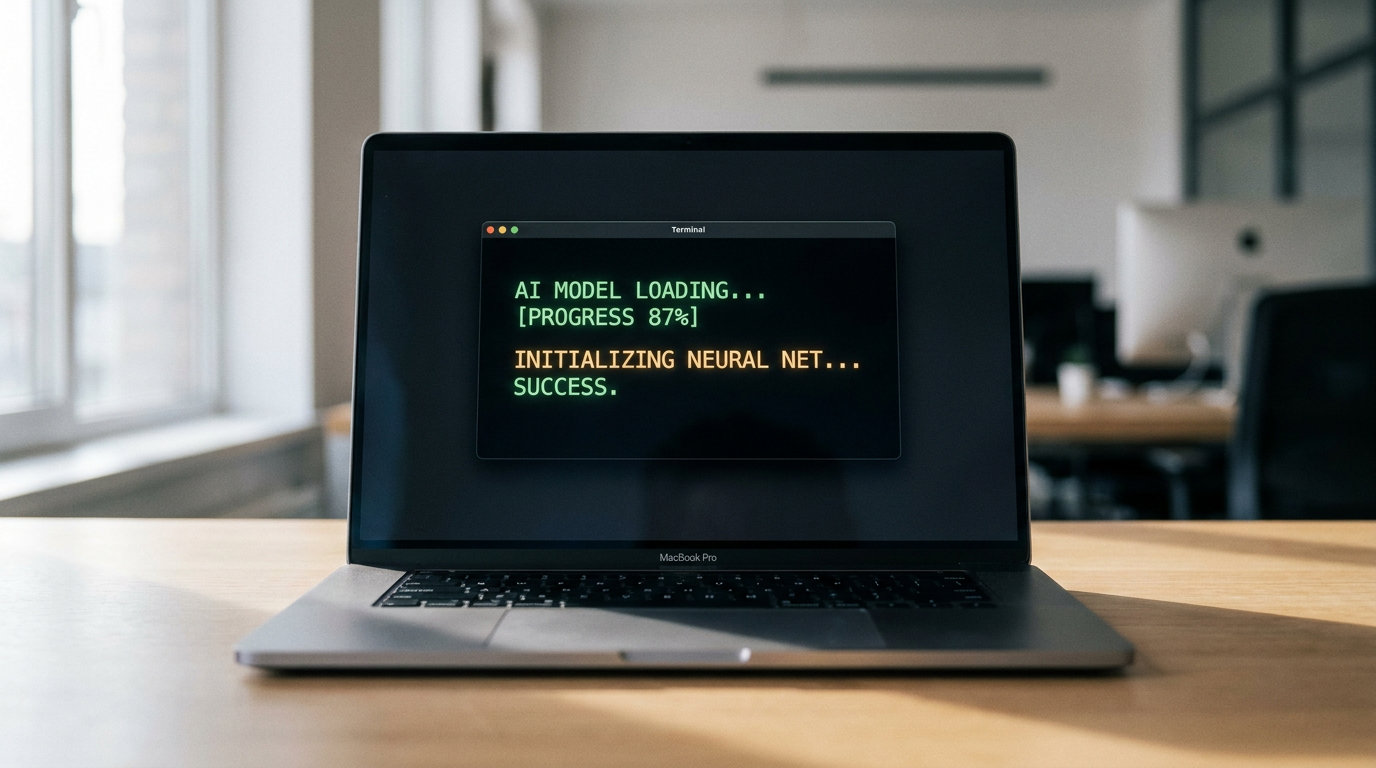
The era of the "local LLM" has arrived. Thanks to a convergence of highly efficient open-weight models, consumer hardware breakthroughs, and user-friendly software, running a large language model entirely on a personal laptop or desktop is no longer restricted to researchers. It is now accessible to anyone with a modern computer.[1][6]
The appeal is immediate and practical. Local inference solves three fundamental problems that hosted APIs cannot: data privacy, recurring costs, and offline reliability. When a model runs locally, prompts never leave the device, making it safe for proprietary code, confidential health records, or sensitive financial data.[4][6]
Furthermore, local AI eliminates per-token billing and subscription fees. Once the model is downloaded, every generation is free, limited only by the cost of electricity. For developers running thousands of automated tasks, or users working on airplanes and air-gapped networks, this independence is transformative.[2][6]

The catalyst for this shift has been the explosion of "Small Language Models" (SLMs) and highly optimized open-weight releases. In 2026, models like Meta's Llama 3.2, Google's Gemma 4, and Microsoft's Phi-4 Mini have proven that parameter count isn't everything. A 3-billion to 8-billion parameter model can now handle summarization, coding assistance, and general chat with startling fluency.[2][3]
But software is only half the equation; the hardware landscape has adapted to meet the demand. The primary bottleneck for running AI is Video RAM (VRAM). Traditional discrete GPUs require models to be loaded entirely into their dedicated memory, which historically priced out average consumers.[3][4]
Apple Silicon changed the paradigm with its unified memory architecture. On M-series Macs, the CPU and GPU share the same pool of memory. A Mac with 16GB or 32GB of unified RAM can allocate almost all of it to the GPU, allowing users to load surprisingly large models without buying a specialized graphics card. Apple's native MLX framework further optimizes this, allowing models to run with near-zero data transfer latency.[5]
Apple Silicon changed the paradigm with its unified memory architecture.
On the PC side, Nvidia's RTX 40-series and 50-series cards remain the gold standard for raw speed. A mid-range consumer card like the RTX 4060 Ti with 16GB of VRAM can comfortably run an 8-billion parameter model at 30 to 50 tokens per second—faster than most people can read.[4][7]

Even with good hardware, a massive uncompressed model won't fit on a laptop. This is where the magic of quantization comes in. Quantization is a compression technique that reduces the precision of the model's weights—typically from 16-bit floating-point numbers down to 4-bit integers.[4]
By rounding off these microscopic mathematical values, developers can shrink a model's memory footprint by up to 75% with only a negligible drop in actual reasoning quality. Formats like GGUF have standardized this process, allowing a massive 70-billion parameter model to squeeze into 40GB of RAM, or an 8-billion parameter model to run on just 6GB.[4][7]
The software to run these quantized models has also shed its academic complexity. Two dominant tools have emerged to make local AI plug-and-play: Ollama and LM Studio. Both abstract away the underlying engine into something anyone can use.[6][7]
Ollama is the developer's darling. Operating primarily as a background service and command-line tool, it allows users to download and run a model with a single command. It automatically detects the system's GPU and exposes a local API, making it trivial to plug local models into coding assistants or custom applications.[6]

LM Studio, conversely, offers a polished graphical user interface. It functions like an app store for AI, allowing users to search for models, check hardware compatibility, and chat in a familiar window. For visual learners and beginners, it is the fastest path to a working local AI.[7]
Despite these advances, local AI is not a universal replacement for frontier cloud models. When it comes to complex, multi-step reasoning, advanced mathematics, or long-horizon agentic tasks, massive data center models still hold a distinct advantage.[2][4]
The consensus among developers in 2026 is a hybrid approach. They use cloud APIs for the genuinely hard, complex reasoning tasks, and route high-volume, privacy-sensitive, or bounded tasks—like text classification, autocomplete, and summarization—to their local machines.[4]
Ultimately, the rise of local AI represents a democratization of compute. It ensures that as artificial intelligence becomes a foundational layer of modern computing, the power to run it remains in the hands of the user, free from the walled gardens of cloud providers.[1]
How we got here
2023
The original LLaMA model weights leak, sparking the open-source local AI movement.
Late 2023
Apple introduces the MLX framework to optimize machine learning on Apple Silicon.
2024
Tools like Ollama and LM Studio launch, making local inference accessible to non-developers.
Early 2026
The release of highly capable 8B and 12B parameter models bridges the quality gap with cloud APIs for everyday tasks.
Viewpoints in depth
Privacy & Security Advocates
Argues that local inference is the only responsible way to process sensitive data.
For healthcare providers, legal teams, and enterprise developers handling proprietary code, sending data to a cloud API creates unacceptable compliance risks. This camp views local AI not as a cost-saving measure, but as a mandatory architecture for data sovereignty. By keeping prompts and model weights entirely on-device, they ensure zero data egress and complete control over the information lifecycle.
Enterprise Developers
Values local AI primarily for its predictable unit economics and zero-latency execution.
When building applications that require thousands of automated classifications or summarizations per hour, cloud API costs scale linearly and unpredictably. This camp favors local inference because a dedicated consumer GPU running a quantized model offers a fixed cost. Furthermore, eliminating the 100-300 millisecond network round-trip to a cloud server allows for highly responsive, real-time agentic workflows.
Hardware Enthusiasts
Focuses on pushing the limits of consumer silicon and optimizing inference speeds.
For this community, the appeal lies in the technical challenge of maximizing tokens-per-second on personal rigs. They actively experiment with different quantization formats, memory offloading techniques, and engine tweaks. They view the rapid evolution of Apple's MLX framework and Nvidia's consumer GPUs as a playground for unlocking data-center-level capabilities on a desktop budget.
What we don't know
- Whether future frontier models will become too large to ever compress down to consumer hardware.
- How cloud providers will adjust their pricing models to compete with free local inference.
Key terms
- Quantization
- A compression technique that reduces the precision of an AI model's weights, drastically lowering memory requirements.
- VRAM (Video RAM)
- The dedicated memory on a graphics card, which is the primary bottleneck for loading and running AI models.
- SLM (Small Language Model)
- A highly optimized AI model (typically 1B to 8B parameters) designed to run efficiently on consumer hardware.
- MLX
- Apple's open-source machine learning framework, designed to leverage the unified memory architecture of Apple Silicon.
- GGUF
- A file format optimized for running quantized AI models locally, primarily used by the llama.cpp engine.
Frequently asked
Do I need an internet connection to use local AI?
Only for the initial download of the model and the software. Once the model is saved to your disk, it runs completely offline.
Can I run these models without a dedicated GPU?
Yes, tools like Ollama and LM Studio can run models on your CPU, though the generation speed will be significantly slower (often 5-15 tokens per second).
Is my data sent back to the creators of the model?
No. When running locally, all processing happens on your machine, and your prompts never leave your device.
Sources
Source coverage
7 outlets
3 viewpoints surfaced







[1]Factlen Editorial Team
Synthesis by Factlen editorial team
Read on Factlen Editorial Team →[2]VibeHackersEnterprise Developers
Run Claude Code or OpenCode against a local model for $0/token
Read on VibeHackers →[3]PromptQuorumHardware Enthusiasts
Fastest Local LLMs for Low-End PCs (2026)
Read on PromptQuorum →[4]OsherPrivacy & Security Advocates
Hardware Requirements: Real Numbers for Local LLMs
Read on Osher →[5]Apple DeveloperHardware Enthusiasts
Apple Machine Learning and Core AI
Read on Apple Developer →[6]ServermanPrivacy & Security Advocates
What is Ollama? Running AI Locally
Read on Serverman →[7]Daily.devEnterprise Developers
Run LLMs on local hardware for privacy, lower costs, and faster inference
Read on Daily.dev →
More in ai
See all 6 stories →Mechanistic Interpretability
Inside the Black Box: How Mechanistic Interpretability is Making AI Safe
8 sources

Drug Discovery
New AI Model Accelerates Molecular Simulations 10,000-Fold, Slashing Drug Discovery Timelines
7 sources

Global AI Regulation
The Transatlantic AI Policy Fracture: EU Enforcement Collides With US Deregulation
8 sources

Open-Weight Models
How Open-Source AI Video Models Are Giving Solo Creators Studio-Level Power
8 sources
Every angle. Every day.
Get ai stories with full source coverage and perspective breakdowns delivered to your inbox.