
How Open-Source AI Video Models Are Giving Solo Creators Studio-Level Power
The release of powerful open-weight models like Wan 2.2 and HunyuanVideo has broken the monopoly of closed AI systems, allowing independent filmmakers to generate, fine-tune, and render cinematic video locally.
By Factlen Editorial Team
- Independent Filmmakers
- Prioritizing creative control, privacy, and absolute character consistency.
- Open-Source Developers
- Focusing on architectural efficiency and community-driven tool building.
- Hardware & Cloud Providers
- Viewing the open-source shift as a driver for high-end GPU sales and specialized cloud rentals.
What's not represented
- · Traditional Hollywood VFX Artists
Why this matters
For independent creators, the shift from renting closed AI tools to owning open-source models eliminates per-generation costs and unlocks the ability to create consistent, studio-quality films from a home computer.
Key points
- Open-weight AI video models like Wan 2.2 and HunyuanVideo now match the cinematic quality of closed systems like Sora.
- Creators can run these models locally, avoiding subscription fees, content filters, and invisible watermarks.
- Node-based interfaces like ComfyUI allow filmmakers to build highly customized, repeatable generation workflows.
- The ability to train custom LoRAs enables perfect character consistency, a critical requirement for narrative filmmaking.
- Running these models locally requires significant hardware, typically an Nvidia GPU with 16GB to 24GB of VRAM.
In the early days of generative video, the landscape was strictly gated. Proprietary behemoths like OpenAI’s Sora and Google’s Veo captured the public imagination with photorealistic clips, but they operated as walled gardens. Creators were forced to rent access, pay per generation, and submit to opaque content filters and invisible watermarks. For independent filmmakers and digital artists, this model offered a fun novelty but lacked the control required for serious production. By mid-2026, however, a quiet revolution has entirely flipped the script. The release of highly capable open-weight video models has broken the monopoly of closed systems, allowing solo creators to download the equivalent of a Hollywood visual effects studio directly to their own machines.[8]
The shift toward open-source AI video means that the underlying code and neural weights of the models are freely available to the public. Instead of sending a text prompt to a distant corporate server and hoping for a usable result, creators can now run these models locally. This paradigm shift democratizes high-end video production, offering unprecedented privacy, infinite iteration without recurring subscription costs, and the ability to deeply customize the generation pipeline. For an indie director working on a shoestring budget, the difference between paying a monthly fee for restricted access and owning the rendering engine outright is the difference between a toy and a professional tool.[1][5]
At the forefront of this open-source renaissance is Wan 2.2, a model developed by Alibaba’s Tongyi Lab that has become the industry benchmark for 2026. Released under an Apache 2.0 license, Wan 2.2 utilizes a sophisticated Mixture-of-Experts (MoE) architecture. Rather than forcing a single massive neural network to process every aspect of a video, the MoE system routes different computational tasks—like lighting, motion, and texture—to specialized sub-networks. This allows the model to generate stunning 720p video at 24 frames per second without requiring a supercomputer, keeping inference costs remarkably low while matching or exceeding the aesthetic quality of closed-source competitors.[1][2]

Tencent’s HunyuanVideo provides another heavyweight option for creators demanding cinematic fidelity. Boasting 13 billion parameters, HunyuanVideo is built on a spatial-temporal latent space architecture that excels at maintaining consistency. In earlier AI video models, characters would notoriously morph into different people or lose limbs when turning their heads. HunyuanVideo solves this by processing text and video tokens through a dual-stream transformer, ensuring that the physical geometry of a scene remains stable over time. It has become the go-to foundation model for creators who need reliable, continuous shots rather than hallucinatory, shifting dreamscapes.[2][4][5]
For creators operating with tighter hardware constraints, the open-source community offers highly optimized alternatives like Genmo’s Mochi 1 and Lightricks’ LTX-Video. Mochi 1 employs a novel Asymmetric Diffusion Transformer designed to prioritize high-fidelity motion and strict adherence to complex text prompts, making it highly hackable for developers. Meanwhile, LTX-Video sacrifices absolute maximum resolution in favor of blistering speed. It allows filmmakers to rapidly prototype shot compositions and camera movements in seconds, serving as a digital storyboard before committing heavier computing resources to the final, high-resolution render.[3][4][6]
For creators operating with tighter hardware constraints, the open-source community offers highly optimized alternatives like Genmo’s Mochi 1 and Lightricks’ LTX-Video.
Understanding how these 2026 models operate requires looking under the hood at their diffusion mechanisms. Unlike traditional rendering software that calculates light bouncing off 3D polygons, these AI models operate in a compressed latent space. When a user inputs a prompt, the model does not draw pixels directly. Instead, it calculates the mathematical essence of motion, depth, and physics within a highly compressed data representation. A 3D variational autoencoder (VAE) then decodes this dense mathematical soup into a fluid, viewable video sequence, allowing the system to generate complex physics—like water splashing or fabric tearing—without actually simulating the underlying particles.[4][6]

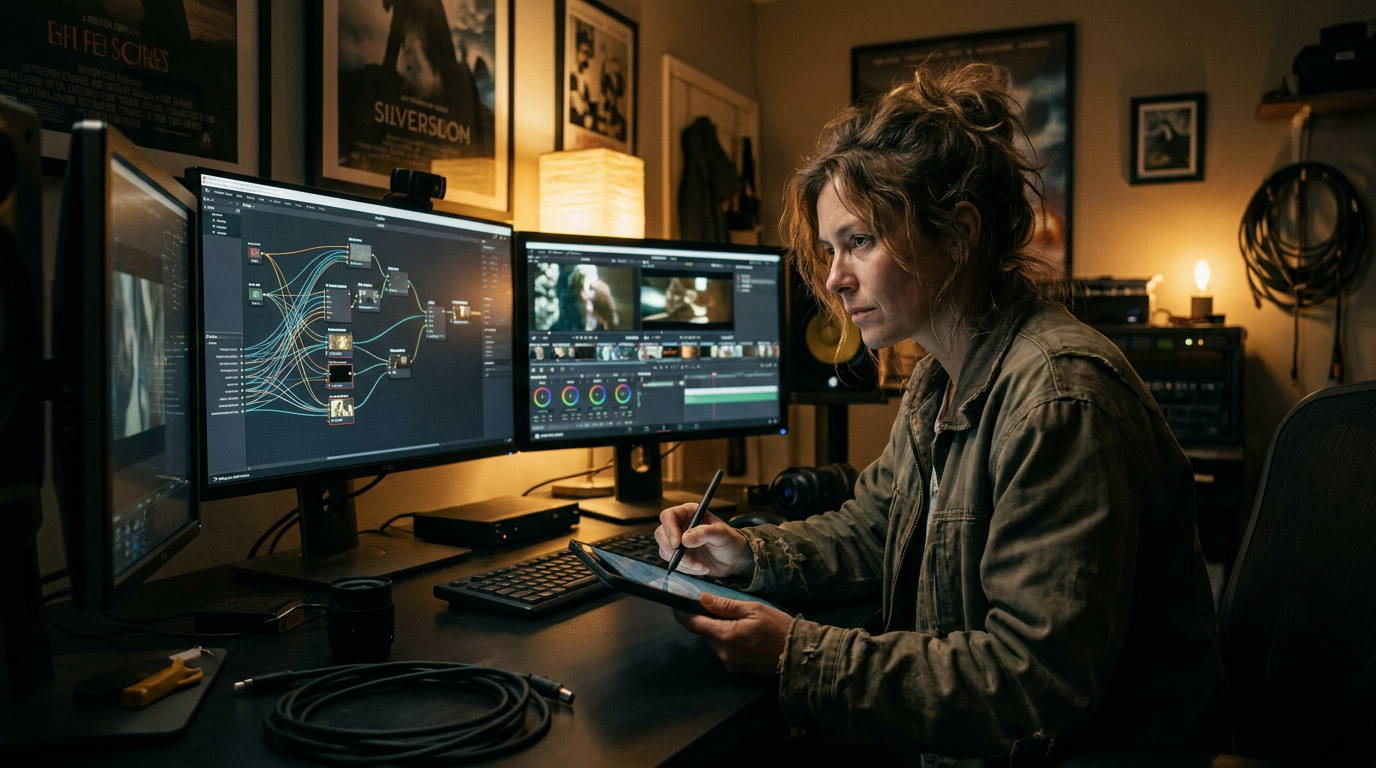
The true power of the open-source video movement, however, lies not just in the models themselves, but in the surrounding ecosystem. The industry standard workflow now revolves around node-based graphical interfaces, most notably ComfyUI. Rather than typing a prompt into a simple text box, creators use ComfyUI to build intricate, visual programming pipelines. They can link text encoders, reference images, motion-control modules, and upscalers into a single, repeatable web of operations. This granular control allows a filmmaker to dictate exactly how a camera pans, how the lighting shifts, and how a character moves through a scene.[2][3][5]
Perhaps the most transformative capability unlocked by open weights is the use of Low-Rank Adaptations, commonly known as LoRAs. A LoRA is a small, lightweight file that fine-tunes a massive foundation model on a specific subject. An indie filmmaker can take 20 photographs of their lead actor, train a custom LoRA in a few hours, and plug it into Wan 2.2 or HunyuanVideo. From that point on, the model will generate infinite, perfectly consistent scenes featuring that exact actor. This level of absolute character consistency is the holy grail of narrative filmmaking, and it is entirely impossible on closed platforms that restrict custom training.[4][8]
Despite the immense creative freedom, the open-source revolution comes with a significant hardware reality check. Running a 13-billion or 14-billion parameter video model locally requires serious computational horsepower. For a smooth, local workflow, creators typically need a high-end consumer graphics card, such as an Nvidia RTX 4090, equipped with at least 16GB to 24GB of VRAM. While quantization techniques have compressed these models to run on lesser hardware, achieving the highest quality outputs without agonizingly slow render times still demands a substantial upfront investment in silicon.[3][5]

For creators who cannot justify the cost of a high-end graphics card, a hybrid ecosystem of specialized cloud providers has emerged to bridge the gap. Platforms like Hyperstack and SiliconFlow offer hourly rental access to enterprise-grade GPUs, such as the Nvidia H100, pre-configured with open-source models and ComfyUI environments. This allows filmmakers to enjoy the privacy, hackability, and fine-tuning capabilities of open weights without the prohibitive hardware barrier, effectively renting the supercomputer while retaining total ownership of the creative pipeline and the generated assets.[1][4]
Ultimately, the maturation of open-source AI video in 2026 represents a fundamental shift in the economics of visual storytelling. The barrier to entry for high-concept science fiction, sprawling fantasy, and intricate animation is no longer defined by a studio's budget, but by the creator's imagination. By placing the means of production directly into the hands of independent artists, these open-weight models are not just changing how videos are made; they are expanding who gets to make them, promising a surge of diverse, visually spectacular narratives that traditional Hollywood could never afford to greenlight.[8]
How we got here
Early 2025
Closed models like Sora and Veo dominate the high-fidelity video generation landscape.
Late 2025
Early open-source models struggle with temporal consistency and require massive enterprise hardware.
January 2026
Tencent releases HunyuanVideo, proving open weights can match closed-source cinematic quality.
March 2026
Alibaba's Wan 2.2 introduces MoE architecture, drastically lowering the inference cost for 720p generation.
June 2026
Node-based workflows like ComfyUI become the industry standard for indie filmmakers using local AI.
Viewpoints in depth
Independent Filmmakers
Prioritizing creative control, privacy, and absolute character consistency.
For solo creators and indie studios, the appeal of open-source video is entirely about control. Closed platforms often act as black boxes, applying invisible watermarks, enforcing rigid content filters, and charging per generation. By moving to local, open-weight models, filmmakers can iterate endlessly without watching a credit balance drain. More importantly, the ability to train custom LoRAs on their own actors or specific aesthetic styles allows them to achieve narrative continuity—the crucial element that separates a random AI tech demo from a coherent short film.
Open-Source Developers
Focusing on architectural efficiency and community-driven tool building.
The developer community views models like Wan 2.2 and Mochi 1 as foundational building blocks rather than finished products. Their focus is on hackability and optimization. By implementing techniques like Mixture-of-Experts and Asymmetric Diffusion Transformers, developers are constantly pushing the boundaries of what can run on consumer hardware. This camp thrives on the modularity of tools like ComfyUI, where researchers and hobbyists collaborate daily to build new motion-control nodes, upscalers, and efficiency patches that outpace the development cycles of proprietary tech giants.
Hardware & Cloud Providers
Viewing the open-source shift as a driver for high-end GPU sales and specialized cloud rentals.
For hardware manufacturers and specialized cloud hosts, the open-source video boom represents a massive new market. They recognize that while the software is free, the compute power required to run it is not. By offering hourly rentals of H100 GPUs or selling 24GB consumer graphics cards, these providers are positioning themselves as the modern-day pickaxe sellers in the AI gold rush, bridging the gap for creators who want open-source freedom without the upfront hardware investment.
What we don't know
- How traditional film festivals and distribution platforms will categorize and judge narrative films generated entirely via open-source AI.
- Whether upcoming consumer GPU generations will lower the VRAM barrier enough to make local generation accessible on standard laptops.
Key terms
- Open-Weight Model
- An AI model where the trained neural network parameters (weights) are publicly available to download and run locally.
- Mixture-of-Experts (MoE)
- An AI architecture that routes different tasks to specialized sub-networks, improving efficiency and lowering compute costs.
- Latent Space
- A highly compressed mathematical representation of data where AI models process concepts before decoding them into visible pixels.
- LoRA (Low-Rank Adaptation)
- A lightweight training method used to fine-tune a large AI model on a specific subject, such as a character's face or an art style.
- VRAM (Video RAM)
- The specialized memory on a graphics card, crucial for loading and running large AI models locally.
- ComfyUI
- A popular node-based graphical interface that allows creators to build custom, complex workflows for AI generation.
Frequently asked
Can I run these AI video models on a standard laptop?
Generally, no. Running models like Wan 2.2 or HunyuanVideo locally requires a dedicated high-end GPU with at least 16GB to 24GB of VRAM, though lighter models like LTX-Video can run on 8GB.
Do open-source video models cost money to use?
The models themselves are free to download and use. However, you must either own the expensive hardware required to run them or pay hourly fees to rent cloud GPUs.
How do creators keep characters looking the same in different shots?
Filmmakers use a technique called LoRA to fine-tune the open-source model on photos of their specific character, ensuring perfect consistency across multiple generated scenes.
Are these models as good as OpenAI's Sora?
Yes. By mid-2026, top open-weight models like Wan 2.2 and HunyuanVideo consistently match or exceed the visual fidelity of closed systems, with the added benefit of total creative control.
Sources
Source coverage
8 outlets
3 viewpoints surfaced







[1]SiliconFlowHardware & Cloud Providers
Our definitive guide to the top open source AI video generation models of 2026
Read on SiliconFlow →[2]KDnuggetsOpen-Source Developers
Choosing a Video Generation Model
Read on KDnuggets →[3]Crepal AIHardware & Cloud Providers
What is the best open source AI video generator in 2026?
Read on Crepal AI →[4]HyperstackHardware & Cloud Providers
Top Open-Source AI Video Generation Models
Read on Hyperstack →[5]WhitefiberIndependent Filmmakers
Explore the best open-source video generation models
Read on Whitefiber →[6]MediumOpen-Source Developers
Open Sora and Cosmos: The Open Source Video Revolution
Read on Medium →[7]HedraIndependent Filmmakers
Best Overall AI Video Generator for Creators and Teams
Read on Hedra →[8]Factlen Editorial TeamIndependent Filmmakers
Synthesis by Factlen editorial team
Read on Factlen Editorial Team →

More in ai
See all 6 stories →AI Safety
Inside the Black Box: How Scientists Are Finally Decoding AI's 'Brain'
7 sources

Local AI
Open-Source AI Officially Closes the Performance Gap with Proprietary Giants
6 sources

AI Video Tech
The AI Filmmaking Pipeline: How Indie Creators Are Bypassing Hollywood in 2026
6 sources
Mechanistic Interpretability
Inside the Black Box: How Mechanistic Interpretability is Making AI Safe
8 sources
Every angle. Every day.
Get ai stories with full source coverage and perspective breakdowns delivered to your inbox.