
Beyond Diabetes: How Continuous Glucose Monitors Are Driving the Precision Nutrition Movement
Wearable sensors that track real-time blood sugar are moving from medical necessity to mainstream wellness, promising highly personalized dietary insights.
By Factlen Editorial Team

- Metabolic Optimizers
- Wellness enthusiasts who view real-time glucose data as essential for preventing chronic disease and maximizing daily energy.
- Clinical Skeptics
- Medical professionals who warn that over-monitoring normal physiological responses can lead to anxiety and disordered eating.
- Precision Nutrition Researchers
- Scientists focused on the biological reality of individual variability, aiming to build AI models that integrate diverse health data.
What's not represented
- · Low-income populations priced out of wearable health technology
- · Eating disorder recovery advocates
Why this matters
Understanding your unique metabolic response to food could replace generalized dieting, allowing you to optimize energy levels, prevent mid-day crashes, and proactively lower the risk of chronic metabolic diseases.
Key points
- Continuous glucose monitors (CGMs) measure real-time blood sugar levels via interstitial fluid, providing immediate feedback on how diet and lifestyle affect metabolism.
- Recent clinical trials reveal that individual glucose responses to the exact same foods vary dramatically, challenging the validity of universal dietary guidelines.
- The gut microbiome, genetics, sleep quality, and stress levels all play significant roles in determining an individual's unique metabolic response.
- While proactive monitoring empowers users to optimize their energy and health, medical professionals caution against unnecessary dietary restriction and data-induced anxiety.
For decades, dietary advice has relied on universal rules: eat less sugar, consume more fiber, avoid late-night meals. But the era of one-size-fits-all nutrition is rapidly giving way to a data-driven alternative. At the center of this shift is the continuous glucose monitor (CGM), a wearable sensor originally developed to manage diabetes that has now crossed over into mainstream wellness.[4]
The premise of precision nutrition is straightforward but revolutionary: human bodies do not respond to the exact same foods in the exact same way. A meal that keeps one person's energy stable might send another's blood sugar soaring, followed by a precipitous crash. By tracking these fluctuations in real time, individuals are gaining unprecedented visibility into their unique metabolic machinery.[1]
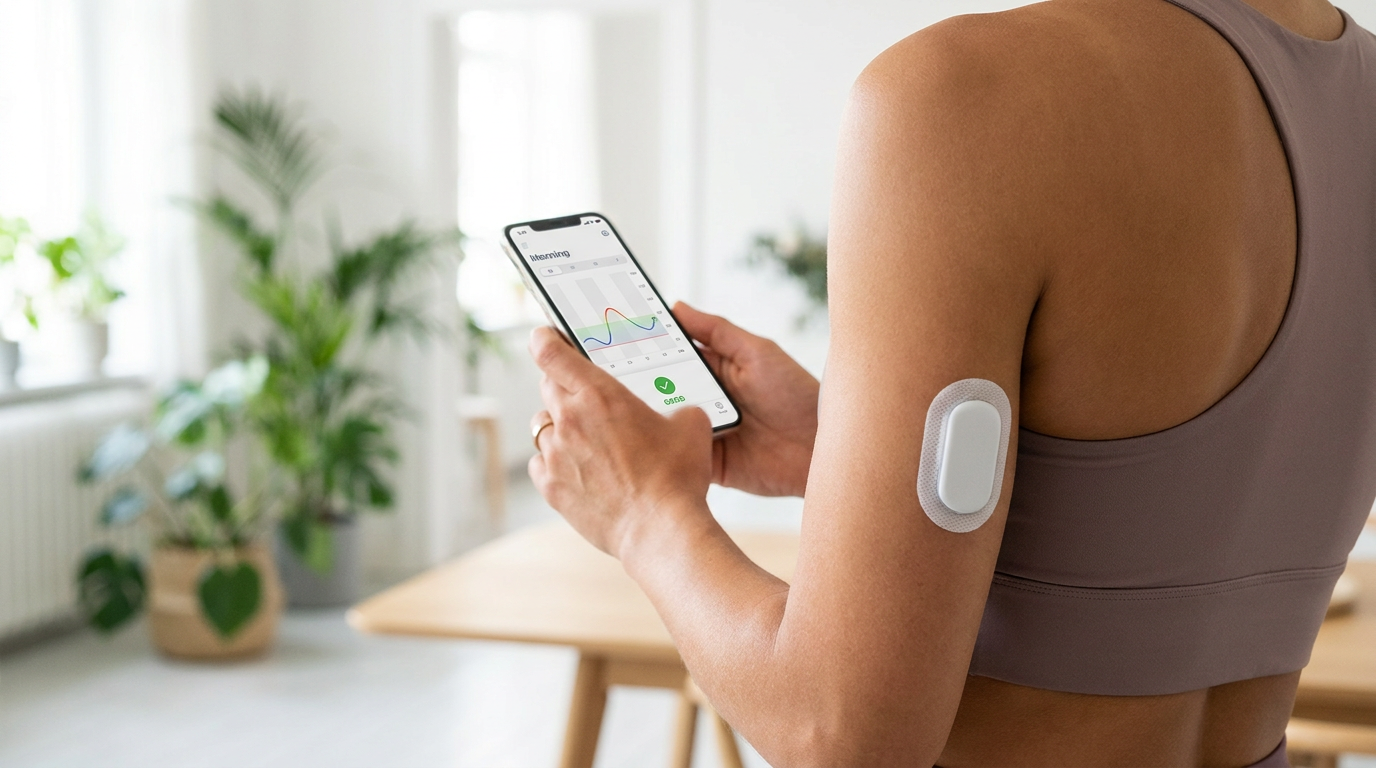
To understand why this matters, it helps to look at the mechanism of glucose tracking. A CGM is a small, water-resistant device, typically worn on the back of the upper arm. It uses a microscopic filament that pierces just beneath the skin to measure glucose levels in the interstitial fluid—the fluid surrounding the body's cells—rather than drawing blood directly from a vein or capillary.[4]

The sensor takes a reading every few minutes, beaming the data continuously to a smartphone app. This creates a dynamic, 24-hour curve of a person's metabolic state. For a healthy adult weighing 150 pounds, the total amount of glucose circulating in the bloodstream at any given moment is roughly four grams—about a single teaspoon. Keeping that delicate balance stable is the primary job of the hormone insulin.[2]
When we eat carbohydrates, our digestive system breaks them down into glucose, which enters the bloodstream. In response, the pancreas releases insulin to shuttle that glucose into cells for energy. However, when the influx of glucose is too rapid, it creates a "spike." The body often overcompensates by releasing too much insulin, leading to a subsequent "crash" or reactive hypoglycemia, which manifests as fatigue, brain fog, and intense cravings.[4]
The traditional assumption was that foods with a high glycemic index, like white bread or sugary cereals, would universally cause these spikes, while complex carbohydrates would not. But landmark research, including the PREDICT trials, has upended this consensus. Researchers discovered that individual glucose responses to identical meals vary wildly.[1]
In these studies, participants were given standardized meals, such as a banana or a slice of whole-wheat bread. One participant might experience a massive glucose spike from the banana but remain perfectly stable after eating the bread. Another participant might show the exact opposite response. This biological variability renders generalized dietary guidelines inherently flawed for a significant portion of the population.[1]

In these studies, participants were given standardized meals, such as a banana or a slice of whole-wheat bread.
What drives this extreme individual variation? Scientists have identified several key factors, with the gut microbiome emerging as a primary suspect. The trillions of bacteria residing in the digestive tract play a crucial role in how carbohydrates are metabolized. Studies from institutions like Stanford Medicine have shown that dietary interventions, such as increasing fermented foods, can alter this microbiome and subsequently change systemic inflammation and metabolic responses.[3][5]
Beyond the microbiome, lifestyle factors exert a profound, immediate influence on glucose dynamics. A poor night of sleep can temporarily induce insulin resistance, meaning a bowl of oatmeal that caused a gentle rise in blood sugar on Tuesday might trigger a massive spike on Wednesday after a restless night. Similarly, stress hormones like cortisol prompt the liver to release stored glucose, raising blood sugar even in the absence of food.[2]
Armed with this real-time feedback, non-diabetic users are engaging in what researchers call "metabolic optimization." By pairing CGM data with artificial intelligence-driven apps, users can run personal experiments. They might discover that taking a ten-minute walk after lunch completely blunts their glucose spike, or that eating a salad before a plate of pasta slows the absorption of carbohydrates.[2]
The commercial market has rapidly adapted to this demand. Companies have built sophisticated platforms that translate raw sensor data into behavioral insights. Furthermore, the regulatory landscape is shifting; the FDA recently cleared several CGM models for over-the-counter sale, removing the requirement for a doctor's prescription and dramatically expanding access.[2]

However, the mainstreaming of CGMs is not without controversy. A growing chorus of clinical skeptics warns that outfitting healthy people with medical-grade monitors could do more harm than good. They point out that occasional glucose spikes are a normal, physiological response to eating, not inherently pathological events that must be flattened at all costs.[4]
There is a genuine concern that hyper-fixation on glucose curves could fuel a rise in orthorexia—an unhealthy obsession with eating "perfectly." If a user sees a spike after eating a bowl of blueberries, they might unnecessarily eliminate a nutrient-dense food from their diet, sacrificing valuable fiber and antioxidants in the pursuit of a flat line on a graph.[4]
Furthermore, the long-term clinical benefits of flattening glucose curves in healthy, non-diabetic individuals remain unproven. While chronic, elevated blood sugar is undeniably linked to cardiovascular disease, metabolic syndrome, and cellular aging, it is not yet clear whether micromanaging everyday postprandial spikes translates to a longer lifespan or sustained weight loss. Broader reviews by the National Institutes of Health emphasize that while diet-microbiome interactions profoundly affect health, isolating glucose as the sole metric of wellness oversimplifies a vastly complex biological system.[3][6]

Despite these uncertainties, the integration of wearable sensors and artificial intelligence represents a paradigm shift in nutritional science. We are moving away from a reactive healthcare model that waits for a diabetes diagnosis, toward a proactive system that identifies metabolic dysfunction years before it becomes a clinical emergency.[3]
As AI models become more sophisticated, they will increasingly synthesize CGM data with microbiome sequencing, genetic profiles, and activity trackers. The ultimate promise of precision nutrition is not a restrictive diet of forbidden foods, but a highly personalized owner's manual for the human body—empowering individuals to eat in harmony with their unique biology.[3][4]
How we got here
1999
The FDA approves the first professional continuous glucose monitoring system, requiring a doctor to download the data.
2017
Factory-calibrated CGMs enter the market, eliminating the need for daily finger-prick blood tests for diabetics.
2020
The landmark PREDICT 1 study publishes findings showing massive individual variability in glucose responses to identical foods.
2024
The FDA clears the first over-the-counter continuous glucose monitors for consumers without a prescription.
2026
AI-driven precision nutrition platforms integrate CGM data with microbiome sequencing for highly personalized dietary coaching.
Viewpoints in depth
Metabolic Optimizers
Wellness enthusiasts who view real-time glucose data as essential for preventing chronic disease and maximizing daily energy.
This camp argues that the traditional healthcare system is too reactive, waiting until a patient develops prediabetes to intervene. By using CGMs proactively, they believe individuals can identify metabolic dysfunction years in advance. They use the data to 'biohack' their daily routines—timing their carbohydrate intake around workouts, taking post-meal walks to blunt spikes, and optimizing their sleep to improve insulin sensitivity.
Clinical Skeptics
Medical professionals who warn that over-monitoring normal physiological responses can lead to anxiety and disordered eating.
Many doctors and dietitians caution that outfitting healthy people with medical-grade monitors creates unnecessary panic over normal bodily functions. A glucose spike after eating a piece of fruit is a healthy, expected physiological response, not a medical emergency. They worry that hyper-fixation on flattening the curve will lead to 'orthorexia'—an obsession with eating perfectly—causing people to unnecessarily restrict nutrient-dense foods like fruits, legumes, and whole grains.
Precision Nutrition Researchers
Scientists focused on the biological reality of individual variability, aiming to build AI models that integrate diverse health data.
Researchers view CGMs as just one piece of a much larger puzzle. They emphasize that glucose responses are heavily influenced by the gut microbiome, genetics, and circadian rhythms. Rather than just telling people to avoid foods that cause spikes, this camp is working to understand *why* those spikes happen. Their goal is to develop sophisticated AI algorithms that can predict an individual's metabolic response and offer personalized, sustainable dietary interventions.
What we don't know
- Whether flattening postprandial glucose curves in healthy, non-diabetic individuals directly leads to a longer lifespan or sustained weight loss.
- How exactly the complex interactions between thousands of different gut bacteria strains dictate specific carbohydrate metabolism.
- The long-term psychological impact of continuously monitoring physiological data on the general public's relationship with food.
Key terms
- Continuous Glucose Monitor (CGM)
- A wearable sensor that tracks glucose levels in real-time by measuring the fluid just beneath the skin.
- Interstitial Fluid
- The fluid found in the spaces around cells, which CGMs measure instead of drawing blood directly from a vein.
- Postprandial Glucose
- The measurement of blood sugar levels occurring after a meal, used to determine how the body processes carbohydrates.
- Precision Nutrition
- An emerging field of science that tailors dietary recommendations to an individual's unique biology, genetics, and microbiome.
- Reactive Hypoglycemia
- A temporary drop in blood sugar that occurs after a large insulin response to a high-carbohydrate meal, often causing fatigue and cravings.
Frequently asked
Do I need a prescription to get a continuous glucose monitor?
In many countries, including the US, over-the-counter CGMs are now available without a prescription specifically for health and wellness tracking.
Does applying the sensor hurt?
Most users report little to no pain. The device uses a tiny, flexible filament that sits just under the skin, applied with a spring-loaded applicator.
Can a CGM diagnose diabetes?
No. While a CGM can show patterns of elevated blood sugar, a formal diagnosis of diabetes or prediabetes requires clinical blood tests administered by a doctor.
Why does my blood sugar spike even when I haven't eaten?
Stress, poor sleep, and intense exercise can trigger the release of hormones like cortisol and adrenaline, which prompt the liver to release stored glucose into the bloodstream.
Sources
Source coverage
6 outlets
3 viewpoints surfaced






[1]Nature MedicinePrecision Nutrition Researchers
Human postprandial responses to food and potential for precision nutrition
Read on Nature Medicine →[2]JMIRMetabolic Optimizers
Engagement Dynamics in Commercial CGM-Integrated Apps
Read on JMIR →[3]Frontiers in NutritionPrecision Nutrition Researchers
Precision nutrition: a review of current approaches and future endeavors
Read on Frontiers in Nutrition →[4]Factlen Editorial TeamClinical Skeptics
Synthesis by Factlen editorial team
Read on Factlen Editorial Team →[5]Stanford MedicinePrecision Nutrition Researchers
Diet, microbiome, and inflammation: The role of fermented foods and fiber
Read on Stanford Medicine →[6]National Institutes of HealthClinical Skeptics
Diet-Microbiome-Brain Axis and Mental Health: Biological Mechanisms and Nutritional Implications
Read on National Institutes of Health →

Every angle. Every day.
Get health stories with full source coverage and perspective breakdowns delivered to your inbox.