
The Sodium-Ion Breakthrough: Why Salt is Powering 2026's Most Important EVs
After years in the lab, sodium-ion batteries are finally hitting the road in mass-market electric vehicles, promising cheaper cars, zero reliance on lithium, and unmatched cold-weather performance.
By Factlen Editorial Team
- Battery Manufacturers
- View sodium-ion not as a replacement for lithium, but as a complementary technology to scale production and lower costs.
- Automakers
- Focus on the technology's ability to lower vehicle sticker prices and offer reliable cold-weather performance to consumers.
- Supply Chain Analysts
- Emphasize the geopolitical and economic benefits of reducing the automotive industry's reliance on critical minerals.
What's not represented
- · Lithium Mining Industry
- · Used EV Market Analysts
Why this matters
By swapping scarce lithium for abundant sodium, this technology breaks the EV industry's reliance on volatile critical minerals. It paves the way for truly affordable electric cars that don't lose half their range in freezing winters, removing two of the biggest barriers to widespread EV adoption.
Key points
- The world's first mass-produced passenger EV with a sodium-ion battery launches in mid-2026.
- Sodium-ion technology eliminates the need for expensive lithium, cobalt, and nickel.
- The batteries retain 90% of their capacity at -40°C, solving winter range anxiety.
- Energy density has reached 175 Wh/kg, making it competitive with standard LFP batteries.
- The industry is moving toward a dual-chemistry model, using lithium for premium EVs and sodium for affordable models.
For more than a decade, the electric vehicle revolution has been entirely dependent on a single, lightweight metal: lithium. Whether a car uses nickel-manganese-cobalt (NMC) or lithium iron phosphate (LFP) chemistry, lithium ions have done the heavy lifting of storing and releasing energy.[4]
But in 2026, the battery industry is undergoing its most significant diversification to date. Sodium-ion batteries, long relegated to laboratory experiments and niche grid storage, are finally entering mass-production passenger vehicles.[2][4]
The watershed moment arrives in mid-2026 with the launch of the Changan Nevo A06, a Chinese sedan that holds the title of the world's first mass-produced passenger EV powered entirely by a sodium-ion pack.[4][6]
Built in partnership with Contemporary Amperex Technology Co., Limited (CATL)—the world's largest battery manufacturer—the vehicle utilizes CATL's new "Naxtra" cells. This marks the transition of sodium technology from a promising prototype to a commercial reality capable of gigawatt-hour scale production.[2][6]
To understand why this shift is monumental, one must look at the underlying chemistry. A sodium-ion battery operates on the same fundamental principles as a lithium-ion cell, shuttling charged atoms back and forth between an anode and a cathode.[4]
The critical difference is the swap of lithium for sodium. Because sodium ions are physically larger and heavier than lithium ions, engineers had to completely redesign the battery's internal architecture, utilizing hard carbon anodes and novel cathode materials like layered oxides or Prussian blue analogues.[4]

The primary driver behind this engineering feat is resource abundance. Sodium is roughly 1,000 times more abundant in the Earth's crust than lithium and can be cheaply extracted from common sources like sea salt.[4][5]
The primary driver behind this engineering feat is resource abundance.
By eliminating the need for lithium, as well as expensive and geopolitically sensitive minerals like cobalt and nickel, sodium-ion batteries promise a dramatic reduction in production costs. The International Energy Agency notes that sodium-ion production costs can be up to 30% lower than comparable LFP batteries once manufacturing scales.[5][7][8]
Historically, the fatal flaw of sodium-ion technology was its low energy density—it simply could not hold enough power to make a car drive a reasonable distance without becoming prohibitively heavy.[4]
That barrier has now been broken. CATL's Naxtra cells achieve an energy density of approximately 175 watt-hours per kilogram (Wh/kg). While this still trails premium high-nickel lithium batteries, which can exceed 250 Wh/kg, it is highly competitive with mid-range LFP cells.[4][6][7]

This density is sufficient to give the Changan Nevo A06 a driving range of over 400 kilometers (roughly 250 miles) on the Chinese testing cycle, proving that sodium is viable for daily commuting and city driving.[5][6]
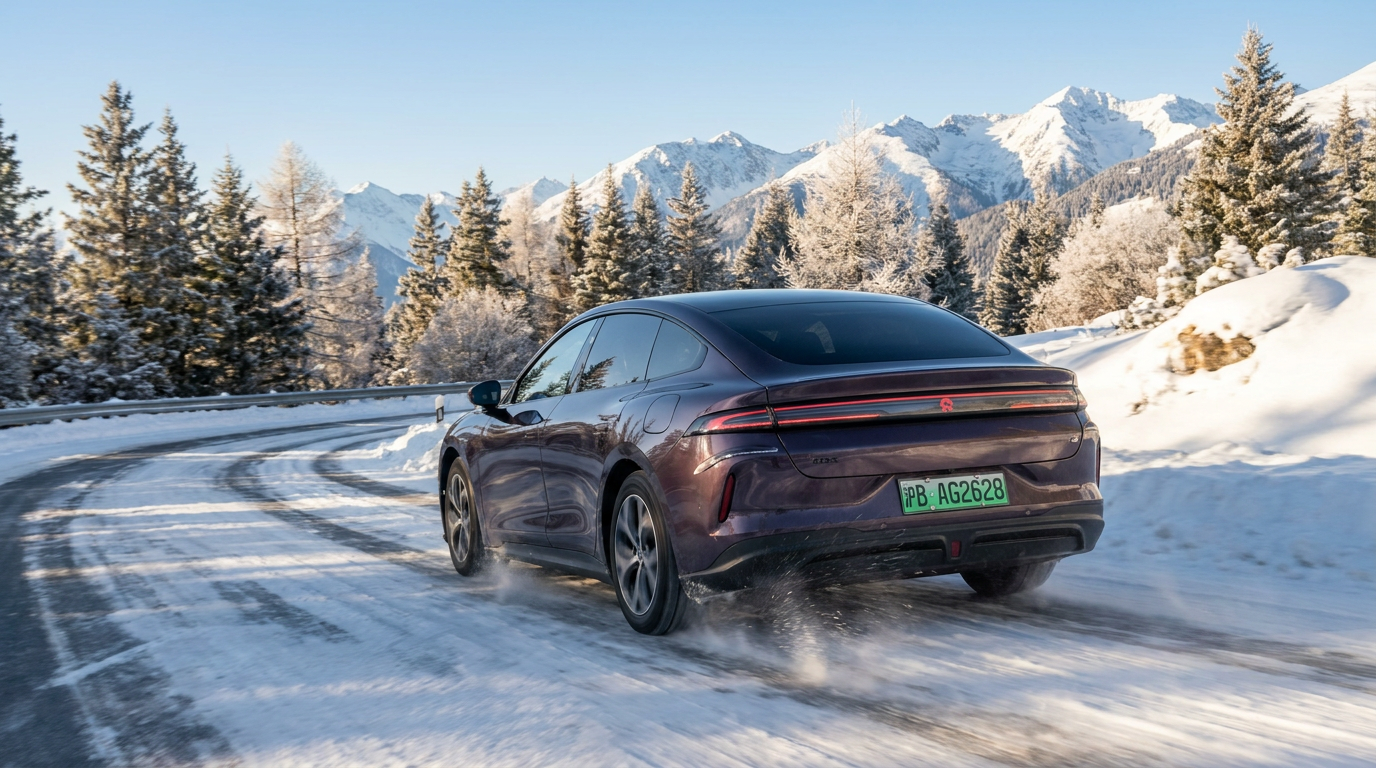
Beyond cost, sodium-ion batteries possess a "killer app" that lithium cannot match: extreme cold-weather performance. Traditional EVs notoriously lose significant range and charging speed in freezing temperatures.[3][4]
Sodium-ion cells, however, thrive in the cold. CATL reports that its Naxtra battery retains 90% of its usable capacity at -40°C (-40°F) and can deliver nearly three times the discharge power of an equivalent LFP cell at -30°C. For drivers in Nordic countries, Canada, or northern climates, this effectively eliminates winter range anxiety.[4][6][8]

The technology also excels in charging speed and safety. Sodium-ion batteries can safely accept ultra-fast charging, with CATL's packs capable of reaching an 80% charge in just 15 minutes. Meanwhile, competitor BAIC has demonstrated prototypes capable of a full recharge in 11 minutes.[1][2][5]
The arrival of sodium-ion does not mean the death of lithium-ion. Instead, 2026 marks the beginning of a "dual-chemistry" era. Lithium will remain the standard for long-range, premium, and performance vehicles where maximizing energy per kilogram is paramount.[4][6]
Sodium-ion, conversely, will dominate the affordable city car segment, cold-climate markets, commercial delivery fleets, and stationary grid storage. With BYD also building a massive 30 GWh sodium-ion plant, the era of the salt-powered car has officially begun, promising to democratize electric mobility for millions.[3][4][8]
How we got here
2021
CATL unveils its first-generation sodium-ion battery prototype.
Late 2023
The first small-scale sodium-ion electric test cars appear in China.
Feb 2026
CATL and Changan officially unveil the Nevo A06 production model.
Mid 2026
The Changan Nevo A06 hits dealerships, marking the first mass-market passenger EV with sodium-ion tech.
End of 2026
CATL projects mass deployment across passenger EVs, commercial fleets, and grid storage.
Viewpoints in depth
Battery Manufacturers
View sodium-ion not as a replacement for lithium, but as a complementary technology to scale production and lower costs.
For giants like CATL and BYD, the goal is not to kill lithium-ion, but to reserve it for where it is strictly necessary. By shifting entry-level city cars, commercial delivery vans, and stationary grid storage over to sodium-ion chemistry, manufacturers can ease the immense supply chain pressure on lithium, cobalt, and nickel. This "dual-chemistry" approach allows them to scale overall battery production much faster while protecting profit margins on high-end, long-range vehicles that still require energy-dense lithium cells.
Automakers
Focus on the technology's ability to lower vehicle sticker prices and offer reliable cold-weather performance to consumers.
Automakers like Changan and BAIC see sodium-ion as the key to unlocking the true mass market. The battery remains the single most expensive component of an electric vehicle, keeping sticker prices artificially high. By utilizing a battery chemistry that promises up to 30% lower production costs, automakers can finally build profitable sub-$20,000 EVs. Furthermore, the exceptional cold-weather performance of sodium cells gives them a powerful marketing tool in northern climates, where traditional lithium-ion EVs have struggled to gain consumer trust due to winter range degradation.
Supply Chain Analysts
Emphasize the geopolitical and economic benefits of reducing the automotive industry's reliance on critical minerals.
Energy analysts and organizations like the IEA view the commercialization of sodium-ion technology as a critical geopolitical hedge. The global lithium supply chain has been plagued by extreme price volatility and geographic concentration, leaving the EV transition vulnerable to bottlenecks. Because sodium can be extracted cheaply from sea salt anywhere in the world, it fundamentally shifts pricing power away from traditional mining conglomerates. While early sodium cells still rely on some critical minerals, the technology represents a massive step toward resource independence and a more stable, predictable cost curve for the entire automotive sector.
What we don't know
- How quickly sodium-ion battery production can scale outside of China to meet global demand.
- Whether the long-term degradation and cycle life of sodium-ion cells will match the proven durability of LFP batteries in real-world passenger use.
- How traditional lithium-ion battery prices will react to the sudden influx of cheaper sodium-ion alternatives.
Key terms
- Sodium-ion battery
- A rechargeable battery that uses sodium ions to store and release energy, replacing the lithium used in conventional EV batteries.
- Energy density
- The amount of energy a battery can hold relative to its weight, typically measured in watt-hours per kilogram (Wh/kg).
- LFP (Lithium Iron Phosphate)
- A popular, durable, and lower-cost lithium-ion battery chemistry widely used in standard-range EVs today.
- Hard carbon
- A type of carbon material used as the anode in sodium-ion batteries because its structure can accommodate the larger sodium ions.
- Dual-chemistry ecosystem
- An industry strategy where automakers use different battery types, like sodium and lithium, for different vehicle classes rather than relying on a single technology.
Frequently asked
Are sodium-ion batteries cheaper than lithium-ion?
Yes. Because sodium is abundantly available in sea salt and the Earth's crust, production costs are projected to be up to 30% lower than comparable lithium batteries.
Will a sodium-ion battery give my car less range?
Generally, yes. Sodium-ion batteries have a lower energy density than premium lithium batteries, meaning they are best suited for vehicles targeting 250 to 300 miles of range rather than ultra-long-distance driving.
Do sodium batteries work better in the winter?
Significantly better. Sodium-ion cells retain up to 90% of their capacity at -40°C, virtually eliminating the winter range loss that plagues traditional lithium-ion EVs.
Sources
Source coverage
8 outlets
3 viewpoints surfaced








[1]CarNewsChinaAutomakers
CATL to mass-produce sodium-ion batteries in 2026, targets 600 km range
Read on CarNewsChina →[2]Electrek
CATL is bringing sodium-ion batteries to EVs in 2026
Read on Electrek →[3]IEASupply Chain Analysts
Recent technological advances and investment announcements suggest dynamics are shifting for sodium-ion batteries
Read on IEA →[4]EleportBattery Manufacturers
Sodium-Ion batteries go mainstream
Read on Eleport →[5]Latam MobilityAutomakers
The future of electric mobility is being redefined by a technology that promises to democratize access to zero-emission vehicles: sodium-ion batteries
Read on Latam Mobility →[6]CATL OfficialBattery Manufacturers
CHANGAN Automobile, in partnership with CATL, today unveiled the world's first mass-production passenger vehicle equipped with sodium-ion batteries
Read on CATL Official →[7]Arab WheelsSupply Chain Analysts
Sodium Ion vs LFP Batteries is no longer a niche lab argument
Read on Arab Wheels →[8]Discovery AlertSupply Chain Analysts
Sodium-Ion Batteries Transform Electric Vehicle Performance in 2026
Read on Discovery Alert →
Every angle. Every day.
Get automotive stories with full source coverage and perspective breakdowns delivered to your inbox.