
How AI and Computer Vision Are Revolutionizing Injury Prevention in Pro Sports
Elite sports franchises are using machine learning and markerless motion capture to predict and prevent soft-tissue injuries before they happen, fundamentally changing how athlete health is managed.
By Factlen Editorial Team
- Sports Technology Developers
- Tech companies emphasizing the scale, accuracy, and biomechanical precision of their predictive machine learning models.
- Sports Medical Researchers
- Medical professionals who view AI as a revolutionary triage tool that shifts their practice from reactive surgery to proactive care.
- Independent Analysts
- Observers focusing on the broader structural impacts, including the ethical and labor dynamics of biometric tracking.
What's not represented
- · Youth sports coaches
- · Sports betting analysts
Why this matters
By transitioning from reactive treatment to proactive prevention, AI is extending the careers of top athletes, reducing the billions of dollars lost to sidelined talent, and slowly democratizing elite sports science for everyday athletes.
Key points
- AI is shifting sports medicine from reactive treatment to proactive injury prevention.
- Computer vision tracks biomechanics in real time without requiring wearable sensors.
- Machine learning models can predict soft-tissue injuries with up to 85% accuracy.
- Ethical debates remain over who owns an athlete's predictive health data.
For decades, the professional sports world treated physical injuries as an unavoidable cost of doing business. A pulled hamstring, a torn ligament, or a stress fracture was routinely chalked up to bad luck, accumulated fatigue, or the natural wear and tear of a grueling competitive season. Medical staffs largely operated in a reactive capacity, deploying ice baths, extended rest periods, and surgical interventions only after the physical damage was already done. Today, that entire paradigm is being fundamentally inverted. Driven by massive leaps in artificial intelligence, machine learning, and computer vision, elite sports franchises are rapidly transitioning from reactive sports medicine to proactive, data-driven injury prevention.[1]
The financial and competitive stakes are astronomical. Across global soccer, basketball, and American football, sidelined stars cost leagues billions in lost revenue, diminished fan engagement, and derailed championship aspirations. In response, the sports analytics market has exploded, reaching an estimated valuation of $1.5 billion in 2025. The ultimate goal of this investment is no longer just to build a faster or stronger athlete, but to keep that athlete consistently on the field. By analyzing millions of data points per session, AI systems are now capable of spotting the subtle, invisible precursors to physical breakdown weeks before a player ever feels a twinge.[2][7]
At the core of this technological revolution is the evolving concept of load management. Historically, coaches and trainers relied on basic intuition, player feedback, and simple minute-counting to determine if an athlete was being overworked. Modern AI load management systems, however, ingest a continuous, massive stream of physiological data to calculate exactly how much physical and mental stress an athlete can endure while remaining in an optimal performance zone. These sophisticated platforms analyze training volume, movement intensity, and individual recovery cycles to flag the exact moment when a player crosses the threshold from productive athletic strain into dangerous, injury-inducing overtraining.[1][2]

This unprecedented predictive power relies entirely on a daily deluge of biometric data. Wearable sensors strapped to athletes track heart rate variability, sleep quality, and internal load indicators, while advanced GPS units map total distance covered, acceleration profiles, and peak sprint velocity during practice. But the most significant recent breakthrough has come from the field of optical tracking. Companies specializing in computer vision now deploy arrays of high-speed stadium cameras that turn live video feeds into billions of data points per game, tracking the exact spatial coordinates of every player and the ball without requiring the athletes to wear any physical sensors.[2][3]
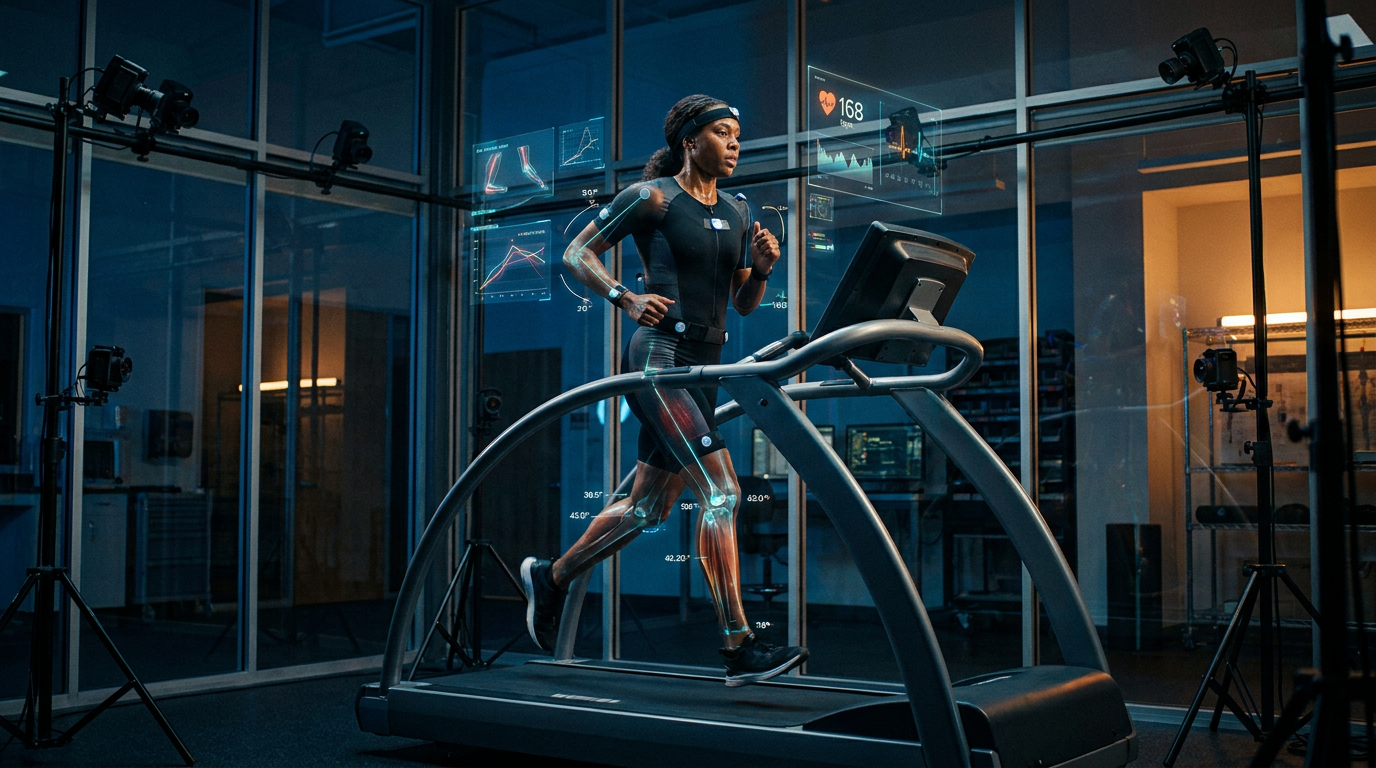
This markerless motion capture technology allows artificial intelligence to analyze human biomechanics in real time. Vision models track over twenty key points on the human body, precisely measuring joint angles, limb velocity, gait symmetry, and stride length during live competition. When an athlete begins to fatigue, their mechanics subtly change—a slight overcompensation in a knee, a fractionally shorter stride, or a microscopic shift in balance. These micro-adjustments are entirely invisible to the human eye, but to a machine learning algorithm, they are glaring red flags indicating an elevated risk of imminent injury.[1][3]
The results of these predictive models are fundamentally changing how professional teams operate on a daily basis. Platforms like Zone7, which was recently integrated into Svexa's comprehensive human performance suite, analyze wearables, game statistics, and even weather conditions to forecast injury risk with remarkable precision. By identifying the hidden patterns that precede soft-tissue injuries, these AI systems have delivered staggering real-world results. For example, Spanish soccer club Getafe CF reported a massive 60% reduction in injuries after adopting AI-driven risk forecasting, allowing the coaching staff to intervene and rest players before their bodies broke down.[3][8]
The results of these predictive models are fundamentally changing how professional teams operate on a daily basis.
Similar predictive successes are being thoroughly documented across peer-reviewed medical literature. A recent comprehensive scoping review published by the National Institutes of Health highlighted that Random Forest machine learning models can now predict hamstring injuries with an impressive 85% accuracy based purely on workload and biomechanical data. Across various global sports, teams employing these comprehensive AI injury prevention programs have routinely seen their overall injury rates drop by up to 30%. By intervening before a micro-tear becomes a season-ending rupture, these franchises are significantly extending the competitive lifespans of their most valuable rosters.[1][4][7]

The impact of this technology extends to acute trauma and collision sports as well. The NFL has heavily invested in its proprietary "Digital Athlete" system, which utilizes 38 high-definition cameras and machine learning to simulate in-game scenarios and track heavy impacts. By analyzing this wealth of data to inform league rule changes, equipment design, and safer practice habits, the league recorded its lowest concussion rate on record in 2024, marking a 17% decrease from the previous year. While AI cannot stop a 250-pound linebacker from making a tackle, it can optimize the environment and the athlete to better absorb the collision.[6]
Beyond simply tracking existing movements, researchers are now using generative AI to simulate human biomechanics from scratch. At the University of California San Diego, scientists developed BIGE (Biomechanics-informed GenAI for Exercise Science), a groundbreaking model trained on motion-capture data and the strict physical constraints of the human body. Unlike standard AI video generators that often create physically impossible movements, BIGE generates highly realistic simulations of muscle activation and joint forces. This allows medical staffs to design highly specific, mathematically optimized rehabilitation exercises that athletes can mimic to safely rebuild strength without risking re-injury.[5]
Interestingly, as AI models ingest more comprehensive data, they are revealing that the biggest predictors of injury often happen far away from the field. Machine learning studies have consistently identified off-field lifestyle factors—specifically sleep duration and psychological stress—as more critical injury risk predictors than traditional physical fitness indicators. Sleep deprivation severely impairs hormonal balance and muscle repair, meaning an athlete with perfect biomechanics but poor sleep is often at a significantly higher risk of tearing a muscle than a well-rested athlete with minor mechanical flaws.[6]

Despite these massive technological breakthroughs, sports scientists and developers are quick to acknowledge the inherent limitations of the technology. Artificial intelligence is ultimately a probability engine, not a magic crystal ball. It excels at predicting overuse ailments, muscular fatigue, and soft-tissue injuries, but it cannot foresee a freak accident, a malicious tackle, or a sudden awkward landing on a wet field. Furthermore, the predictive models are only as reliable as the data they ingest. If a player intentionally hides an injury or provides inaccurate subjective wellness scores to stay in the starting lineup, the algorithm's predictions will inherently be skewed and ineffective.[1][3]
The widespread adoption of biometric tracking also introduces complex ethical and labor dynamics into the sports world. Player associations and unions are increasingly focused on data privacy, questioning exactly who owns the intimate physiological data generated by these tracking systems. There is a lingering, valid fear among athletes that an AI model flagging them as "high risk" for a future injury could be weaponized by front offices during contract negotiations, leading to reduced guaranteed money based entirely on a machine's prediction of their future health.[1]
For the time being, collective bargaining agreements across major sports leagues generally restrict the use of biometric data strictly to health and performance optimization, explicitly banning its use in contract negotiations. As the technology matures, the financial cost of computer vision and AI analytics is rapidly decreasing, democratizing access far beyond elite professional leagues. NCAA Division I college programs are already seeing significant reductions in clinic visits after adopting comprehensive injury surveillance systems, and the technology is slowly trickling down to high school programs and elite youth sports academies, promising a safer future for the next generation of athletes.[1][6]

The ultimate promise of artificial intelligence in sports analytics is not just about optimizing athletic performance, but about preserving human health and longevity. By transforming the human body into a measurable, predictable system, technology is giving athletes the unprecedented ability to push their physical limits with a safety net that never previously existed. In the near future, the most valuable asset a sports franchise possesses will not just be its star player, but the sophisticated algorithm that ensures that player is healthy enough to take the field when it matters most.[1]
How we got here
2018
Zone7 launches its AI-driven human performance platform for injury forecasting.
2024
The NFL's "Digital Athlete" system helps drive a 17% reduction in league concussions.
2025
The sports AI analytics market reaches an estimated valuation of $1.5 billion.
Oct 2025
UC San Diego researchers unveil BIGE, a generative AI model for biomechanically accurate exercise simulation.
Viewpoints in depth
Sports Medical Researchers' view
Medical professionals view AI as a revolutionary triage tool that shifts their practice from reactive surgery to proactive care.
For decades, team doctors relied on subjective player feedback and basic minute-counting to gauge fatigue. Researchers argue that AI fundamentally changes this dynamic by quantifying the invisible. By relying on objective biomarkers like heart rate variability and markerless motion capture, medical staffs can intervene before a micro-tear becomes a season-ending rupture, ultimately extending athletic careers and improving long-term health outcomes.
Sports Technology Developers' view
Tech companies emphasize the scale and precision of their predictive models.
Developers point to the sheer volume of data now available—billions of data points per game—as the catalyst for this revolution. They argue that human coaches simply cannot process the subtle biomechanical deviations that precede an injury. By deploying machine learning algorithms like Random Forest models, these companies claim they can achieve up to 85% accuracy in predicting soft-tissue injuries, turning injury prevention into a mathematical certainty rather than a guessing game.
Independent Analysts' view
Observers focus on the broader structural and ethical impacts of biometric tracking.
Independent analysts and editorial observers acknowledge the undeniable health benefits of AI tracking, but they highlight the looming labor disputes over data ownership. Analysts point out that if an AI model flags a player as 'high risk' for a future injury, front offices could theoretically use that algorithm to devalue the player in contract negotiations. Ensuring that predictive health data is used exclusively for player safety, rather than financial leverage, remains the critical hurdle for widespread adoption.
What we don't know
- How predictive models will account for unpredictable, acute contact injuries like collisions.
- Whether player unions will allow AI health forecasts to be used in future contract negotiations.
- How quickly this elite-level technology will become affordable for standard youth sports programs.
Key terms
- Load Management
- The deliberate monitoring and adjustment of an athlete's physical and mental stress to optimize performance and prevent overtraining.
- Computer Vision
- A field of AI that trains computers to interpret and understand the visual world, used in sports to track player movements from video feeds.
- Markerless Motion Capture
- Technology that tracks human joint angles and biomechanics using only standard cameras, without requiring the subject to wear reflective dots or sensors.
- Heart Rate Variability (HRV)
- The variation in time between consecutive heartbeats, used by AI models as a key indicator of an athlete's nervous system recovery and readiness.
- Random Forest Model
- A machine learning algorithm that uses multiple decision trees to classify data, highly effective in predicting injury risks based on historical patterns.
Frequently asked
Can AI predict when a player will tear an ACL?
It cannot predict a specific acute event like a bad tackle, but it can flag when a player's biomechanics and fatigue levels put them in a high-risk zone for soft-tissue injuries.
Do athletes have to wear sensors during actual games?
While some wear GPS vests, modern computer vision uses markerless optical tracking from stadium cameras, requiring no wearables during live play.
Who owns the biometric data collected by these systems?
This is a major point of negotiation between player unions and leagues, with current agreements usually restricting data use to health and performance, explicitly banning its use in contract negotiations.
Sources
Source coverage
8 outlets
3 viewpoints surfaced








[1]Factlen Editorial TeamIndependent Analysts
Synthesis by Factlen editorial team
Read on Factlen Editorial Team →[2]Mimic SportsSports Technology Developers
What is AI in sports load management?
Read on Mimic Sports →[3]WSC SportsSports Technology Developers
AI-driven injury prevention and load management
Read on WSC Sports →[4]National Institutes of HealthSports Medical Researchers
Artificial Intelligence in Sports Biomechanical Analysis: A Scoping Review
Read on National Institutes of Health →[5]UC San DiegoSports Medical Researchers
Generative AI Model Helps Prevent Injuries in Athletes
Read on UC San Diego →[6]Top Doctor MagazineSports Medical Researchers
The Future of Injury Prevention Belongs to Every Athlete
Read on Top Doctor Magazine →[7]SparkCo AISports Technology Developers
AI Sports Analytics: Transforming Performance and Injury Prevention
Read on SparkCo AI →[8]SvexaSports Technology Developers
Zone7 joins svexa to create end-to-end AI human performance suite
Read on Svexa →

More in sports
See all 6 stories →Women's Super League
Mary Earps Returns to Women's Super League in Statement Signing for London City Lionesses
7 sources

WSL Transfers
Mary Earps Returns to WSL in Statement Signing for London City Lionesses
7 sources

Combat Tech
The Science of the Strike: How Smart Gloves and Sensors Are Making Combat Sports Safer
9 sources
Women's Wrestling
How Women's Wrestling Became the Fastest-Growing Sport in America
6 sources

Every angle. Every day.
Get sports stories with full source coverage and perspective breakdowns delivered to your inbox.