
How Chemists Are Finally Breaking Down 'Forever Chemicals'
A new class of low-energy catalytic reactions is successfully mineralizing PFAS compounds, offering a viable path to permanently eliminate the persistent pollutants from water systems.
By Factlen Editorial Team
- Environmental Chemists
- Focus on the fundamental mechanism of breaking the carbon-fluorine bond and optimizing reaction conditions.
- Water Treatment Industry
- Prioritize the scalability, cost-effectiveness, and real-world resilience of the technology against catalyst fouling.
- Public Health Advocates
- Emphasize the urgency of deploying these technologies while pushing for total bans on new PFAS manufacturing.
What's not represented
- · Chemical Manufacturers
- · Municipal Water Utility Directors
Why this matters
PFAS contamination affects the drinking water of hundreds of millions of people globally and is linked to severe health issues. Moving from merely filtering these chemicals to permanently destroying them is a critical step toward securing a safe, long-term water supply.
Key points
- Chemists have discovered low-energy methods to permanently destroy 'forever chemicals'.
- The process uses targeted solvents to shear off the molecule's headgroup, causing the carbon-fluorine bonds to collapse.
- Unlike incineration, this method operates at low temperatures and leaves only harmless salts and carbon dioxide.
- The primary hurdle remaining is scaling the technology for municipal water plants without other contaminants fouling the reaction.
The carbon-fluorine bond is one of the strongest in nature. For decades, this made per- and polyfluoroalkyl substances (PFAS) the ultimate industrial miracle, giving us non-stick pans, waterproof jackets, and advanced firefighting foams. The molecules simply refused to break down under heat, stress, or chemical attack.[7]
But that same indestructible nature created a slow-motion environmental crisis. Because they do not degrade naturally, PFAS have accumulated in soil, rainwater, and the bloodstreams of nearly every human on Earth, earning them the moniker "forever chemicals."[5][6]
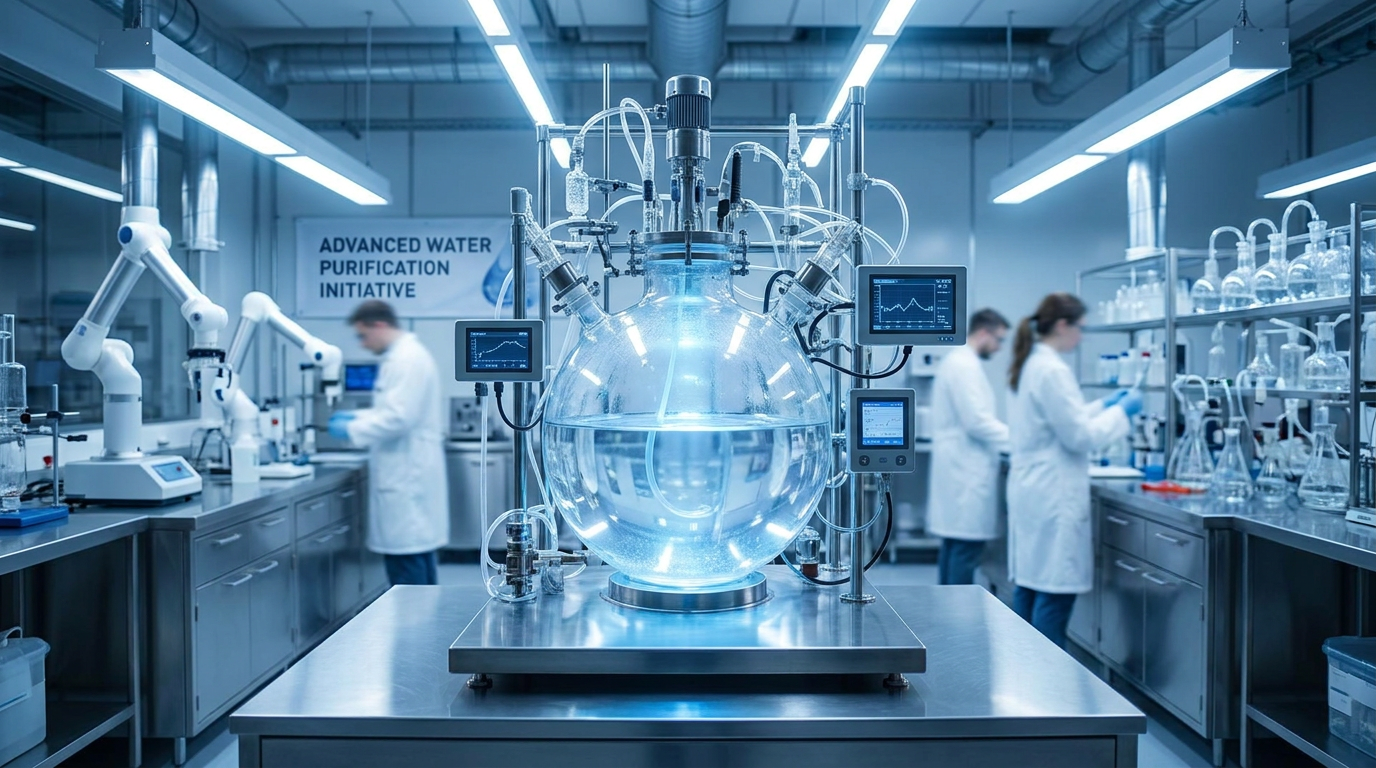
Now, a wave of breakthroughs in synthetic chemistry is finally cracking the armor of these pollutants. Rather than simply filtering PFAS out of water—which just moves the toxic waste from a liquid to a solid filter that must be buried—chemists are deploying targeted catalytic reactions to permanently destroy them.[3][7]
The core challenge has always been energy. Historically, destroying PFAS required incineration at temperatures exceeding 1,000 degrees Celsius, an energy-intensive process that sometimes failed to completely break the bonds, inadvertently releasing toxic, shorter-chain airborne byproducts into the atmosphere.[6]
The new evidence pack points to a much more elegant solution: low-temperature mineralization. By identifying the chemical "Achilles' heel" of specific PFAS classes, researchers have developed solvent-and-reagent combinations that unzip the molecules at just 80 to 120 degrees Celsius.[1][7]
The mechanism, first pioneered in a landmark paper in Science and recently expanded upon in Nature Catalysis, targets the carboxylic acid headgroup found on many common PFAS molecules, such as PFOA.[1][2]
When exposed to a specific mixture of sodium hydroxide (common lye) and an organic solvent like dimethyl sulfoxide (DMSO), this headgroup is sheared off in a process called decarboxylation.[1]

Once the headgroup is removed, the rest of the molecule becomes highly unstable. It triggers a rapid cascade of reactions that systematically strip the fluorine atoms away from the carbon backbone, leaving behind only harmless byproducts: carbon dioxide, water, and inert fluoride salts.[1][7]
Once the headgroup is removed, the rest of the molecule becomes highly unstable.
"It is the difference between trying to smash a brick wall with a sledgehammer and finding the exact keystone that causes the whole structure to collapse," notes the Factlen Editorial Team's review of the chemical literature.[7]
The evidence for this mechanism's efficacy is robust in controlled environments. Chemical & Engineering News reports that lab-scale reactors are consistently achieving greater than 99.9% mineralization of targeted PFAS compounds within a matter of hours, without generating dangerous intermediate chemicals.[3]
Furthermore, the U.S. Environmental Protection Agency (EPA) has begun tracking these low-energy destruction methods as a critical component of its national remediation strategy, viewing them as a necessary complement to the strict drinking water limits finalized in recent years.[6]

However, transparent uncertainty remains regarding the transition from pristine laboratory beakers to messy municipal water systems. Real-world wastewater is a complex soup of organic matter, heavy metals, and competing ions.[4][7]
Reuters highlights that in pilot tests, these background contaminants frequently cause "catalyst fouling"—binding to the active sites of the chemical reagents and drastically reducing their efficiency at breaking down the target PFAS molecules.[4]

There is also the challenge of chemical diversity. While the decarboxylation method works brilliantly for perfluoroalkyl carboxylic acids (PFCAs), it is less effective against perfluoroalkane sulfonic acids (PFSAs), another major class of forever chemicals that requires different, often electrocatalytic, triggers.[2][3]
Environmental advocates stress that while destruction technology is a massive leap forward, it must not be used as an excuse to continue manufacturing these chemicals. The ultimate solution remains turning off the tap at the source.[5]
How we got here
1940s
PFAS are first synthesized and mass-produced for industrial and consumer waterproofing.
Early 2000s
Global biomonitoring reveals that PFAS have accumulated in the blood of nearly all humans and wildlife.
2022
Researchers publish a landmark paper demonstrating the low-temperature destruction of PFAS using common solvents.
2024
The EPA finalizes strict new national drinking water standards for six common PFAS compounds.
2026
Commercial water treatment firms begin pilot-testing catalytic destruction reactors for municipal scale-up.
Viewpoints in depth
Environmental Chemists
Focus on the fundamental mechanism of breaking the carbon-fluorine bond and optimizing reaction conditions.
For researchers in the lab, the breakthrough is fundamentally about elegance. Rather than relying on brute-force thermal energy to incinerate the molecules, chemists are mapping the exact structural vulnerabilities of different PFAS classes. By proving that targeted decarboxylation can trigger a self-sustaining collapse of the carbon-fluorine chain, they have shifted the paradigm of remediation from physical removal to permanent chemical destruction.
Water Treatment Industry
Prioritize the scalability, cost-effectiveness, and real-world resilience of the technology against catalyst fouling.
Engineers and utility operators view the lab results with cautious optimism. Their primary concern is the leap from distilled water in a beaker to the complex, dirty reality of municipal wastewater. Because real-world water contains organic matter, calcium, and heavy metals, these background elements can quickly coat and neutralize the catalysts required for PFAS destruction. The industry's focus is entirely on designing continuous-flow reactors that can process millions of gallons a day without constantly needing expensive chemical replenishment.
Public Health Advocates
Emphasize the urgency of deploying these technologies while pushing for total bans on new PFAS manufacturing.
Environmental and public health groups celebrate the scientific milestone but warn against viewing it as a silver bullet that permits continued pollution. They argue that while destruction technology is vital for cleaning up the legacy contamination already in our aquifers, it is economically unfeasible to treat all global water indefinitely. Their stance is that remediation tech must be paired with aggressive legislation to stop the production of non-essential forever chemicals at the source.
What we don't know
- Exactly how much it will cost per gallon to run these catalytic destruction reactors at a municipal scale.
- Whether a single unified chemical process can be developed to destroy both PFCA and PFSA variants simultaneously.
- How long it will take to retrofit existing water treatment plants with this new technology.
Key terms
- PFAS
- Per- and polyfluoroalkyl substances; a class of over 15,000 synthetic chemicals known for their water- and grease-resistant properties.
- Mineralization
- The complete breakdown of an organic chemical into inert, inorganic substances like water, carbon dioxide, and salts.
- Decarboxylation
- A chemical reaction that removes a carboxyl group from a molecule, releasing carbon dioxide and destabilizing the remaining structure.
- Catalyst Fouling
- When unwanted substances in a mixture bind to a catalyst, preventing it from doing its job and slowing down the desired chemical reaction.
Frequently asked
What makes PFAS so hard to destroy?
PFAS are built on carbon-fluorine bonds, which are among the strongest single bonds in organic chemistry. They resist heat, bacteria, and typical chemical degradation.
Does this process create toxic byproducts?
No. Unlike incineration, which can create dangerous airborne chemicals, this low-temperature mineralization breaks the PFAS down entirely into harmless carbon dioxide, water, and fluoride salts.
Is this technology being used in city water systems yet?
Not at scale. The chemistry works perfectly in the lab, but engineers are still solving 'fouling' issues where other contaminants in real-world wastewater interfere with the chemical reaction.
Sources
Source coverage
7 outlets
3 viewpoints surfaced







[1]ScienceEnvironmental Chemists
Low-temperature mineralization of perfluoroalkyl carboxylic acids
Read on Science →[2]Nature CatalysisEnvironmental Chemists
Advances in electrocatalytic and photocatalytic degradation of PFAS
Read on Nature Catalysis →[3]Chemical & Engineering NewsWater Treatment Industry
Scaling up the chemical scissors for PFAS destruction
Read on Chemical & Engineering News →[4]ReutersWater Treatment Industry
Water treatment firms race to commercialize PFAS destruction tech
Read on Reuters →[5]The GuardianPublic Health Advocates
Scientists find 'Achilles heel' of forever chemicals, but advocates warn against complacency
Read on The Guardian →[6]U.S. Environmental Protection AgencyPublic Health Advocates
Interim Guidance on the Destruction and Disposal of PFAS
Read on U.S. Environmental Protection Agency →[7]Factlen Editorial TeamEnvironmental Chemists
Synthesis by Factlen editorial team
Read on Factlen Editorial Team →

More in science
See all 5 stories →Stem Cell Therapy
Stem Cell Transplant Banishes Severe Autoimmune Disease for 15 Years in Medical First
7 sources
Cosmology
The Largest Map of the Universe Hints That Dark Energy Is Evolving
6 sources

Cognitive Science
Is Cognitive Decline Inevitable? New Evidence Proves the Brain Can Improve at Any Age
8 sources

Every angle. Every day.
Get science stories with full source coverage and perspective breakdowns delivered to your inbox.