
How AI-Equipped Drones Are Rewriting the Rules of Mine Clearance
By fusing multi-spectrum sensors with deep learning, a new generation of autonomous drones is detecting unexploded ordnance up to 90% faster than traditional methods. We examine the evidence behind the technology clearing the world's most dangerous minefields.
By Factlen Editorial Team
- Humanitarian Deminers
- Advocates prioritize the rapid restoration of land for civilian use and agriculture.
- AI & Robotics Researchers
- Technologists focus on sensor fusion, model accuracy, and edge computing capabilities.
- Defense & EOD Specialists
- Military and disposal experts emphasize the necessity of human oversight and the dangers of false negatives.
What's not represented
- · Local farmers and landowners in contaminated regions
- · Manufacturers of traditional demining equipment
Why this matters
Landmines and unexploded ordnance render millions of acres of agricultural land unusable and cause thousands of civilian casualties annually. Automating the detection process not only saves the lives of clearance personnel but drastically accelerates the economic recovery of post-conflict regions.
Key points
- AI-equipped drones are reducing the time required to survey minefields by up to 90%.
- Multi-sensor arrays combine optical, thermal, and radar data to detect both surface and buried threats.
- Machine learning models can now identify over 150 distinct types of unexploded ordnance.
- Experts mandate a 'Human-in-the-Loop' approach, using AI for triage rather than autonomous clearance.
The arithmetic of humanitarian demining has long been a grim equation. Using traditional methods—metal detectors, probing sticks, and trained dogs—clearing a single square kilometer of mine-contaminated land can take months and cost millions of dollars. In heavily contaminated regions like Ukraine, where an estimated 139,000 square kilometers are littered with explosive remnants of war, manual clearance was projected to take over a century.[1][4][8]
But a profound technological shift is altering that timeline. Over the past 36 months, the convergence of small uncrewed aerial systems (sUAS), multi-spectrum sensors, and advanced machine learning has birthed a new paradigm in explosive ordnance detection. We are no longer relying solely on boots on the ground; we are deploying algorithms in the sky.[6][8]
The core innovation lies in replacing human visual inspection with artificial intelligence. Historically, drones were used to capture aerial footage of suspected minefields, which human analysts then painstakingly reviewed. Today, AI models trained on massive datasets of unexploded ordnance (UXO) can process that imagery in a fraction of a second, automatically drawing bounding boxes around suspected threats.[1][2][4]

The evidence supporting this shift is robust and growing. Norwegian People's Aid (NPA), one of the world's largest humanitarian demining organizations, recently integrated cloud-based AI processing into their non-technical survey operations. The results were staggering: the AI platform reduced survey image analysis times by nearly 90% and cut associated costs by an estimated 80%.[2]
This acceleration does not come at the expense of accuracy. Peer-reviewed research published in Remote Sensing demonstrated that Convolutional Neural Networks (CNNs), specifically fine-tuned YOLOv5 models, could identify surface UXO from thermal drone imagery with over 90% probability. In controlled tests, the Mean Average Precision (mAP) reached 99.5% at standard confidence thresholds.[3]
Commercial developers have scaled these academic findings into battle-tested platforms. Safe Pro AI, a leading developer in the space, utilizes a proprietary dataset containing over 2.75 million drone images to train its models. Their system is now capable of identifying more than 150 distinct types of explosive threats, ranging from anti-personnel mines to cluster munitions and improvised explosive devices (IEDs).[1]
In May 2026, the company announced it had surpassed 50,000 confirmed landmine and UXO detections in real-world operations, primarily supporting agricultural remediation in Ukraine. This milestone represents a transition from experimental technology to a proven operational capability.[1][8]

This milestone represents a transition from experimental technology to a proven operational capability.
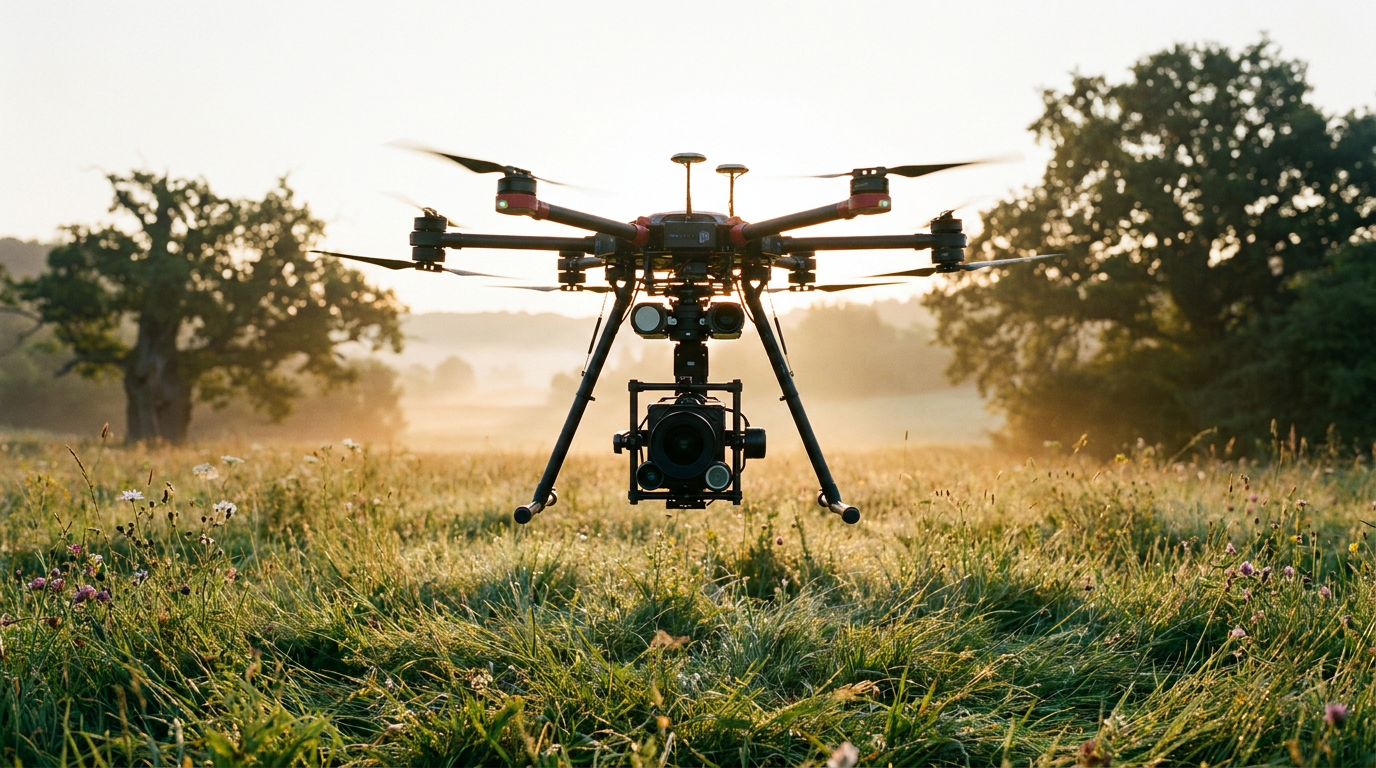
To understand the mechanism behind these detection rates, we must look at the sensor payloads. A single optical camera is insufficient for complex environments. Modern demining drones utilize a multi-sensor approach, combining high-resolution RGB cameras, thermal imaging, and Light Detection and Ranging (LiDAR).[5][6]
Thermal imaging is particularly effective because landmines and the surrounding soil absorb and retain heat at different rates. During the thermal crossover periods—shortly after sunrise and sunset—the temperature differential creates a distinct thermal signature that the AI is trained to recognize, even if the mine is partially obscured by vegetation.[3][6]
For fully buried threats, the technological challenge is steeper. Developers are actively integrating miniaturized Ground-Penetrating Radar (GPR) and magnetometers onto drone platforms. These sensors detect subsurface anomalies and magnetic disturbances caused by the metallic components of buried UXO. The data from all these sensors is fused into a single information model, generating a high-resolution, multi-layered threat map.[4][7]
Despite these breakthroughs, the evidence also highlights clear limitations and uncertainties. AI-assisted detection is highly dependent on data quality and environmental conditions. Dense forest canopies, heavy rain, and deep snow can severely degrade sensor performance, leading to false negatives—the most dangerous outcome in demining.[5]

Conversely, false positives remain a persistent friction point. Shrapnel, metallic debris, and even certain types of rocks can trigger the AI, forcing Explosive Ordnance Disposal (EOD) technicians to waste valuable time investigating harmless anomalies. The models are only as good as their training data, and a system optimized for the arid terrain of the Middle East may struggle in the muddy fields of Eastern Europe without extensive retraining.[5][6]
Furthermore, defense and EOD specialists emphasize that AI drones are a tool for triage, not automatic clearance. The technology excels at rapid wide-area mapping, allowing human teams to bypass safe zones and focus directly on confirmed threat clusters. However, the physical neutralization of the ordnance still requires human judgment and intervention.[5][8]
The consensus among experts is that a 'Human-in-the-Loop' (HITL) architecture remains mandatory. The AI highlights the probable hazard, but a trained specialist must validate the detection and determine the safest method of disposal. This collaborative approach maximizes the speed of the machine while preserving the critical thinking of the human.[5][7][8]

Looking ahead, the integration of AI detection with robotic excavation promises to further remove humans from the blast radius. Organizations like the HALO Trust are exploring workflows where an AI drone maps the minefield, and a remote-controlled ground robot—such as the compressed-air excavation systems developed by Japanese robotics firms—safely unearths the detected mines.[7]
The implications of this technology extend far beyond the immediate post-conflict zones. The same multi-sensor AI architecture is being adapted for infrastructure inspection, disaster response, and the remediation of contaminated industrial sites.[1][5]
By transforming mine clearance from a slow, manual crawl into a rapid, data-driven science, AI and drone technologies are doing more than just clearing fields. They are accelerating the return of displaced populations, restoring vital agricultural economies, and proving that the most advanced defense technologies can be harnessed to heal the scars of war.[2][8]
How we got here
2014-2021
Early academic research proves the viability of using neural networks to identify surface UXO from drone imagery.
Mid-2022
Humanitarian organizations in Ukraine begin deploying commercial drones to map contaminated agricultural land.
Late 2023
Norwegian People's Aid initiates pilot projects using cloud-based AI to automate the processing of drone footage.
2024-2025
AI models achieve a breakthrough, capable of identifying over 150 types of ordnance and processing images in fractions of a second.
May 2026
Safe Pro AI surpasses 50,000 confirmed landmine and UXO detections in real-world operations.
Viewpoints in depth
Humanitarian Deminers
Advocates prioritize the rapid restoration of land for civilian use and agriculture.
For organizations like Norwegian People's Aid and the HALO Trust, the primary metric of success is the speed at which land can be safely returned to local communities. They view AI and drone technology as a critical force multiplier that can reduce survey times by up to 90%. Their focus is less on achieving perfect autonomous clearance and more on rapid triage—identifying the exact boundaries of minefields so that agricultural production can resume in safe zones while clearance teams focus on confirmed threats.
Defense & EOD Specialists
Military and disposal experts emphasize the necessity of human oversight and the dangers of false negatives.
Explosive Ordnance Disposal (EOD) technicians approach AI with cautious optimism tempered by operational reality. They stress that a machine learning model's output is only a recommendation, not a final verdict. Their primary concern is the false negative rate—if the AI misses a buried mine due to poor weather or unusual soil composition, human lives are at immediate risk. Consequently, they advocate for strict 'Human-in-the-Loop' protocols, where AI serves to keep humans further from the blast radius during the survey phase, but human judgment dictates the final neutralization.
What we don't know
- How effectively current AI models can adapt to entirely new terrains and soil compositions without extensive local retraining.
- The long-term reliability of miniaturized ground-penetrating radar on lightweight drones for detecting deeply buried, non-metallic mines.
- Whether the cost of scaling multi-sensor drone fleets will remain prohibitive for smaller NGOs operating in underfunded post-conflict zones.
Key terms
- Unexploded Ordnance (UXO)
- Explosive weapons such as bombs, shells, and grenades that failed to detonate and remain hazardous.
- Convolutional Neural Network (CNN)
- A type of artificial intelligence specifically designed to process and analyze visual imagery.
- Ground-Penetrating Radar (GPR)
- A geophysical method that uses radar pulses to image the subsurface, detecting buried objects.
- Human-in-the-Loop (HITL)
- A system design where artificial intelligence assists in detection, but a human operator makes the final critical decisions.
Frequently asked
Can AI drones physically remove the landmines?
No. Current AI drone systems are designed for detection and mapping (triage). Physical clearance still requires human Explosive Ordnance Disposal (EOD) technicians or specialized ground robots.
How accurate is the AI at finding buried mines?
Accuracy depends on the sensor and depth. Surface and partially buried mines are detected with over 90% accuracy using thermal and RGB cameras, while deeply buried mines require ground-penetrating radar, which is still being refined.
Does bad weather affect the drones' ability to detect explosives?
Yes. Heavy rain, dense vegetation, and poor lighting can degrade optical and thermal sensor performance, which is why multi-sensor arrays (including magnetometers) are used to compensate.
Sources
Source coverage
8 outlets
3 viewpoints surfaced








[1]Safe Pro AIAI & Robotics Researchers
Automating Detection of Landmines through Drones and AI
Read on Safe Pro AI →[2]Norwegian People's AidHumanitarian Deminers
NPA Ukraine Conducts Pilot Project with Safe Pro AI for Automated Processing of Drone Imagery
Read on Norwegian People's Aid →[3]MDPI Remote SensingAI & Robotics Researchers
UAV Thermal Imaging for Unexploded Ordnance Detection by Using Deep Learning
Read on MDPI Remote Sensing →[4]Euromaidan PressHumanitarian Deminers
Kyiv's AI coders take aim at hidden Russia's killers beneath soil
Read on Euromaidan Press →[5]TecProTechDefense & EOD Specialists
AI drones and the hard problem of explosive ordnance detection
Read on TecProTech →[6]Defense Technical Information CenterDefense & EOD Specialists
AI-Based UXO Detection Using sUAS Equipped With A Single- or Multi-Spectrum EO Sensor
Read on Defense Technical Information Center →[7]NATO Science for Peace and SecurityAI & Robotics Researchers
SPS Sparks Magazine: Advancing Robotic Solutions for Demining
Read on NATO Science for Peace and Security →[8]Factlen Editorial TeamDefense & EOD Specialists
Synthesis by Factlen editorial team
Read on Factlen Editorial Team →
Every angle. Every day.
Get defense security stories with full source coverage and perspective breakdowns delivered to your inbox.