
The Rise of Zero-Emission Trains: How Hydrogen and Batteries Are Replacing Diesel Rail
As the rail industry races to decarbonize, hydrogen fuel cells and battery-electric systems are emerging as the primary tools to replace diesel locomotives on un-electrified routes.
By Factlen Editorial Team
- Hydrogen Advocates
- Argue that hydrogen is the only viable zero-emission replacement for diesel on long, heavy-duty rail routes.
- Battery & Electrification Proponents
- Emphasize the energy inefficiency of hydrogen, advocating for direct overhead electrification and battery trains.
- Hybrid Integrators
- Believe the optimal solution is a tailored mix of hydrogen and battery technologies depending on route topography.
What's not represented
- · Freight Rail Operators
- · Grid Infrastructure Managers
Why this matters
With nearly half of Europe's rail network still relying on polluting diesel locomotives, the shift to zero-emission hydrogen and battery trains is critical for meeting global climate targets. Understanding how these technologies work—and where each excels—reveals how the transportation sector plans to decarbonize its hardest-to-reach routes.
Key points
- Nearly half of Europe's railway network remains un-electrified, relying heavily on diesel locomotives for regional transit.
- Hydrogen trains use onboard fuel cells to combine hydrogen and oxygen, generating electricity and emitting only water vapor.
- While hydrogen offers superior range and fast refueling, battery-electric trains provide higher overall energy efficiency.
- Experts conclude that decarbonizing rail requires a mix of both technologies, tailored to specific route lengths and topographies.
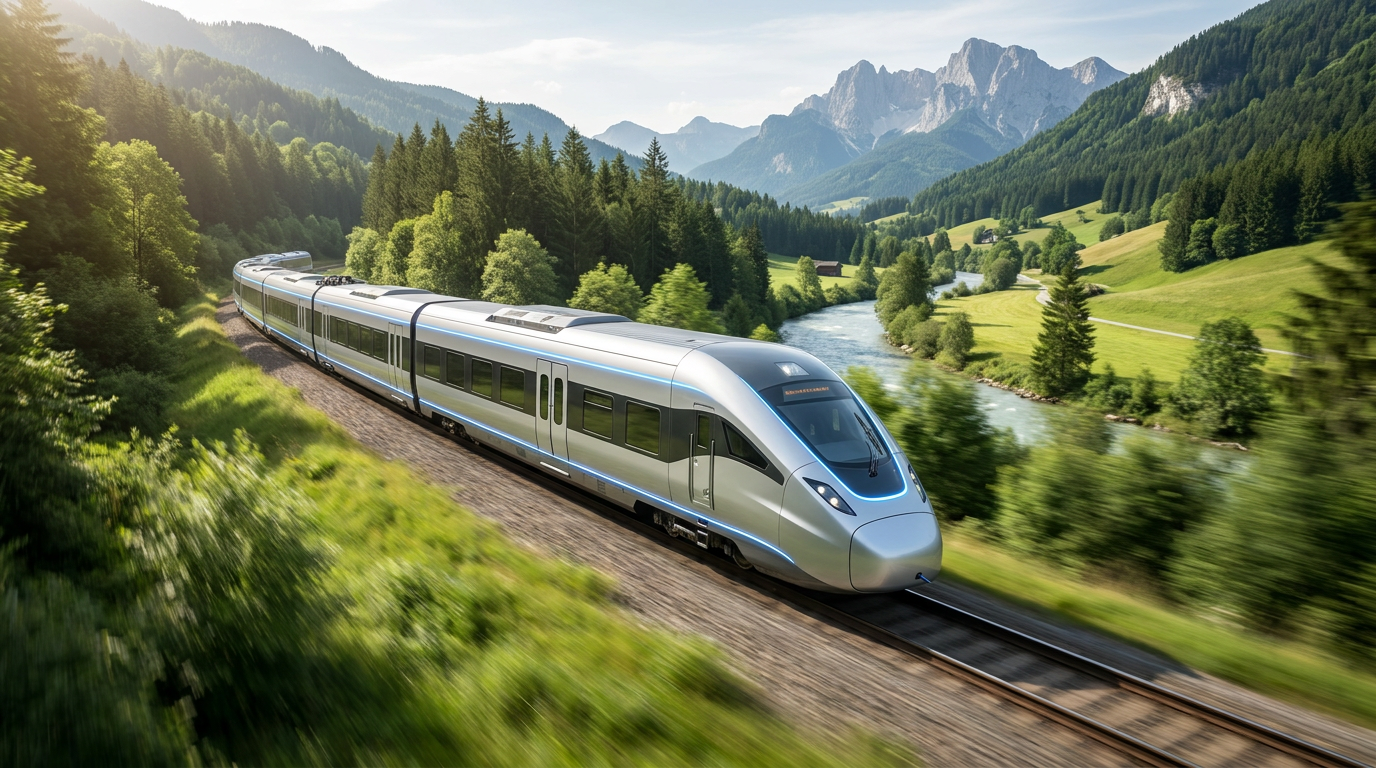
The paradox of modern rail transport is striking: while it is widely celebrated as the poster child for clean mobility, a massive portion of the global network remains tethered to fossil fuels. Across Europe, nearly half of the railway infrastructure is still un-electrified, and in North America, the figure is substantially higher. For decades, the only practical solution for traversing these sprawling, remote regional lines has been the traditional diesel locomotive, which continues to emit significant greenhouse gases and local air pollutants.[3]
However, the aggressive push to achieve net-zero emissions by 2050 has forced a technological reckoning within the rail industry. Electrifying every single mile of track with overhead catenary wires is a prohibitively expensive and logistically daunting task, particularly in rural areas or across difficult terrain. To bridge this critical infrastructure gap, engineers and transit authorities are rapidly turning to two competing zero-emission alternatives: hydrogen fuel cells and battery-electric propulsion systems.[3][5]
The concept of "hydrail"—trains powered entirely by hydrogen—has swiftly transitioned from an experimental prototype to a commercial reality. In a major milestone for the technology, Romania's Railway Reform Authority awarded Siemens Mobility a landmark contract in April 2026 to deliver 12 Mireo Plus H hydrogen trains. This agreement marks one of the first major deployments of hydrogen regional fleets in Eastern Europe, signaling a broader acceptance of the technology beyond its early testing grounds in Germany.[1][6]
To truly understand the appeal of these new trains, it is essential to look at their underlying mechanism. A modern hydrogen train is not simply a traditional combustion engine retrofitted to burn hydrogen gas. Instead, it is fundamentally an electric vehicle that generates its own electricity on board, eliminating the need for continuous overhead power lines while maintaining the smooth, quiet ride of an electric multiple unit.[3][7]
The heart of this system is the fuel cell stack. Inside the cell, hydrogen gas—stored safely in high-pressure tanks on the train's roof—is continuously combined with oxygen drawn from the ambient air. Through a sophisticated electrochemical reaction known as reverse electrolysis, this combination produces a steady electrical current. The only physical byproduct emitted from the train's exhaust is pure, harmless water vapor.[7][8]

The electricity generated by the fuel cell is then fed directly into the train's electric traction motors to drive the wheels. However, rail traction is a highly dynamic process. Trains require massive surges of power to accelerate away from a station or to climb a steep gradient, followed by extended periods of low-power cruising. A fuel cell alone is not ideally suited to handle these rapid fluctuations in power demand.[7]
To manage these intense peaks, hydrogen trains incorporate an onboard energy storage system, typically a high-capacity lithium-ion battery. This hybrid approach allows the battery to absorb excess energy from the fuel cell during low-demand periods. Furthermore, it captures kinetic energy during regenerative braking, deploying it instantly when the train needs a sudden burst of acceleration, thereby improving overall efficiency and reducing wear on the fuel cell.[3][4]
The primary advantage that hydrogen holds over pure battery power is its operational range and rapid refueling speed. A state-of-the-art hydrogen train, such as the Siemens Mireo Plus H, can travel between 800 and 1,200 kilometers on a single tank of fuel. This endurance allows transit operators to run the trains all day on sprawling regional networks without needing to pause for lengthy recharging sessions.[1][2]
The primary advantage that hydrogen holds over pure battery power is its operational range and rapid refueling speed.
This remarkable capability was dramatically demonstrated in March 2024, when Stadler’s FLIRT H2 passenger train, equipped with Ballard fuel cells, set a Guinness World Record. The train traveled an astonishing 2,803 kilometers over 42 hours without a single refueling stop. For rail operators, this means a hydrogen train can seamlessly mimic the operational cadence and turnaround times of the diesel trains they are designed to replace, requiring only about 15 minutes to refuel.[2]
Despite these impressive performance metrics, hydrogen is not universally viewed as a silver bullet. Energy analysts and environmental critics frequently point to the fundamental physics of hydrogen production. Because hydrogen is an energy carrier rather than a primary energy source, it must be manufactured, and the climate benefit of the train depends entirely on how that hydrogen is produced.[3]
If the hydrogen is extracted from fossil fuels—a product known as "grey hydrogen"—the overall climate benefits are severely diluted. True decarbonization requires the use of "green hydrogen," which is produced by splitting water molecules via electrolysis powered entirely by renewable energy sources, such as wind or solar power. Securing a reliable, cost-effective supply of green hydrogen remains a significant hurdle for widespread hydrail adoption.[3][5]
Even when utilizing green hydrogen, the "well-to-wheel" efficiency of the technology is a major point of contention. The multi-step process of converting renewable electricity into hydrogen, compressing it for transport, and then converting it back into electricity inside the train's fuel cell results in substantial energy losses. Critics argue that this cycle is inherently less efficient than using the electricity directly.[3]

This fundamental inefficiency has bolstered the case for the primary alternative: battery-electric multiple units (BEMUs). These trains operate exactly like traditional electric trains when under overhead wires, but they utilize massive onboard batteries to "bridge the gap" and provide power across non-electrified sections of track, offering a highly efficient, direct use of grid electricity.[3]
Because battery trains draw electricity directly from the grid, their overall energy efficiency is substantially higher than the hydrogen cycle. They are considered ideal for routes that are already partially electrified, allowing the train to charge its batteries dynamically while running under the wires, which completely eliminates the need to build separate, expensive hydrogen refueling infrastructure.[3]
However, batteries come with their own severe limitations, primarily regarding weight and energy density. On long, entirely un-electrified routes, the sheer volume of batteries required to complete the journey would be so heavy that it would severely compromise the train's performance, track wear, and passenger capacity, making pure battery power unfeasible for deep rural networks.[4]
The emerging consensus among rail engineers and transit planners is that the future of zero-emission rail is not a winner-take-all battle between the two technologies. A comprehensive 2025 digital modeling study conducted by scientists at the Sapienza University of Rome confirmed that there is no universal solution, and that powertrains must be tailored to specific environments.[4]

The Italian researchers demonstrated that the optimal choice depends entirely on a route's specific topography and operational profile. On short, complex routes with frequent stops and varying gradients, a larger battery component is necessary to capture braking energy and smooth out power fluctuations, making battery-electric or battery-heavy hybrids the logical choice.[4]
Conversely, on long, flat regional corridors where sustained cruising is required and overhead wires are absent, a larger hydrogen fuel cell system is far more effective. The hydrogen provides the necessary endurance, preventing the battery from being rapidly depleted and ensuring stable system operation over vast distances.[4]
Ultimately, the transition away from diesel will require a pragmatic, mosaic approach. As battery chemistry continues to improve and green hydrogen production scales up globally, transit authorities will have a robust, diversified toolkit at their disposal, allowing them to finally decarbonize even the hardest-to-reach corners of the global rail network.[9]
How we got here
2018
Alstom's Coradia iLint, the world's first hydrogen-powered passenger train, enters commercial service in Germany.
March 2024
Stadler's FLIRT H2 sets a Guinness World Record by traveling 2,803 kilometers without refueling.
October 2025
Sapienza University researchers publish a digital model proving hybrid rail systems must be tailored to specific route topographies.
April 2026
Romania awards Siemens Mobility a contract for 12 Mireo Plus H trains, marking a major expansion into Eastern Europe.
Viewpoints in depth
Hydrogen Advocates
Argue that hydrogen is the only viable zero-emission replacement for diesel on long, heavy-duty rail routes.
Proponents of hydrail emphasize that batteries simply cannot match the energy density of diesel fuel. For sprawling regional networks with hundreds of miles of un-electrified track, carrying enough batteries would make the train prohibitively heavy and reduce passenger capacity. Hydrogen, they argue, allows operators to maintain their existing schedules, offering 1,000-kilometer ranges and 15-minute refueling times without the multi-billion-dollar cost of stringing overhead wires across rural landscapes.
Direct Electrification Proponents
Emphasize the energy inefficiency of hydrogen, advocating for direct overhead electrification and battery trains.
Critics of hydrogen point to the undeniable physics of energy conversion. Creating green hydrogen via electrolysis, compressing it, and converting it back to electricity in a fuel cell wastes more than half of the original renewable energy. This camp argues that it is far more efficient to use that electricity directly. They advocate for electrifying as much track as possible and using battery-electric trains (BEMUs) to bridge the remaining gaps, ensuring maximum grid efficiency.
Hybrid Integrators
Believe the optimal solution is a tailored mix of hydrogen and battery technologies depending on route topography.
Engineers and pragmatic transit planners view the debate not as a zero-sum game, but as a toolkit. Digital modeling shows that short, stop-and-go routes with steep gradients benefit immensely from the regenerative braking and high efficiency of batteries. Conversely, long, flat routes where trains cruise for hours are perfectly suited for hydrogen. This camp focuses on integrating both systems, often placing both fuel cells and batteries on the same train to balance power peaks and endurance.
What we don't know
- How quickly the global production of 'green hydrogen' can scale to meet the demands of expanding hydrail fleets.
- Whether future breakthroughs in solid-state battery density will eventually render hydrogen trains obsolete on longer routes.
- The long-term maintenance costs of fuel cell stacks compared to traditional diesel engines over a 30-year operational lifespan.
Key terms
- Hydrail
- A portmanteau of hydrogen and rail, referring to any rail vehicle powered by hydrogen fuel cells.
- Fuel Cell
- A device that generates electricity through an electrochemical reaction between hydrogen and oxygen, producing only water as a byproduct.
- Green Hydrogen
- Hydrogen produced by splitting water molecules using electrolysis powered entirely by renewable energy sources, ensuring a zero-carbon footprint.
- Regenerative Braking
- A mechanism that captures the kinetic energy normally lost during braking and converts it into electricity to recharge onboard batteries.
- BEMU
- Battery-Electric Multiple Unit; a train that can run on power from overhead wires and use onboard batteries to traverse un-electrified sections.
Frequently asked
Are hydrogen trains safe?
Yes. The hydrogen is stored in heavily reinforced, crash-tested tanks on the roof. Because hydrogen is lighter than air, any leak dissipates rapidly upward, unlike diesel fuel which pools on the ground and creates a lasting fire hazard.
Can existing diesel trains be converted to hydrogen?
While retrofitting is technically possible and has been tested, most modern hydrogen trains are purpose-built electric multiple units. This ensures the weight distribution and energy efficiency are optimized for the fuel cell system.
Why not just use batteries for all trains?
Batteries are extremely heavy and have a lower energy density than hydrogen. On long, un-electrified regional routes, carrying enough batteries to complete the journey would make the train too heavy and severely reduce passenger capacity.
Sources
Source coverage
9 outlets
3 viewpoints surfaced









[1]Siemens MobilityHybrid Integrators
Romania awards its first-ever hydrogen contract
Read on Siemens Mobility →[2]Ballard Power SystemsHydrogen Advocates
Hydrogen Trains Undergo Rigorous Testing in Germany and the US
Read on Ballard Power Systems →[3]IlluminemBattery & Electrification Proponents
The Hydrogen Train Debate
Read on Illuminem →[4]Global Energy PrizeHybrid Integrators
Hydrogen trains to replace diesel locomotives?
Read on Global Energy Prize →[5]Fortune Business InsightsBattery & Electrification Proponents
Hydrogen Train Market Size, Share & Industry Analysis
Read on Fortune Business Insights →[6]Railway-NewsHybrid Integrators
Romania Orders 12 Hydrogen Trains from Siemens Mobility
Read on Railway-News →[7]LhyfeHydrogen Advocates
Hydrogen trains explained
Read on Lhyfe →[8]TWI GlobalHydrogen Advocates
How Do Hydrogen Powered Trains Work?
Read on TWI Global →[9]Factlen Editorial TeamHybrid Integrators
Synthesis by Factlen editorial team
Read on Factlen Editorial Team →
Every angle. Every day.
Get automotive stories with full source coverage and perspective breakdowns delivered to your inbox.