
2026 Rivian R2 vs. Tesla Model Y: Comparing the Top Electric SUVs
The highly anticipated 2026 Rivian R2 challenges the refreshed Tesla Model Y 'Juniper' in a battle of off-road utility versus aerodynamic efficiency.
By Factlen Editorial Team
- Utility Seekers
- Buyers who view their vehicle as a tool for hauling gear, family, and outdoor equipment.
- Value & Efficiency Drivers
- Consumers prioritizing low cost of ownership, aerodynamic range, and proven software.
- Performance Enthusiasts
- Drivers focused on 0-60 times, handling dynamics, and track-capable acceleration.
What's not represented
- · Traditional legacy automakers losing market share to both EV startups
- · Urban apartment dwellers reliant entirely on public charging infrastructure
Why this matters
For buyers entering the EV market in 2026, choosing between the Rivian R2 and the Tesla Model Y represents a $45,000 decision that dictates not just their daily commute, but their access to charging networks, cargo flexibility, and weekend adventure capabilities.
Key points
- The 2026 Rivian R2 starts around $45,000, directly targeting the Tesla Model Y's price bracket.
- Rivian's R2 offers 90.1 cubic feet of total cargo space, significantly beating the Model Y's 76 cubic feet.
- The refreshed Tesla Model Y 'Juniper' features improved ride quality and aerodynamic efficiency.
- Both vehicles are expected to offer over 300 miles of range in their long-range configurations.
- The R2 boasts 9.6 inches of ground clearance compared to the Model Y's 6.0 inches, making it far more trail-capable.
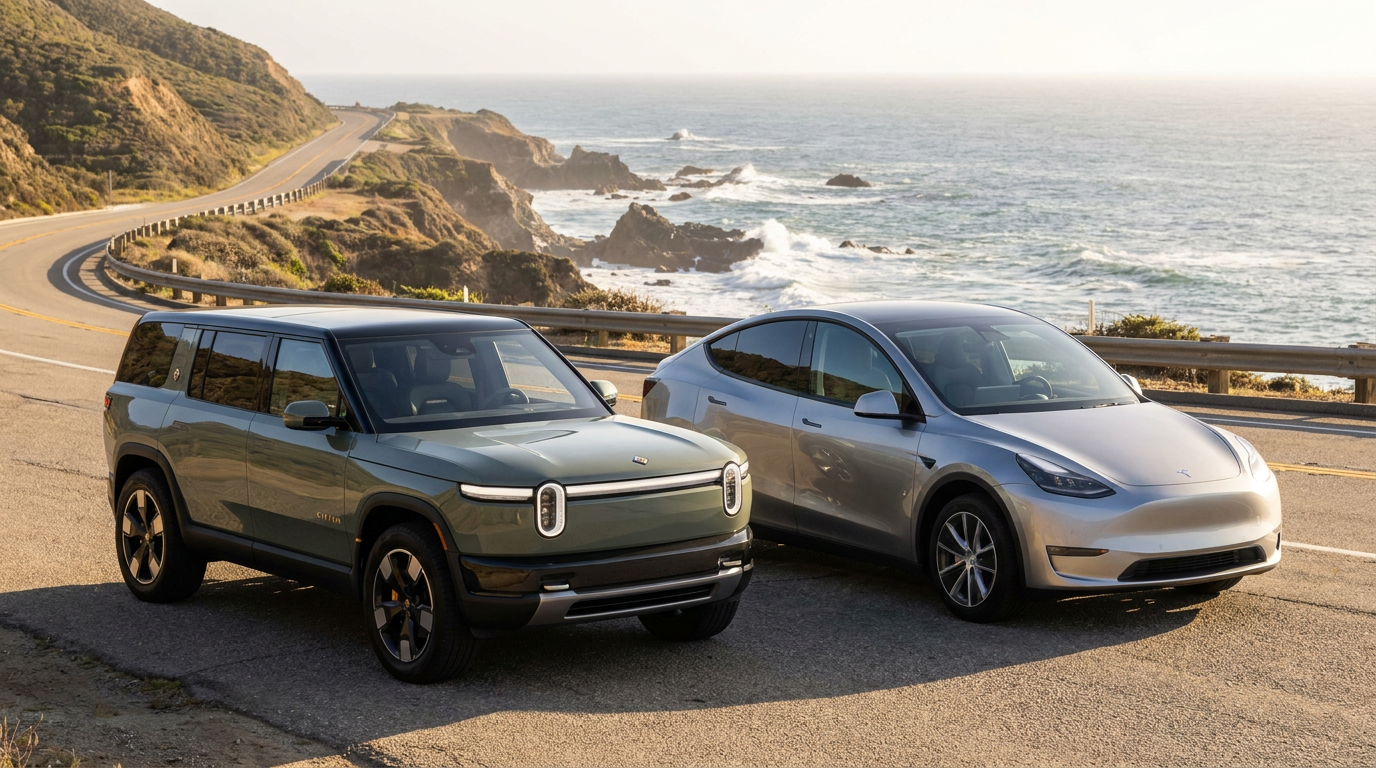
The mid-size electric SUV market in 2026 is defined by a heavyweight title fight. Tesla's refreshed Model Y, dubbed the "Juniper" update, faces its most formidable challenger yet: the all-new Rivian R2. For years, the Model Y has dominated the global sales charts, offering a blend of range, software, and charging convenience that legacy automakers struggled to match. Now, Rivian is stepping downmarket from its flagship R1 series to offer a highly capable, $45,000 compact SUV that directly targets Tesla's bread and butter, giving consumers a genuine alternative.[1][2]
The stakes for consumers are massive. Choosing between these two vehicles represents a foundational decision about how a driver interacts with the electric future. The Model Y represents the aerodynamic, frictionless, tech-forward approach that made Tesla an automotive juggernaut. The Rivian R2, conversely, leans heavily into rugged utility, boxy aesthetics, and off-road capability. Both vehicles aim to hit the exact sweet spot for American buyers, but they go about solving the family transportation equation in fundamentally different ways, forcing buyers to weigh their actual daily needs against their weekend aspirations.[1][3]
Pricing is the primary battleground where these two electric crossovers will compete for driveway space. The 2026 Tesla Model Y starts at an aggressive $41,630 for the base Rear-Wheel Drive model, with the Long Range All-Wheel Drive variant coming in around $50,630. Rivian has priced the R2 to compete directly, with an expected starting MSRP of roughly $45,000 for its single-motor standard battery configuration. Both vehicles are manufactured in the United States and are expected to qualify for the $7,500 federal EV tax credit, making them highly accessible to the mass market and keeping monthly payments competitive.[1][6][7]

When it comes to range and efficiency, the numbers are remarkably close, though they are achieved through entirely different engineering philosophies. The Tesla Model Y Long Range boasts an EPA-estimated 321 miles on standard 18-inch wheels, utilizing its teardrop shape to slip effortlessly through the air. The Rivian R2, despite its blunt front fascia and taller, more aggressive stance, manages to extract an estimated 300 to 330 miles of range depending on the specific battery and motor configuration chosen by the buyer.[1][4][7]
Surprisingly, the Rivian R2 Performance actually edges out the Model Y Performance in official EPA efficiency ratings. The R2 achieves a 109 MPGe combined rating, making it about five percent more efficient than the Model Y Performance's 104 MPGe. This is a remarkable engineering feat by Rivian's development team, considering the R2 is roughly 370 pounds heavier, three inches taller, and pushes a much less aerodynamic, brick-like shape through the wind compared to the sleek Tesla. This efficiency proves that Rivian has mastered battery management and motor optimization, ensuring that buyers do not have to sacrifice daily driving range just to get a vehicle that looks like a traditional off-roader.[3]
Charging infrastructure, once considered Tesla's ultimate competitive moat, has been effectively neutralized in this matchup. The 2026 Rivian R2 natively supports the North American Charging Standard (NACS) right out of the factory. This means Rivian drivers can pull up to almost any Tesla Supercharger and plug in without a cumbersome adapter, enjoying the same seamless, plug-and-charge experience that Model Y owners have relied on for years. Both vehicles can charge their battery packs from 10 to 80 percent in roughly 30 minutes at a high-speed DC fast charger, making road trips equally viable for either camp.[1][5][8]
Straight-line performance remains a hallmark of both brands, proving that family SUVs can still deliver exhilarating acceleration. The Tesla Model Y Performance, utilizing the upgraded rear motor from the new Model 3, delivers a staggering 461 kilowatts of power and sprints from zero to 60 mph in just 3.5 seconds. Rivian answers back with a tri-motor setup in its top-tier R2 Performance Launch Edition, pushing out 656 horsepower and 609 pound-feet of torque, completing the zero to 60 mph dash in a nearly identical 3.6 seconds.[4][8]

Straight-line performance remains a hallmark of both brands, proving that family SUVs can still deliver exhilarating acceleration.
Where the two vehicles diverge sharply is in their physical dimensions and off-road geometry. The Rivian R2 boasts a towering 9.6 inches of ground clearance, representing a massive 60 percent increase over the Model Y's 6.0 inches. Combined with a 25-degree approach angle and a 26-degree departure angle, the R2 is genuinely trail-capable right off the showroom floor. The Model Y, while perfectly competent on gravel driveways or snowy suburban streets, is fundamentally designed for pavement and lacks the suspension travel required for serious overlanding.[3][4]
This boxy, upright design pays massive dividends when it comes to interior packaging and cargo hauling. The Rivian R2 offers 90.1 cubic feet of total cargo space when the rear seats are folded, which includes a spacious 5.2 cubic foot front trunk. This represents a 19 percent increase over the Model Y's 76 cubic feet of total storage. Furthermore, the R2 features fold-flat seats in both the first and second rows, effectively transforming the cabin into a cavernous cargo van or a completely flat sleeping surface for weekend car camping.[3][4][6]
The Tesla Model Y counters with a slightly longer overall body and a highly refined, minimalist interior. The highly anticipated 'Juniper' update brings significant improvements to ride quality, utilizing an adaptive suspension system with electronic continuous damping to resolve the harsh ride complaints that plagued earlier models. The cabin remains ultra-minimalist, centered entirely around a 15.4-inch touchscreen, but now features wrap-around ambient lighting, ventilated seats, and improved acoustic glass for a noticeably quieter highway driving experience. These refinements make the Model Y feel more like a luxury vehicle than a stark tech appliance, appealing heavily to buyers who prioritize comfort during their daily commute.[2][7][8]

Rivian's interior takes a distinctly different approach, described by the company as 'nature-inspired minimalism.' It features a large 15.6-inch central display, but retains a more traditional premium feel with physical stalks on the steering column and tactile materials throughout the cabin. The R2 also includes unique lifestyle features, such as a power-retractable rear window that drops completely into the tailgate. This allows for the easy transport of extra-long items like surfboards or lumber, while simultaneously enhancing open-air airflow through the cabin on warm days.[2][5][6]
In a direct trade-off analysis, the arguments for the Rivian R2 center squarely on its superior utility and ruggedness. The case for the R2 highlights its massive 90.1 cubic feet of cargo space, its 9.6 inches of ground clearance, and its highly versatile fold-flat seating arrangement. The arguments against the R2 involve its unproven long-term reliability compared to the legacy Model Y, and the reality that its boxy shape may suffer more severe range degradation at high highway speeds. The evidence shows that for buyers who prioritize outdoor adventure and gear-hauling, the R2's physical geometry is objectively superior.[3][4][6]
Conversely, the arguments for the Tesla Model Y are built on its proven track record, aerodynamic efficiency, and software maturity. The case for the Model Y emphasizes its lower starting price, its slightly faster charging curve, and its highly refined software ecosystem, including the controversial but technologically advanced Full Self-Driving suite. The arguments against the Model Y highlight its complete lack of off-road capability and its ubiquitous, somewhat aging exterior design. The evidence points to the Model Y being the ultimate frictionless commuter vehicle, optimized for paved roads, maximum energy efficiency, and ease of use.[1][7][8]

Ultimately, the Rivian R2 fits well when a buyer needs a vehicle that doubles as an adventure tool. It is the superior choice for families who frequently camp, haul large dogs, transport bulky sports equipment, or regularly navigate deep snow and unpaved trails. The R2's boxy dimensions and clever storage solutions make it a highly practical substitute for a traditional gas-powered SUV. It does not fit well when a buyer prioritizes the absolute lowest purchase price, or when they desire the sports-car-like handling and aerodynamic efficiency of a lower-slung crossover.[3][4][5]
The Tesla Model Y fits well when a buyer wants the most streamlined, proven electric vehicle experience currently on the market. It excels as a daily commuter, offering a quiet, comfortable ride, exceptional highway efficiency, and a software interface that remains the undisputed industry benchmark. It is the logical choice for drivers who stick to the pavement and want maximum range per dollar spent. It does not fit well when a buyer needs to traverse rocky terrain, requires maximum vertical cargo space, or simply wants to stand out in a sea of identical aerodynamic crossovers.[1][7][8]
How we got here
Early 2023
Tesla Model Y becomes the world's best-selling vehicle, dominating the EV crossover market.
March 2024
Rivian officially unveils the R2, promising a $45,000 starting price and over 300 miles of range.
Late 2025
Tesla rolls out the 'Juniper' update for the Model Y, featuring refreshed styling and improved suspension.
Spring 2026
First deliveries of the high-performance Rivian R2 Launch Edition begin.
Viewpoints in depth
Off-Road Enthusiasts
Buyers prioritizing trail capability and rugged utility.
This camp heavily favors the Rivian R2 due to its 9.6 inches of ground clearance, 25-degree approach angle, and boxy design that maximizes gear storage. They argue that the Model Y, while competent on dirt roads, lacks the geometry and suspension travel required for genuine overlanding or deep snow.
Efficiency Maximizers
Drivers focused on aerodynamic range, charging speed, and proven reliability.
Efficiency advocates lean toward the Tesla Model Y, citing its teardrop shape and industry-leading energy management. They point to the Model Y's lower starting price and native integration with the Supercharger network as evidence that it remains the most frictionless EV ownership experience available.
What we don't know
- Exact real-world delivery timelines for the base $45,000 Rivian R2 trim.
- How the Rivian R2's real-world highway efficiency will suffer compared to the aerodynamic Model Y at speeds over 75 mph.
Key terms
- NACS
- North American Charging Standard, the charging connector originally developed by Tesla and now adopted by Rivian and other automakers.
- MPGe
- Miles Per Gallon Equivalent, a metric used by the EPA to compare the energy efficiency of electric vehicles to gas-powered cars.
- Frunk
- A front trunk, utilizing the space where a traditional internal combustion engine would normally sit, providing extra enclosed storage.
Frequently asked
Will the Rivian R2 use Tesla Superchargers?
Yes, the Rivian R2 is designed to support the NACS charging standard natively, granting it access to the vast majority of the Tesla Supercharger network without an adapter.
Which SUV has more cargo space?
The Rivian R2 offers significantly more cargo capacity, with 90.1 cubic feet of total storage (including the frunk) compared to the Model Y's 76 cubic feet.
Are both vehicles eligible for the federal tax credit?
Both the Rivian R2 and Tesla Model Y are built in the United States and are expected to qualify for the $7,500 federal EV tax credit, depending on final battery sourcing rules.
Sources
Source coverage
8 outlets
3 viewpoints surfaced








[1]Motor DostValue & Efficiency Drivers
Rivian R2 vs Tesla Model Y 2026: Range, Price, AWD
Read on Motor Dost →[2]TrueCarValue & Efficiency Drivers
2026 Rivian R2 Review | Pricing, Trims & Photos
Read on TrueCar →[3]ElectrekUtility Seekers
Rivian R2 vs Tesla Model Y spotted side-by-side: Detailed size comparison
Read on Electrek →[4]CarBuzzUtility Seekers
All The Ways The Rivian R2 Performance Beats Tesla's Top Model Y
Read on CarBuzz →[5]AutoblogUtility Seekers
2026 Rivian R2 Performance vs. 2026 Tesla Model Y: Which Crossover EV Should You Choose?
Read on Autoblog →[6]Kelley Blue BookUtility Seekers
2026 Rivian R2 Price, Pictures, Release Date & More
Read on Kelley Blue Book →[7]Car and DriverValue & Efficiency Drivers
2026 Tesla Model Y Review, Pricing, and Specs
Read on Car and Driver →[8]CarSaucePerformance Enthusiasts
2026 Tesla Model Y Performance Review
Read on CarSauce →

Every angle. Every day.
Get automotive stories with full source coverage and perspective breakdowns delivered to your inbox.