
The Rise of Precision Nutrition: How AI, CGMs, and Microbiome Data Are Replacing the 'One-Size-Fits-All' Diet
Advances in wearable technology, microbiome sequencing, and artificial intelligence are ushering in an era of personalized nutrition. By tracking individual biological responses to food, this data-driven approach promises to optimize metabolic health, though experts caution that the science is still evolving.
By Factlen Editorial Team
- Digital Health Advocates
- Believe that real-time data and AI-driven insights empower individuals to optimize their health and prevent chronic disease.
- Clinical Skeptics
- Warn that using medical devices like CGMs in healthy populations lacks long-term evidence and risks inducing anxiety.
- Public Health Traditionalists
- Argue that hyper-personalized tech solutions distract from the broader societal need to fix the ultra-processed food environment.
- Nutritional Scientists
- Focus on validating the biological mechanisms of gene-diet interactions while acknowledging the need for more rigorous trials.
What's not represented
- · Low-income populations unable to afford out-of-pocket wearable tech
- · Primary care physicians managing the influx of patient-generated health data
Why this matters
As chronic metabolic diseases continue to rise, precision nutrition offers a proactive, evidence-based way to understand exactly how your body reacts to food. By moving away from generic advice, individuals can make targeted dietary changes that directly improve their daily energy, longevity, and overall health.
Key points
- Precision nutrition uses DNA, microbiome data, and real-time glucose monitoring to tailor dietary advice to individual biology.
- Continuous glucose monitors (CGMs) are increasingly used by non-diabetics to track how specific foods impact their blood sugar.
- Studies show personalized nutrition interventions lead to better dietary adherence and improved metabolic markers compared to generic advice.
- Clinical experts warn that without professional guidance, wearable health data can lead to unnecessary food restriction and anxiety.
For decades, public health authorities have relied on a universal playbook for healthy eating: consume more vegetables, prioritize whole grains, and limit saturated fats. Yet, a growing body of evidence suggests that this one-size-fits-all approach is fundamentally flawed. Two people can eat the exact same bowl of oatmeal; one might experience sustained energy, while the other suffers a rapid blood sugar spike followed by a lethargic crash.[1][5]
This biological reality is driving the rapid rise of "precision nutrition," an emerging medical and wellness paradigm that tailors dietary recommendations to an individual's unique genetic makeup, gut microbiome, and real-time metabolic data. Rather than relying on population averages, precision nutrition leverages artificial intelligence to analyze vast, multi-dimensional datasets, creating highly targeted eating plans designed to optimize metabolic health and prevent chronic disease.[3][7]
The shift from generalized advice to computational nutrition represents a turning point in dietary science. By integrating biological measures with lifestyle and environmental factors, researchers are beginning to predict individual dietary responses with unprecedented accuracy. This data-driven approach promises to empower consumers, offering a sense of control over their health through actionable, personalized feedback.[3][4][6][9]
At the core of precision nutrition are three biological domains: genomics, microbiomics, and metabolomics. Genomics examines how natural variations in our DNA—known as single nucleotide polymorphisms—influence how our bodies process specific nutrients and manage inflammation. While our genetics remain static, they provide the baseline blueprint for our metabolic potential and predispositions.[4][7]

The second domain, the gut microbiome, is highly dynamic and acts as the crucial interface between the food we eat and our host metabolism. The trillions of bacteria residing in the digestive tract dictate how we extract energy from food and produce essential compounds like short-chain fatty acids, which regulate satiety hormones. Microbiome-informed nutrition suggests that individuals with low microbial diversity might require specific prebiotic or fermented foods to optimize their metabolic response.[4][7]
The third pillar, metabolomics, provides a real-time readout of the body's biochemical state. This is where wearable technology, specifically the continuous glucose monitor (CGM), has revolutionized the field. Originally designed as a critical, life-saving tool for managing diabetes, CGMs have rapidly migrated into the mainstream wellness market, allowing metabolically healthy individuals to track their blood sugar fluctuations 24 hours a day.[2][4][8]
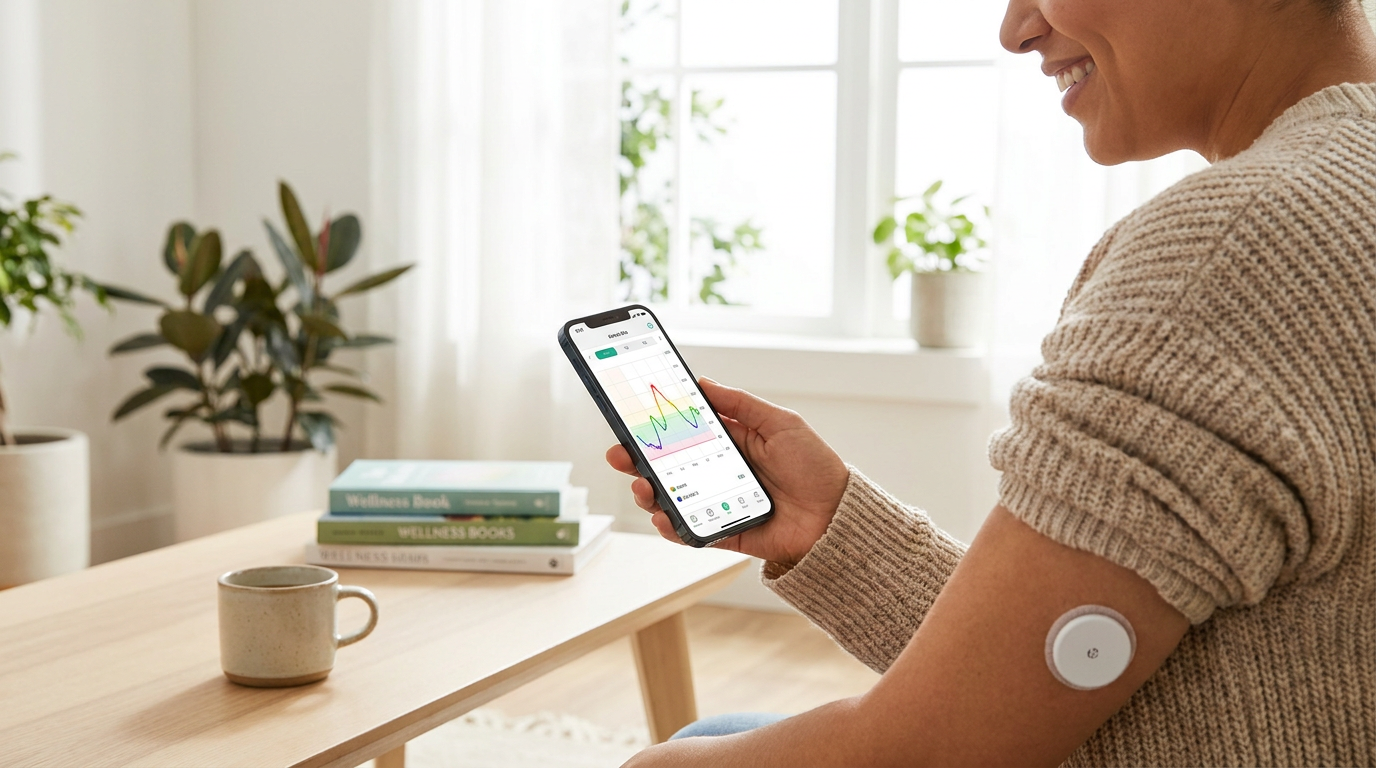
A CGM is a small, waterproof sensor typically worn on the back of the upper arm for up to 14 days. It measures glucose levels in the interstitial fluid—the fluid between cells just under the skin—transmitting readings to a smartphone app every few minutes. For non-diabetics, the primary value of a CGM lies in identifying subclinical glycemic patterns and revealing the dramatic variation in individual postprandial, or post-meal, glucose responses.[1][8]
A CGM is a small, waterproof sensor typically worn on the back of the upper arm for up to 14 days.
Recent exploratory clinical trials have demonstrated just how varied these responses can be. In healthy young adults subjected to controlled dietary challenges, high-carbohydrate meals produced average glucose peaks of over 160 mg/dL, with significant interpersonal differences. Wearable data can also reveal phenomena like the "dawn effect"—a natural, hormone-driven rise in early morning blood sugar that can be amplified in individuals with early insulin resistance.[8]

Proponents argue that this granular data is far more effective at driving behavioral change than generic advice. When people can literally see a specific food causing a massive glucose spike on their smartphone screen, they are highly motivated to adjust their habits—perhaps by taking a 20-minute walk after a meal, which has been shown to significantly reduce insulin levels and blunt the glucose peak.[8]
Large-scale studies support the efficacy of this personalized approach. Research involving thousands of participants has shown that individuals who receive personalized nutrition interventions—based on their unique biological data—are significantly more likely to improve their overall diet quality compared to those receiving standard guidelines. These tailored programs consistently lead to reduced consumption of red meat and refined carbohydrates, alongside improvements in metabolic markers like triglycerides and insulin sensitivity.[5]

However, the mainstream adoption of precision nutrition and wearable sensors is not without controversy. Clinical experts caution that while CGMs are strongly evidence-based for diabetes care, their use in the general, healthy population remains experimental. Unlike diabetes management, there are currently no established clinical protocols or universally accepted guidelines for interpreting CGM data in non-diabetics.[6]
This lack of standardization raises concerns about data misinterpretation and health anxiety. Blood glucose naturally fluctuates throughout the day in response to food, exercise, stress, and hormonal changes. Without professional guidance from a credentialed dietitian or physician, users may panic over normal physiological responses, leading to obsessive tracking, unnecessary stress, and the over-restriction of otherwise healthy foods.[2][6][8]
Similar limitations apply to commercial microbiome testing. While the science linking gut bacteria to health is robust, there are currently no universally accepted definitions of a "perfect" or "healthy" microbiome composition. The gut microbiota is massive and constantly shifting, making one-off stool tests difficult to interpret in a strict medical context without broader clinical correlation.[6]
Furthermore, some public health advocates argue that the intense focus on hyper-personalized, high-tech nutrition is a distraction from the root causes of the modern metabolic crisis. They contend that while precision nutrition is scientifically fascinating, it is unrealistic to view it as a broad public health solution in a society dominated by ultra-processed foods and systemic barriers to healthy eating.[1]

Despite these valid critiques, the trajectory of nutritional science is unmistakably moving toward personalization. As artificial intelligence continues to improve its ability to synthesize multi-omics data, the algorithms predicting our individual responses to food will only become more accurate.[3][4][9]
In 2026, the integration of digital health platforms and biological testing is transitioning from a niche biohacking trend to a recognized, albeit evolving, clinical tool. For individuals willing to invest in the data and work alongside healthcare professionals to interpret it, precision nutrition offers a powerful, evidence-based roadmap to optimize energy, performance, and long-term metabolic health.[4][7][9]
How we got here
2015
A landmark study by the Weizmann Institute demonstrates massive interpersonal variability in blood glucose responses to identical foods.
2020
Researchers publish major findings linking individual postprandial responses to genetics, microbiome composition, and lifestyle.
2024
The FDA approves the first over-the-counter continuous glucose monitors for non-diabetic individuals.
2025
Systematic reviews confirm that personalized nutrition interventions consistently improve dietary quality and metabolic markers over generalized advice.
Viewpoints in depth
Digital Health Advocates
Believe that real-time data and AI-driven insights empower individuals to optimize their health and prevent chronic disease.
This camp, driven by health-tech startups and personalized nutrition platforms, argues that the era of generalized dietary guidelines has failed to curb the metabolic disease epidemic. They point to massive interpersonal variability in how bodies process identical foods, asserting that tools like CGMs and microbiome sequencing are essential for true optimization. By providing immediate, actionable feedback, they believe these technologies drive sustainable behavioral change far better than abstract advice.
Clinical Skeptics
Warn that using medical devices like CGMs in healthy populations lacks long-term evidence and risks inducing anxiety.
Medical professionals in this camp emphasize that devices like CGMs were rigorously tested and approved for managing diabetes, not for general wellness optimization. They caution that healthy bodies naturally experience glucose fluctuations, and without clinical protocols, users may misinterpret these normal spikes as pathological. This group worries that the gamification of biological data can lead to orthorexia, unnecessary food restriction, and heightened health anxiety without delivering proven long-term cardiovascular benefits.
Public Health Traditionalists
Argue that hyper-personalized tech solutions distract from the broader societal need to fix the ultra-processed food environment.
For these experts, the focus on individual genetic and metabolic optimization misses the forest for the trees. They argue that the primary drivers of modern chronic disease are systemic: the ubiquity of ultra-processed foods, food deserts, and socioeconomic disparities. From this viewpoint, precision nutrition is a luxury solution for the worried well, offering marginal gains while ignoring the fundamental environmental factors that shape public health.
What we don't know
- Whether the short-term behavioral changes driven by CGM use in healthy individuals translate into long-term reductions in cardiovascular disease.
- The exact definition of an 'optimal' gut microbiome, as microbial diversity is massive and constantly shifting.
- How to scale precision nutrition technologies to make them accessible and affordable for lower-income populations most at risk for metabolic disease.
Key terms
- Precision Nutrition
- A medical and dietary approach that tailors nutritional recommendations to an individual's unique biology, genetics, and lifestyle.
- Metabolomics
- The large-scale study of small molecules (metabolites) within cells, biofluids, tissues, or organisms, providing a real-time readout of biochemical activity.
- Interstitial Fluid
- The fluid found in the spaces around cells, which is where continuous glucose monitors measure sugar levels rather than directly in the blood.
- Postprandial Glucose
- The measurement of blood sugar levels occurring after a meal, a key metric for understanding how the body processes specific foods.
- Dawn Effect
- A natural, hormone-driven rise in blood sugar that occurs in the early morning hours to prepare the body for waking.
Frequently asked
What is a continuous glucose monitor (CGM)?
A CGM is a small wearable sensor, typically attached to the upper arm, that measures glucose levels in the interstitial fluid just under the skin and transmits the data to a smartphone.
Do I need a prescription to get a CGM?
While traditionally requiring a prescription for diabetes management, the FDA approved the first over-the-counter CGMs for metabolically healthy individuals in 2024.
Can a personalized diet cure metabolic diseases?
While not a cure, personalized nutrition interventions have been shown to significantly improve dietary adherence, insulin sensitivity, and overall metabolic markers compared to standard dietary advice.
Why does the gut microbiome matter for nutrition?
The trillions of bacteria in your digestive tract act as an interface between food and your body, dictating how you extract energy and produce hormones that regulate appetite and metabolism.
Sources
Source coverage
9 outlets
4 viewpoints surfaced




[1]The Washington PostPublic Health Traditionalists
Can personalized nutrition and CGMs make a real dent in obesity and disease?
Read on The Washington Post →[2]The BMJClinical Skeptics
The wellness inspired rise of continuous glucose monitors for people without diabetes
Read on The BMJ →[3]Institute of Food TechnologistsNutritional Scientists
Precision Technologies: How genetics, wearables, and AI are advancing precision nutrition
Read on Institute of Food Technologists →[4]National Institutes of HealthNutritional Scientists
Digital Health Technologies and Precision Medicine in Personalized Weight Management
Read on National Institutes of Health →[5]ZOEDigital Health Advocates
What is personalized nutrition, and does it work?
Read on ZOE →[6]Mather HospitalClinical Skeptics
Precision Nutrition: Proceed with Caution
Read on Mather Hospital →[7]Premium Medical CircleDigital Health Advocates
Personalized Nutrition: How DNA, Microbiome & Technology Are Revolutionizing Health
Read on Premium Medical Circle →[8]Pravida HealthDigital Health Advocates
CGM for Non-Diabetics: What the Data Reveals
Read on Pravida Health →[9]Factlen Editorial TeamNutritional Scientists
Synthesis by Factlen editorial team
Read on Factlen Editorial Team →

Every angle. Every day.
Get food drink stories with full source coverage and perspective breakdowns delivered to your inbox.