
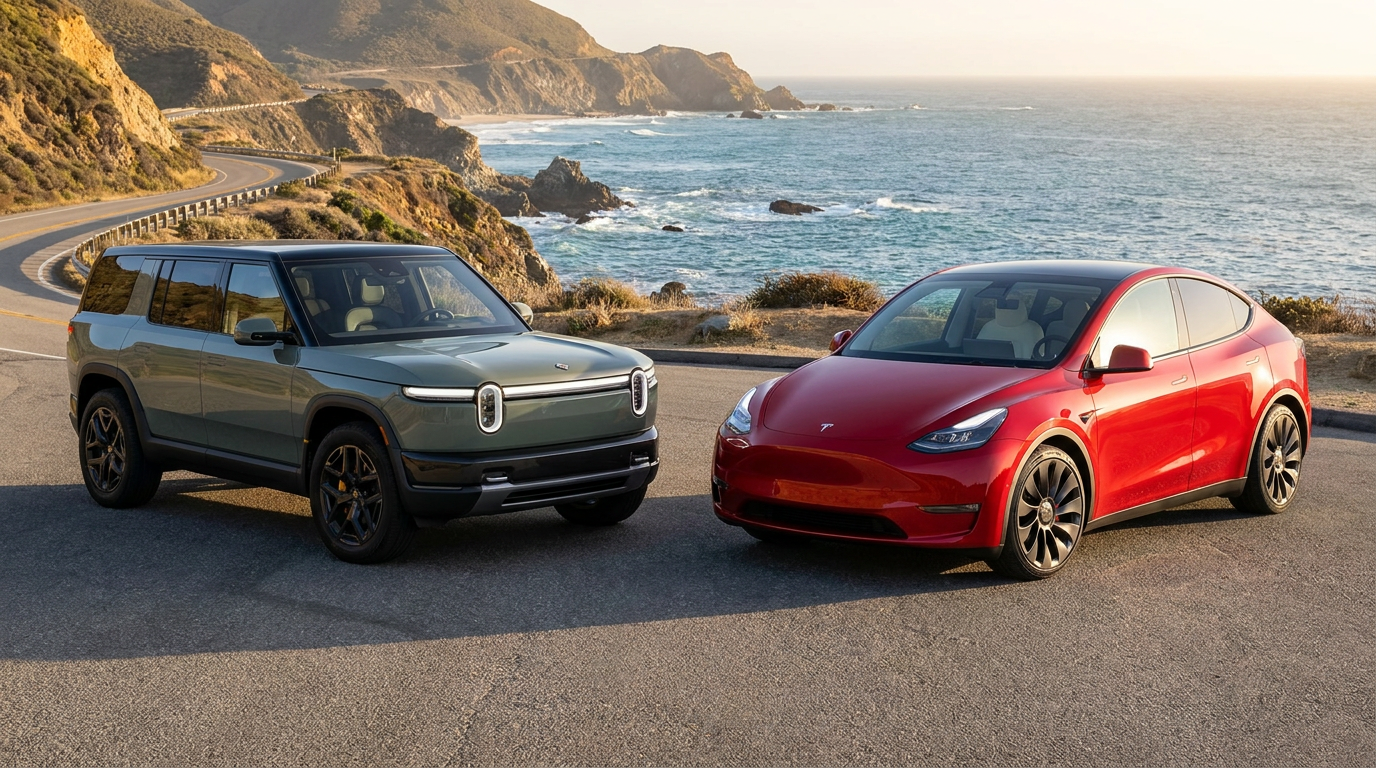
2026 Rivian R2 vs. Tesla Model Y Juniper: Comparing the Next Generation of Electric SUVs
As Rivian launches its highly anticipated R2 SUV, it faces off against Tesla's newly refreshed 'Juniper' Model Y in a battle of rugged utility versus aerodynamic efficiency.
By Factlen Editorial Team
- Efficiency & Value Seekers
- Focus on aerodynamic range, lower starting prices, and on-road handling.
- Utility Maximizers
- Prioritize cargo space, ground clearance, and off-road capability.
- Tech & Design Reviewers
- Evaluate the software experience, interior materials, and overall aesthetic.
What's not represented
- · Traditional auto dealership networks
- · Legacy automakers losing market share to both brands
Why this matters
For buyers entering the electric vehicle market in 2026, the midsize crossover segment is the most competitive it has ever been. Choosing between the R2 and the Model Y dictates whether you prioritize outdoor versatility and cargo space or aerodynamic efficiency and a lower starting price.
Key points
- The 2026 Rivian R2 and refreshed Tesla Model Y represent two distinct approaches to the electric crossover market.
- Rivian's R2 prioritizes rugged utility, offering 90.1 cubic feet of cargo space and 9.6 inches of ground clearance.
- Tesla's updated Model Y focuses on aerodynamic efficiency, achieving a 0.22 drag coefficient and a lower $39,990 starting price.
- Both vehicles now utilize the North American Charging Standard (NACS), providing equal access to Tesla's Supercharger network.
The midsize electric crossover segment has reached a new boiling point in 2026. For years, the Tesla Model Y has been the default choice for buyers seeking an electric family hauler. However, the landscape shifted dramatically this spring with the launch of the Rivian R2, a smaller, more affordable sibling to the flagship R1S. Simultaneously, Tesla rolled out its highly anticipated "Juniper" refresh for the Model Y, bringing crucial updates to its suspension, cabin noise, and aerodynamics. This sets up a fascinating showdown between two distinct automotive philosophies: Rivian's rugged, adventure-focused utility versus Tesla's hyper-efficient, street-oriented refinement.[2][5]
The case for the Rivian R2 centers entirely on its unmatched versatility and outdoor capability. Designed with a boxy, traditional SUV silhouette, the R2 is built for buyers who view their vehicle as a basecamp for adventure rather than just a commuter pod. It prioritizes ground clearance, tactile interior luxury, and clever storage solutions over aerodynamic sleekness. Rivian has engineered the cabin to maximize usable space, ensuring that both rows of seats fold completely flat to accommodate camping gear, large cargo, or even an inflatable mattress for overnight stays off the grid.[3][4]
The case against the Rivian R2 revolves around its initial pricing and its physical footprint. While Rivian promises a base model starting around $45,000, that version will not arrive until 2027. For buyers shopping in 2026, the only available option is the top-tier Performance Launch Edition, which carries a steep $57,990 price tag. Furthermore, the R2's boxy design makes it nearly 800 pounds heavier than the Model Y, resulting in a vehicle that feels less nimble on winding roads and requires more energy to push through the air at highway speeds.[2][6]
The evidence supporting the R2's utility is heavily quantified in its dimensions. The SUV boasts an impressive 9.6 inches of ground clearance and a 115.6-inch wheelbase, giving it superior approach and departure angles for off-road trails. Inside, the R2 offers a massive 90.1 cubic feet of total storage space, significantly aided by a 5.2-cubic-foot front trunk. Additionally, the R2 features a unique roll-down rear window that, when combined with the fold-flat seats, allows drivers to easily transport oversized items like surfboards or lumber without leaving the tailgate open.[3][4]

Conversely, the case for the 2026 Tesla Model Y "Juniper" rests on its aerodynamic efficiency, immediate affordability, and refined on-road dynamics. Tesla's recent updates directly addressed the vehicle's historical weaknesses, introducing acoustic glass and frequency-response dampers to create a dramatically quieter and smoother ride. The Model Y is engineered to be the ultimate highway cruiser, offering a sports-sedan handling profile that makes it genuinely fun to drive on paved roads.[2][5]
Conversely, the case for the 2026 Tesla Model Y "Juniper" rests on its aerodynamic efficiency, immediate affordability, and refined on-road dynamics.
The case against the Model Y highlights its polarizing minimalist design choices and its lack of rugged capability. The Juniper update controversially removed the steering column stalks, forcing drivers to use haptic steering wheel buttons for turn signals and the touchscreen for gear selection. Furthermore, its sloping roofline and lower stance make it far less practical for off-road excursions, and its "egg-like" crossover aesthetic lacks the traditional SUV presence that many American buyers still crave.[4][5]
The evidence for the Model Y's dominance is clear in its pricing and aerodynamic metrics. The 2026 rear-wheel-drive base model starts at a highly accessible $39,990, making it nearly $18,000 cheaper than the currently available Rivian R2. The Juniper refresh also achieved a remarkable drag coefficient of 0.22, allowing the Long Range AWD version to squeeze up to 330 miles out of a relatively compact battery pack. However, its total cargo capacity tops out at roughly 76 cubic feet, noticeably less than its Rivian rival.[2][5]
When comparing top-tier performance, the two vehicles overlap surprisingly well, proving that utility does not have to come at the expense of speed. The $57,990 Rivian R2 Performance delivers a staggering 656 horsepower, launching the heavy SUV to 60 mph in just 3.6 seconds while achieving an EPA-estimated 330 miles of range. The similarly priced Model Y Performance counters with a slightly faster 3.3-second sprint to 60 mph, though its range drops to 306 miles. Remarkably, despite the Rivian's heavier weight and boxier shape, EPA data shows the R2 Performance matches the Model Y Performance in overall energy efficiency at 105 MPGe, a testament to Rivian's battery management software.[1][6]

Inside the cabin, the technological philosophies diverge sharply. Rivian offers a 12.3-inch digital gauge cluster directly in front of the driver, complemented by open-pore wood accents and a 15.6-inch central display. Tesla, meanwhile, relies entirely on a single 15.4-inch central screen for all instrumentation and controls, creating a stark, buttonless environment. Fortunately, the charging landscape has leveled out; the Rivian R2 natively incorporates the North American Charging Standard (NACS) port, granting both vehicles seamless, adapter-free access to Tesla's expansive Supercharger network.[2][4]
Ultimately, the Rivian R2 fits well when a buyer prioritizes outdoor capability, needs maximum cargo volume for bulky gear, and prefers a traditional, boxy SUV aesthetic with tactile interior luxury. It is the definitive choice for drivers who frequently navigate rough terrain or want the ability to sleep comfortably in the back of their vehicle. It does not fit well when the budget is strictly under $50,000 in 2026, or when maximum on-road agility and sports-car handling are the primary goals.[2][3]

The Tesla Model Y fits well when a buyer wants immediate delivery at a sub-$40,000 price point, values hyper-efficient highway cruising, and prefers a sleek, aerodynamic design. It remains the logical choice for urban and suburban families who prioritize a quiet cabin, cutting-edge driver assistance software, and the option to add a small third row for seven-passenger capacity. It does not fit well when the driver requires serious off-road ground clearance, needs to haul oversized outdoor equipment, or strongly dislikes stalkless steering wheels and purely touchscreen-based controls.[4][5]
How we got here
March 2024
Rivian officially unveils the R2 platform, targeting a smaller footprint and lower price.
Late 2025
Tesla begins rolling out the 'Juniper' refresh for the Model Y in international markets.
Spring 2026
Rivian begins initial customer deliveries of the $57,990 R2 Performance Launch Edition.
Summer 2027
Rivian is scheduled to release the base $44,990 standard range R2.
Viewpoints in depth
Outdoor Enthusiasts
Drivers who prioritize off-road capability and gear hauling.
This camp heavily favors the Rivian R2. They point to the 9.6 inches of ground clearance, the 32-inch tires, and the boxy geometry that allows for 90.1 cubic feet of storage. Features like the roll-down rear window and fold-flat seats are seen as essential tools for camping and surfing, making the R2 a true utility vehicle rather than just a lifted sedan.
Efficiency Purists
Buyers focused on aerodynamics, energy consumption, and on-road dynamics.
For this group, the Tesla Model Y remains the gold standard. They value the Juniper update's 0.22 drag coefficient and the vehicle's lighter weight, which translates to a more nimble, sports-car-like driving experience. They argue that most crossover buyers rarely go off-road, making Tesla's focus on highway efficiency and lower starting prices the more logical choice.
Family Pragmatists
Parents balancing budget, safety, and daily usability.
This demographic is split. Many lean toward the Model Y for its immediate availability at a $39,990 starting price and its optional third-row seating, which the R2 lacks. However, others are drawn to the R2's larger frunk and wider rear cargo area, arguing that the Rivian's boxy shape makes loading strollers and sports equipment significantly easier.
What we don't know
- How the Rivian R2's real-world highway range will hold up against its EPA estimates when fully loaded with outdoor gear.
- Whether Tesla will eventually reintroduce physical steering column stalks in future updates due to consumer pushback.
Key terms
- Drag Coefficient (Cd)
- A metric used to quantify the resistance of an object in a fluid environment, such as air; lower numbers mean better aerodynamic efficiency.
- NACS
- The North American Charging Standard, originally developed by Tesla, which allows vehicles to plug directly into Tesla Superchargers.
- Frunk
- A front trunk located where an internal combustion engine would traditionally sit, providing additional enclosed storage.
Frequently asked
Which vehicle is cheaper?
In 2026, the Tesla Model Y is significantly cheaper, starting around $39,990. The Rivian R2 currently starts at $57,990 for its launch edition, though cheaper trims are coming in 2027.
Do both cars use Tesla Superchargers?
Yes. The Rivian R2 is built with a native NACS port, allowing it to use Tesla Superchargers without needing an adapter.
Which SUV has more cargo space?
The Rivian R2 offers more total cargo space, boasting 90.1 cubic feet compared to the Model Y's roughly 76 cubic feet.
Does the Rivian R2 have a third row?
No, the Rivian R2 is strictly a five-seater. The Tesla Model Y offers an optional third row that increases capacity to seven.
Sources
Source coverage
6 outlets
3 viewpoints surfaced






[1]ElectrekTech & Design Reviewers
Rivian R2 Performance matches Tesla Model Y on efficiency, beats it on range
Read on Electrek →[2]Road EthosEfficiency & Value Seekers
Tesla Model Y vs Rivian R2: An Honest Comparison For 2026 Buyers
Read on Road Ethos →[3]CarBuzzUtility Maximizers
Here's Every Way The Rivian R2 Beats The Tesla Model Y
Read on CarBuzz →[4]Car ConfectionsTech & Design Reviewers
2027 Rivian R2 vs. 2026 Tesla Model Y
Read on Car Confections →[5]CinchEfficiency & Value Seekers
Tesla Model Y Juniper updates
Read on Cinch →[6]CleanTechnicaUtility Maximizers
Rivian R2 Delivery Timeline
Read on CleanTechnica →
Every angle. Every day.
Get automotive stories with full source coverage and perspective breakdowns delivered to your inbox.