
How 'End-to-End' AI Models Finally Unlocked Human-Like Autonomous Driving
The autonomous vehicle industry has abandoned traditional rule-based programming in favor of unified neural networks, allowing cars to learn fluid driving behavior directly from data rather than rigid, hand-coded instructions.
By Factlen Editorial Team
- End-to-End Purists
- Argue that unified neural networks are the only path to human-like driving, relying entirely on data scaling rather than hand-coded rules.
- Hybrid & Simulation Developers
- Focus on the necessity of generative 'World Models' and safety envelopes to validate AI behavior in unpredictable edge cases.
- Market & Academic Analysts
- Track the financial explosion of the AI compute sector and the technical latency-accuracy trade-offs of the new architectures.
What's not represented
- · Pedestrian Safety Advocates
- · Traditional Auto Mechanics
- · Insurance Underwriters
Why this matters
The shift to end-to-end neural networks is rapidly accelerating the deployment of self-driving cars, making them smoother, safer, and more capable of handling unpredictable city streets. This breakthrough moves autonomous vehicles from experimental novelties to reliable daily transportation.
Key points
- The autonomous driving industry is shifting from modular, rule-based programming to unified 'end-to-end' neural networks.
- End-to-end systems learn driving behavior directly from massive datasets, resulting in smoother, more human-like navigation.
- Generative 'World Models' allow AI to practice in hyper-realistic 3D simulations, mastering rare and dangerous edge cases.
- The lack of explainability in neural networks remains a regulatory challenge, prompting the use of hard-coded 'safety envelopes'.
- The market for end-to-end autonomous software is projected to reach $2.5 billion by 2035.
For years, riding in an autonomous vehicle felt distinctly robotic. While technically capable of navigating city streets, early self-driving cars were often overly cautious, prone to jerky braking, and easily confused by complex, unscripted human behavior. They drove like nervous teenagers strictly following a driver's manual. But in 2026, the autonomous vehicle industry has crossed a critical threshold, abandoning the rigid rulebooks of the past in favor of a fundamentally different approach: end-to-end neural networks.[6]
This paradigm shift represents the most significant breakthrough in autonomous mobility since the DARPA Grand Challenges of the 2000s. Instead of relying on millions of lines of hand-coded software to dictate how a car should react to a stop sign or a jaywalker, automakers and tech companies are now deploying unified artificial intelligence models. These systems learn to drive by ingesting massive amounts of human driving data, absorbing the intuitive, fluid dynamics of the road in a way that traditional programming never could.[5][6]
To understand the magnitude of this shift, one must look at the "modular" architecture that dominated the industry until recently. Historically, a self-driving car's brain was divided into distinct, isolated departments. One software module handled perception (identifying a pedestrian), another handled prediction (guessing where the pedestrian would walk), a third handled motion planning (plotting a path around them), and a final module executed the physical steering and braking.[5][6]

The modular approach worked well in highly controlled environments, but it suffered from a fatal flaw: the "if-then" rule explosion. Engineers found themselves trapped in an endless game of whack-a-mole, trying to write explicit code for every conceivable edge case on the road. If a truck drops a mattress on the highway, or a person in a chicken suit rides a unicycle through a crosswalk, a rule-based system that has never been explicitly programmed for that exact scenario will freeze or fail.[6]
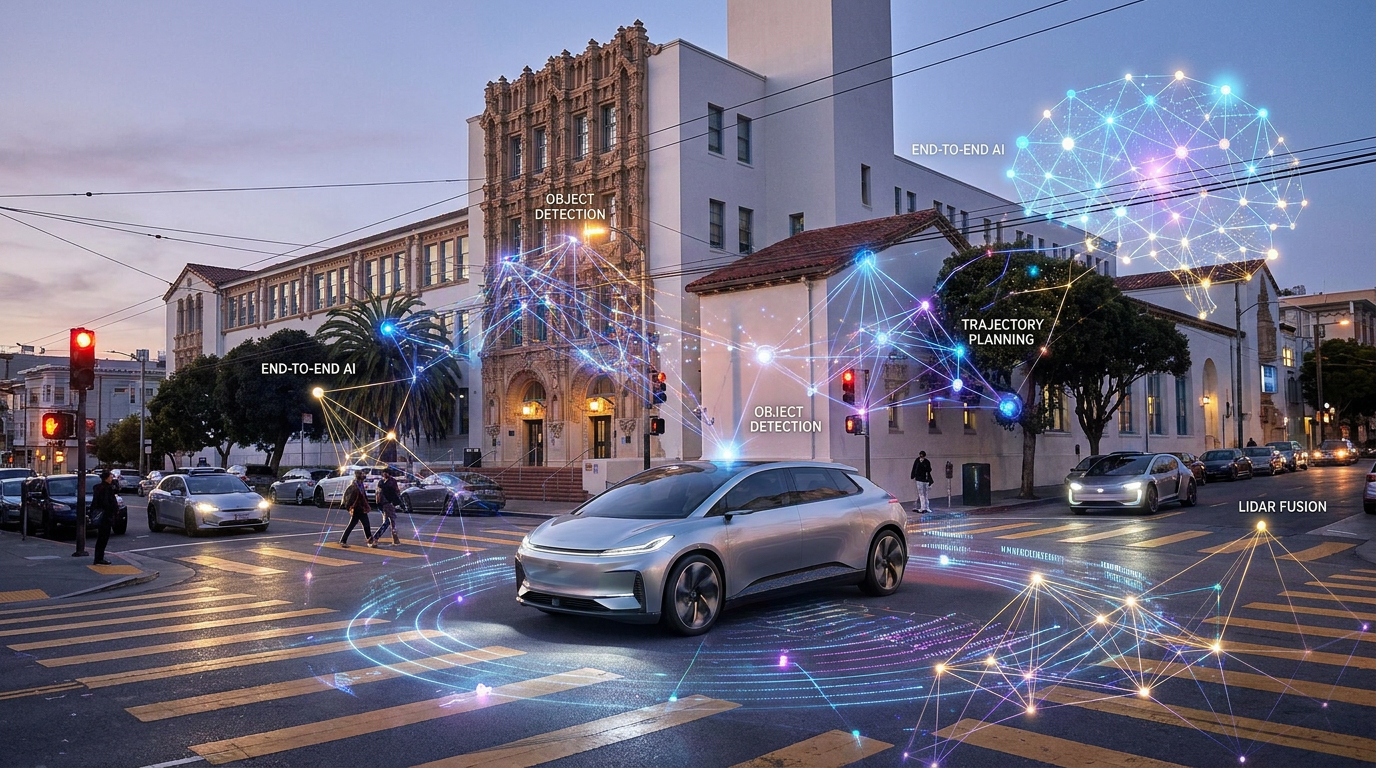
End-to-end deep learning eliminates these rigid silos. In an end-to-end system, raw sensor data—video feeds, radar, and LiDAR—flows directly into a single, massive neural network. The network processes this data and outputs steering, acceleration, and braking commands directly. There are no intermediate hand-coded rules. The system learns the optimal behavior by imitating millions of hours of expert human driving and through reinforcement learning, figuring out the safest and smoothest path on its own.[5][7]
The results have been transformative. Vehicles equipped with end-to-end models exhibit vastly more "human-like" behavior, smoothly navigating complex intersections and intuitively yielding to aggressive drivers without the mechanical jerkiness of earlier prototypes. Furthermore, unifying the perception, planning, and control pipelines into a single framework significantly reduces the computational latency—the critical delay between sensing a hazard and applying the brakes.[3][5][7]
A major catalyst for this leap has been the development of "World Models." In early 2026, Waymo introduced the Waymo World Model, a frontier generative AI system built upon Google DeepMind's Genie 3 architecture. Rather than just learning from the 200 million fully autonomous miles Waymo has driven in the real world, the World Model allows the AI to dream up and practice in hyper-realistic, interactive 3D simulations.[1]

This synthetic training ground is crucial for mastering the "long tail" of rare edge cases. By leveraging the vast world knowledge embedded in these models, engineers can simulate exceedingly rare events—from navigating through a sudden tornado to reacting to a pedestrian stepping out from behind a city bus—that are nearly impossible to capture safely at scale in reality. The AI can run millions of counterfactual "what if" scenarios in the simulation, refining its reflexes before ever touching physical asphalt.[1]
This synthetic training ground is crucial for mastering the "long tail" of rare edge cases.
Tesla has also aggressively pivoted to this architecture. With the rollout of its Full Self-Driving (FSD) versions 13 and 14, the company largely abandoned traditional heuristics in favor of a pure end-to-end neural network. Tesla's approach relies entirely on optical cameras, stripping out radar and ultrasonic sensors, and trusting the neural network to infer depth, speed, and trajectory purely from visual data.[4][6]
The integration of advanced AI is also changing how humans interact with these vehicles. In mid-2026, Tesla began integrating its Grok AI model directly into the autonomous driving stack, allowing drivers to issue natural-language commands. Instead of dropping a pin on a map, a user can simply tell the car, "Park near the entrance, but avoid the puddles," and the Vision-Language Model interprets the context and executes the maneuver.[4]
The financial markets have recognized the permanence of this architectural shift. The global market for end-to-end neural network autonomous driving systems, valued at roughly $671 million in 2025, is projected to surge to $2.5 billion by 2035, growing at a compound annual rate of nearly 15%. Automakers are pouring capital into high-performance computing clusters and custom AI silicon to train these increasingly massive models.[2][7]

However, the end-to-end revolution is not without its skeptics and technical hurdles. The primary criticism of unified neural networks is the "black box" problem. When a modular system makes a mistake, engineers can look at the code and pinpoint exactly which rule failed. When an end-to-end neural network makes an unexpected swerve, it is incredibly difficult to decipher exactly which combination of pixels and weights triggered the decision.[6]
This lack of explainability presents a massive challenge for regulators and safety certifiers. Earning public trust and regulatory approval requires a verifiable safety case. If an automaker cannot explicitly prove why their AI decided to brake, agencies like the National Highway Traffic Safety Administration (NHTSA) face difficulties in auditing the software for compliance with federal motor vehicle safety standards.[5][6]
To bridge this gap, many companies are adopting a hybrid approach. They utilize the fluid, intuitive decision-making of an end-to-end neural network for general driving, but wrap it in a deterministic "safety envelope." These hard-coded guardrails run in parallel, ensuring that no matter what the neural network outputs, the vehicle is physically prevented from violating fundamental laws of physics or traffic logic—such as steering into an oncoming lane.[6]
As these models continue to scale, the fundamental nature of the automobile is changing. The car is no longer just a mechanical machine that requires a human to act as its perceptual and decision-making unit. Powered by end-to-end artificial intelligence and vast simulated world models, the vehicle is becoming an intelligent, adaptable companion, capable of reasoning through the chaos of the physical world with unprecedented sophistication.[1][5]
How we got here
2004
The DARPA Grand Challenge kickstarts the modern autonomous vehicle industry using early rule-based systems.
2018
Waymo launches the first commercial robotaxi pilot, relying heavily on modular software architectures.
Early 2024
Tesla releases FSD v12, marking a major commercial shift toward vision-based end-to-end neural networks.
Feb 2026
Waymo introduces the 'Waymo World Model,' integrating generative AI to simulate hyper-realistic edge cases for training.
Mid 2026
Automakers begin integrating Vision-Language Models (VLMs) to allow natural-language interaction with autonomous driving stacks.
Viewpoints in depth
End-to-End Purists
Advocates who believe that unified neural networks are the only path to true autonomy.
This camp argues that the complexity of the real world cannot be captured by human-written code. They believe that by scaling compute power and training data, an end-to-end neural network will naturally develop a superhuman intuition for driving. For these developers, retaining any legacy modular code is a bottleneck that prevents the system from reaching its full potential.
Modular Safety Advocates
Engineers and regulators who insist on explainable, hard-coded safety guardrails.
Critics of pure end-to-end systems point out that neural networks are inherently 'black boxes.' If a vehicle makes a catastrophic error, it is nearly impossible to debug the specific mathematical weight that caused the failure. This camp argues that while neural networks are excellent for general navigation, they must be constrained by deterministic, rule-based safety envelopes to satisfy regulatory standards and ensure public trust.
Simulation Pioneers
Researchers focused on using generative AI to create synthetic training environments.
This perspective highlights that real-world driving data is mostly boring and repetitive. To train an AI for the 'long tail' of rare, dangerous events, these pioneers argue that the industry must rely on Large World Models. By generating interactive, photorealistic simulations of edge cases—like extreme weather or bizarre pedestrian behavior—they can safely stress-test autonomous systems before they ever hit the pavement.
What we don't know
- How quickly regulatory bodies like the NHTSA will adapt their certification processes to accommodate 'black box' neural networks.
- Whether pure vision-based end-to-end systems can match the safety metrics of multi-sensor fusion approaches in severe weather conditions.
Key terms
- End-to-End Deep Learning
- An AI architecture that maps raw inputs directly to final outputs within a single neural network, without intermediate hand-coded steps.
- Modular Architecture
- The traditional software approach that divides driving into separate, explicitly programmed tasks like perception, planning, and control.
- World Model
- A generative AI system that simulates the physics and dynamics of the real world, used to train autonomous vehicles in virtual environments.
- Sensor Fusion
- The process of combining data from multiple sensors—like cameras, radar, and LiDAR—to create a single, accurate understanding of the vehicle's surroundings.
- Vision-Language Model (VLM)
- An advanced AI model capable of understanding both visual imagery and natural language, allowing users to give conversational commands to a vehicle.
Frequently asked
What is 'end-to-end' autonomous driving?
It is an AI architecture where a single neural network processes raw sensor data and directly outputs driving commands, replacing traditional hand-coded rules.
Why are companies abandoning the old 'modular' approach?
Modular systems rely on explicit 'if-then' programming, which struggles to account for the infinite, unpredictable edge cases encountered on real roads.
What is a 'World Model'?
A World Model is a generative AI system that creates hyper-realistic, interactive 3D simulations, allowing autonomous vehicles to practice driving in rare or dangerous scenarios virtually.
Is end-to-end AI safe if it operates as a 'black box'?
While end-to-end models drive more smoothly, their lack of explainability is a challenge. Many companies solve this by wrapping the AI in a hard-coded 'safety envelope' that prevents dangerous maneuvers.
Sources
Source coverage
7 outlets
3 viewpoints surfaced







[1]WaymoHybrid & Simulation Developers
The Waymo World Model: A New Frontier For Autonomous Driving Simulation
Read on Waymo →[2]Global Market InsightsMarket & Academic Analysts
End-to-End Neural Network Autonomous Driving System Market Size
Read on Global Market Insights →[3]arXivMarket & Academic Analysts
Multi-Resolution End-to-End Deep Neural Network for Optimizing Latency-Accuracy Tradeoff in Autonomous Driving
Read on arXiv →[4]ElectrekEnd-to-End Purists
Elon Musk says Tesla's Full Self-Driving will soon remember your parking preferences
Read on Electrek →[5]ValeoHybrid & Simulation Developers
Step 2 Understand: AI, compute and sensor fusion
Read on Valeo →[6]Factlen Editorial TeamEnd-to-End Purists
Synthesis by Factlen editorial team
Read on Factlen Editorial Team →[7]Research and MarketsMarket & Academic Analysts
Global End-to-End Neural Network Autonomous Driving System Market
Read on Research and Markets →
Every angle. Every day.
Get automotive stories with full source coverage and perspective breakdowns delivered to your inbox.