
Humanoid Robots Cross the Commercial Threshold: Inside the 2026 Factory Floor Deployments
AI-powered humanoid robots have officially moved from laboratory demonstrations to active automotive assembly lines, with companies like Tesla, Figure AI, and Boston Dynamics deploying thousands of units in real-world manufacturing roles.
By Factlen Editorial Team
- Industrial Automation Optimists
- View humanoids as the ultimate solution to chronic labor shortages and the key to unlocking unprecedented manufacturing efficiency.
- Robotics Pragmatists
- Emphasize that while the AI is impressive, hardware reliability, battery life, and wear-and-tear remain significant bottlenecks to mass adoption.
- Labor Augmentation Advocates
- Focus on the ergonomic benefits of robots taking over physically degrading tasks, shifting human workers into safer oversight roles.
What's not represented
- · Labor Union Representatives
- · Traditional Industrial Robot Manufacturers
Why this matters
The successful integration of humanoid robots into active assembly lines marks a permanent shift in industrial economics. By automating physically exhausting and ergonomically dangerous tasks, manufacturers are simultaneously addressing chronic labor shortages and protecting human workers from repetitive strain injuries.
Key points
- Humanoid robots have officially transitioned from R&D labs to active automotive assembly lines in 2026.
- Figure AI successfully completed an 11-month deployment at BMW, contributing to the production of 30,000 vehicles.
- Tesla has deployed over 1,000 Optimus Gen 3 units at its Fremont factory for internal data collection and task execution.
- Advances in Vision-Language-Action (VLA) models have allowed robots to operate autonomously without rigid, hardcoded programming.
- Current deployments focus on task-replacement for ergonomically dangerous work, rather than full job-replacement.
- Battery life and long-term hardware reliability remain the primary engineering hurdles for 24/7 autonomous operation.
For the better part of a decade, humanoid robots existed primarily as viral internet entertainment—multimillion-dollar research projects performing carefully choreographed backflips or dancing in controlled laboratory environments. But in the first half of 2026, the robotics industry crossed a critical commercial threshold. Humanoid machines powered by advanced artificial intelligence are now clocking in for daily shifts on live automotive assembly lines, marking the dawn of the "Physical AI" era.[4][5]
This transition from prototype to production floor has been driven by a fundamental breakthrough in how robots learn. Historically, the "sim-to-real gap"—the discrepancy between how a robot behaves in a virtual simulation versus a messy, unpredictable physical factory—kept humanoids sidelined. Today, companies are leveraging synthetic data and Vision-Language-Action (VLA) models to bridge that divide. Instead of following rigid, hardcoded paths, modern humanoids can look at a scene, understand a spoken or programmed command, and autonomously generate the physical torque required to execute the task.[5]
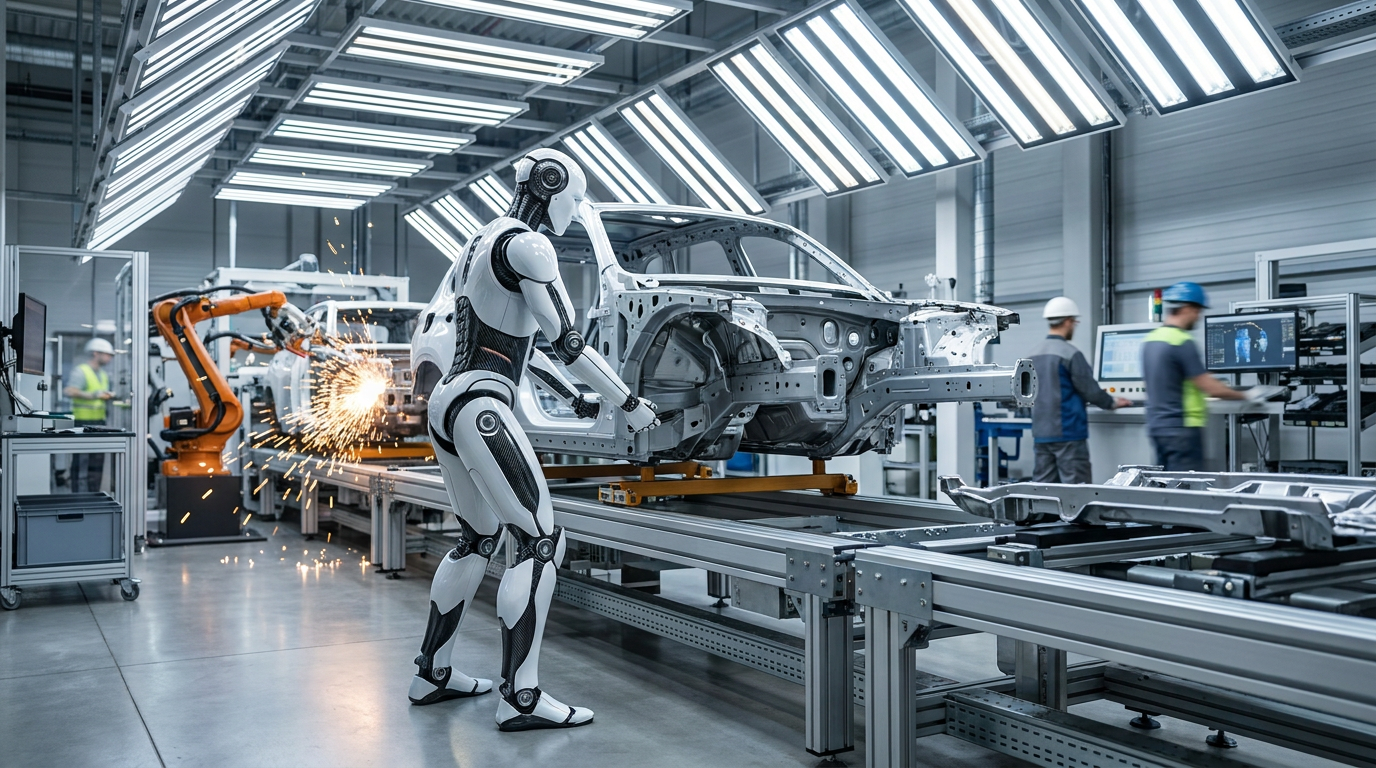
The most transparent proof point of this new era recently concluded at BMW's Spartanburg, South Carolina manufacturing plant. In a landmark 11-month deployment, California-based Figure AI integrated its Figure 02 humanoid directly into BMW's active production workflow. The results provided the industry with its first set of long-term, verifiable performance metrics for a humanoid robot operating at scale.[2][3]
Working standard 10-hour shifts from Monday to Friday, the Figure 02 fleet handled the precise removal and positioning of sheet metal parts for chassis assembly fixtures. Over the course of the pilot, the robots loaded more than 90,000 components, accumulated 1,250 hours of continuous runtime, and directly contributed to the production of over 30,000 BMW X3 SUVs. The task was specifically chosen because positioning heavy sheet metal with millimeter precision is physically exhausting and ergonomically taxing for human workers.[2][3]

Crucially, Figure AI did not hide the physical toll of this labor. When the company retired the Figure 02 fleet in mid-2026 to make way for its next-generation model, it released data detailing the wear and tear on the machines. The robot's forearm—which housed complex microcontroller boards and dynamic cabling to manage three degrees of freedom—emerged as the primary hardware failure point under the stress of continuous torque. These real-world scars directly informed the architecture of the upcoming Figure 03, which eliminates the vulnerable distribution boards in favor of direct motor-to-computer communication.[3]
While Figure AI pursues a partnership model with existing automakers, Tesla is executing a radically different, vertically integrated strategy. Tesla is simultaneously the robot manufacturer and its own largest customer. By early 2026, CEO Elon Musk confirmed that over 1,000 Optimus Gen 3 robots were operating on the live production floor at Tesla's Fremont, California factory.[6][8]
The Optimus fleet is currently tasked with repetitive operations such as sorting 4680 battery cells, kitting parts for human assembly workers, and performing basic quality inspections. While some industry analysts note that these early deployments are primarily designed to generate massive amounts of training data rather than maximize immediate economic output, the sheer scale of the operation is unprecedented. Tesla is currently converting its discontinued Model S and X assembly lines into a dedicated robotics plant, targeting an eventual production capacity of one million humanoid units per year.[6][8]

The design philosophies driving these machines are as varied as their deployment strategies. While Tesla and Figure aim for human-like proportions to seamlessly integrate into spaces built for people, Boston Dynamics is taking a decidedly different approach with its new fully electric Atlas robot. Backed by parent company Hyundai, Boston Dynamics engineered Atlas to deliberately exceed human biological limits.[1][4]
The design philosophies driving these machines are as varied as their deployment strategies.
The electric Atlas features 56 degrees of freedom and utilizes custom actuators that allow its waist and head joints to rotate a full 360 degrees. Rather than mimicking human movement, Atlas can reach around, under, and through industrial spaces in ways that a human-form constraint would prevent. Capable of lifting 50 kilograms and operating in extreme temperatures, Atlas is slated for mass deployment across Hyundai's manufacturing sites, starting with its Georgia facility.[1][4]
As the hardware matures, the economics of humanoid labor are coming into sharp focus. Current entry-level models, such as Unitree's G1, are hitting the market at astonishingly low price points between $13,500 and $16,000. Tesla has publicly targeted a long-term commercial price of $20,000 to $30,000 for Optimus. At these capital expenditure levels, the return on investment for a machine that can work multiple shifts without fatigue becomes highly compelling for mid-size manufacturers, not just global automotive giants.[6][7]

However, the narrative that these robots will immediately trigger mass human unemployment misunderstands the current technology. In 2026, humanoids are task-replacers, not job-replacers. A typical warehouse or assembly worker performs 30 to 50 distinct tasks throughout a shift; a state-of-the-art humanoid can currently perform 5 to 10 of those reliably. The immediate future of the factory floor is augmentation, where robots absorb the most repetitive, dangerous, and physically degrading tasks, allowing human workers to transition into oversight, maintenance, and complex problem-solving roles.[7]
The industry is also solving its own manufacturing bottlenecks through recursive automation. In early 2026, Figure AI unveiled "BotQ," a dedicated production facility where humanoid robots actively assist in building the next generation of humanoid robots. By keeping production in-house and utilizing their own AI systems to assemble components, early metrics indicate that production times are shrinking by up to 60%.[3][4]
Despite the rapid progress, significant engineering hurdles remain before humanoids achieve ubiquitous deployment. Battery density is the most pressing limitation. A 160-pound robot that is constantly standing, walking, twisting, and processing complex edge-AI calculations consumes massive amounts of power. Most current models max out at two to four hours of runtime. Companies are currently mitigating this through "hot-swappable" battery packs or autonomous docking routines during factory downtime, but the industry is eagerly awaiting the commercialization of high-density solid-state batteries to unlock true 24/7 operation.[1]

Reliability is the final frontier. Automotive assembly lines operate with punishing efficiency, and a single robot failure can halt millions of dollars of production. Achieving the 99.9% uptime required by tier-one manufacturers demands not just robust hardware, but AI models capable of instantly recovering from unexpected physical anomalies—a dropped part, a misaligned fixture, or a sudden change in lighting.[1][5]
What is undeniable is that the era of the humanoid robot is no longer a distant horizon. Driven by the convergence of massive capital investment, breakthroughs in physical AI, and the relentless pressure of global labor shortages, 2026 will be remembered as the year these machines finally put on hard hats and went to work.[5][7]
How we got here
January 2024
Figure AI and BMW sign a commercial agreement to explore humanoid robotics in automotive manufacturing.
January 2026
Elon Musk confirms that over 1,000 Optimus Gen 3 units are operating on the live production floor at Tesla's Fremont factory.
March 2026
Figure AI unveils 'BotQ', a dedicated manufacturing facility where humanoid robots assist in building new robots.
April 2026
Boston Dynamics announces the fully electric Atlas robot, slated for mass deployment at Hyundai manufacturing sites.
June 2026
Figure AI retires the Figure 02 fleet after an 11-month deployment at BMW, utilizing the wear-and-tear data to launch Figure 03.
Viewpoints in depth
Industrial Automation Optimists
View humanoids as the ultimate solution to chronic labor shortages and the key to unlocking unprecedented manufacturing efficiency.
For manufacturing executives and automation integrators, 2026 represents the moment the math finally works. With entry-level humanoids dropping below the $20,000 threshold, the capital expenditure is now lower than the fully loaded annual cost of a single human worker in many developed nations. This camp argues that because factories are already highly structured environments, they are the perfect proving ground for Physical AI. They point to Tesla's aggressive scale-up at Fremont and Figure's success at BMW as proof that the technology is ready to solve the chronic labor shortages that have plagued the manufacturing sector since 2020.
Robotics Pragmatists
Emphasize that while the AI is impressive, hardware reliability, battery life, and wear-and-tear remain significant bottlenecks to mass adoption.
Engineers and floor managers tasked with actually keeping these machines running offer a more measured perspective. While they acknowledge the massive leaps in AI and sim-to-real training, they stress that industrial environments are unforgiving to complex hardware. A robot that can intelligently identify a part is useless if its wrist actuator burns out after 1,000 cycles or if its battery dies mid-shift. This camp closely monitors metrics like Figure 02's forearm failures, arguing that until humanoids can guarantee the 99.9% mechanical uptime of traditional bolted-down robotic arms, they will remain supplementary tools rather than the backbone of production.
Labor Augmentation Advocates
Focus on the ergonomic benefits of robots taking over physically degrading tasks, shifting human workers into safer oversight roles.
Workplace safety experts and industrial ergonomists view the arrival of humanoids through the lens of worker health. Automotive assembly requires humans to perform highly repetitive motions, often while lifting heavy components or working at awkward angles, leading to chronic musculoskeletal injuries. This perspective champions the deployment of robots like Figure 02 specifically for tasks like sheet metal positioning. By absorbing the physical toll of manufacturing, humanoids allow human workers to transition into roles focused on quality assurance, robot maintenance, and process optimization, effectively extending the healthy working years of the industrial labor force.
What we don't know
- Whether humanoid robots can achieve the 99.9% mechanical reliability required to completely replace traditional, single-task industrial robotic arms.
- How quickly solid-state battery technology will scale to solve the current two-to-four-hour runtime limitations of untethered humanoids.
- The exact timeline for when Tesla will begin selling Optimus units to third-party commercial customers outside of its own factories.
Key terms
- Physical AI
- Artificial intelligence models designed specifically to understand physical environments and control the complex mechanical movements of robots in the real world.
- Sim-to-real gap
- The historical challenge in robotics where a machine trained successfully in a virtual computer simulation fails when faced with the unpredictable physics and lighting of the real world.
- Vision-Language-Action (VLA) model
- An AI system that allows a robot to see its environment, understand spoken or text commands, and directly translate that understanding into physical mechanical movement.
- Degrees of Freedom (DOF)
- The number of independent joints or movable axes a robot has; a higher number generally indicates greater flexibility and dexterity.
- Teleoperation
- The process of a human remotely controlling a robot's movements, often used to generate the initial training data that the robot's AI will later use to operate autonomously.
Frequently asked
Are humanoid robots replacing human factory workers?
Currently, they are replacing specific tasks, not entire jobs. Humanoids are taking over the most repetitive and physically exhausting duties, such as heavy lifting and precise part positioning, while humans handle complex problem-solving and oversight.
How much does a humanoid robot cost in 2026?
Prices vary significantly by capability, but entry-level industrial models like the Unitree G1 start around $13,500. Major players like Tesla are targeting a long-term commercial price of $20,000 to $30,000 as mass production scales.
How long can these robots work before needing a charge?
Most current humanoid models have a continuous runtime of two to four hours. To maintain factory uptime, companies use hot-swappable battery packs or have the robots autonomously walk to charging stations during line downtime.
Why make them shaped like humans instead of traditional robot arms?
Factories, tools, and workflows have been designed around the human body for over a century. A humanoid form factor allows the robot to seamlessly drop into existing workspaces without requiring manufacturers to completely redesign their facilities.
Sources
Source coverage
8 outlets
3 viewpoints surfaced








[1]EE TimesRobotics Pragmatists
Why humanoids are the future of manufacturing
Read on EE Times →[2]BMW GroupLabor Augmentation Advocates
First pilot project with humanoid robots in Europe
Read on BMW Group →[3]Figure AIRobotics Pragmatists
Figure 02 Contributed to the Production of 30,000 Cars at BMW
Read on Figure AI →[4]TechStoriessIndustrial Automation Optimists
Humanoid robots are fast making their way to factory floors
Read on TechStoriess →[5]Neural NotesLabor Augmentation Advocates
The Rise of AI-Powered Robotics: How 2026 Is Reshaping Manufacturing and Automation
Read on Neural Notes →[6]iFactoryIndustrial Automation Optimists
Tesla Optimus Gen 3 at Fremont: 1,000+ Units, Mass Production
Read on iFactory →[7]AI MagicxIndustrial Automation Optimists
Humanoid Robots in the Workplace: The 2026 Business Leader's Reality Check
Read on AI Magicx →[8]New Market PitchRobotics Pragmatists
Tesla Optimus factory deployment 2026
Read on New Market Pitch →

More in ai
See all 5 stories →
Every angle. Every day.
Get ai stories with full source coverage and perspective breakdowns delivered to your inbox.