
OLED vs. Mini-LED in 2026: The Ultimate Display Technology Comparison
As display technologies converge in 2026, choosing between OLED and Mini-LED requires a careful trade-off analysis based on room lighting, content, and longevity.
By Factlen Editorial Team
- Bright-Room Viewers
- Focus on sustained full-screen brightness, glare reduction, and daytime visibility.
- Cinematic Purists
- Prioritize perfect black levels, infinite contrast, and pixel-level precision above all else.
- Power Users & Gamers
- Weigh motion clarity against the risk of permanent burn-in from static interfaces.
What's not represented
- · Budget-Conscious Consumers
- · Environmental Regulators
Why this matters
Choosing the wrong display technology for your specific room lighting and viewing habits can result in a washed-out picture or thousands of dollars lost to permanent screen burn-in. Understanding the precise trade-offs between OLED and Mini-LED ensures you invest in a screen that actually fits your daily life.
Key points
- The 2026 display market features a 'Great Convergence,' with OLEDs getting brighter and Mini-LEDs improving contrast.
- OLED technology remains the undisputed champion for dark-room cinematic viewing and competitive gaming due to perfect black levels and near-zero response times.
- Mini-LED technology excels in bright, sunlit rooms, sustaining massive peak brightness levels without the risk of permanent burn-in.
- Newer 'Tandem OLED' panels can hit 2,000 nits of peak brightness, while flagship Mini-LEDs now exceed 4,000 nits.
- Choosing between the two technologies depends entirely on room lighting, content type, and whether the screen will display static elements for long periods.
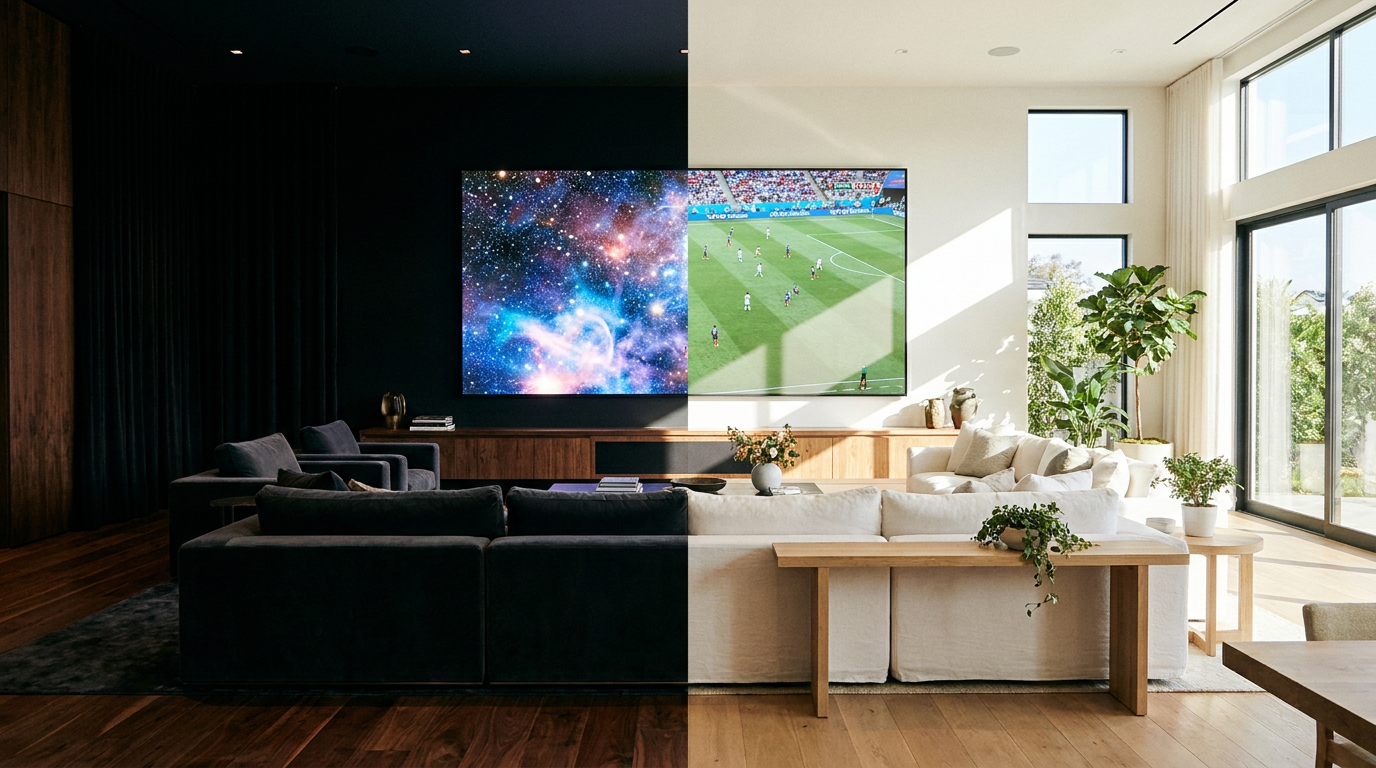
The 2026 display market has reached a point of 'Great Convergence.' The long-standing rivalry between OLED and Mini-LED technologies is no longer a simple binary of dark-room contrast versus bright-room power. For years, consumers were forced to choose between the perfect black levels of organic light-emitting diodes and the brute-force brightness of liquid crystal displays. Today, that gap has narrowed significantly. Both technologies have aggressively encroached on each other's traditional territory, creating a highly competitive landscape where the right choice is less about absolute superiority and more about matching the hardware to the specific environment.[4]
Manufacturers have pushed both panel types to their absolute physical limits. OLED panels have adopted tandem stacking and quantum dots to push peak brightness to unprecedented levels, solving their historical weakness in well-lit rooms. Meanwhile, Mini-LEDs have shrunk their diodes and multiplied their dimming zones to mimic the pixel-perfect blacks that once made OLED the undisputed king of home theater. With both technologies now capable of delivering breathtaking high-dynamic-range imagery, the decision process has fundamentally shifted from a spec-sheet comparison to a lifestyle assessment.[4][6]
For buyers, this means the decision requires a side-by-side trade-off analysis based on environmental realities rather than outdated assumptions. The choice hinges entirely on room lighting, content type, and longevity requirements. A display that looks flawless in a pitch-black basement cinema might struggle in a sun-drenched living room with floor-to-ceiling windows. By quantifying the specific strengths and weaknesses of each architecture, consumers can navigate the marketing noise and select the panel that actually fits their daily viewing habits.[2][6]
The case for OLED rests on its fundamental self-emissive architecture. Because each of the millions of pixels generates its own light and can turn off completely independently of its neighbors, the technology delivers a mathematically infinite contrast ratio. There is no backlight shining through a liquid crystal layer; when an OLED pixel is instructed to display black, it emits zero light. This pixel-level precision allows for incredibly nuanced shadow detail and a three-dimensional pop that traditional backlit displays struggle to replicate.[1][2]

The evidence supporting OLED's superiority in controlled lighting is overwhelming. Reviewers and professional calibrators consistently note that in dark rooms, OLED provides an unmatched cinematic depth. There is absolutely zero light bleed or 'haloing' around bright objects like crisp white subtitles, glowing streetlamps, or stars set against a deep night sky. For movie enthusiasts who want to experience films exactly as the director intended in a dedicated, light-controlled home theater, OLED remains the absolute gold standard of picture quality.[1][2][6]
Furthermore, OLED continues to dominate in motion clarity and gaming responsiveness. Because the pixels change state almost instantaneously, OLED panels boast response times as low as 0.03 milliseconds. This effectively eliminates motion blur, making it the undisputed champion for competitive esports, fast-paced action movies, and high-speed sports broadcasts. Gamers also benefit from the technology's inherently low input lag and flawless variable refresh rate performance, ensuring that every button press translates to immediate, crystal-clear on-screen action without any ghosting or smearing.[7]
The argument against OLED centers on its physical limitations and the reality of organic degradation. The organic compounds that make the technology work are inherently susceptible to permanent image retention, commonly known as burn-in. When exposed to static elements—such as scrolling news tickers, persistent broadcast network logos, PC taskbars, or gaming heads-up displays—over thousands of hours, those specific pixels degrade faster than the rest of the screen. This uneven wear leaves a permanent, irreversible ghost image behind, which can ruin the display.[3][5][7]
While 2026 models heavily mitigate this risk with advanced pixel-shifting algorithms and dedicated hardware heat sinks, the fundamental thermal ceiling remains intact. Even the newest 'Tandem OLED' architectures, which stack multiple light-emitting layers to achieve impressive peak highlights of 2,000 nits, cannot sustain maximum full-screen brightness. To protect the organic panel from overheating and accelerated degradation, OLEDs employ an Automatic Brightness Limiter. This software aggressively dims the entire screen during bright, full-screen scenes, such as a daytime hockey game or a sweeping snow-covered landscape.[4]
The case for Mini-LED is built entirely on brute-force luminance and inorganic durability. By utilizing thousands of microscopic light-emitting diodes clustered into thousands of independent local dimming zones, the technology blasts through ambient light with ease. Because it relies on a traditional liquid crystal display layer illuminated by an incredibly powerful inorganic backlight, Mini-LED does not suffer from the same thermal constraints or degradation risks that plague organic panels. This robust architecture allows the backlight to be driven much harder for much longer.[2][3]
The case for Mini-LED is built entirely on brute-force luminance and inorganic durability.
The evidence supporting Mini-LED's dominance in bright environments is stark and easily quantifiable. Modern RGB Mini-LED panels effortlessly sustain 2,000 to 3,000 nits across large portions of the screen, with some flagship consumer models pushing well beyond 4,000 nits in high-dynamic-range highlights. Unlike OLED, a Mini-LED television can display a bright, full-screen commercial or a sunlit outdoor sports field without aggressively dimming the overall picture. This ensures the display maintains a consistently punchy, vivid, and highly saturated image regardless of the content.[4][7]

This sustained output means that in a sun-drenched living room or a corporate office with harsh overhead lighting, a Mini-LED screen remains vibrant and fully legible. In these exact same high-glare environments, an OLED panel might appear washed out, overly dim, or plagued by distracting reflections on its glossy surface. For families who watch television during the day with the curtains wide open, the sheer light output of a Mini-LED provides a vastly superior, more comfortable, and highly engaging viewing experience.[2][6]
Additionally, Mini-LED completely eliminates the anxiety of permanent burn-in. Because the underlying technology is inorganic, it can safely display static productivity applications, coding environments, or persistent sports scorebugs for sixteen hours a day without any risk of permanent screen degradation. This makes Mini-LED the undisputed choice for heavy PC monitor use, commercial digital signage, or households where the television is routinely left on all day as a background source for rolling news broadcasts and financial tickers.[3][5][7]
The primary argument against Mini-LED remains its fundamental reliance on dimming zones rather than individual pixels. Even with the most advanced 2026 models boasting upwards of 5,000 independent dimming zones, a single zone still illuminates thousands of pixels simultaneously. It simply cannot match the granular, one-to-one light control of a self-emissive OLED panel. This architectural limitation means that the Mini-LED backlight must inevitably make compromises when displaying complex scenes that mix extreme, piercing brightness directly adjacent to absolute, pitch-black darkness.[1][2]
When a bright highlight sits directly adjacent to pure black, the Mini-LED backlight inevitably bleeds over into the dark area, creating a faint halo effect known as blooming. While sophisticated 2026 processing algorithms have suppressed this blooming to levels that are imperceptible to most casual viewers during normal content, cinematic purists and side-by-side testing still reveal the compromise. In a pitch-black room, white text on a black background will still exhibit a slight, noticeable glow that breaks the perfect cinematic illusion.[1][2][7]
Mini-LED also falls slightly behind in off-axis viewing angles and raw pixel response times. While high-end IPS-based Mini-LED monitors offer relatively wide viewing angles, many large-format television variants utilize VA panels that lose color accuracy and contrast when viewed from the side of the room. Furthermore, the liquid crystals take physical time to transition between states, meaning their response times simply cannot match the near-zero latency of OLED, occasionally resulting in minor motion smearing during exceptionally fast camera pans.[1][5]

Ultimately, quantifying these specific trade-offs reveals that neither display technology claims a universal, unconditional victory; instead, they serve distinct operational realities. The marketing narrative that one panel type is objectively superior to the other has been entirely replaced by a more nuanced understanding of specific use cases. Buyers must honestly evaluate their room lighting, their primary content sources, and their personal tolerance for either burn-in risk or minor backlight blooming before making a premium, long-term television or monitor purchase.[2][6]
OLED fits perfectly when the primary use case involves a light-controlled home theater, late-night cinematic movie viewing, or competitive gaming where absolute motion clarity is paramount. If the goal is to replicate the flawless contrast and pixel-level precision of a professional Hollywood mastering monitor in a dark room, OLED remains the undisputed champion. The technology provides an immersive, three-dimensional depth that elevates prestige television, high-dynamic-range films, and high-fidelity single-player gaming to breathtaking new heights of visual fidelity.[2][6]
However, OLED does not fit well when the screen will face direct sunlight, serve as a daily productivity monitor with static windows, or run continuously as a background television. The inherent risk of permanent image retention makes it a poor choice for users who leave the same news channel running all day or who require a display for eight hours of daily spreadsheet work. In these specific, high-stress scenarios, the organic panel essentially becomes a ticking clock of inevitable degradation.[5][7]
Mini-LED fits exceptionally well when deployed in bright, open-concept living rooms, used heavily for daytime sports viewing, or tasked with PC productivity and text-heavy workloads. The sheer brute-force brightness cuts through the harshest ambient glare, ensuring the picture remains punchy and vibrant even at high noon. Furthermore, the complete immunity to burn-in provides total peace of mind for power users who need a reliable, long-lasting display that can handle static interfaces without requiring constant, anxiety-inducing pixel-refresh cycles.[3][6][7]
Conversely, Mini-LED does not fit well when the buyer demands absolute pixel-level precision in a pitch-black room, or when the slightest hint of blooming around subtitles would distract from the cinematic experience. While the technology has made massive strides in contrast, it still relies on a backlight shining through a liquid crystal layer. For the uncompromising videophile who watches movies exclusively in the dark, the faint glow around bright highlights will always serve as a reminder that they are not watching an OLED.[1][2]
How we got here
2013
The first commercial large-screen OLED televisions launch, establishing a new benchmark for perfect black levels and contrast.
2019
Mini-LED technology enters the consumer TV market, offering a brighter, burn-in-free alternative to OLED.
2022
Quantum Dot OLED (QD-OLED) is introduced, significantly boosting the color brightness and volume of OLED panels.
2024
Flagship Mini-LED televisions cross the 5,000 local dimming zone threshold, drastically reducing blooming artifacts.
2026
The 'Great Convergence' occurs as Tandem OLEDs hit 2,000 nits of brightness and RGB Mini-LEDs refine their contrast to near-OLED levels.
Viewpoints in depth
Cinematic Purists
Prioritize perfect black levels, infinite contrast, and pixel-level precision above all else.
For home theater enthusiasts and movie purists, the conversation begins and ends with OLED. This camp argues that the ability to turn individual pixels completely off creates a depth and three-dimensionality that no backlit technology can replicate. They point to the complete absence of blooming around stars in a night sky or bright subtitles on a black bar as the ultimate benchmark of picture quality. While they acknowledge Mini-LED's brightness advantage, they argue that in a properly light-controlled room, OLED's 2,000-nit peaks are more than enough to deliver blinding HDR highlights without washing out the surrounding shadows.
Bright-Room Viewers
Focus on sustained full-screen brightness, glare reduction, and daytime visibility.
This perspective represents the reality of most modern living rooms, which feature large windows, open floor plans, and daytime viewing habits. Advocates for Mini-LED argue that OLED's perfect blacks are entirely lost the moment sunlight hits the screen. They emphasize that Mini-LED's ability to sustain 3,000+ nits across the entire panel cuts through ambient glare, making daytime sports and casual viewing significantly more vibrant. For this camp, the brute-force luminance of Mini-LED provides a more consistent and usable experience throughout the day, far outweighing the minor haloing effects that are only visible in pitch-black rooms.
Power Users & Gamers
Weigh motion clarity against the risk of permanent burn-in from static interfaces.
The PC and gaming community is heavily divided based on specific use cases. Competitive gamers lean toward OLED for its instantaneous 0.03ms response times, which eliminate motion blur during fast-paced action. However, power users who use their monitors for coding, productivity, or HUD-heavy MMO games increasingly champion Mini-LED. They cite the inherent risk of organic burn-in from static taskbars and the superior text clarity provided by Mini-LED's standard RGB subpixel layout. For users who leave their screens on for 12 hours a day, Mini-LED offers the peace of mind that OLED simply cannot guarantee.
What we don't know
- Whether MicroLED technology will become affordable enough to replace both OLED and Mini-LED before the end of the decade.
- How the long-term degradation of the newest Tandem OLED structures will compare to traditional single-layer OLEDs after five years of heavy use.
Key terms
- OLED (Organic Light-Emitting Diode)
- A display technology where each individual pixel generates its own light and can turn off completely, resulting in perfect black levels.
- Mini-LED
- An advanced LCD backlight technology that uses thousands of microscopic LEDs grouped into dimming zones to provide high brightness and precise contrast.
- Local Dimming Zones
- Specific areas of a Mini-LED backlight that can dim or turn off independently to improve contrast and black levels in dark scenes.
- Burn-in (Image Retention)
- Permanent degradation of a screen caused by displaying static images (like news tickers or taskbars) for prolonged periods, primarily affecting OLEDs.
- Nits
- A unit of measurement for the brightness of a display. A standard SDR TV might output 300 nits, while high-end HDR displays can exceed 3,000 nits.
- Tandem OLED
- A newer OLED architecture that stacks multiple light-emitting layers to significantly increase peak brightness and extend panel lifespan.
Frequently asked
Does Mini-LED suffer from burn-in?
No. Because Mini-LED relies on an inorganic backlight rather than self-emissive organic compounds, it is immune to the permanent image retention (burn-in) that can affect OLED screens.
Can OLED TVs get bright enough for a living room?
Yes, modern 2026 OLEDs—especially those using Tandem or QD-OLED technology—can reach peak brightness levels of 2,000 nits. However, they still aggressively dim the screen during bright, full-screen scenes to protect the panel, making them less ideal than Mini-LEDs for sun-drenched rooms.
Which technology is better for PC monitors?
It depends on the workload. Mini-LED is generally better for text-heavy productivity and static apps due to its standard subpixel layout and lack of burn-in risk. OLED is preferred for pure gaming and media consumption due to its motion clarity.
What is blooming or haloing?
Blooming is a visual artifact where light from a bright object bleeds into the surrounding dark areas of the screen. It occurs on Mini-LEDs because the backlight zones are larger than individual pixels, though modern algorithms have significantly reduced the effect.
Sources
Source coverage
7 outlets
3 viewpoints surfaced







[1]RTINGSCinematic Purists
Mini LED vs. OLED TVs: Which One Is The Best?
Read on RTINGS →[2]CNETCinematic Purists
Mini-LED vs. OLED: Which TV Tech Should You Get?
Read on CNET →[3]PCWorldPower Users & Gamers
OLED is old news. Mini-LED is the future
Read on PCWorld →[4]ElectronicsHubBright-Room Viewers
OLED vs Mini LED TV Comparison Guide for 2026
Read on ElectronicsHub →[5]SUNULPower Users & Gamers
Mini LED Display vs OLED: Which mini led screen triumphs?
Read on SUNUL →[6]TCLBright-Room Viewers
QD-Mini LED vs OLED: How to Choose for Your Viewing Environment
Read on TCL →[7]XDA DevelopersPower Users & Gamers
Forget OLED — mini-LED is the real future of displays
Read on XDA Developers →
Every angle. Every day.
Get shopping stories with full source coverage and perspective breakdowns delivered to your inbox.