
The New 'Nutrition Label' for Digital Media: How Content Credentials Are Restoring Trust Online
As generative AI blurs the line between real and synthetic media, a coalition of tech giants, newsrooms, and creators is rolling out a tamper-proof digital provenance standard to verify what we see online.
By Factlen Editorial Team
- Open-Standard Advocates
- Believe cryptographic provenance is the only scalable way to restore trust in digital media without resorting to censorship or flawed AI detection.
- Independent Creators
- Value the standard for proving human authorship, protecting copyright, and providing a technical mechanism to opt out of AI training data scraping.
- Privacy & Human Rights Advocates
- Support the technology but warn that a 'verify by default' internet must accommodate anonymous assertions to protect whistleblowers and dissidents.
What's not represented
- · Open-source AI developers who rely on public data scraping
- · Dissidents in authoritarian regimes who fear identity verification
Why this matters
As AI-generated deepfakes and synthetic media flood the internet, traditional methods of verifying reality have failed. This new cryptographic standard empowers users to instantly check the origin of a photo or video, protecting creators' copyrights while giving the public a reliable tool to navigate an increasingly deceptive digital landscape.
Key points
- Content Credentials provide a cryptographically secure 'nutrition label' for digital media, showing origin and editing history.
- The C2PA standard relies on manifests, invisible watermarks, and fingerprinting to survive metadata stripping by social platforms.
- Hardware manufacturers like Leica and Sony are embedding cryptographic signing directly into cameras at the point of capture.
- The standard allows creators to prove human authorship and embed 'do not train' flags to opt out of AI scraping.
- Provenance proves the origin of a file, but it does not guarantee the factual truth or context of the content itself.
In the mid-2020s, the internet reached an epistemic breaking point. As generative artificial intelligence made it trivial to conjure photorealistic images, clone voices, and synthesize video in seconds, the traditional markers of digital authenticity collapsed. For years, the tech industry’s primary response was an arms race of AI detection tools—software designed to sniff out synthetic content after the fact. But as generation models grew more sophisticated, detection algorithms consistently fell behind, plagued by false positives and easily bypassed by minor edits. The paradigm needed to flip: instead of trying to detect every fake, the digital ecosystem needed a reliable way to prove what was real.[7]
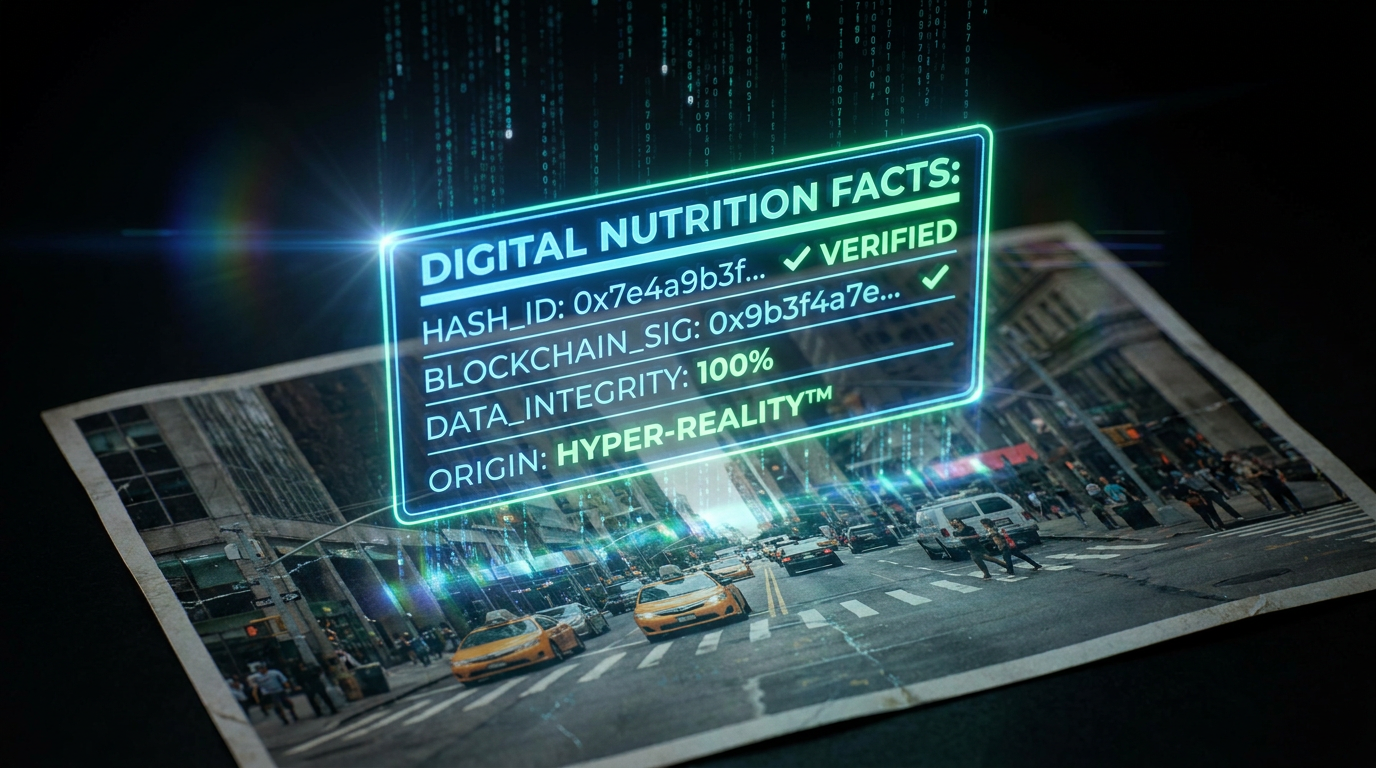
Enter the Coalition for Content Provenance and Authenticity (C2PA), a sprawling consortium of tech giants, news organizations, and camera manufacturers that has spent the last few years building the internet’s new trust layer. Their solution, consumer-facing as "Content Credentials," acts as a digital nutrition label for media. Rather than making subjective judgments about whether an image is "good" or "bad," the standard provides a tamper-evident, cryptographically secure record of an asset's origin, the tools used to create it, and any subsequent edits.[1][2]
By 2026, this standard has moved from theoretical whitepapers to active deployment. Major hardware manufacturers are embedding the technology directly into camera silicon, software giants are integrating it into editing suites, and social platforms are beginning to display verification badges to users. For ethical advertising, journalism, and independent creators, Content Credentials represent a rare, unifying technological triumph—a proactive system designed to restore epistemic integrity to the open web without resorting to censorship.[3][4]
To understand how Content Credentials work, it is helpful to look at the mechanism behind the scenes. The system relies on a data structure known as a "manifest." When a creator takes a photo or generates an image using a C2PA-compliant tool, the software generates a manifest containing specific "assertions." These assertions are factual statements about the file: the date and time of creation, the device or AI model used, the location data, and the identity of the creator.[1][2]

Crucially, this manifest is not just a standard metadata file, which can be easily edited or stripped away by anyone with basic software. Instead, the manifest is cryptographically signed using Public Key Infrastructure (PKI)—the same underlying security protocol that powers HTTPS web encryption and secure banking. A Certificate Authority verifies the identity of the software or hardware generating the claim, sealing the manifest to the digital file.[1][6]
If a bad actor attempts to alter the image or tamper with the manifest, the cryptographic signature breaks, immediately flagging the file as modified or unverified. When a user encounters a credentialed image online, they can click a small "CR" (Content Credentials) pin in the corner of the media. This opens a transparent breakdown of the file’s entire lifecycle, showing the original capture, any color corrections or crops, and whether generative AI was used to fill in backgrounds or alter subjects.[1][2][5]
However, building a secure manifest is only half the battle. The historical vulnerability of digital provenance has been "metadata stripping." For decades, social media platforms and messaging apps have automatically stripped metadata from uploaded files to save server space and protect user privacy, such as removing GPS coordinates. If a C2PA manifest is stripped during an upload to a non-compliant platform, the chain of trust is broken.[3][4]
To solve this, the Content Authenticity Initiative (CAI) developed what it calls the "Three Pillars of Provenance." The first pillar is the cryptographic manifest itself. The second is an invisible digital watermark embedded directly into the pixels or audio waves of the file. Unlike visible watermarks, these are imperceptible to the human eye and designed to survive heavy compression, cropping, and screenshots.[4]
To solve this, the Content Authenticity Initiative (CAI) developed what it calls the "Three Pillars of Provenance." The first pillar is the cryptographic manifest itself.
The third pillar is cryptographic fingerprinting. If a social media platform strips the C2PA manifest, the invisible watermark remains intact. When a user or a verification tool scans the image, the watermark acts as a search query, matching the file's unique fingerprint against a decentralized, immutable trust registry. This allows the system to retrieve and reattach the stripped Content Credentials, ensuring that the provenance data follows the media wherever it travels across the internet.[4][5]

The adoption curve for this technology has accelerated dramatically. At the hardware level, camera manufacturers like Leica, Sony, and Nikon have integrated C2PA signing capabilities directly into their flagship mirrorless cameras. When a photojournalist presses the shutter, the camera's internal chipset generates a cryptographic signature at the exact moment of capture, establishing an unbreakable "glass-to-pixel" chain of custody.[3][6]
In the newsroom, content management systems used by organizations like the BBC, the Associated Press, and Agence France-Presse maintain this chain. If a photo editor crops the image or adjusts the exposure, the software logs those specific actions as new assertions in the manifest. By the time the image reaches a reader's screen, the Content Credential proves that the photo depicts a real event and has not been subjected to AI manipulation.[1][3]
Beyond combating misinformation, Content Credentials are fundamentally reshaping the economics of the creator economy. In the wake of generative AI, independent artists, designers, and photographers have struggled to protect their work from being scraped for training data or cloned by synthetic generators. Furthermore, the U.S. Copyright Office has maintained that purely AI-generated works lacking human authorship cannot be copyrighted.[5]

Content Credentials provide creators with an indisputable, portable proof of human authorship. By attaching a verifiable timeline of their creative process—from initial sketch to final render—artists can instantly prove their originality to clients, marketplaces, and copyright regulators. This eliminates the friction of disputes and allows platforms to filter for verified human-made art.[5]
Additionally, the C2PA standard includes ethical opt-out mechanisms. Creators can embed a "do not train" assertion directly into their cryptographic manifest. While honoring this flag currently relies on the good faith of AI developers, emerging legislative frameworks in the European Union and the United States are increasingly looking to C2PA manifests as the technical foundation for enforcing creator rights and data scraping regulations.[4][7]
Despite the technological elegance of the standard, significant challenges and uncertainties remain. The most profound is a philosophical one: provenance does not equal truth. A cryptographically verified, unaltered photograph can still be staged, taken out of context, or used to push a false narrative. Content Credentials can prove that an image of a protest was taken at a specific time and place, but they cannot verify the motivations of the protesters or the accuracy of the caption attached to it by a third party.[2][6]
There is also an inherent tension between verifiable identity and human rights. While news organizations and brands benefit from transparent attribution, anonymous whistleblowers, activists in authoritarian regimes, and marginalized groups rely on the ability to share media without cryptographic ties to their real-world identities. The C2PA standard allows for anonymous or redacted assertions, but privacy advocates warn that a "verify by default" internet could inadvertently marginalize those who cannot safely attach their names to their digital realities.[1][6][7]
Finally, the success of Content Credentials hinges entirely on ubiquitous adoption. While major players like Adobe, Microsoft, and Google have championed the standard, the ecosystem requires universal compliance to be truly effective. If a major social network refuses to display the "CR" badge or actively breaks the watermarking pillars, the chain of trust fractures for billions of users.[3][4][7]
Nevertheless, the trajectory is clear. The digital world is transitioning from an era of implicit trust to one of cryptographic verification. By building an open, interoperable standard that prioritizes transparency over censorship, the Coalition for Content Provenance and Authenticity is providing the foundational infrastructure for a more honest internet. In a future where synthetic media is infinite and free, verifiable human reality is becoming the most valuable digital asset of all.[1][2][5][7]
How we got here
2019
The Content Authenticity Initiative (CAI) is founded by Adobe, Twitter, and The New York Times to address digital misinformation.
2021
The Coalition for Content Provenance and Authenticity (C2PA) is formally established to create an open technical standard.
2023
Leica releases the M11-P, the world's first camera with built-in hardware-level C2PA content credentials.
2024
Major platforms including TikTok and LinkedIn begin supporting and displaying Content Credentials on user uploads.
2026
C2PA adoption accelerates as the 'Three Pillars' approach solves the metadata stripping problem across the open web.
Viewpoints in depth
Open-Standard Advocates
Tech coalitions argue that cryptographic provenance is the only scalable way to restore trust.
Organizations like the Content Authenticity Initiative and C2PA argue that the internet cannot rely on AI detection tools, which are perpetually engaged in a losing arms race against generative models. Instead, they advocate for a 'verify by default' ecosystem. By building an open, interoperable standard based on established Public Key Infrastructure, they believe the industry can empower consumers to make informed decisions about media without requiring platforms to act as arbiters of truth or engage in censorship.
Independent Creators
Artists view the standard as a vital tool for protecting copyright and proving human authorship.
For the creator economy, Content Credentials are less about combating political misinformation and more about economic survival. As generative AI floods marketplaces with synthetic imagery, human artists struggle to prove their work is original. By attaching a cryptographic timeline of their creative process, creators can definitively prove human authorship to clients and the U.S. Copyright Office. Furthermore, the ability to embed a 'do not train' assertion provides a much-needed technical foundation for artists attempting to opt out of AI data scraping.
Privacy & Human Rights Advocates
Privacy groups warn that mandatory provenance could endanger vulnerable individuals.
While acknowledging the utility of the standard, privacy advocates caution against the unintended consequences of a fully verified internet. If platforms begin to penalize or downrank media that lacks Content Credentials, anonymous whistleblowers, activists in authoritarian regimes, and marginalized groups could be silenced. These advocates stress that the C2PA standard must continue to robustly support redacted and anonymous assertions, ensuring that the push for digital authenticity does not come at the cost of human rights and operational security.
What we don't know
- Whether all major social media networks will universally adopt the standard and stop stripping metadata by default.
- How courts will ultimately rule on the legal weight of C2PA 'do not train' assertions in copyright infringement lawsuits against AI developers.
- The long-term impact of 'verify by default' systems on anonymous whistleblowers and dissidents in authoritarian regimes.
Key terms
- Content Credentials
- A tamper-evident digital label attached to media that displays its origin, creation tools, and editing history.
- C2PA Manifest
- A cryptographically secured data structure embedded in a file containing factual assertions about its provenance.
- Cryptographic Signature
- A mathematical scheme used to verify the authenticity of digital messages or documents, ensuring they haven't been altered.
- Metadata Stripping
- The common practice by social media platforms of deleting hidden file data (like GPS or camera settings) to save server space or protect user privacy.
- Invisible Watermark
- Data embedded directly into the pixels or audio waves of a file that survives compression and cropping, unlike standard metadata.
Frequently asked
Does a Content Credential prove that an image is true?
No. It only proves the origin and editing history of the file. A cryptographically verified, unaltered photograph can still be staged, taken out of context, or given a misleading caption.
Can Content Credentials be removed or stripped?
While standard metadata is easily stripped by social media platforms, the C2PA standard uses a 'Three Pillars' approach involving invisible watermarks and digital fingerprinting to recover and reattach stripped credentials.
Does this prevent AI companies from scraping my art?
Creators can embed a 'do not train' opt-out flag in their credentials. While currently reliant on voluntary compliance from AI developers, it provides a technical foundation for future legal enforcement.
Do I have to reveal my real name to use this?
No. The C2PA standard allows for redacted or anonymous assertions, protecting whistleblowers and activists who need to verify media without exposing their real-world identities.
Sources
Source coverage
7 outlets
3 viewpoints surfaced







[1]C2PA.orgOpen-Standard Advocates
Content Credentials Explainer
Read on C2PA.org →[2]Privacy GuidesPrivacy & Human Rights Advocates
Content Credentials: Your Digital Verification Label
Read on Privacy Guides →[3]DevoteamOpen-Standard Advocates
The Three-Layer Framework for AI Governance
Read on Devoteam →[4]Content Authenticity InitiativeOpen-Standard Advocates
The three pillars of provenance that make up durable Content Credentials
Read on Content Authenticity Initiative →[5]CheqdIndependent Creators
What Are Content Credentials and How They Protect Creators
Read on Cheqd →[6]InfosysOpen-Standard Advocates
Insights into Coalition for Content Provenance and Authenticity (C2PA)
Read on Infosys →[7]Factlen Editorial Team
Synthesis by Factlen editorial team
Read on Factlen Editorial Team →



Every angle. Every day.
Get culture stories with full source coverage and perspective breakdowns delivered to your inbox.