
Beyond Gentle Stretching: The Biomechanics and Neuroscience of Tai Chi for Aging
Once viewed as merely a gentle pastime, Tai Chi is increasingly recognized by clinical researchers as a rigorous, multi-modal intervention that drives neuroplasticity, builds lower-body strength, and significantly reduces fall risk in older adults.
By Factlen Editorial Team
- Clinical Biomechanists
- Focus on the physical load and kinematic data of Tai Chi forms.
- Neuroscientists
- Study the cognitive demands and neuroplastic responses to the practice.
- Public Health Officials
- Emphasize the scalability and cost-effectiveness of the practice.
What's not represented
- · Traditional martial arts instructors
- · Older adults currently practicing Tai Chi
Why this matters
Falls cost the U.S. healthcare system billions annually and are a leading cause of lost independence for older adults. Understanding Tai Chi as a scientifically validated, accessible tool for both physical stability and cognitive preservation offers a scalable solution to the challenges of an aging population.
Key points
- Tai Chi requires sustained isometric and eccentric muscle contractions, providing a higher physical load than normal walking.
- A major meta-analysis found that regular Tai Chi practice reduces the incidence of falls in older adults by 31%.
- The cognitive demand of memorizing Tai Chi forms increases Brain-Derived Neurotrophic Factor (BDNF), promoting neuroplasticity.
- Brain imaging shows 12 weeks of Tai Chi can increase neuronal density in regions associated with memory.
- Researchers are using AI to isolate the most effective Tai Chi movements to create streamlined fall-prevention programs.
When most people envision exercise for older adults, they picture brisk walking, water aerobics, or light stretching. Tai Chi, with its slow, flowing motions, often gets lumped into this category of gentle, low-impact activities.[6]
However, a growing body of clinical research is dismantling the perception that Tai Chi is merely "slow walking." Biomechanists and neuroscientists are revealing that this ancient martial art is actually a highly demanding, multi-modal intervention that drives structural changes in the brain and fundamentally alters lower-body mechanics.[6]
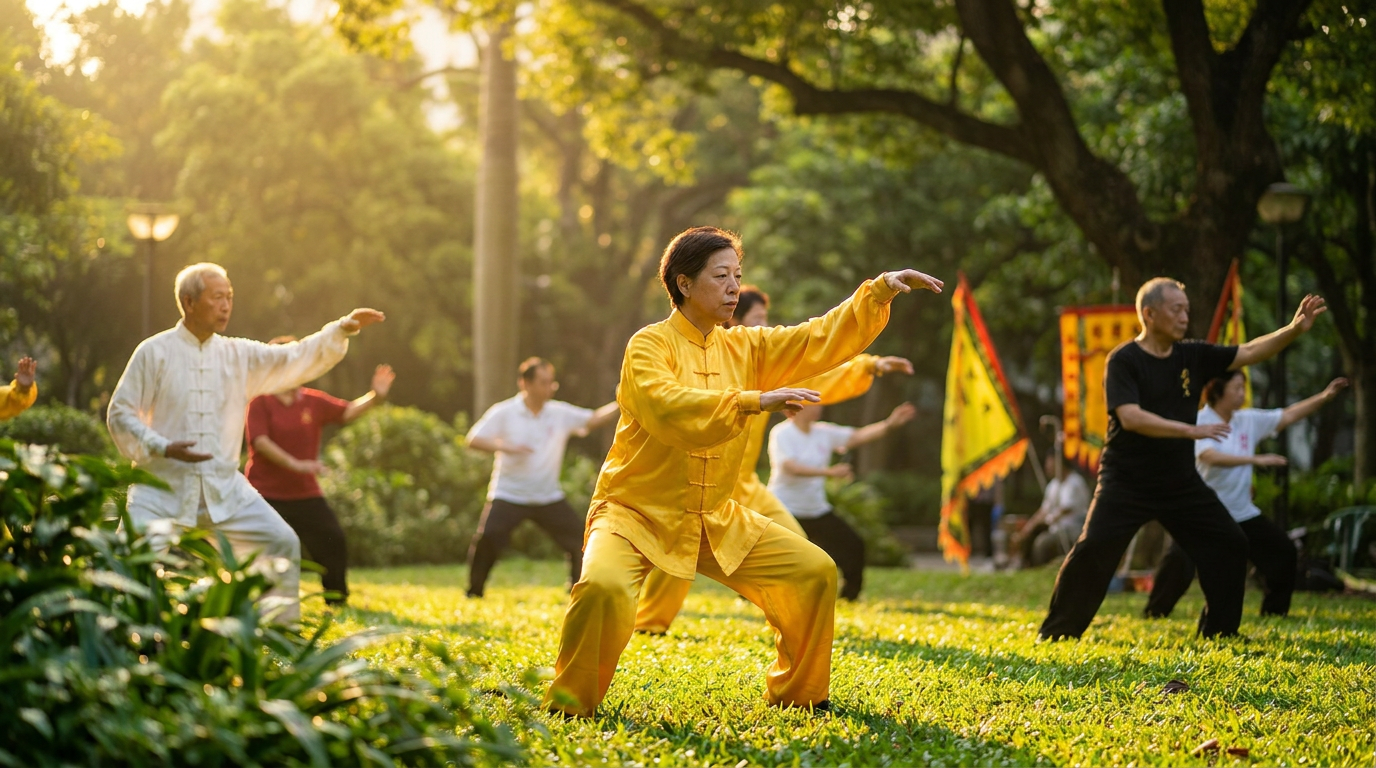
The physical demands of Tai Chi are rooted in its unique postures. Practitioners spend the majority of a session in a semi-squat position, shifting their center of gravity slowly from one leg to the other.[1]
This continuous weight-shifting requires sustained isometric and eccentric muscle contractions. Electromyography (EMG) studies demonstrate that Tai Chi activates the muscles of the lower extremities—including the erector spinae, tibialis anterior, and gastrocnemius—at significantly higher levels than normal walking.[1]

This intense neuromuscular engagement translates directly to real-world stability. A landmark meta-analysis published in BMJ Open, which reviewed data from over 3,800 participants, found that regular Tai Chi practice reduced the total incidence of falls in older adults by 31%.[4]
The protective effect against falls is so pronounced that researchers at UT Health San Antonio are currently using artificial intelligence and motion-tracking technology to develop "optimized" Tai Chi programs.[3]
By analyzing the kinematics of specific forms, these researchers aim to isolate the exact movements that best challenge dynamic balance, creating streamlined routines specifically designed to prevent falls in patients with Alzheimer's disease and related dementias.[3]

But the benefits of Tai Chi extend far beyond the muscles and joints; it is increasingly recognized as a powerful catalyst for cognitive preservation.[6]
But the benefits of Tai Chi extend far beyond the muscles and joints; it is increasingly recognized as a powerful catalyst for cognitive preservation.
Unlike repetitive exercises like jogging or cycling on a stationary bike, Tai Chi is a complex motor-learning task. It requires the practitioner to memorize long sequences of movements, maintain spatial awareness, and coordinate breath with physical motion.[6]
This intense cognitive demand triggers a biological response in the brain. Studies tracking older adults with mild cognitive impairment have found that 10 to 12 weeks of Tai Chi practice significantly elevates plasma levels of Brain-Derived Neurotrophic Factor (BDNF).[5]
BDNF is a crucial protein that acts like fertilizer for the brain, promoting the survival of existing neurons and encouraging the growth of new synapses—a process known as neuroplasticity.[5]

Advanced imaging techniques are confirming these chemical changes at a structural level. Magnetic Resonance Spectroscopy (MRS) studies conducted by researchers affiliated with Harvard Medical School have measured the concentration of specific metabolites in the brains of Tai Chi practitioners.[2]
Following a 12-week Tai Chi intervention, older adults exhibited significantly increased ratios of N-acetylaspartate to creatine (NAA/Cr) in the posterior cingulate gyrus, a key region of the brain involved in memory and emotional regulation.[2]
Because NAA is a metabolite found almost exclusively within the cell bodies of neurons, an increase in this ratio strongly suggests an increase in neuronal density, offering physical evidence that Tai Chi may help protect against age-related brain atrophy.[2]

The combination of physical load and cognitive challenge makes Tai Chi a uniquely efficient intervention. It simultaneously addresses two of the most critical threats to independence in older age: physical frailty and cognitive decline.[6]
While researchers are still working to determine the optimal "dose" of Tai Chi—investigating whether shorter, targeted routines can deliver the same benefits as mastering the traditional 24 or 108 forms—the existing evidence is clear.[3]
Far from being just a gentle pastime, Tai Chi is a rigorous, scientifically validated practice that leverages the deep connection between movement and the mind to promote a longer, healthier, and more stable life.[6]
How we got here
17th Century
Tai Chi originates in China as a martial art focused on internal energy and self-defense.
Late 20th Century
The practice gains global popularity as a gentle, low-impact exercise for health and relaxation.
2010s
Large-scale meta-analyses begin confirming Tai Chi's efficacy in significantly reducing fall rates among the elderly.
2020s
Neuroimaging and biomarker studies reveal Tai Chi's direct impact on brain structure, neuronal density, and neuroplasticity.
2025-2026
Researchers integrate AI motion tracking to isolate the specific biomechanical forms most effective for dementia patients.
Viewpoints in depth
Clinical Biomechanists
Focus on the physical load and kinematic data of Tai Chi forms.
To biomechanists, Tai Chi is a highly efficient delivery system for eccentric muscle contraction and proprioceptive training. Because practitioners maintain a lowered center of gravity and move slowly through single-leg stances, the muscles of the lower extremities—particularly the hip abductors and ankle stabilizers—experience greater time-under-tension than they do during normal walking. This physical load directly translates to improved dynamic balance and a reduced fear of falling.
Neuroscientists
Study the cognitive demands and neuroplastic responses to the practice.
Neuroscientists view Tai Chi as a complex dual-task intervention. It requires the practitioner to simultaneously manage physical balance, spatial awareness, and the memorization of long, sequential movement patterns. This cognitive load stimulates the release of neurotrophic factors like BDNF and increases neuronal density in brain regions associated with memory and executive function, offering a protective effect against age-related cognitive decline.
Public Health Officials
Emphasize the scalability and cost-effectiveness of the practice.
For public health strategists, the appeal of Tai Chi lies in its accessibility. It requires no specialized equipment, can be practiced safely by frail individuals, and scales easily in community centers. By simultaneously addressing two of the most expensive and debilitating risks of aging—falls and cognitive impairment—it represents a high-value, low-cost population health intervention.
What we don't know
- The exact minimum 'dose' of Tai Chi required to maintain cognitive benefits over years.
- Whether specific traditional forms are strictly necessary, or if simplified, optimized movements provide identical neurological benefits.
- Long-term adherence rates for older adults practicing Tai Chi outside of supervised clinical trials.
Key terms
- Neuroplasticity
- The brain's ability to reorganize itself by forming new neural connections throughout life.
- Brain-Derived Neurotrophic Factor (BDNF)
- A protein that promotes the survival of nerve cells and encourages the growth of new neurons and synapses.
- Eccentric Contraction
- The lengthening of a muscle while it is under tension, such as the quadriceps when slowly lowering into a squat.
- Proprioception
- The body's subconscious ability to sense its location, movements, and actions in physical space.
Frequently asked
Is Tai Chi better than walking for older adults?
While walking is excellent for cardiovascular health, Tai Chi provides superior benefits for dynamic balance, lower-body muscle activation, and cognitive engagement due to its complex, multi-directional movements.
How long does it take to see cognitive benefits?
Clinical studies indicate that practicing Tai Chi two to three times a week can lead to measurable increases in neuroplasticity markers like BDNF in as little as 10 to 12 weeks.
Do I need to learn all the traditional forms?
Not necessarily. Researchers are currently developing 'optimized' Tai Chi programs that isolate a handful of the most effective movements for fall prevention, making it easier to learn and practice.
Sources
Source coverage
6 outlets
3 viewpoints surfaced





[1]National Institutes of HealthClinical Biomechanists
Biomechanical analysis of Tai Chi movements and fall prevention
Read on National Institutes of Health →[2]Harvard Medical SchoolNeuroscientists
Magnetic Resonance Spectroscopy of Tai Chi Training in Older Adults
Read on Harvard Medical School →[3]UT Health San AntonioPublic Health Officials
Prescription for fall prevention: AI and Tai Chi
Read on UT Health San Antonio →[4]BMJ OpenClinical Biomechanists
Tai Chi for fall prevention in the elderly: a meta-analysis
Read on BMJ Open →[5]Sciencehood PublishingNeuroscientists
Tai Chi, Qigong, and Neurogenesis in Older Adults
Read on Sciencehood Publishing →[6]Factlen Editorial TeamPublic Health Officials
Synthesis by Factlen editorial team
Read on Factlen Editorial Team →

Every angle. Every day.
Get fitness stories with full source coverage and perspective breakdowns delivered to your inbox.