
Andy Burnham Wins Makerfield By-Election, Clearing Path for Potential Leadership Challenge
Greater Manchester Mayor Andy Burnham has won the Makerfield by-election by a decisive margin, securing the parliamentary seat required to mount a potential challenge against Prime Minister Keir Starmer.
By Factlen Editorial Team
- Leadership Change Advocates
- Argues that the party must adopt a new vision to win back working-class voters and replace a failing administration.
- International Observers
- Focuses on the instability of UK politics and the broader rise of populism in post-industrial areas.
- Establishment Continuity
- Maintains that changing prime ministers mid-term creates unnecessary national instability and ignores the 2024 mandate.
- Constitutional Analysts
- Examines the mechanics of the engineered by-election and its historical precedent.
What's not represented
- · Residents of Greater Manchester who may feel abandoned by their mayor mid-term.
- · Conservative Party leadership observing the Labour infighting.
Why this matters
The Makerfield result provides Andy Burnham with the necessary parliamentary seat to challenge Keir Starmer for the leadership of the Labour Party. If Burnham launches a successful bid, it could lead to a change in Prime Minister within weeks without a general election.
Key points
- Andy Burnham won the Makerfield by-election with 54.8% of the vote, defeating Reform UK.
- The victory gives the Greater Manchester Mayor the parliamentary seat required to run for Labour leader.
- The by-election was triggered when Labour MP Josh Simons resigned specifically to create a vacancy for Burnham.
- Prime Minister Keir Starmer faces mounting pressure to resign or face a formal leadership challenge.
- Burnham campaigned on a platform of 'Manchesterism' and ending 'trickle-down economics.'
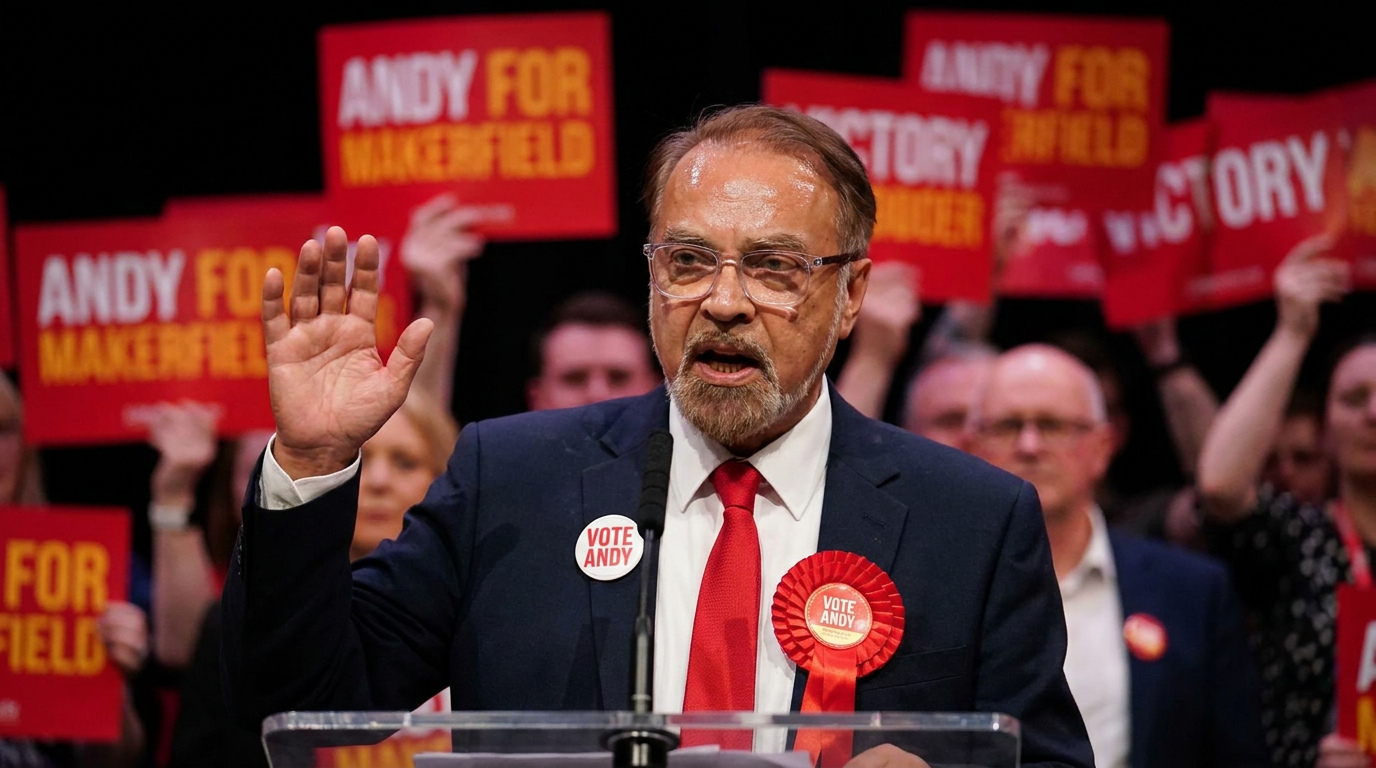
Greater Manchester Mayor Andy Burnham has decisively won the Makerfield by-election, securing the parliamentary seat he needs to mount a direct challenge against Prime Minister Keir Starmer. In a result announced early Friday morning, Burnham captured 54.8% of the vote, comfortably defeating his closest rival, Robert Kenyon of the anti-immigration Reform UK party. The victory marks a critical juncture in British politics, effectively firing the starting gun on a Labour Party leadership contest that has been brewing for weeks. By returning to the House of Commons, Burnham clears the final constitutional hurdle required to run for the premiership, transforming a local race in northwest England into an event of profound national consequence.[1][2][3]
The final tally underscored Burnham’s enduring popularity in the region, often earning him the moniker 'King of the North.' Burnham secured 24,927 votes, establishing a commanding majority of 9,231 over Kenyon, who garnered 15,696 votes for Reform UK. The newly formed hardline faction, Restore Britain, finished a distant third with 3,111 votes, while the Conservative Party languished with just under a thousand ballots. Turnout was notably high for a special election, reaching 58.75%—an increase of more than six percentage points from the 2024 general election. Political analysts noted that Burnham successfully assembled a broad anti-Reform coalition, drawing support from across the traditional political spectrum to secure his mandate.[1][6][7]

Addressing supporters in his victory speech, Burnham framed the result as a mandate for sweeping national reform rather than a mere local triumph. 'Everyone knows that politics isn't working,' Burnham declared from the podium. 'Everyone can feel that the country isn't where it should be. Tonight could—just could—be the turning point.' He warned that this was the Labour Party's 'final chance to change,' urging a departure from the divided politics that have characterized recent years. Burnham reiterated his commitment to 'Manchesterism,' a policy platform focused on ending trickle-down economics and delivering greater power and investment to post-industrial towns that have long felt forgotten by the Westminster establishment.[1][3][5]
The Makerfield contest was highly unusual, engineered specifically to facilitate Burnham’s return to national politics. The by-election was triggered in May when incumbent Labour MP Josh Simons voluntarily resigned his seat. Simons stepped down amid a growing Labour leadership crisis, explicitly stating his intention to provide Burnham with a pathway to Parliament. It marked the first time since the 1965 Leyton by-election that a parliamentary vacancy was deliberately created to parachute a non-sitting politician into the House of Commons. The maneuver required special authorization from the Labour Party’s National Executive Committee, which had previously blocked Burnham from standing in a different by-election earlier in the year.[4][6]

The Makerfield contest was highly unusual, engineered specifically to facilitate Burnham’s return to national politics.
Burnham’s ascension comes at a perilous moment for Prime Minister Keir Starmer, who has faced mounting internal pressure following a dismal showing in the May 2026 local elections. Frustration over stagnant economic growth, strained public services, and controversial diplomatic appointments has fueled an open revolt within Labour ranks. The crisis escalated when Wes Streeting resigned as Health Secretary, citing a 'vacuum' of vision at the top of the government. With Burnham now holding a seat in Parliament, the pressure on Starmer to either resign gracefully or face a bruising formal leadership challenge is expected to become overwhelming. Under the UK's parliamentary system, a change in governing party leadership automatically results in a new Prime Minister without the need for a general election.[3][4][6]
Despite the looming threat to his premiership, Starmer has publicly maintained a posture of resilience. Following the Makerfield declaration, the Prime Minister posted a brief statement on social media congratulating Burnham, asserting that voters had chosen 'Labour's campaign of hope and optimism over division and hate.' Earlier in the week, while attending the G7 summit in France, Starmer insisted he had no intention of walking away from the mandate he won in 2024. 'I will fight if there's a challenge,' he told reporters, even suggesting he would offer Burnham a prominent Cabinet role. However, allies of the Greater Manchester Mayor have firmly indicated that Burnham is not interested in serving under Starmer, setting the stage for an inevitable clash.[1][3]

While the night belonged to Burnham, the by-election also highlighted the shifting political tectonic plates in northern England. Reform UK leader Nigel Farage had framed the Makerfield race as a 'David versus Goliath battle,' pouring significant resources into the constituency. Although Reform failed to capture the seat, their 34.5% vote share confirms their status as the primary opposition to Labour in many post-industrial working-class districts. The collapse of the Conservative vote to a mere 2.2% further illustrates the realignment of the British right. For Labour strategists, Burnham’s ability to decisively beat back the Reform insurgency in Makerfield strengthens his core argument: that he possesses a unique electoral appeal capable of neutralizing the populist right.[1][3][5]
Attention now turns to Westminster, where Burnham is expected to be sworn into the House of Commons as early as Monday. Political observers anticipate a tense standoff in the coming days, with Burnham likely seeking a meeting with Starmer to demand a clear timetable for the Prime Minister's departure. If Starmer refuses to yield, Burnham’s allies are prepared to trigger the formal mechanisms for a leadership contest. Meanwhile, Burnham’s victory also sets the clock ticking in Greater Manchester; if he successfully captures the premiership, he will be forced to resign his mayoral post, triggering yet another high-stakes election in a region that has suddenly become the epicenter of British political power.[3][5][6]
How we got here
May 2026
Labour suffers poor results in local elections, sparking a leadership crisis and the resignation of Health Secretary Wes Streeting.
May 14, 2026
Labour MP Josh Simons announces his resignation to allow Andy Burnham to run for his Makerfield seat.
May 20, 2026
The Labour Party's National Executive Committee officially certifies Burnham as the candidate.
June 18, 2026
Voters in Makerfield go to the polls.
June 19, 2026
Burnham is declared the winner with a majority of over 9,000 votes.
Viewpoints in depth
Pro-Change Labour Faction
Argues that the party must adopt a new vision to win back working-class voters.
Supporters of the leadership change argue that the current administration has exhausted its political capital and failed to deliver on its 2024 mandate. They point to the collapse of the Labour vote in the May local elections as proof that the party is bleeding support to populist alternatives. For this camp, 'Manchesterism'—a platform focused on regional devolution and moving away from London-centric economic policies—represents the only viable strategy to neutralize the threat from Reform UK and re-energize the party's traditional base.
Continuity Loyalists
Maintains that changing prime ministers mid-term creates unnecessary national instability.
Allies of the current Prime Minister emphasize that the government won a decisive general election mandate just two years ago and deserves the time to implement its agenda. They view the engineered by-election as a distracting internal coup that paralyzes the government's ability to address pressing national issues like economic growth and public services. This faction warns that indulging a leadership contest now will only project an image of chaos to the electorate and international allies.
Anti-Establishment Populists
Frames the Labour infighting as evidence of a failing political consensus.
For Reform UK and other right-wing populist groups, the Makerfield result is a victory in disguise. Despite losing the seat, they captured over a third of the vote in a traditional Labour stronghold, effectively annihilating the local Conservative presence. This camp argues that the bitter leadership struggle within Labour proves the Westminster establishment is out of touch with ordinary voters. They intend to use the impending national political chaos as a recruitment tool, positioning themselves as the only stable alternative for forgotten post-industrial communities.
What we don't know
- Whether Keir Starmer will resign voluntarily or force Burnham to trigger a formal leadership contest.
- How quickly a leadership vote would take place if Starmer steps down.
- Who will succeed Burnham as Mayor of Greater Manchester, as he must resign the position if he becomes Prime Minister.
Key terms
- By-election
- An election held in a single political constituency to fill a vacancy that arises during a government's term.
- Member of Parliament (MP)
- A representative elected to the House of Commons; under Labour rules, only an MP can run for party leader.
- Manchesterism
- A political philosophy championed by Andy Burnham focusing on regional devolution, public investment, and moving away from London-centric neoliberal economics.
- Reform UK
- A right-wing, anti-immigration political party that has gained traction in post-industrial areas of the UK.
Frequently asked
Why did Andy Burnham need to win this specific election?
Under Labour Party rules, a candidate for leader must be a sitting Member of Parliament. Burnham was serving as a mayor, not an MP.
Does this mean there will be a new Prime Minister?
It is highly likely. Because Labour holds a majority in Parliament, the leader of the Labour Party automatically becomes Prime Minister without a general election.
What happens to Burnham's role as Mayor of Greater Manchester?
If Burnham becomes Prime Minister or takes a full-time role in Parliament, he will be required to step down as mayor, triggering a separate mayoral by-election.
Sources
Source coverage
7 outlets
4 viewpoints surfaced







[1]The GuardianLeadership Change Advocates
‘Astonishing’ win for Andy Burnham puts pressure on Starmer to step aside
Read on The Guardian →[2]Al JazeeraInternational Observers
Burnham by-election victory raises stakes for Starmer
Read on Al Jazeera →[3]Associated PressEstablishment Continuity
Labour's Andy Burnham wins a special election, setting up a showdown with Starmer to lead Britain
Read on Associated Press →[4]Washington PostInternational Observers
The outcome of a special election in the small working-class district of Makerfield could upend Labour Party leadership and U.K. politics
Read on Washington Post →[5]ITV NewsLeadership Change Advocates
Candidates for the Makerfield by-election are being announced in a political race which could lead to a new Prime Minister
Read on ITV News →[6]WikipediaConstitutional Analysts
2026 Makerfield by-election
Read on Wikipedia →[7]Makerfield By-Election Official SiteConstitutional Analysts
Makerfield By-Election: Thursday 18 June 2026
Read on Makerfield By-Election Official Site →
More in news politics
See all 5 stories →US-Iran Truce
US-Iran Peace Talks in Switzerland Postponed Amid Renewed Lebanon Clashes
10 sources
US-Iran Deal
US-Iran Talks in Switzerland Postponed as Trump's Peace Deal Faces Domestic and Regional Backlash
8 sources
US-Iran Deal
US-Iran Peace Talks Postponed as Regional Violence Flares and Hormuz Remains Mined
8 sources

Every angle. Every day.
Get news politics stories with full source coverage and perspective breakdowns delivered to your inbox.