
Timberwolves Acquire LaMelo Ball in Blockbuster Trade with Hornets
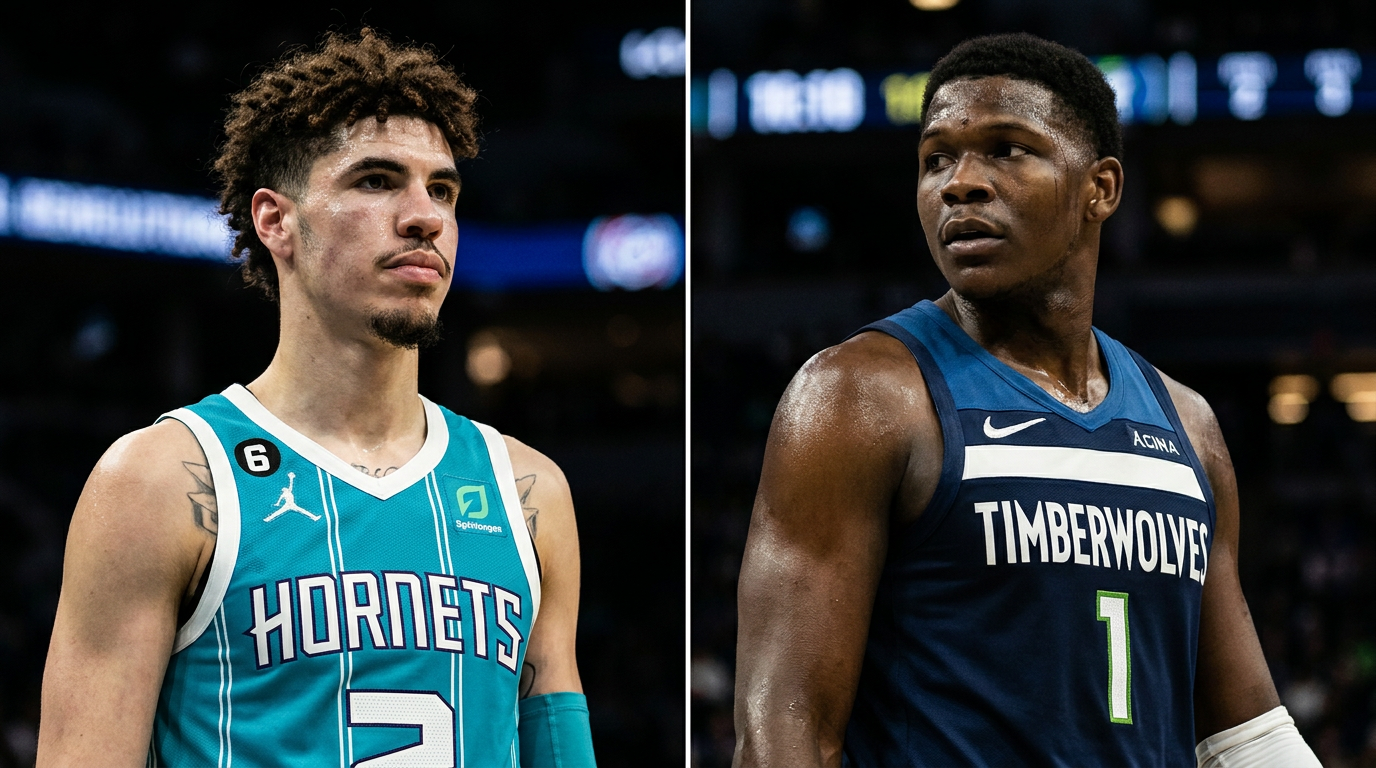
The Minnesota Timberwolves have acquired star point guard LaMelo Ball from the Charlotte Hornets in exchange for Naz Reid and a massive haul of future draft picks.
By Factlen Editorial Team
- Minnesota's Win-Now Camp
- Argues that pairing Anthony Edwards with an elite playmaker is worth the steep cost in draft capital and depth.
- Charlotte's Rebuild Strategists
- Praises the Hornets for selling high on Ball to secure a historic haul of draft assets and financial flexibility.
- Skeptical Analysts
- Questions the defensive viability of the new Timberwolves backcourt and the loss of crucial frontcourt depth.
What's not represented
- · Small-market general managers
- · Timberwolves season ticket holders
Why this matters
This blockbuster trade fundamentally shifts the balance of power in the NBA's Western Conference, pairing two of the league's brightest young stars while setting up Charlotte with unprecedented draft capital for the next decade.
Key points
- The Timberwolves acquired LaMelo Ball and Josh Green to pair with franchise cornerstone Anthony Edwards.
- Charlotte receives former Sixth Man of the Year Naz Reid and seven future draft assets, including a 2033 unprotected first-round pick.
- The trade creates an NBA-record $41 million trade exception for the Hornets, offering massive financial flexibility.
- Ball arrives in Minnesota after a healthy 72-game season, averaging 20.1 points and 7.1 assists per game.
The Minnesota Timberwolves have executed one of the most significant blockbuster trades of the NBA offseason, acquiring star point guard LaMelo Ball from the Charlotte Hornets. The deal fundamentally reshapes the Western Conference landscape, pairing Ball with franchise cornerstone Anthony Edwards to form what projects to be one of the league's most dynamic backcourts.[1][8]
In exchange for Ball and wing Josh Green, the Timberwolves are sending fan-favorite center Naz Reid and a massive haul of future draft capital to Charlotte. The Hornets will receive a 2033 unprotected first-round pick, three first-round pick swaps in 2028, 2029, and 2030, and three second-round picks in 2029, 2032, and 2033.[1][2]
The aggressive move signals Minnesota's urgent desire to maximize their current championship window. Timberwolves management had been searching for a premier ball-handler to alleviate the intense defensive pressure and double-teams that Edwards faced throughout the previous season. By acquiring Ball, Minnesota secures an elite playmaker capable of running the offense and generating transition scoring.[3][4][8]

The pairing of Edwards and Ball carries a unique historical symmetry. The two guards were born just 17 days apart and were selected first and third overall, respectively, in the 2020 NBA Draft. Now, they will share a backcourt on the same developmental timeline, both locked into long-term contracts that solidify Minnesota's core for the foreseeable future.[3][6]
Ball arrives in Minnesota coming off a highly productive and, crucially, healthy campaign. After struggling with recurring ankle injuries that limited him to just 105 games between 2022 and 2025, the 24-year-old played 72 games last season. He averaged 20.1 points, 7.1 assists, and 4.8 rebounds per game, leading the Hornets to a 44-win season and a play-in tournament berth.[3][5][6]
Ball arrives in Minnesota coming off a highly productive and, crucially, healthy campaign.
However, the acquisition comes at a steep cost for the Timberwolves. Naz Reid, who won the NBA's Sixth Man of the Year award in the 2023-24 season, had developed into a beloved figure in Minnesota and a crucial piece of their frontcourt rotation. Reid averaged 13.6 points and 6.2 rebounds last season, providing essential floor-spacing and scoring punch off the bench.[3][4][7]

Minnesota's frontcourt depth has been significantly depleted this offseason. The departure of Reid follows the team's earlier move to trade Julius Randle to the Brooklyn Nets, leaving the Timberwolves heavily reliant on Rudy Gobert and Jaden McDaniels inside. The inclusion of Josh Green in the Ball trade helps offset some rotational losses; Green is a career 38.7 percent three-point shooter who will provide valuable perimeter depth.[3][4][7]
For the Charlotte Hornets, the trade represents a stunning pivot by President of Basketball Operations Jeff Peterson. Despite the team's recent on-court success, management opted to capitalize on Ball's peak trade value rather than commit to him as the sole face of the franchise. The decision prioritizes long-term flexibility and asset accumulation over immediate contention.[3][5]
The sheer volume of draft capital acquired gives Charlotte immense optionality for the next decade. The unprotected 2033 first-round pick is particularly valuable, as it conveys long after the current iterations of both rosters will have evolved. Furthermore, the transaction creates an NBA-record trade exception of nearly $41 million for the Hornets, allowing them to absorb massive contracts in future deals without sending salary back.[2][5]

Reid is expected to step into a prominent role in Charlotte, either as a starting frontcourt anchor or a high-usage bench scorer. He joins a young core that includes recent draft picks Hannes Steinbach and Brandon Miller, who are now poised to take on larger offensive responsibilities in Ball's absence.[4]
The trade also reflects a broader trend of NBA front offices aggressively consolidating assets for star talent under the new collective bargaining agreement. By pushing their chips to the center of the table, the Timberwolves have embraced the immense pressure of championship expectations.[3][8]
As the new league year approaches in July, all eyes will be on how quickly Ball and Edwards can develop chemistry on the floor. If their contrasting styles mesh—Ball's visionary passing complementing Edwards' explosive scoring—Minnesota could boast the offensive firepower necessary to dominate the Western Conference for years to come.[6][8]
How we got here
Nov 2020
Anthony Edwards and LaMelo Ball are selected first and third overall in the NBA Draft.
April 2024
Naz Reid wins the NBA Sixth Man of the Year award for his breakout season with Minnesota.
April 2026
Ball completes a healthy 72-game season, leading the Hornets to a 44-win record and a play-in berth.
June 2026
Minnesota trades Julius Randle to Brooklyn, clearing frontcourt space and signaling a roster shakeup.
June 25, 2026
The Timberwolves and Hornets agree to a blockbuster trade sending Ball to Minnesota and Reid to Charlotte.
Viewpoints in depth
Minnesota's Win-Now Camp
Argues that pairing Anthony Edwards with an elite playmaker is worth the steep cost in draft capital and depth.
Proponents of the trade emphasize that Anthony Edwards' ascension to superstardom requires a co-star capable of running the offense and punishing double-teams. By acquiring Ball, the Timberwolves secure a visionary passer who perfectly aligns with Edwards' age and timeline. This camp believes that in the modern NBA, elite guard play dictates playoff success, making the sacrifice of future draft picks a necessary gamble to open a legitimate championship window today.
Charlotte's Rebuild Strategists
Praises the Hornets for selling high on Ball to secure a historic haul of draft assets and financial flexibility.
Supporters of Charlotte's front office view the trade as a masterstroke of asset management. Despite Ball's talent, his injury history made his supermax contract a long-term risk. By trading him after a healthy season, the Hornets extracted maximum value—seven draft assets and a record-setting $41 million trade exception. This perspective argues that the move allows Charlotte to build a more sustainable, well-rounded roster around Brandon Miller and their incoming draft picks, rather than relying on a single injury-prone star.
Skeptical Analysts
Questions the defensive viability of the new Timberwolves backcourt and the loss of crucial frontcourt depth.
Critics of the blockbuster deal point to the significant defensive questions surrounding a Ball-Edwards backcourt, noting that Ball has historically struggled to contain perimeter penetration. Furthermore, this camp highlights the immense loss of Naz Reid, whose floor-spacing and scoring were vital to Minnesota's second unit. Skeptics argue that by trading away Reid and mortgaging their draft future until 2033, the Timberwolves have severely depleted their depth and margin for error, leaving them vulnerable against larger, more physical Western Conference opponents.
What we don't know
- How quickly Ball and Edwards will develop on-court chemistry and balance their offensive usage.
- Whether Minnesota's depleted frontcourt depth will hold up against larger Western Conference opponents.
- How the Hornets plan to utilize their record-setting $41 million trade exception in future transactions.
Key terms
- Pick Swap
- The right for a team to exchange its own draft pick with another team's pick in the same round if the other team's pick is higher.
- Trade Exception
- A salary cap mechanism allowing a team that trades away more salary than it takes back to absorb future contracts up to that difference.
- Unprotected Pick
- A traded draft pick that conveys to the receiving team regardless of where it lands in the lottery, offering maximum value.
Frequently asked
Who did the Timberwolves give up for LaMelo Ball?
Minnesota traded fan-favorite center Naz Reid, a 2033 unprotected first-round pick, three first-round pick swaps, and three second-round picks.
Why did Charlotte trade their franchise star?
The Hornets capitalized on Ball's healthy season to acquire a massive haul of seven draft assets and create financial flexibility for a long-term rebuild.
How does this impact Anthony Edwards?
The trade pairs Edwards with an elite playmaker in Ball, alleviating the double-teams Edwards faced and creating one of the NBA's most dynamic young backcourts.
Sources
Source coverage
8 outlets
3 viewpoints surfaced








[1]ESPNSkeptical Analysts
Sources: Hornets' Ball to Wolves for Reid, picks
Read on ESPN →[2]AP NewsSkeptical Analysts
Hornets trade LaMelo Ball, Josh Green to Timberwolves for Naz Reid, draft picks
Read on AP News →[3]Sports IllustratedCharlotte's Rebuild Strategists
Hornets Make Stunning Decision to Trade LaMelo Ball to Minnesota Timberwolves
Read on Sports Illustrated →[4]NBC SportsMinnesota's Win-Now Camp
Timberwolves acquire LaMelo Ball in blockbuster trade with Hornets
Read on NBC Sports →[5]Hoops RumorsCharlotte's Rebuild Strategists
Hornets To Trade LaMelo Ball To Timberwolves
Read on Hoops Rumors →[6]TSNMinnesota's Win-Now Camp
Report: Charlotte Hornets trade Lamelo Ball to Minnesota Timberwolves
Read on TSN →[7]CBS NewsSkeptical Analysts
Timberwolves trade Naz Reid to Hornets for LaMelo Ball and Josh Green
Read on CBS News →[8]BasketNewsMinnesota's Win-Now Camp
LaMelo Ball trade to Timberwolves: Full details revealed
Read on BasketNews →
More in sports
See all 11 stories →Tactics
The Swiss Watch: How Murat Yakin Built a Chameleon System for the 2026 World Cup
6 sources
Storyline
The Resurrection Culture: How Emerse Faé Built Côte d'Ivoire's Unbreakable Mentality for the 2026 World Cup
7 sources
History
The Giant Killers: How World Cup Expansions Forged Football's Greatest Underdog Stories
5 sources
Tactics
The Fluid Front: How Vincenzo Montella Built Turkiye's Strikerless System for the 2026 World Cup
7 sources
Every angle. Every day.
Get sports stories with full source coverage and perspective breakdowns delivered to your inbox.