
The 12th Man: How Host Nations Have Historically Overperformed at the FIFA World Cup
From Uruguay's inaugural triumph in 1930 to Korea Republic's stunning 2002 semi-final run, playing on home soil has historically provided a massive statistical and psychological boost at the FIFA World Cup.
By Factlen Editorial Team
- Sports Historians
- Focuses on the legacy, cultural impact, and narrative romance of host nations achieving historic victories on home soil.
- Statistical Analysts
- Examines the quantifiable metrics of the home advantage, including win percentages, historical data trends, and performance bumps.
- Sports Psychologists
- Analyzes the mental and physiological drivers behind the '12th man' effect, balancing the emotional lift against the burden of expectation.
What's not represented
- · Current international players detailing the specific physical toll of away travel
- · Referees discussing the historical pressure of officiating in front of massive home crowds
Why this matters
Understanding the historical power of the host advantage provides crucial context for how tournaments unfold, revealing that a nation's passionate support can physically and psychologically elevate a team beyond its baseline talent level.
Key points
- Six different host nations have won the World Cup throughout the tournament's history.
- The 'host bump' frequently propels underdog nations to historic finishes, such as Sweden's run to the final in 1958.
- Academic studies attribute the home advantage to a mix of physiological benefits, like lack of travel fatigue, and psychological boosts from the crowd.
- Co-hosting has also proven effective, as seen in 2002 when both Japan and Korea Republic achieved historic milestones on home soil.
- While usually an advantage, the immense pressure of a home crowd can sometimes become a psychological burden for heavy favorites.
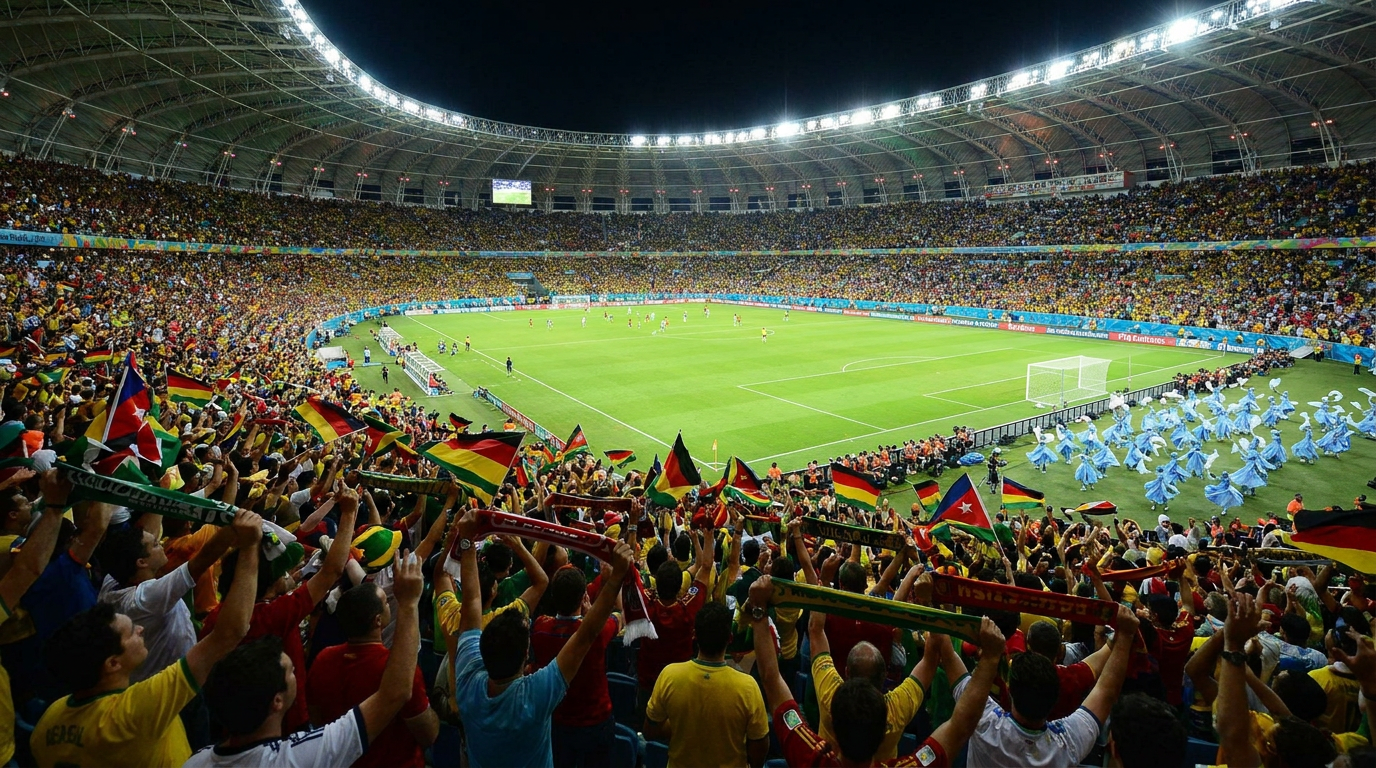
The FIFA World Cup is a traveling festival, a quadrennial gathering that shifts across continents and cultures. But for the nation that opens its doors to the globe, the tournament is something far more profound than a logistical exercise. Playing on home soil transforms a football team, turning stadiums into fortresses and crowds into engines of momentum.[4]
Across the nearly century-long history of the competition, the 'host bump' stands as one of the most reliable statistical anomalies in international sports. It is a phenomenon that has repeatedly disrupted established hierarchies and propelled underdog nations to unimaginable heights.[2]
The raw numbers paint a compelling picture of this advantage. Six times in the history of the competition, the host nation has navigated the immense pressure to lift the most coveted trophy in sports.[1][3]
This tradition of home dominance began at the very inception of the tournament. In 1930, Uruguay leveraged the passionate, deafening crowds in Montevideo to become the first-ever world champions, setting a precedent that would echo through the decades.[3][5]

In 1966, England rode the wave of a roaring Wembley Stadium to their finest footballing hour. The familiar surroundings and the unified voice of the nation provided the backdrop for a historic triumph that remains the pinnacle of English football.[1]
Eight years later, in 1974, West Germany utilized their home advantage to overcome a revolutionary Netherlands side. Playing in Munich, the German squad found an extra gear, proving that tactical brilliance can be matched by the sheer willpower generated by a home crowd.[3][5]
The pattern continued in 1978, as Argentina, propelled by the swirling ticker-tape storms of Estadio Monumental in Buenos Aires, captured their first star. The atmosphere was widely cited by players as a physical force that drove them forward in the tournament's dying moments.[1][5]
The most recent host to win the tournament outright was France in 1998. The team united a nation, drawing immense energy from the Parisian crowds to secure a historic victory that reshaped the country's footballing identity.[1][3]
But the host advantage is not solely about winning the ultimate prize; it is equally visible in the Cinderella runs of teams that punch far above their historical weight when playing within their own borders.[4]

Sweden, a nation with a proud but modest footballing pedigree, reached the final in 1958 when they hosted the tournament. The familiar climate and fervent local support helped them navigate a grueling bracket to reach the ultimate match.[3]
Sweden, a nation with a proud but modest footballing pedigree, reached the final in 1958 when they hosted the tournament.
The most dramatic modern example of the host bump occurred in 2002, during the first co-hosted World Cup. The tournament proved that the home advantage could be successfully split across multiple nations.[1]
Korea Republic, backed by the deafening 'Red Devils' supporters, embarked on a miraculous run to the semi-finals. The energy in the stadiums was palpable, driving the team to historic victories that captivated the globe.[3][5]
Japan, sharing hosting duties that same year, also experienced a massive surge in performance. They won their group and reached the knockout stages for the first time in their history, validating the power of the home crowd.[3]
What exactly creates this advantage? Academic studies point to a complex confluence of physiological, psychological, and environmental factors that tip the scales in favor of the home side.[2][6]

Physiologically, host nations are spared the grueling travel schedules, jet lag, and climate adaptation that visiting teams must endure. They sleep in familiar beds, train at familiar facilities, and operate in their natural time zones.[6]
Psychologically, the '12th man' effect is highly quantifiable. Data shows that players competing in front of a home crowd cover more ground, execute more high-intensity sprints, and recover faster between matches due to adrenaline surges.[2][6]
However, the home crowd can also become a crushing burden if expectations are not managed. Brazil, the most successful nation in the tournament's history, has hosted twice and suffered traumatic national heartbreak both times, proving that home soil can sometimes feel like quicksand.[4][5]
For nations with a history of hosting, the historical data remains incredibly encouraging. Mexico hosted the tournament in 1970 and 1986, reaching the quarter-finals on both occasions—which remain their highest ever finishes in the competition.[1][3]

Similarly, the United States hosted in 1994, advancing to the knockout rounds and setting overall attendance records that remained untouched for decades, sparking a domestic soccer boom in the process.[1][5]
As the tournament continues to evolve, expand, and explore new frontiers, the historical record remains clear. Tactical blueprints and superstar rosters are vital, but the roar of the home crowd is a force multiplier unlike any other in international football.[4]
How we got here
1930
Uruguay hosts and wins the inaugural World Cup, establishing the power of the home advantage.
1966
England lifts their first and only World Cup trophy at Wembley Stadium in London.
1998
France becomes the most recent sole host nation to win the tournament outright.
2002
Korea Republic and Japan successfully share the host advantage, both reaching historic milestones in the first co-hosted tournament.
Viewpoints in depth
The Historical Romance View
Views the host advantage as the magical, unquantifiable soul of the tournament that creates legendary narratives.
Sports historians often frame the host advantage not as a statistical anomaly, but as the very essence of the World Cup's magic. From the ticker-tape of Buenos Aires in 1978 to the unifying triumph of Paris in 1998, these moments are viewed as cultural milestones where a nation's identity merges with its football team. This perspective argues that the emotional resonance of a home victory transcends the sport, creating generational memories that define the tournament's legacy.
The Analytical View
Strips away the emotion to focus on the hard data, travel logistics, and physiological metrics that favor the home side.
Statistical analysts and sports scientists approach the host bump as a measurable equation. They point to data showing that host teams benefit from zero timezone disruption, familiar climate conditions, and optimized recovery protocols. Furthermore, tracking data indicates that players spurred on by a home crowd consistently register higher high-intensity sprint distances. For analysts, the 'magic' of the home crowd is simply the biological result of adrenaline and optimal physiological preparation.
The Psychological View
Examines the delicate balance between the empowering energy of a home crowd and the crushing weight of national expectation.
Sports psychologists emphasize that the host advantage is a double-edged sword. While the '12th man' effect can elevate a good team to greatness, it can also paralyze a team under the weight of expectation. They cite Brazil's traumatic experiences hosting the tournament as proof that when the desire to win morphs into a fear of disappointing the nation, the home stadium can become an incredibly hostile environment for the host players themselves.
What we don't know
- Whether the expansion to 48 teams will dilute or amplify the traditional host advantage.
- How the unprecedented scale of travel across three massive North American nations will impact the physiological benefits typically enjoyed by hosts.
- If modern tactical parity and advanced sports science have permanently narrowed the gap created by playing on home soil.
Key terms
- 12th Man
- A term used to describe the home fans in a football stadium, whose vocal support provides a psychological advantage equivalent to having an extra player on the pitch.
- Host Bump
- The statistical phenomenon where a national team performs significantly better in a tournament they are hosting compared to their historical average in away tournaments.
- Knockout Stages
- The phase of the tournament following the group stage, where teams face single-elimination matches to advance toward the final.
Frequently asked
How many host nations have won the World Cup?
Six host nations have won the tournament: Uruguay (1930), Italy (1934), England (1966), West Germany (1974), Argentina (1978), and France (1998).
What is the '12th man' effect?
The '12th man' refers to the psychological and physiological boost a team receives from a passionate home crowd, often resulting in players covering more ground and sprinting faster.
Have co-hosts ever benefited from the home advantage?
Yes, in 2002, co-hosts Korea Republic and Japan both experienced massive performance boosts, with Korea Republic reaching the semi-finals and Japan winning their group.
Sources
Source coverage
6 outlets
3 viewpoints surfaced






[1]FIFA Historical ArchivesSports Historians
FIFA World Cup Historical Host Performances
Read on FIFA Historical Archives →[2]Journal of Sports SciencesSports Psychologists
Quantifying the Home Advantage in International Football
Read on Journal of Sports Sciences →[3]Rec.Sport.Soccer Statistics Foundation (RSSSF)Statistical Analysts
World Cup History and Statistics
Read on Rec.Sport.Soccer Statistics Foundation (RSSSF) →[4]Factlen Editorial TeamStatistical Analysts
Synthesis by Factlen editorial team
Read on Factlen Editorial Team →[5]Encyclopedia BritannicaSports Historians
World Cup History, Winners, and Legacy
Read on Encyclopedia Britannica →[6]International Journal of Sports PsychologySports Psychologists
Psychological Drivers of the 12th Man Effect in Major Tournaments
Read on International Journal of Sports Psychology →

More in sports
See all 21 stories →Injury
Progress on the Diamond: Bieber, Rutschman, and Bregman Clear Major Rehab Hurdles
8 sources

Standings
Late June Baseball Standings: Milwaukee Brewers Set Pace as NPB Central League Enters Three-Way Tie
6 sources

Injury
Stefan Bajcetic Cleared for Liverpool Pre-Season After Two-Year Injury Nightmare
6 sources

Standings
Palmeiras Builds Formidable Lead in 2026 Brasileirão Standings Ahead of World Cup Break
6 sources

Every angle. Every day.
Get sports stories with full source coverage and perspective breakdowns delivered to your inbox.