
The Science of Macrophage Synapses: How Immune Cells Use Calcium to Jump-Start Muscle Repair in Seconds
A breakthrough discovery reveals that immune cells form neuron-like connections with damaged muscle fibers, delivering rapid calcium pulses to trigger cellular repair within seconds.
By Factlen Editorial Team
- Immunologists & Cell Biologists
- Focus on the groundbreaking revelation that immune cells can act like neurons, fundamentally blurring the lines between the body's systems.
- Sports Medicine Researchers
- Evaluate how this rapid repair mechanism challenges traditional recovery protocols, particularly the use of anti-inflammatories.
- Clinical Neuromuscular Specialists
- View the discovery as a potential therapeutic pathway for treating chronic muscle-wasting conditions like muscular dystrophy.
What's not represented
- · Physical Therapists
- · Athletic Trainers
Why this matters
Understanding that the immune system directly 'wires' into our muscles to trigger instant repair fundamentally changes how we view exercise recovery. It suggests that aggressively suppressing post-workout inflammation with ice or painkillers might actually block the body's fastest healing mechanism.
Key points
- Macrophages form physical, neuron-like synapses with damaged muscle fibers.
- The immune cells deliver calcium directly into the muscle to seal membrane tears.
- This rapid repair mechanism triggers electrical activity in the muscle within 10 to 30 seconds.
- The discovery challenges the traditional view of the immune system as merely a slow 'cleanup crew'.
- The mechanism successfully promoted healing in both acute injury and chronic muscle-wasting models.
The fundamental equation of fitness is simple: apply stress, incur microscopic damage, and allow the body to rebuild the tissue stronger than before. Whether you are executing a heavy deadlift, pushing through a deep flexibility stretch, or running a marathon, the mechanical tension creates micro-tears in the muscle fibers. For decades, sports scientists and cellular biologists believed they understood exactly how the body handled this damage. The immune system was viewed as a secondary cleanup crew, arriving slowly to clear out cellular debris and secrete generalized inflammatory signals to stimulate rebuilding.
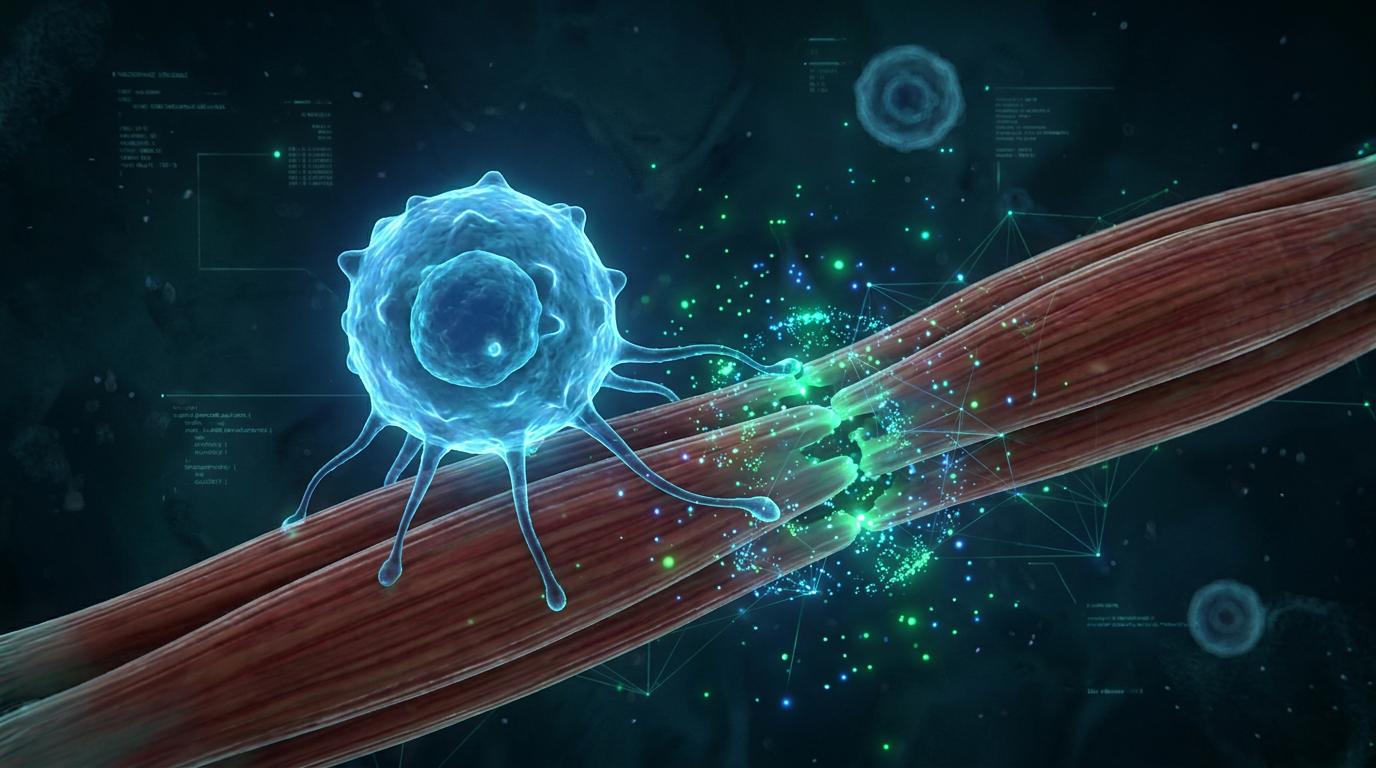
But a groundbreaking discovery has completely rewritten the timeline and the mechanics of muscle recovery. Researchers have found that the immune system does not just passively bathe damaged muscles in inflammatory chemicals. Instead, specific immune cells physically wire themselves into the muscle fibers, acting almost exactly like the nervous system to jump-start the repair process in a matter of seconds.[1][2]
The paradigm shift stems from a study published in the journal Current Biology by researchers at Cincinnati Children's Hospital. The team, led by Dr. Gyanesh Tripathi and Dr. Michael Jankowski, was originally investigating how the immune system modulates pain after tissue damage. What they found instead was a hidden biological mechanism that blurs the line between immunology and neurology.[1][4]
The central actors in this discovery are macrophages—a type of white blood cell whose name literally translates to "big eater." Historically, macrophages have been characterized as the microscopic garbage trucks of the immune system, responsible for engulfing dead cells and foreign pathogens. While they do perform this vital cleanup role, the new research reveals they possess a hidden, highly sophisticated capability: they can form "synaptic-like" contacts with muscle cells.[3][4]

A synapse is the microscopic gap where a neuron passes an electrical or chemical signal to another cell, a feature previously thought to be the exclusive domain of the nervous system. Yet, using advanced intravital imaging, the researchers watched in real-time as infiltrating macrophages flocked to the site of a muscle micro-tear and physically docked onto the damaged myofiber, creating a direct communication channel.[1][6]
Once docked, the macrophage does not wait hours or days to initiate repair. Instead, it delivers a concentrated payload of calcium ions directly into the muscle fiber. In cellular biology, calcium is the universal trigger for action. In muscle cells, a sudden influx of calcium is the signal that forces the cell membrane to rapidly seal itself, preventing the cell from dying after a mechanical tear.[2][3]
The speed of this macrophage-induced calcium flash is staggering. The researchers noted that within 10 to 30 seconds of the macrophage activating, a burst of electrical activity could be detected inside the damaged muscle. The immune cell was literally shocking the muscle fiber into repairing its own membrane. "You can activate the macrophage and make the muscle twitch subtly almost immediately," Dr. Jankowski noted, highlighting the neuron-like speed of the interaction.[3][4]
The speed of this macrophage-induced calcium flash is staggering.
To prove this was happening, the team utilized chemogenetics—a technique where cells are engineered to respond to a specific designer drug. By delivering a chemical that selectively activated the macrophages in live mice, the researchers could trigger the calcium delivery on command. Electromyography (EMG) recordings confirmed that the muscle tissue responded with low-level electrical activity the moment the macrophages fired.[1][6]
For the fitness and sports medicine communities, this mechanism explains a long-standing mystery regarding how muscles survive the intense mechanical shearing of eccentric exercise and deep flexibility training. When a muscle is stretched under load, the cell membranes are subjected to immense physical stress. The ability of macrophages to instantly patch these microscopic leaks explains why our muscles do not simply break down completely after a heavy workout.

This discovery also casts a critical new light on popular recovery protocols. For years, athletes have relied on non-steroidal anti-inflammatory drugs (NSAIDs) like ibuprofen, or aggressive cold-water immersion (ice baths), to blunt the immune response and reduce post-workout soreness. However, if infiltrating macrophages are responsible for the crucial 30-second calcium flash that seals torn membranes, suppressing their arrival could actively hinder the most critical phase of muscle repair.[2]
The implications extend far beyond the gym. The researchers tested this synaptic repair mechanism in two distinct models: acute physical injury (akin to a sports tear) and chronic muscle wasting (akin to muscular dystrophy). Remarkably, the macrophage synapse functioned in both scenarios. In the disease model, the immune cells still flocked to the deteriorating tissue and induced waves of muscle fiber activity.[3][4]
The results in the chronic damage models were highly encouraging. Ten days after the macrophage activity was stimulated, the treated subjects showed significantly larger numbers of new, healthy muscle fibers compared to the control group. This suggests that the immune system's synaptic repair mechanism could eventually be harnessed as a therapeutic target for degenerative muscle diseases, not just athletic recovery.[4]

Despite the breakthrough, several mysteries remain. The researchers initially embarked on the study hoping to find a way to reduce pain signaling, but they discovered that while the macrophage synapse accelerates physical repair, it does not numb the associated pain. The biological reason why the body separates the structural repair signal from the pain sensation is still an open question for neurologists.[3][4]
Furthermore, scientists are now trying to understand exactly how the circulating macrophages know precisely where to dock. A muscle fiber is massive on a cellular scale; finding a microscopic tear in the membrane and forming a synapse at that exact location requires a highly specific homing signal that has yet to be fully mapped.[6]
As sports science continues to digest these findings, the narrative around the immune system is shifting. Inflammation is no longer viewed merely as a painful side effect of training that needs to be minimized. Instead, the immune system is being recognized as an active, high-speed architect of human performance.[2][5]

Future research will likely explore whether certain nutritional interventions or recovery modalities can enhance this macrophage-to-muscle synaptic connection. If scientists can find a way to optimize this calcium delivery without triggering excessive systemic inflammation, it could unlock new frontiers in both athletic longevity and physical therapy.[5]
Ultimately, the discovery of the macrophage synapse proves that the human body is far more interconnected than traditional biology textbooks suggest. Our immune cells are not just passive sweepers of debris; they are dynamic, neuron-like operators that physically wire themselves into our muscles to keep us moving, adapting, and growing stronger.[3]
How we got here
Pre-2025
Macrophages are widely understood primarily as phagocytic cells that clean up debris and secrete inflammatory cytokines over hours or days.
Nov 2025
Researchers at Cincinnati Children's Hospital publish findings in Current Biology revealing the synaptic-like connections between macrophages and muscle fibers.
Early 2026
The sports science and clinical communities begin re-evaluating recovery protocols and muscular dystrophy treatments based on the rapid calcium-signaling mechanism.
Viewpoints in depth
Cellular Biologists
Focus on how the discovery blurs the traditional boundaries between the immune and nervous systems.
For cellular biologists, the revelation that a circulating immune cell can form a synapse is a paradigm-shifting event. Textbooks have long taught that synapses are the exclusive domain of neurons, used for rapid electrical and chemical communication across a fixed network. The idea that a mobile white blood cell can navigate through tissue, find a microscopic breach in a muscle membrane, and temporarily wire itself into the cell to deliver a calcium payload suggests that the immune system possesses a level of real-time, localized control previously thought impossible.
Sports Scientists
Evaluate the practical implications for exercise recovery and the potential downsides of anti-inflammatory protocols.
Sports medicine researchers are viewing this mechanism as the missing link in understanding how muscles survive the extreme mechanical stress of heavy lifting and deep stretching. If the body relies on this 30-second calcium flash to seal micro-tears, it fundamentally challenges the widespread use of NSAIDs and ice baths immediately post-workout. By artificially blunting the infiltration of macrophages to reduce soreness, athletes may inadvertently be blocking the very cells required to execute the fastest and most critical phase of structural repair.
Clinical Researchers
Explore the therapeutic potential of harnessing macrophage synapses to treat degenerative muscle diseases.
For researchers focused on conditions like muscular dystrophy, the fact that this synaptic repair mechanism functions in chronic disease models is highly promising. In these diseases, muscle membranes are inherently fragile and constantly leaking. If clinical therapies can be developed to safely upregulate this macrophage-to-muscle calcium delivery without triggering a runaway inflammatory response, it could provide a novel way to preserve muscle mass and slow the progression of debilitating neuromuscular disorders.
What we don't know
- It remains unclear exactly what homing signal the muscle fiber releases to guide the macrophage to the precise microscopic location of the membrane tear.
- Researchers do not yet understand why this rapid, synaptic-like repair mechanism does not simultaneously reduce the sensation of pain in the damaged tissue.
- It is unknown if specific nutritional interventions or supplements can safely enhance this macrophage calcium-delivery process.
Key terms
- Macrophage
- A type of white blood cell that engulfs cellular debris and, as newly discovered, physically docks with muscle cells to trigger repair.
- Synapse
- A microscopic junction where a cell passes an electrical or chemical signal to another cell, traditionally associated only with the nervous system.
- Myofiber
- A single, elongated muscle cell that contracts to generate force and is susceptible to microscopic tears during exercise.
- Calcium Transient
- A rapid, temporary increase in intracellular calcium that acts as a signaling mechanism to trigger cellular events like membrane repair.
- Chemogenetics
- A laboratory technique where cellular receptors are engineered to respond exclusively to a specific, designer drug, allowing researchers to activate specific cells on command.
Frequently asked
Does this mean I shouldn't take ibuprofen after a workout?
While occasional use is fine, sports scientists increasingly warn that routinely taking NSAIDs (like ibuprofen) can blunt the immune system's ability to infiltrate the muscle and execute these rapid, necessary repairs.
How fast does this cellular repair happen?
Once the macrophage docks to the damaged muscle fiber, it delivers a pulse of calcium that triggers electrical activity and membrane sealing within 10 to 30 seconds.
Can this help people with muscular dystrophy?
Yes, early animal models showed that stimulating this macrophage synapse mechanism in diseased muscles resulted in a larger number of healthy muscle fibers after 10 days.
Sources
Source coverage
6 outlets
3 viewpoints surfaced




[1]Current BiologyImmunologists & Cell Biologists
Synaptic-like coupling of macrophages to myofibers regulates muscle repair
Read on Current Biology →[2]ScienceDailySports Medicine Researchers
Immune Cells Jump-Start Muscle Repair via Neuron-Like Signals
Read on ScienceDaily →[3]SciTechDailyClinical Neuromuscular Specialists
A Neuron-Like Repair System Revealed in Muscle Tissue
Read on SciTechDaily →[4]News-MedicalClinical Neuromuscular Specialists
Scientists discover shared mechanism that speeds muscle repair
Read on News-Medical →[5]Cincinnati Children's HospitalImmunologists & Cell Biologists
Novel Functions of Immune Cells in Muscle Repair
Read on Cincinnati Children's Hospital →[6]National Institutes of HealthImmunologists & Cell Biologists
Peripheral injury responses essential for muscle repair and nociception
Read on National Institutes of Health →

Every angle. Every day.
Get fitness stories with full source coverage and perspective breakdowns delivered to your inbox.