
One Year Later: The World's First Bladder Transplant Patient is Thriving
A groundbreaking surgical technique has allowed a 43-year-old cancer survivor to regain full urinary function, proving that fully vascularized bladder transplants are viable in humans.
By Factlen Editorial Team
- Surgical Innovators
- Emphasizes the technical breakthrough of vascularizing the bladder and establishing a reproducible operative protocol.
- Clinical Researchers
- Focuses on the empirical evidence, capacity benchmarks, and the rigorous documentation of both successes and complications.
- Patient Advocates
- Highlights the dramatic improvement in quality of life and the psychological impact of escaping dialysis and catheter dependence.
What's not represented
- · Organ Procurement Organizations
- · Pediatric Nephrologists
Why this matters
For decades, patients with terminal bladder disease had to rely on artificial reservoirs made from their own intestines, leading to chronic infections and kidney damage. Proving that a true, vascularized bladder can be successfully transplanted opens the door to a genuine cure, promising to restore normal urinary function and independence for thousands of patients.
Key points
- A 43-year-old cancer survivor became the first human to receive a fully vascularized bladder transplant, alongside a new kidney.
- The procedure bypassed the traditional method of building a makeshift bladder out of intestinal tissue, which often causes chronic infections.
- At the six-month mark, the patient's new bladder reached a normal, healthy capacity of 600 milliliters.
- The patient is now completely off dialysis, free from catheters, and has returned to work and normal family life.
- The surgical team has performed two additional transplants and plans to eventually expand the procedure to pediatric patients.
One year ago, Oscar Larrainzar became the first human to receive a fully vascularized bladder transplant.[1][3]
Now, a peer-reviewed study published in The Lancet has chronicled his six-month and one-year outcomes, confirming the experimental procedure's overwhelming success.[2][4]
For decades, bladder transplants were deemed medically impossible. The pelvic cavity contains a highly complex web of microscopic blood vessels, making it exceedingly difficult to establish a reliable blood supply to a donor organ without the tissue dying.[1][6]
Because of this anatomical hurdle, the standard of care for patients with terminal bladder disease has been the construction of a "neobladder." Surgeons would remove a segment of the patient's own intestine and fashion it into a makeshift pouch to hold urine.[5][7]
However, this workaround comes with severe drawbacks. The human intestine is biologically designed to absorb substances, while the bladder is designed to excrete them. This fundamental mismatch frequently leads to chronic bacterial infections, severe metabolic imbalances, and a high risk of long-term kidney damage.[1][5]

Larrainzar, a 43-year-old father of four, knew these complications well. He had survived a rare form of bladder cancer and renal cancer, which necessitated the removal of both his kidneys and the majority of his bladder. For seven years, he was tethered to dialysis machines and relied on external medical equipment just to survive.[3][4]
To offer patients like Larrainzar a better option, Dr. Nima Nassiri of UCLA Health and Dr. Inderbir Gill of USC spent years developing a new approach. They conducted extensive preclinical research, practicing complex robotic retrievals on animal models and cadavers, often working in the middle of the night to perfect the technique.[1][6]
Their breakthrough was treating the bladder as a standalone, fully vascularized organ. Instead of repurposing intestinal tissue, the surgical team prepared to transplant a true donor bladder alongside a donor kidney, preserving the organ's native architecture and blood flow.[2][5]
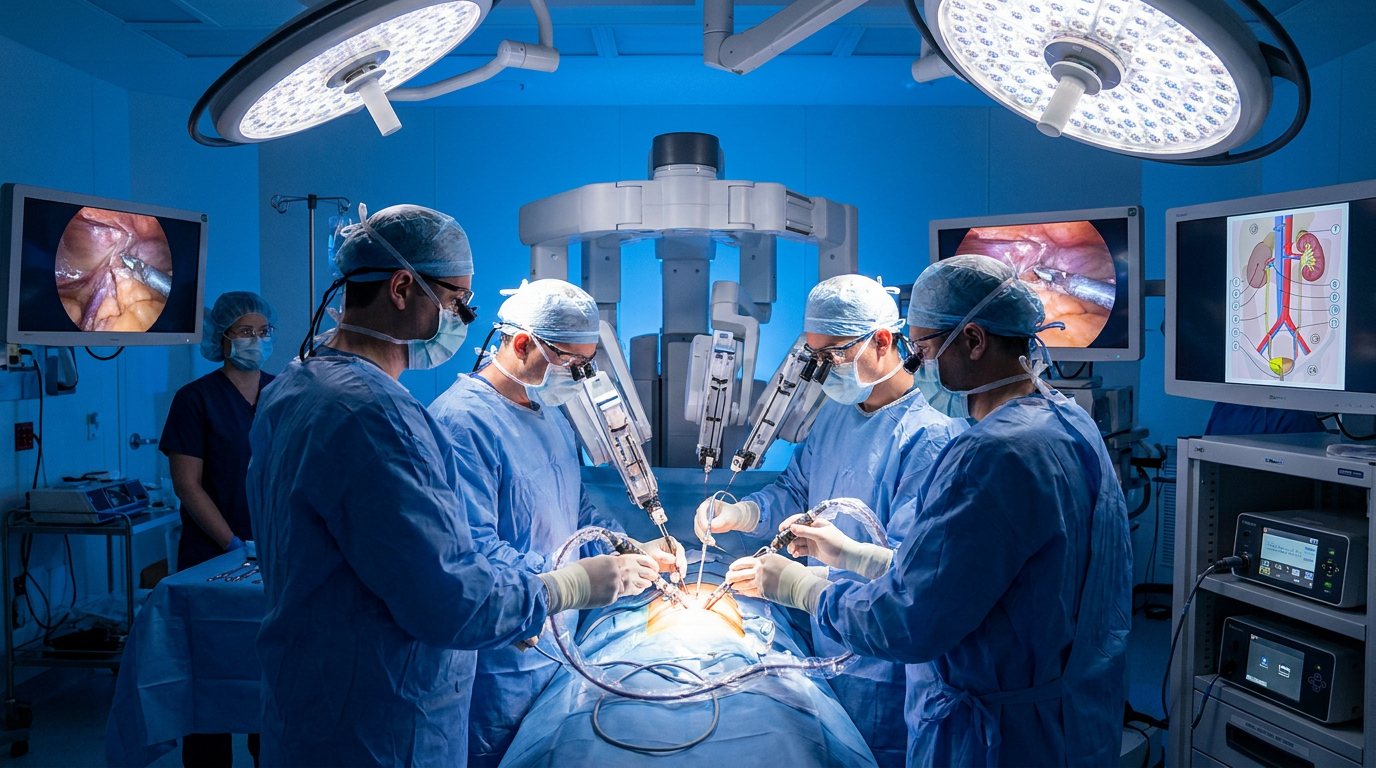
On May 4, 2025, the team put their protocol to the test in an eight-hour operation. They first transplanted the donor kidney, and then meticulously connected the donor bladder's delicate blood vessels directly to Larrainzar's pelvic blood supply.[3][7]
On May 4, 2025, the team put their protocol to the test in an eight-hour operation.
The results were immediate. As soon as blood flow was restored, the new kidney began producing a large volume of urine, which drained perfectly into the newly vascularized bladder.[1][7]
Because this was a first-in-human trial, the surgical team had to invent the clinical benchmarks for success. According to the data published in The Lancet, the primary 30-day goal was for the new bladder to safely hold 200 milliliters of urine.[2][4]
Larrainzar easily surpassed that metric, reaching a capacity of 270 milliliters by day 30. By the six-month mark, his bladder had stretched to accommodate 600 milliliters—roughly 20 ounces—which is the full capacity of a normal, healthy adult bladder.[4][5]

The recovery process was heavily scrutinized for the study, and the researchers were transparent about the hurdles. On day 25, Larrainzar developed a localized infection caused by a urine leak from a secondary "suprapubic" tube, which had been inserted through his abdomen as a backup drain.[4]
Dr. Nassiri performed a minor follow-up procedure to close the leak and remove the tube. By studying this specific complication, the surgical team determined that future transplants can safely omit these secondary backup tubes entirely, streamlining the postoperative recovery protocol.[1][4]
The human impact of the surgery has been profound. Today, Larrainzar is completely off dialysis, working full-time, and free from catheters. He recently took a family vacation to Las Vegas, where he was able to swim with his 10-year-old daughter for the first time since she was an infant.[3][4]

While Larrainzar's case is a historic triumph, the procedure remains strictly experimental. The operation was part of an ongoing phase-zero clinical trial at UCLA Health designed to rigorously test the feasibility of combined kidney-bladder transplants.[5][6]
The reality of experimental medicine means not every outcome is perfect. The team has since performed a second combined transplant, but the patient experienced a complication that required the new bladder to be removed. Fortunately, the patient's new kidney continues to function well, and the team is planning a rare re-transplant attempt later this year.[1][4]
A third patient, who received the combined transplant more recently, is currently two months post-surgery and is already urinating independently without the need for a catheter, reinforcing the procedure's overall viability.[1]
With two additional surgeries planned for the remainder of 2026, the surgical team is looking toward the future. Dr. Nassiri has stated that the ultimate goal is to expand the protocol to pediatric patients, for whom bladder failure is a leading cause of secondary kidney failure.[1][4]
The successful one-year milestone proves that fully vascularized bladder transplantation is no longer a surgical impossibility. By moving beyond the limitations of intestinal neobladders, medical science has taken a massive step toward offering a genuine, lasting cure for end-stage bladder disease.[2][5]
How we got here
2020
Larrainzar has both failed kidneys removed and loses most of his bladder to cancer, beginning seven years of dialysis.
2021–2024
Dr. Nassiri and Dr. Gill conduct extensive preclinical research, practicing bladder retrievals on animal models and cadavers.
May 4, 2025
The surgical team performs the world's first fully vascularized human bladder and kidney transplant on Larrainzar.
June 2025
Larrainzar surpasses the 30-day clinical benchmark, holding 270 ml of urine, though a minor tube leak requires a quick repair.
November 2025
At the six-month mark, Larrainzar's new bladder reaches a normal, healthy capacity of 600 ml.
June 23, 2026
The Lancet publishes the peer-reviewed feasibility study, officially chronicling the procedure's long-term success.
Viewpoints in depth
Surgical Innovators
Focuses on the technical triumph of overcoming the pelvic vascular complexity.
For surgical innovators, the success of this procedure represents the dismantling of a long-standing anatomical barrier. By proving that a bladder can be transplanted with its native blood supply intact, they have established a reproducible robotic protocol that shifts bladder transplantation from a theoretical concept to a clinical reality. They view this as a foundational step that will eventually allow surgeons worldwide to adopt the technique.
Clinical Researchers
Focuses on the empirical data and the necessity of rigorous trials.
Clinical researchers emphasize the importance of the capacity benchmarks published in The Lancet. They argue that while the first patient's success is historic, the true value of the phase-zero trial lies in its rigorous documentation of both successes and complications. By transparently reporting the second patient's graft removal and the first patient's tube leak, researchers can refine the standard of care and establish strict eligibility criteria for future patients.
Patient Advocates
Focuses on the profound quality-of-life improvements for patients with terminal disease.
Patient advocacy groups highlight the human element of the breakthrough. For decades, patients have had to choose between external bags or intestinal neobladders that often lead to chronic infections and a loss of dignity. Advocates argue that moving toward true vascularized transplants fundamentally restores a patient's independence, allowing them to escape the grueling cycle of dialysis and catheter dependence to reclaim a normal life.
What we don't know
- It remains unclear exactly how long the transplanted bladder will maintain its function over the patient's total lifespan.
- Researchers are still determining the optimal long-term immunosuppression dosage required specifically for bladder tissue.
- The exact clinical criteria that will make future patients eligible for this highly complex surgery are still being finalized.
Key terms
- Vascularized Organ
- An organ transplanted with its own intact network of blood vessels, allowing it to be directly connected to the recipient's blood supply.
- Neobladder
- A surgically constructed urinary reservoir, traditionally made from a segment of the patient's intestine, used when the natural bladder is removed.
- Suprapubic Tube
- A hollow flexible tube inserted through the abdominal wall directly into the bladder to drain urine, often used as a temporary backup during surgical recovery.
- Immunosuppression
- Medications given to transplant recipients to lower the body's immune response and prevent it from rejecting the new donor organs.
Frequently asked
Why haven't bladder transplants been done before?
The pelvic cavity contains a highly complex web of microscopic blood vessels, making it extremely difficult to establish a reliable blood supply to a transplanted bladder without the tissue dying.
What was the previous treatment for a failing bladder?
Surgeons typically constructed a "neobladder" using a segment of the patient's own intestine, but this often led to chronic infections and metabolic issues because intestines are designed to absorb, not excrete.
Did the patient also receive a kidney?
Yes. Because the patient had end-stage kidney disease, the surgical team performed a combined transplant, transferring both a kidney and a bladder from the same donor.
Is the procedure available to the public now?
Not yet. It remains part of an ongoing, highly selective clinical trial at UCLA Health to establish safety and efficacy protocols before wider adoption.
Sources
Source coverage
7 outlets
3 viewpoints surfaced







[1]UCLA HealthSurgical Innovators
UCLA Health study documents successful one-year outcome following first-ever bladder transplant
Read on UCLA Health →[2]The LancetClinical Researchers
First-in-human fully vascularized bladder graft transplanted with a kidney
Read on The Lancet →[3]The GuardianPatient Advocates
Surgeons in California perform first ever successful bladder transplant
Read on The Guardian →[4]News MedicalPatient Advocates
One year after the first human bladder transplant, the patient is thriving
Read on News Medical →[5]BioengineerClinical Researchers
UCLA Health achieves historic milestone with world's first successful human bladder transplant
Read on Bioengineer →[6]Keck Medicine of USCSurgical Innovators
USC, UCLA team up for the world's first-in-human bladder transplant
Read on Keck Medicine of USC →[7]SciMexClinical Researchers
First bladder transplant reaches 6-month milestone
Read on SciMex →
Every angle. Every day.
Get health stories with full source coverage and perspective breakdowns delivered to your inbox.