
The Anti-Minimalist Revolt: Why Designers Are Rejecting AI-Driven Sameness for Expressive Aesthetics
As generative AI makes generic, clean design effortless, creatives across UX, interiors, and fashion are embracing tactile, personality-driven maximalism to reclaim human authenticity.
By Factlen Editorial Team
- Expressive Maximalists
- Advocates for bold, personality-driven, and tactile design to counter AI-generated sameness.
- Brand Strategists
- Professionals focused on differentiation, shelf-appeal, and escaping the corporate 'blanding' trap.
- Warm Minimalists
- Designers seeking a middle ground that combines clean lines with human warmth and rich textures.
What's not represented
- · Minimalist purists who argue that clean, frictionless design remains the most accessible and democratic approach for global audiences.
- · Environmental advocates concerned that the shift toward maximalism and 'Dopamine Decor' could drive overconsumption of fast-furniture.
Why this matters
In a world saturated with AI-generated content, the spaces, apps, and brands that stand out are abandoning sterile perfection for genuine human personality. Understanding this shift helps consumers and creators build environments and identities that foster real emotional connection.
Key points
- The proliferation of generative AI has made generic, minimalist design effortless, stripping it of its value as a differentiator.
- Designers are actively rejecting 'blanding' in favor of expressive, personality-driven aesthetics across UX, interiors, and fashion.
- The new visual language relies on tactile textures, asymmetric grids, and high-contrast colors to signal human authenticity.
- Interior design is shifting toward 'Eclectic Maximalism' and 'Dopamine Decor,' prioritizing emotional resonance over sterile perfection.
- Brands are abandoning identical sans-serif logos for custom, idiosyncratic identities to rebuild shelf-appeal and memorability.
- Minimalism isn't dead, but it is evolving into 'Warm Minimalism,' trading clinical whites for earthy tones and rich textures.
For the better part of a decade, the visual world converged on a single, frictionless aesthetic. Tech startups, luxury fashion houses, and direct-to-consumer brands alike shed their idiosyncratic logos in favor of identical, geometric sans-serif typefaces. Websites became vast expanses of white space. Living rooms were draped in sterile beige and greige. This phenomenon, widely dubbed "blanding," was initially celebrated as a triumph of clean, user-friendly modernity. But by 2026, the pursuit of simplicity has reached a saturation point, creating a digital and physical landscape that feels technically flawless yet emotionally vacant.[3]
The catalyst for the sudden rejection of this aesthetic is the rapid proliferation of generative AI. As AI design tools went mainstream, they fundamentally altered the value of minimalism. Generative models excel at calculating statistical averages, and the average of millions of modern interfaces is generic, stripped-down minimalism. When anyone can generate a polished, "clean" layout or a perfectly balanced beige living room in seconds, minimalism ceases to be a signal of premium restraint. Instead, it has become a marker of algorithmic mediocrity—a shortcut that avoids making distinct creative decisions.[1][4]
In response, a fierce counter-movement has erupted across the creative industries. Designers are actively revolting against what they view as a crisis of generic sameness. This "Anti-Minimalist" rebellion is not about returning to the cluttered, skeuomorphic excess of the early 2000s, but rather a deliberate push toward expressive, personality-driven aesthetics. From UX/UI and graphic design to interior decorating and high fashion, creatives are reclaiming human craft and visual distinctiveness as the ultimate competitive moat against synthetic perfection.[1][7]
At the core of this shift is the concept of "intentional abundance." If minimalism preached that "less is more," the 2026 ethos argues that "less is a template." The new visual language favors stories over empty space, and character over clinical cleanliness. Designers are embracing the imperfect, the tactile, and the deeply personal, recognizing that in an endlessly scrolling world of infinite digital sameness, distinct personality is the only way to forge a genuine emotional connection with an audience.[2][5]

In graphic design and digital interfaces, this revolt manifests as a dramatic departure from rigid grids and safe typography. Brands are abandoning geometric sans-serifs for typefaces packed with personality—hand-drawn letterforms, brutalist grotesques, and variable fonts that animate dynamically. Perfect, predictable layouts are giving way to intentional asymmetry and overlapping elements that create visual density. The goal is to build interfaces that feel like a specific brand's voice before the user even reads a single word of copy.[1][6]
To counter the flat, sterile feel of the "synthocene"—an era defined by synthetic, AI-generated outputs—designers are also heavily reintroducing tactile textures. Digital platforms are rediscovering materiality through the use of film grain, noise, paper textures, and updated glassmorphism that implies actual physical depth. These elements are not merely decorative; they serve a functional purpose by creating a visual hierarchy that feels grounded in the physical world, signaling human authorship in a sea of machine-made pixels.[1][7]
This craving for the physical and the authentic is driving what industry analysts call the "rehumanisation of culture." Consumers are experiencing a deep-seated fatigue with digital perfection and the endless scroll of identical interfaces. The algorithmic efficiency that once felt like a modern convenience now feels like a deprivation of genuine sensory experience. Forward-thinking brands are responding to this cultural shift by prioritizing raw, unpredictable, and emotionally resonant design choices that generative AI fundamentally struggles to replicate authentically.[4]
The algorithmic efficiency that once felt like a modern convenience now feels like a deprivation of genuine sensory experience.
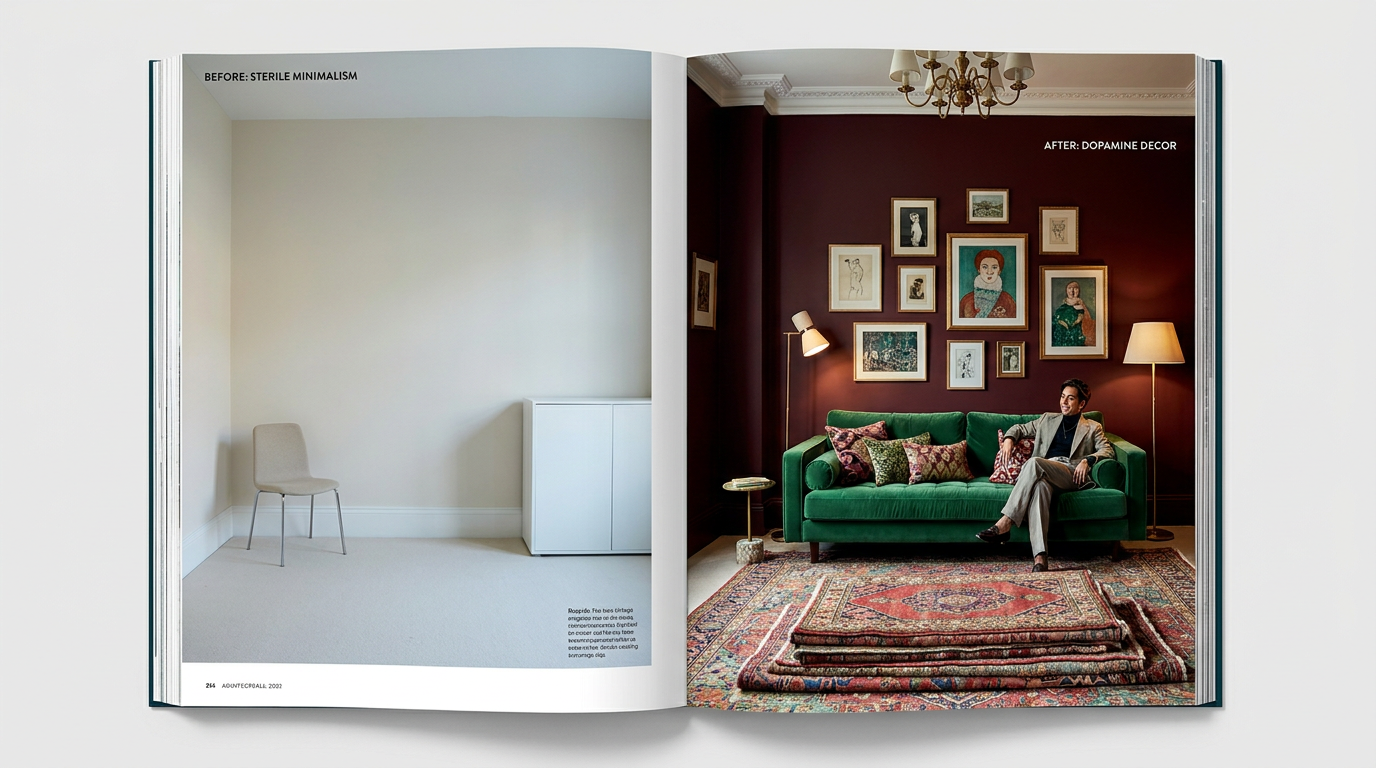
Nowhere is this shift more palpable than in interior design. The era of the showroom-perfect, minimalist home is rapidly fading, replaced by a surge of "Eclectic Maximalism." Homeowners are rejecting the cookie-cutter catalog look in favor of spaces that layer vintage rugs with modern furniture, bold wallpapers with antique lighting, and rich, saturated hues. The home is increasingly viewed as the ultimate canvas for self-expression—a sanctuary where individuals can project their complex identities rather than conforming to a curated, neutral aesthetic.[5]

The data behind this interior design pivot is striking. Trend monitoring platforms report massive surges in search traffic for expressive aesthetics, with "Dopamine Decor"—a style focused on vibrant, joy-inducing colors and playful elements—seeing a 110% increase in interest. Similarly, "Vintage Maximalism" has spiked by 260%. Driven largely by Gen Z and Millennials, who now dictate the majority of upcoming design trends, the market is decisively shifting its focus from mere visual aesthetics to the emotional temperature of a space.[5]

However, industry experts emphasize that 2026's maximalism is fundamentally different from the clutter of the past. It is about intentionally curating meaningful objects rather than simply accumulating stuff. Interior designers refer to this as the "Quirk Quotient"—the strategic placement of personal artifacts, inherited heirlooms, and unexpected art pieces that tell a coherent story. This thoughtful layering creates a tension and juxtaposition that makes a room memorable, proving that a space can be visually rich without being overwhelming.[2]
The fashion industry is echoing this exact sentiment. During the Spring 2026 fashion week circuit, the pervasive "quiet luxury" trend—characterized by streamlined silhouettes and neutral palettes—was noticeably disrupted by a wave of anti-minimalist statements. Runways were dominated by tactile, "more is more" details: vibrant floral appliqués, billowing hemlines, and fanciful fringed fabrics with loose, trailing threads. Designers are leaning into frayed, heavily textured garments that demand to be touched, directly challenging the smooth, frictionless garments of previous seasons.[8]
In the realm of consumer packaging, the pushback against "blanding" is equally fierce. For years, brands stripped away their heritage details to create simplified logos that scaled easily across digital platforms. Now, rule-breaking brands are realizing that homogenous packaging destroys shelf-appeal. There is a rapid return to custom illustrations, atmospheric gradients, and "storybook gothic" aesthetics that communicate authority and depth. Brands are discovering that a unique, even slightly eccentric visual identity is far more memorable than a perfectly optimized, generic logo.[3][6]

A critical challenge in this anti-minimalist era is balancing expressive design with usability and accessibility. As digital interfaces become bolder and more complex, UX designers must ensure that expression does not compromise function. High-contrast color palettes are being deployed not just for emotional impact, but to create instant visual hierarchy in dense spaces. Touch targets remain large, and multimodal interfaces are being engineered to transition seamlessly between voice, touch, and visual commands, proving that a design can be highly expressive while remaining deeply accessible.[1]
For those who still find full maximalism visually overwhelming, the design industry has carved out an elegant compromise known as "Warm Minimalism" or "Neo-Minimalism." This approach retains the uncluttered, highly functional layouts of traditional minimalism but entirely replaces clinical whites and cool grays with earthy terracotta, rich oxblood, and warm beige. It incorporates biophilic elements and heavy, natural textures like raw wood, stone, and linen, offering a soothing environment that still feels distinctly human, grounded, and comfortably lived-in.[2][5]
Ultimately, the anti-minimalist revolt is not a rejection of technology, but a recalibration of how it is used. AI is not disappearing from the design process; rather, its role is shifting from that of an aesthetic dictator to a high-speed production assistant. By offloading the generation of basic assets to AI, human designers are freed to focus on high-level creative strategy, emotional resonance, and the injection of deliberate imperfections.[7]
The design landscape of 2026 has made one thing abundantly clear: the era of "less is more" has been definitively replaced by "more is you." In a world where flawless, generic execution is instantly available to anyone with an internet connection, perfection is no longer a differentiator. Distinctiveness, personality, and human warmth are the new benchmarks of premium design, ensuring that the spaces we inhabit and the brands we interact with actually make us feel something.[1][4]
How we got here
2018–2022
The 'blanding' trend peaks as brands adopt identical sans-serif logos and ultra-minimalist aesthetics for digital scalability.
2024
Generative AI design tools go mainstream, making generic, clean minimalism effortless and ubiquitous.
Late 2025
Search trends for 'Dopamine Decor' and 'Vintage Maximalism' surge as consumers seek emotional connection in their spaces.
Spring 2026
Major fashion houses and digital product teams actively pivot to tactile, expressive, and anti-minimalist designs.
Viewpoints in depth
Expressive Maximalists
Designers advocating for bold, personality-driven aesthetics to counter AI sameness.
This camp argues that 'blanding' has reached a crisis point, making brands and spaces entirely forgettable. They champion the use of high-contrast colors, asymmetric grids, and tactile textures like grain and glassmorphism. By leaning into 'intentional abundance' and deliberate imperfection, they believe designers can create emotional resonance that generative AI simply cannot replicate.
Brand Strategists
Marketers focused on differentiation and escaping the homogenization of corporate identities.
For strategists, the rejection of minimalism is purely a matter of competitive advantage. They point out that when every company uses the same geometric sans-serif fonts and stripped-back logos, shelf-appeal is destroyed. They advocate for a return to custom illustrations, unique typography, and idiosyncratic brand voices to rebuild consumer loyalty and stand out in crowded digital feeds.
Warm Minimalists
Creatives seeking a middle ground between sterile simplicity and overwhelming clutter.
Not ready to fully abandon the calming effects of uncluttered spaces, this group promotes 'Neo-Minimalism.' They maintain clean architectural lines and functional layouts but replace clinical whites with earthy tones like terracotta and warm beige. By incorporating biophilic elements and rich, natural textures, they aim to provide a soothing, human-centric environment without the visual noise of full maximalism.
What we don't know
- It remains unclear if the push for highly expressive, asymmetric digital interfaces will alienate older users accustomed to straightforward, grid-based layouts.
- Whether the maximalist interior design trend will prove sustainable long-term, or if the accumulation of eclectic decor will eventually trigger a renewed desire for extreme decluttering.
- How generative AI platforms will adapt their default outputs as human designers continue to push for deliberate imperfection and tactile 'noise'.
Key terms
- Blanding
- The homogenization of brand identities, characterized by the widespread adoption of generic sans-serif fonts and stripped-back, minimalist aesthetics.
- Synthocene
- A cultural era dominated by synthetic, AI-generated content and algorithmic perfection, which often lacks human warmth.
- Dopamine Decor
- An interior design approach that utilizes highly saturated colors and eclectic, joyful items to boost mood and emotional well-being.
- Glassmorphism
- A UI design trend that mimics the look of frosted glass, updated in 2026 to include actual depth and environmental context.
- Neo-Minimalism
- A balanced design approach that retains clean, uncluttered layouts but introduces warmer, human-centered, and tactile elements.
Frequently asked
What is the 'blanding' design trend?
Blanding refers to the homogenization of corporate and visual identities, where brands stripped away unique details in favor of identical, generic sans-serif fonts and minimalist layouts.
Why are designers rejecting minimalism in 2026?
Because generative AI tools have made generic, clean design effortless, stripping minimalism of its value as a premium differentiator. Designers are pivoting to expressive styles to signal human authenticity.
What is 'Dopamine Decor'?
It is an interior design trend focused on vibrant, highly saturated colors and eclectic, joyful items designed to boost mood and create an emotional connection with a space.
Does anti-minimalism mean digital interfaces will be harder to use?
No. UX designers are balancing expressive typography and asymmetry with strict accessibility standards, using high-contrast colors to actually improve visual hierarchy and legibility.
Is minimalism completely dead?
Not entirely. It is evolving into 'Warm Minimalism,' which keeps clean layouts but incorporates earthy tones, biophilic elements, and rich natural textures instead of clinical white.
Sources
Source coverage
8 outlets
3 viewpoints surfaced








[1]MediumExpressive Maximalists
The Anti-Minimalist Manifesto: What Replaces Generic Clean
Read on Medium →[2]ForbesWarm Minimalists
Eight Interior Design Trends We'll See In 2026
Read on Forbes →[3]The DielineBrand Strategists
The End of Blanding: How Brands Are Rejecting Homogenous Packaging
Read on The Dieline →[4]Design4RetailBrand Strategists
Navigating Brand Experience at the Dawn of the Synthocene
Read on Design4Retail →[5]Paintit.aiExpressive Maximalists
Why Maximalism Is Redefining Interior Design in 2026
Read on Paintit.ai →[6]Zeka GraphicBrand Strategists
Logo Design Trends 2026: The Push-Pull Between AI Sameness and Human Authenticity
Read on Zeka Graphic →[7]KrumziExpressive Maximalists
2026 Graphic Design Trends: Imperfect by Design
Read on Krumzi →[8]Marie ClaireExpressive Maximalists
Spring 2026's Fringe Trend Is Bringing Anti-Minimalism Back
Read on Marie Claire →
Every angle. Every day.
Get lifestyle stories with full source coverage and perspective breakdowns delivered to your inbox.