
SpaceX Warns Investors: Water Scarcity Is Now a Critical Risk for AI Infrastructure Expansion
In an amended IPO filing, SpaceX has officially listed water scarcity as a core risk factor for its AI data centers, highlighting the growing physical constraints of the generative AI boom.
By Factlen Editorial Team
- AI Infrastructure Developers
- Argue that securing massive water and power resources is an unavoidable necessity to maintain global leadership in artificial intelligence.
- Local Municipalities
- Prioritize the protection of local watersheds and drinking supplies, arguing that tech companies must not drain community resources during droughts.
- Hardware Engineers
- Focus on technical mitigation, advocating for the rapid adoption of closed-loop and immersion cooling to decouple AI from fresh water.
What's not represented
- · Agricultural sector competing for water rights
- · Global South nations facing infrastructure expansion
Why this matters
As artificial intelligence becomes deeply integrated into the global economy, its massive physical footprint is colliding with climate realities. Understanding the water demands of AI explains why local communities are pushing back against tech expansion and how resource scarcity could dictate the future of computing.
Key points
- SpaceX amended its IPO filing to list water scarcity as a critical risk for its AI infrastructure expansion.
- U.S. data centers used 17 billion gallons of water for direct cooling in 2023, a number projected to double by 2030.
- 70% of Americans now oppose local data center expansion due to concerns over municipal water depletion.
- Transitioning to waterless immersion cooling requires massive capital expenditure and custom hardware, delaying immediate adoption.
The race to build artificial intelligence has long been measured in silicon and electricity. But as SpaceX prepares for its highly anticipated initial public offering, the company has quietly signaled that the next great bottleneck for AI is much more fundamental: water. For years, the technology industry has treated fresh water as an abundant, cheap utility, pumping millions of gallons through server farms to keep them from overheating. Now, the physical realities of climate change and resource scarcity are colliding with the exponential growth of generative AI, forcing a reckoning in Silicon Valley about the true environmental cost of computation.
In an amended S-1 filing submitted to the Securities and Exchange Commission in early June 2026, SpaceX explicitly added water scarcity to its list of critical operational risks. The aerospace company, which houses Elon Musk's xAI division, warned prospective investors that the expansion of its artificial intelligence infrastructure is now constrained by the availability of power and water at economically feasible prices. This formal disclosure elevates water from a background operational detail to a material financial threat.[1][4]
Previously, SpaceX's financial disclosures focused on standard infrastructure hurdles—securing enough advanced processors, navigating long construction timelines, and sourcing affordable electricity to power the grid. The sudden inclusion of water marks a turning point in how the technology sector evaluates the physical footprint of generative AI. It is a stark acknowledgment that the cloud is not an abstract digital realm, but a heavy industrial process tethered to local ecosystems and highly vulnerable to earthly climate conditions and municipal resource management.[1][2]
To understand why a space exploration and satellite internet company is worried about local water taps, one must look at the fundamental physics of artificial intelligence. Training and running large language models requires incredibly dense clusters of specialized graphics processing units (GPUs). These processors operate at maximum computational capacity for weeks or months at a time, generating an immense amount of thermal energy in tightly packed server racks. If left unchecked, this heat would quickly destroy the delicate silicon architecture.[5]
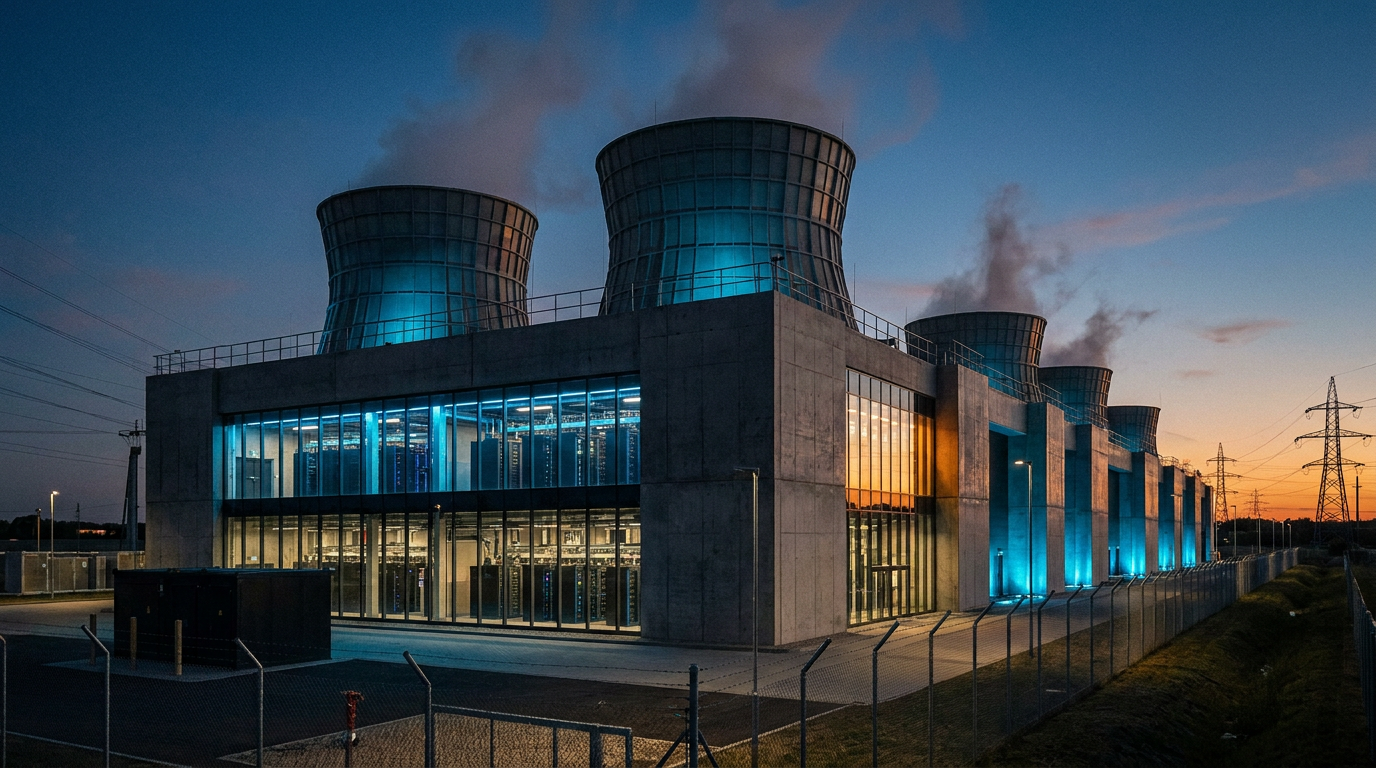
To prevent catastrophic hardware failure, most hyperscale data centers rely heavily on evaporative cooling systems. In this setup, fresh water absorbs the ambient heat from the server racks and is then pumped to massive outdoor cooling towers, where it evaporates into the atmosphere. It is a highly effective method for moving heat away from the processors, but it comes with a severe environmental tradeoff. Because the water evaporates into the air, it is permanently removed from the local watershed rather than being treated and returned to the municipal supply.[5]

While evaporative cooling is highly energy-efficient—saving electricity compared to traditional mechanical air conditioning—it consumes staggering volumes of liquid. In 2023, United States data centers utilized approximately 17 billion gallons of water for direct cooling. This immense draw places a massive burden on local utilities, especially as the sheer number of data centers required to support the AI boom continues to multiply across the country. The industry is effectively trading an electricity problem for a water problem, shifting the environmental burden to a different set of natural resources.[6]
As the artificial intelligence boom accelerates, that consumption rate is skyrocketing at an unsustainable pace. A recent report from the Lawrence Berkeley National Laboratory projects that if hyperscale facilities continue relying on evaporative methods, their collective water consumption could reach 33 billion gallons annually by 2030. Single facilities are already drawing massive amounts of resources; Google's data center in Council Bluffs, Iowa, consumed over 1 billion gallons in a single year, highlighting the extreme demands of modern compute. These figures are forcing a reevaluation of where and how these facilities can be built.[6]

As the artificial intelligence boom accelerates, that consumption rate is skyrocketing at an unsustainable pace.
This insatiable thirst is putting the technology industry on a collision course with local communities, particularly in regions already grappling with severe climate-driven droughts. Data centers are directly competing with agriculture, municipal drinking supplies, and local ecosystems for a finite and increasingly precious resource. During the summer months, data center cooling demands peak at the exact same time that residential water supplies are most stressed, creating a volatile political and environmental dynamic. Tech companies are finding that securing land and power is useless if the local municipality refuses to turn on the tap.[3][5]
The tension has escalated from isolated town hall meetings to a broader national sentiment against tech expansion. A recent Gallup poll found that 70% of Americans now oppose the expansion of data centers in their communities, with water scarcity cited as the primary concern. In several states, grassroots opposition and local zoning boards have successfully delayed or blocked billions of dollars in proposed AI infrastructure over these exact fears, proving that public pushback is a material threat. Communities are no longer swayed by the promise of tech jobs if it means risking their fundamental water security.[6]
For investors evaluating the upcoming SpaceX IPO, the amended SEC filing translates this environmental friction into hard, quantifiable financial risk. If local regulators cap water usage or severe droughts force municipal rationing, AI companies face a cascading series of operational failures. Without sufficient cooling, data centers cannot run their servers at full capacity, directly bottlenecking the core product that these companies are trying to sell. The physical environment is now dictating the pace of software development, a reality that Wall Street is only just beginning to price into its models.[2][3]
When cooling capacity drops, it bottlenecks AI training, drives up operational costs, and delays the deployment of new, more advanced models. As SpaceX explicitly noted in its filing, severe water constraints could force the company to halt expansion entirely or pivot to alternative, vastly more expensive cooling technologies. The disclosure proves that artificial intelligence expansion now hinges on complex resource negotiation. Success requires not just securing the latest silicon chips and venture capital, but successfully negotiating for the slowest water meter in the county without triggering a public relations disaster.[1][2]
Hardware engineers are actively developing solutions to break the industry's dependency on fresh water. One promising approach is closed-loop liquid cooling, which circulates the same fluid continuously through the facility without any evaporative loss. Another more radical solution is dielectric immersion cooling, where entire server blades are fully submerged in a specialized, non-conductive synthetic fluid. This fluid absorbs heat far more efficiently than air or water, allowing for much higher compute density without draining local aquifers. These technologies represent the necessary future of sustainable, high-performance computing.[5]

However, transitioning to these alternatives is not a simple software update or a quick hardware swap. Immersion cooling requires entirely custom server designs and heavily reinforced facility floors to handle the immense physical weight of the fluid tanks. Retrofitting existing data centers is prohibitively expensive and time-consuming, meaning the industry remains largely tethered to legacy evaporative systems for the near future. The transition to waterless cooling will take years and billions of dollars in capital expenditure, leaving current AI expansion plans highly vulnerable to immediate climate and regulatory shocks.[5]
The SpaceX disclosure is serving as a massive wake-up call for Wall Street and the broader financial sector. Institutional investors and ESG (Environmental, Social, and Governance) analysts are increasingly demanding that tech giants disclose their exact water footprints and mitigation strategies. Water is rapidly transitioning from a cheap, assumed utility to a core metric in investment pricing, forcing companies to prove their infrastructure is resilient against climate change. A company's valuation is now tied to its ability to secure sustainable cooling.[3][4]
As SpaceX moves closer to its highly anticipated public debut—while simultaneously reserving up to 5% of its IPO shares for employees and insiders—the amended prospectus sets a new standard for corporate transparency. It forces the entire tech sector to acknowledge the physical limits of digital growth. Ultimately, the artificial intelligence revolution will not just be won by the company with the fastest chips, the most data, or the smartest algorithms. It will be won by the company that can figure out how to keep it all from overheating without draining the local watershed.[3]
How we got here
2023
Generative AI boom triggers a massive expansion of high-density data centers, pushing U.S. direct cooling water usage to 17 billion gallons.
2024
Individual hyperscale facilities, such as Google's Council Bluffs data center, begin surpassing 1 billion gallons of annual water consumption.
Early 2026
Grassroots opposition and local zoning boards begin blocking multi-billion dollar AI data center projects over water scarcity concerns.
June 2026
SpaceX amends its S-1 IPO filing to officially classify water scarcity as a core risk factor for its AI infrastructure expansion.
Viewpoints in depth
The AI Developers' View
Securing physical resources is the primary bottleneck to artificial general intelligence.
For companies like SpaceX, xAI, and other hyperscalers, the race to build more capable AI models is currently constrained by the physical world. They view the acquisition of land, power, and water as a strategic imperative. From their perspective, the economic and technological benefits of AI justify the massive resource footprint, though they acknowledge that failing to secure these resources at 'economically feasible prices' poses an existential threat to their growth roadmaps.
The Municipal View
Local resources cannot be sacrificed for corporate computing power.
City councils, environmental groups, and local residents in drought-prone areas argue that data centers provide relatively few local jobs while placing massive strain on municipal infrastructure. They point out that during summer months, data center cooling demands peak at the exact same time that residential water supplies are most stressed. This camp is increasingly utilizing zoning laws and public protests to block hyperscale developments until tech companies can prove they will not deplete local aquifers.
The Engineering View
The industry must transition to next-generation cooling technologies.
Thermal engineers and hardware designers argue that evaporative cooling is a legacy technology that cannot scale with the heat density of modern AI chips. They advocate for a rapid transition to dielectric immersion and direct-to-chip liquid cooling. While they acknowledge the high upfront capital expenditure required to retrofit facilities, they argue that these technologies are the only mathematically viable way to sustain AI's growth curve without triggering severe regulatory crackdowns.
What we don't know
- Whether the SEC will require mandatory water footprint disclosures for all tech IPOs moving forward.
- How quickly dielectric immersion cooling can reach price parity with traditional evaporative systems.
- Which specific municipalities might introduce hard caps on data center water consumption this year.
Key terms
- Evaporative Cooling
- A method used by data centers where fresh water absorbs heat from servers and is evaporated into the atmosphere to keep the facility cool.
- Dielectric Immersion Cooling
- An advanced cooling technique where computer servers are fully submerged in a non-conductive synthetic fluid that absorbs heat without using water.
- S-1 Filing
- The initial registration form a private company must file with the U.S. Securities and Exchange Commission before going public.
- Hyperscale Data Center
- Massive, highly efficient computing facilities built by major tech companies to support vast cloud and artificial intelligence workloads.
Frequently asked
Why does AI use more water than regular cloud computing?
AI requires specialized processors (GPUs) that run at maximum capacity for extended periods to train models. This generates significantly more heat per square foot than traditional web servers, requiring exponentially more water to cool.
Can data centers use seawater for cooling?
Generally no. Seawater is highly corrosive and would destroy standard plumbing and cooling infrastructure. Desalinating it first requires massive amounts of electricity, defeating the efficiency gains.
What happens if a data center runs out of water?
The facility must throttle its servers to prevent the silicon chips from melting. This severely slows down AI training and operations, directly impacting the company's bottom line.
Sources
Source coverage
7 outlets
3 viewpoints surfaced







[1]TechRepublicAI Infrastructure Developers
SpaceX says water access could affect data center growth
Read on TechRepublic →[2]CryptoRankHardware Engineers
Water access emerges as a risk factor in SpaceX's IPO filing
Read on CryptoRank →[3]PANews
SpaceX Identifies Water Scarcity as Key Risk in AI Expansion
Read on PANews →[4]TradingkeyAI Infrastructure Developers
SpaceX's updated S-1 filing identifies water scarcity as a significant risk
Read on Tradingkey →[5]CodeSecAIHardware Engineers
SpaceX IPO AI Risk: How Water Scarcity Threatens the Future of AI Data Centers
Read on CodeSecAI →[6]BenzatineLocal Municipalities
How some data center operators are tackling their water use problems
Read on Benzatine →[7]Binance News
SpaceX Lists Water Scarcity as an AI Expansion Risk
Read on Binance News →


Every angle. Every day.
Get technology stories with full source coverage and perspective breakdowns delivered to your inbox.