
FDA Approves Veppanu, the First 'Protein Degrader' Therapy for Advanced Breast Cancer
The FDA has authorized the first-ever PROTAC drug, a novel class of medicines that hijacks the cell's own waste disposal system to destroy cancer-driving proteins rather than merely blocking them.
By Factlen Editorial Team
- Clinical Oncologists
- View the drug as a critical new tool to overcome the inevitable resistance tumors develop against traditional hormone blockers.
- Biotech Analysts
- Focus on the approval as the ultimate regulatory validation for the multi-billion dollar targeted protein degradation industry.
- Patient Advocates
- Emphasize the quality-of-life benefits of replacing painful monthly clinic injections with an at-home daily pill.
What's not represented
- · Health Insurance Payers
- · Global Access Advocates
Why this matters
For decades, targeted therapies have worked by temporarily blocking disease-causing proteins, a method that often fails when cancers mutate and develop resistance. By completely shredding the target protein, PROTACs open an entirely new frontier in pharmacology, offering a highly effective lifeline for patients who have exhausted standard treatments.
Key points
- The FDA has approved Veppanu, the first drug in a new class called PROTACs.
- Unlike traditional drugs that block proteins, PROTACs tag cancer-driving proteins for complete destruction by the cell.
- The drug targets ER+/HER2- advanced breast cancer, specifically overcoming common tumor mutations that cause resistance.
- Veppanu is taken as a once-daily oral pill, replacing painful monthly intramuscular injections.
- The approval validates the PROTAC mechanism, paving the way for similar drugs targeting prostate cancer and Alzheimer's.
The Food and Drug Administration has granted full approval to Veppanu (vepdegestrant), marking the first time a drug from the revolutionary "PROTAC" class has been cleared for human use. Developed jointly by Arvinas and Pfizer, the once-daily oral pill is authorized for adults with advanced estrogen receptor-positive (ER+), human epidermal growth factor receptor 2-negative (HER2-) breast cancer whose disease has progressed after standard endocrine therapy. The decision represents a watershed moment not just for breast cancer oncology, but for the entire pharmaceutical industry, validating a radically different approach to how medicines interact with the human body.[1][3]
To understand why Veppanu is considered a generational breakthrough, it is necessary to understand the limitations of traditional drug design. ER+/HER2- is the most common subtype of breast cancer, accounting for roughly 70 percent of all diagnoses. These tumors are fueled by estrogen binding to receptors on the cancer cells, signaling them to multiply and spread. For decades, the standard of care has relied on "occupancy-driven" pharmacology—drugs like tamoxifen or fulvestrant that act as molecular earplugs, wedging themselves into the estrogen receptor to block the hormone from attaching.[4][6]
The problem with occupancy-driven drugs is that cancer is highly adaptable. When a tumor's receptors are blocked, the cancer cells often mutate to change the shape of the receptor, rendering the drug useless. In other cases, the tumor simply manufactures an overwhelming number of new receptors, essentially outnumbering the drug molecules. This phenomenon, known as endocrine resistance, is a leading cause of mortality in metastatic breast cancer, leaving patients with few options beyond systemic chemotherapy.[4][8]
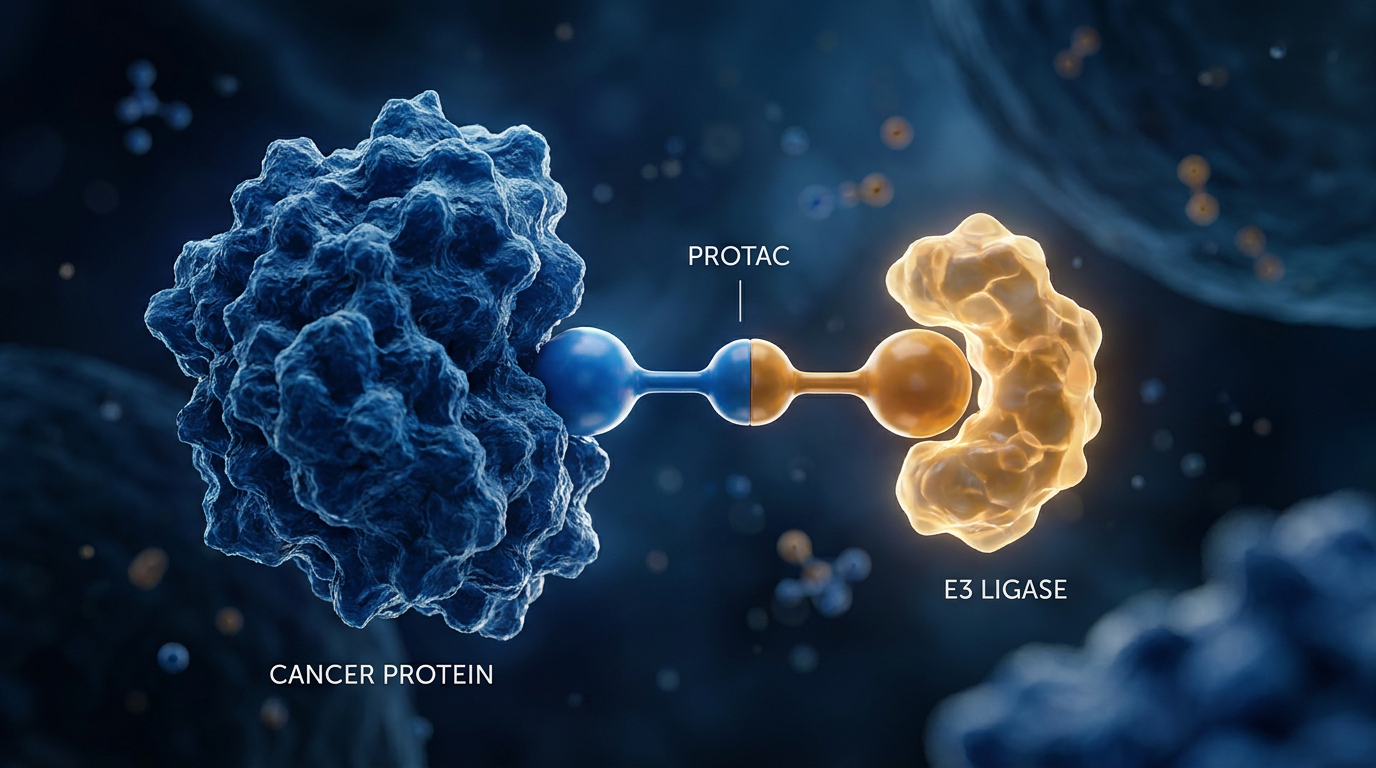
PROTACs, which stands for Proteolysis Targeting Chimeras, abandon the blocking strategy entirely. Instead of trying to plug the receptor, they hijack the cell's natural waste disposal system to destroy it. A PROTAC is a two-headed molecule connected by a chemical linker, often described by biochemists as a molecular dumbbell. One end of the dumbbell is designed to bind specifically to the target—in this case, the estrogen receptor driving the breast cancer.[2][5]

The true innovation lies in the other end of the dumbbell. Once the first end has grabbed the estrogen receptor, the second end reaches out and grabs an enzyme called an E3 ubiquitin ligase. This ligase is part of the cell's natural housekeeping machinery; its normal job is to patrol the cell for damaged or misfolded proteins and tag them for destruction. By bringing the estrogen receptor and the E3 ligase into close proximity, the PROTAC forces the ligase to do its job on the cancer-driving receptor.[5][11]
The ligase slaps a molecular barcode called "ubiquitin" onto the estrogen receptor. In cellular biology, ubiquitin is the kiss of death. Once a protein is tagged with ubiquitin, it is immediately recognized by the proteasome—a barrel-shaped structure that acts as the cell's garbage disposal. The proteasome pulls the tagged estrogen receptor inside and shreds it into harmless amino acids, completely eliminating the protein from the cell.[5][7]
Crucially, the PROTAC molecule itself is not destroyed in this process. Once the estrogen receptor is tagged and sent to the proteasome, the PROTAC releases its grip, floats away, and binds to the next receptor to repeat the cycle. Because it acts as a catalyst rather than a single-use blocker, a single PROTAC molecule can orchestrate the destruction of hundreds of cancer-driving proteins. Pharmacologists refer to this as "event-driven" medicine, a paradigm shift that requires far lower drug concentrations to achieve massive cellular effects.[5][11]
Crucially, the PROTAC molecule itself is not destroyed in this process.
The clinical evidence supporting Veppanu's approval stems primarily from the Phase 3 VERITAC-2 trial, which enrolled over 500 patients with heavily pre-treated metastatic breast cancer. The results demonstrated that Veppanu reduced the risk of disease progression or death by 42 percent compared to the standard-of-care injection, fulvestrant. More importantly, the drug showed remarkable efficacy in patients whose tumors harbored ESR1 mutations—the exact mutations that typically render traditional hormone blockers ineffective.[3][4]
By physically destroying the mutated receptors rather than trying to fit into their altered binding pockets, Veppanu bypasses the most common mechanism of tumor resistance. Trial data showed that Veppanu degraded up to 90 percent of estrogen receptors in tumor tissue, starving the cancer cells of the signals they need to survive. This deep degradation translated to a median progression-free survival of 11.2 months in the mutated subgroup, nearly double that of the control arm.[4][8]

Beyond the survival metrics, Veppanu offers a significant quality-of-life upgrade for patients. The previous last-line endocrine therapy, fulvestrant, requires two large, painful intramuscular injections into the buttocks every month, which must be administered at a clinic. Veppanu is a once-daily oral pill that patients can take at home. Patient advocacy groups have heavily emphasized this shift, noting that replacing clinic-based injections with oral medication restores a degree of normalcy and autonomy to patients living with advanced cancer.[6][9]
Despite the breakthrough, Veppanu is not without side effects or limitations. The most common adverse events reported in the trials were nausea, fatigue, joint pain, and neutropenia (low white blood cell counts). While generally considered manageable and less severe than traditional chemotherapy, these side effects required dose reductions in roughly 15 percent of trial participants. The FDA label includes warnings for liver enzyme elevation, requiring regular blood monitoring during the first few months of treatment.[3][4]
Furthermore, researchers are already studying how cancers might eventually outsmart PROTACs. Early data suggests that tumors subjected to prolonged PROTAC therapy can develop resistance by mutating their own E3 ligase machinery, essentially breaking the cell's tagging system so the PROTAC has nothing to grab onto. While this type of resistance appears to take longer to develop than traditional binding-site mutations, it underscores that Veppanu is a life-extending treatment, not a definitive cure for metastatic disease.[10]
The approval of Veppanu sends a massive signal to the biotechnology sector, where billions of dollars have been poured into targeted protein degradation over the last decade. Until now, PROTACs were a brilliant theoretical concept that had shown promise in early-stage trials but lacked the ultimate validation of a regulatory green light. With the FDA's endorsement, the floodgates are expected to open for a massive pipeline of similar drugs.[2][7]

The implications extend far beyond breast cancer. Because the PROTAC mechanism can theoretically be engineered to target almost any protein, researchers are currently developing degraders for "undruggable" targets—proteins that lack the deep pockets required for traditional drugs to bind. Clinical trials are already underway for PROTACs targeting prostate cancer, lung cancer, and severe autoimmune disorders.[5][11]
Perhaps most tantalizing is the potential for PROTACs in neurodegenerative diseases. Conditions like Alzheimer's, Parkinson's, and Huntington's disease are fundamentally driven by the accumulation of toxic, misfolded proteins in the brain. If researchers can successfully engineer PROTACs to cross the blood-brain barrier, they could theoretically tag these toxic plaques and tangles for destruction by the brain's own proteasomes, offering a mechanism to clear the underlying cause of dementia.[11]

For now, the focus remains on the immediate impact in oncology. Veppanu will launch in the U.S. market next week, providing a vital new tool for oncologists managing treatment-resistant breast cancer. It represents the culmination of over two decades of basic science research, transforming a quirk of cellular waste management into one of the most sophisticated weapons in modern medicine.[1][7]
How we got here
2001
The first conceptual paper describing the PROTAC mechanism is published by academic researchers.
2013
Scientists successfully synthesize the first drug-like PROTACs capable of entering human cells.
2019
The first PROTAC therapy enters Phase 1 human clinical trials for cancer.
2023
The Phase 3 VERITAC-2 trial begins, comparing vepdegestrant against standard-of-care injections.
June 2026
The FDA grants full approval to Veppanu, marking the first regulatory clearance of a protein degrader.
Viewpoints in depth
Clinical Oncologists
Doctors emphasize the drug's ability to bypass the tumor's most common defense mechanisms.
For practicing oncologists, the excitement around Veppanu is rooted in its ability to solve a specific, lethal problem: ESR1 mutations. When patients are treated with traditional hormone blockers, the tumor eventually mutates the shape of its estrogen receptors so the drug can no longer fit. Because Veppanu completely destroys the receptor rather than trying to plug it, these shape-shifting mutations no longer protect the cancer. Oncologists view this as a critical new tool that extends the window of targeted therapy before a patient must resort to harsh systemic chemotherapy.
Biotech Analysts
Industry watchers see the approval as the starting gun for a massive new sector of pharmacology.
Financial and scientific analysts view the Veppanu approval as the ultimate de-risking event for the entire targeted protein degradation field. For years, skeptics questioned whether PROTAC molecules—which are significantly larger and more complex than traditional small-molecule drugs—could be reliably absorbed as oral pills and tolerated by the human body without triggering massive off-target toxicity. The FDA's green light proves the platform is viable, which analysts predict will trigger a surge of investment into pipeline PROTACs targeting previously 'undruggable' proteins in oncology and neurology.
Patient Advocates
Advocacy groups highlight the restoration of dignity and autonomy through oral administration.
While the scientific community focuses on the molecular mechanism, patient advocacy groups are celebrating the delivery method. The previous standard of care for this stage of breast cancer required patients to visit a clinic monthly to receive two large, highly viscous intramuscular injections of fulvestrant—a notoriously painful procedure that often causes lingering soreness and mobility issues. By replacing these injections with a daily pill taken at home, advocates argue that Veppanu significantly reduces the medicalization of the patient's daily life, offering a profound upgrade in day-to-day quality of life.
What we don't know
- It is not yet known if Veppanu significantly extends overall survival (total lifespan), as the data for that specific metric is still maturing.
- Researchers are still studying exactly how long it takes for tumors to develop resistance to the PROTAC mechanism by mutating their E3 ligase enzymes.
- The long-term safety profile of continuously hijacking the cell's natural protein-degradation machinery over several years remains to be fully mapped.
Key terms
- PROTAC
- A novel class of drugs that acts as a bridge, connecting a disease-causing protein to the cell's waste disposal system to destroy it.
- Proteasome
- A barrel-shaped complex inside cells that acts as a garbage disposal, shredding damaged or unneeded proteins into amino acids.
- Ubiquitin
- A small molecular tag that cells attach to proteins to mark them for destruction by the proteasome.
- E3 Ligase
- The specific enzyme responsible for attaching the ubiquitin 'death tag' onto a target protein.
- Endocrine Resistance
- A state where hormone-driven cancers mutate or adapt so that traditional hormone-blocking drugs no longer stop their growth.
Frequently asked
What does PROTAC stand for?
PROTAC stands for Proteolysis Targeting Chimera. It refers to a two-headed molecule that binds a target protein to the cell's natural degradation machinery.
How is Veppanu different from chemotherapy?
Chemotherapy broadly attacks all rapidly dividing cells, causing widespread side effects. Veppanu is highly targeted; it specifically seeks out and destroys only the estrogen receptors driving the breast cancer.
Who is eligible to take Veppanu?
It is approved for adults with advanced or metastatic estrogen receptor-positive (ER+), HER2-negative breast cancer whose disease has progressed after initial endocrine therapies.
Can PROTACs treat other diseases?
Yes. While Veppanu is the first to be approved, dozens of other PROTACs are currently in clinical trials for prostate cancer, autoimmune disorders, and neurodegenerative diseases like Alzheimer's.
Sources
Source coverage
11 outlets
3 viewpoints surfaced








[1]ReutersBiotech Analysts
FDA approves Arvinas and Pfizer's novel breast cancer drug Veppanu
Read on Reuters →[2]STAT NewsPatient Advocates
With Veppanu approval, the PROTAC revolution finally arrives in the clinic
Read on STAT News →[3]FDA
FDA approves vepdegestrant for advanced ER-positive, HER2-negative breast cancer
Read on FDA →[4]The Lancet OncologyClinical Oncologists
Efficacy and safety of vepdegestrant in ER+/HER2- advanced breast cancer: results from the phase 3 VERITAC-2 trial
Read on The Lancet Oncology →[5]Nature Reviews Drug Discovery
The clinical maturation of targeted protein degradation
Read on Nature Reviews Drug Discovery →[6]Breastcancer.orgClinical Oncologists
What the Approval of Veppanu (vepdegestrant) Means for ER-Positive Breast Cancer
Read on Breastcancer.org →[7]Fierce PharmaBiotech Analysts
Pfizer and Arvinas secure historic first-in-class nod for PROTAC therapy
Read on Fierce Pharma →[8]Journal of Clinical OncologyClinical Oncologists
Overcoming ESR1 mutations with targeted protein degradation in metastatic breast cancer
Read on Journal of Clinical Oncology →[9]Patient Empowerment NetworkPatient Advocates
Trading Injections for Pills: The Quality of Life Impact of Oral Degraders
Read on Patient Empowerment Network →[10]Cell
Mechanisms of acquired resistance to proteolysis targeting chimeras (PROTACs)
Read on Cell →[11]Endpoints NewsBiotech Analysts
The dawn of event-driven pharmacology: What the Veppanu approval means for biotech
Read on Endpoints News →



Every angle. Every day.
Get health stories with full source coverage and perspective breakdowns delivered to your inbox.