
The End of the Allen Wrench: How Tool-Free Joinery is Revolutionizing Flat-Pack Furniture
Driven by consumer frustration and circular economy mandates, the furniture industry is rapidly replacing metal screws and cam locks with precision-milled, snap-together joints.
By Factlen Editorial Team
- Industrial Engineers
- Focus on shifting precision from the consumer to the factory floor to reduce assembly errors and returns.
- Sustainability Advocates
- Prioritize joinery that allows for infinite disassembly and reuse, keeping flat-pack furniture out of landfills.
- Consumers and Renters
- Value the elimination of frustrating hardware and the ability to move furniture without destroying the particleboard.
What's not represented
- · Traditional carpenters who argue that mass-produced friction joints still cannot match the longevity of hand-glued, custom-built furniture.
- · Budget consumers who may be priced out of the premium engineered woods required for tool-free systems.
Why this matters
For decades, moving apartments meant accepting that your particleboard furniture would likely strip, wobble, or break. The rapid adoption of tool-free joinery means your next bookshelf or bed frame will assemble in minutes, survive infinite moves, and eliminate the frustration of the Allen wrench entirely.
Key points
- Over half of new modular furniture collections in 2026 feature tool-free assembly mechanisms.
- Innovations like the wedge dowel and click-inserts reduce assembly times by up to 80%.
- Tool-free joinery allows furniture to be disassembled infinitely without stripping the wood.
- Manufacturers are seeing a 40% drop in returns by eliminating hardware-related user errors.
- Premium brands are reviving Kumiki, a Japanese joinery method that uses gravity instead of nails.
The universal ritual of flat-pack furniture assembly has long been defined by a specific kind of domestic friction: a blistered palm, a missing cam lock, and a tiny hexagonal Allen wrench. For decades, the industry relied on cheap metal fasteners driven into engineered wood to hold bookshelves and bed frames together. But this paradigm is rapidly shifting. In 2026, the Allen wrench is quietly being engineered out of existence.
Driven by consumer frustration, the rise of nomadic renting cultures, and strict new European circular-economy mandates, the furniture industry is embracing a radical simplification. Tool-free joinery—systems that allow panels to simply click, slide, or snap together—has moved from a niche premium feature to a mass-market standard. According to recent market analysis, 54% of new modular furniture collections released this year utilize tool-free assembly mechanisms.[5][6]
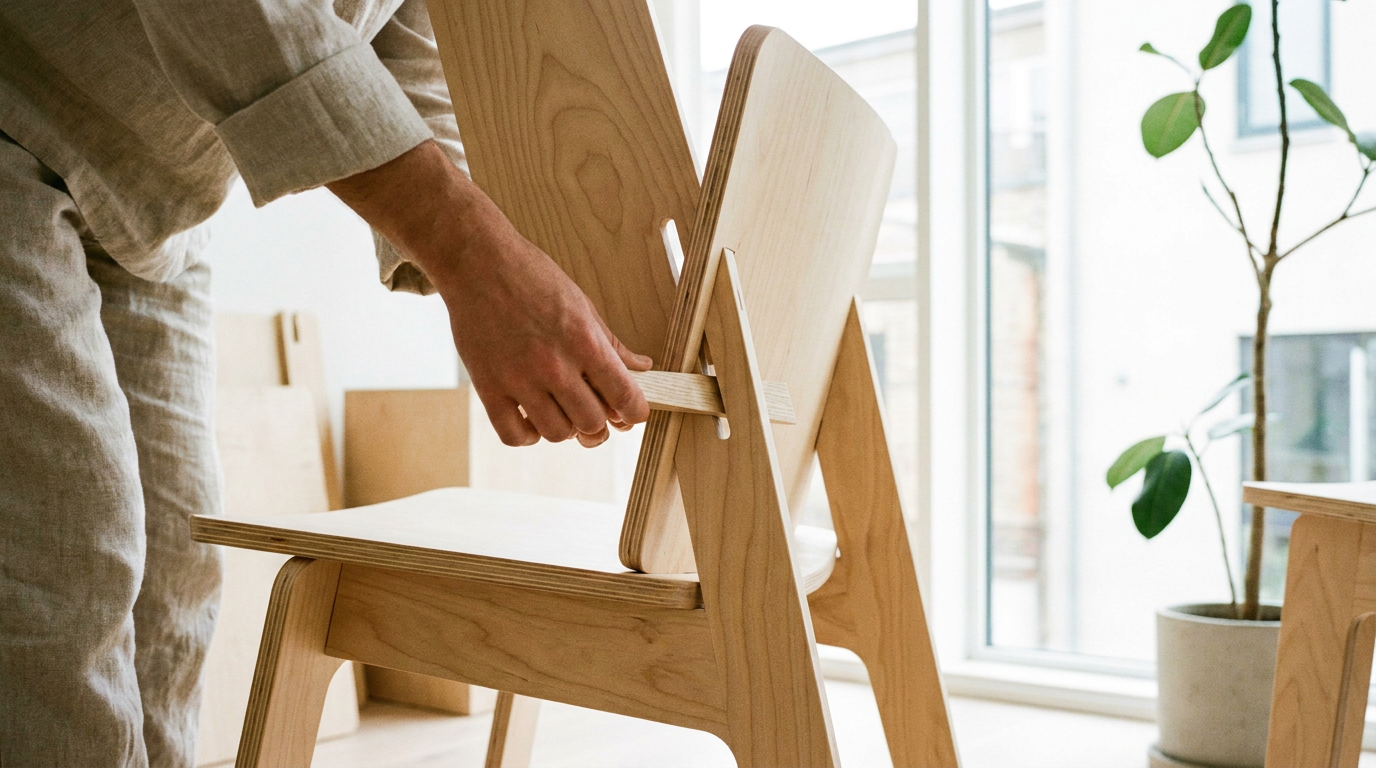
The mechanical shift is fundamental. Traditional flat-pack furniture relies on tension created by metal screws biting into particleboard. Tool-free joinery relies on precision geometry and friction. By milling exact interlocking shapes directly into the wood or integrating spring-loaded plastic clips during manufacturing, designers are shifting the burden of precision from the consumer in their living room back to the factory floor.
The most visible pioneer of this movement is IKEA, which spent years developing a proprietary joint known as the "wedge dowel." Unlike a smooth wooden peg that requires wood glue, the wedge dowel is a ribbed, tapered cylinder that comes pre-installed on the furniture panel. The consumer simply slides it into a corresponding keyhole-shaped slot on the adjoining piece, where it locks firmly into place.[1]

The efficiency gains are stark. IKEA engineers estimate that the wedge dowel reduces assembly time by 50% to 80% compared to traditional cam-lock designs. A dining table that once took 25 minutes and a dozen screws to build can now be snapped together in under three minutes. Because the joint replaces metal fittings entirely, it also reduces the raw material footprint of the packaging.[1]
While IKEA relies on wood-on-wood friction, other manufacturers are deploying high-tech mechanical solutions. The Swedish firm Välinge Innovation, originally famous for inventing the click-together laminate flooring system, has adapted its technology for cabinetry and furniture. Their "Threespine" system allows solid panels to be joined seamlessly at 90-degree angles with a simple push.[2][3]
The mechanism behind Threespine is a flexible plastic insert hidden within the edge of the panel. As one piece of wood is pushed into another, the insert compresses backward. Once the panel reaches its final, flush position, the spring-loaded insert snaps outward into a wedge groove on the opposite panel, locking the joint permanently. Industry tests show this method is up to ten times faster than traditional screw assembly.[2][3]

The mechanism behind Threespine is a flexible plastic insert hidden within the edge of the panel.
At the premium end of the market, brands are looking backward rather than forward, reviving ancient woodworking techniques. Direct-to-consumer companies like Thuma have built massive followings by utilizing "Kumiki," a traditional Japanese carpentry method that joins wood without nails or fasteners.[4]
In a Kumiki-inspired bed frame, the wooden rails feature complex, interlocking cuts that slide together like a three-dimensional puzzle. The joints rely on gravity and the sheer weight of the mattress to maintain tension. Because there is no metal hardware to loosen over time, these friction-fit joints actually tend to settle and become tighter and quieter with use, eliminating the notorious squeak of a metal-bolted bed frame.[4]
Beyond convenience, the tool-free revolution is solving a critical durability problem for modern renters. Traditional particleboard furniture is notoriously fragile when disassembled; removing and reinserting metal screws strips the composite wood, ensuring the piece rarely survives more than one or two moves. Tool-free joints, conversely, are designed for infinite cycles of assembly and disassembly without degrading the core material.[6]

This reusability is a cornerstone of the industry's push toward a circular economy. Furniture that survives relocation does not end up in a landfill. By making disassembly as effortless as construction, manufacturers are enabling a robust secondary market for used flat-pack goods, aligning with new environmental regulations that penalize planned obsolescence.[6]
For the manufacturers themselves, the upfront cost of precision milling is offset by a massive reduction in customer service overhead. Companies utilizing tool-free connectors report that customer complaints and returns related to assembly errors have plummeted by over 40%. When a product can only physically fit together one way, the risk of a consumer misaligning a cabinet door or driving a screw through a finished veneer drops to zero.[5][7]

However, the transition is not without engineering hurdles. Friction-fit and interlocking joints require incredibly tight manufacturing tolerances—often down to fractions of a millimeter. Wood is a hygroscopic material, meaning it expands and contracts with ambient humidity. If a factory in a dry climate mills a wedge dowel too tightly, a consumer in a humid environment may find the pieces impossible to slide together.[8]
To mitigate this, manufacturers are increasingly pairing tool-free joinery with highly stable engineered woods, like premium-grade plywood or advanced MDF, which resist warping better than solid pine or oak. Others are incorporating micro-bevels and expansion gaps into their joint designs to accommodate seasonal swelling.[8]
As the technology matures in 2026, tool-free assembly is expanding beyond lightweight bookshelves and bed frames. The mechanisms are now being integrated into heavy-duty applications, including wall-mounted kitchen cabinetry and commercial office fit-outs, where the labor savings of rapid installation easily justify the premium hardware.[6]
The era of the disposable, frustratingly complex flat-pack box is drawing to a close. By replacing the Allen wrench with precision engineering, the furniture industry is proving that the most sophisticated technological advancements are often the ones that make the end product feel entirely effortless.
How we got here
2013
IKEA begins developing the wedge dowel to reduce assembly time and hardware waste.
2017
The Lisabo table launches, becoming one of the first mass-market products to fully utilize tool-free wedge dowels.
2020
Välinge Innovation adapts its click-flooring technology into the Threespine system for cabinetry.
2024
European circular economy mandates accelerate the adoption of furniture designed for easy disassembly.
2026
Over half of all new modular furniture collections feature tool-free joinery as a standard specification.
Viewpoints in depth
Industrial Engineers
Focus on shifting precision from the consumer to the factory floor.
For manufacturing engineers, the Allen wrench is a liability. Every bag of loose hardware introduces the risk of missing parts, and every manual screw introduces the risk of user error. By milling the locking mechanism directly into the wood—or pre-installing click-inserts on the assembly line—engineers ensure the product can only physically fit together one way. This upfront investment in factory precision pays massive dividends by virtually eliminating the customer service costs associated with misaligned doors, stripped wood, and frustrated buyers.
Sustainability Advocates
Prioritize joinery that allows for infinite disassembly and reuse.
Environmental advocates view the traditional cam lock as a primary driver of the 'fast furniture' waste crisis. Because metal screws degrade engineered wood each time they are removed, traditional flat-pack furniture rarely survives a household move, ending up in landfills. Tool-free joinery transforms furniture from a disposable commodity into a circular asset. Because the joints can be snapped apart without damaging the core material, the furniture can be easily flat-packed, transported, and resold on the secondary market.
Consumers and Renters
Value the elimination of frustrating hardware and the ability to move easily.
For the end user, the appeal of tool-free furniture is purely practical. The modern renter moves frequently, and the prospect of spending two hours deciphering a manual and wrestling with an Allen wrench is a major pain point. Friction-fit and click-assembly systems reduce build times from hours to minutes. More importantly, they provide peace of mind that a heavy bed frame or bookshelf can be broken down in seconds when a lease ends, without the fear of the piece wobbling permanently upon reassembly.
What we don't know
- How well friction-fit joints will hold up over decades of extreme humidity fluctuations, which can cause wood to swell or shrink.
- Whether the higher manufacturing costs of precision milling will eventually trickle down to the ultra-budget tiers of flat-pack furniture.
Key terms
- Cam Lock
- A traditional two-part metal fastener used in flat-pack furniture, notorious for loosening over time and stripping particleboard.
- Wedge Dowel
- A ribbed, tapered wooden peg that slides into a keyhole slot, locking panels together without metal hardware.
- Kumiki
- A traditional Japanese woodworking technique involving interlocking wooden joints without nails or screws, now adapted for modern bed frames.
- Threespine Technology
- A patented click-assembly system using flexible plastic inserts that snap into grooves, adapted from flooring technology.
- Circular Furniture
- Products designed to be easily disassembled, repaired, and reassembled to extend their lifespan and prevent landfill waste.
Frequently asked
Is tool-free furniture as sturdy as furniture built with screws?
Yes. Because tool-free joints rely on exact geometric interlocking and friction, they often distribute weight more evenly than a single metal screw, which can strip out of particleboard over time.
Can you take tool-free furniture apart when moving?
Yes. Most tool-free systems, including wedge dowels and click-inserts, are specifically designed to be disassembled and reassembled multiple times without damaging the wood.
Why is the furniture industry making this change now?
The shift is driven by consumer demand for easier assembly, a desire to reduce costly customer returns caused by missing hardware, and new environmental regulations encouraging reusable, circular products.
Sources
Source coverage
8 outlets
3 viewpoints surfaced








[1]Fast CompanyConsumers and Renters
Ikea’s New Furniture Takes Minutes To Assemble And Requires No Tools
Read on Fast Company →[2]Välinge InnovationIndustrial Engineers
Threespine Click Furniture Technology
Read on Välinge Innovation →[3]Furniture Design IndiaIndustrial Engineers
Valinge Innovation’s Threespine technology revolutionizes furniture assembly
Read on Furniture Design India →[4]ELLE DecorConsumers and Renters
Is the Thuma Bed Actually Worth the Hype?
Read on ELLE Decor →[5]Market Reports WorldSustainability Advocates
Modular and Flat Pack Furniture Market Latest Trends 2026
Read on Market Reports World →[6]Mordor IntelligenceSustainability Advocates
Europe Ready-to-Assemble (RTA) Furniture Market Analysis
Read on Mordor Intelligence →[7]OVVO TechIndustrial Engineers
Why Tool-Free Furniture Assembly Reduces Returns and Complaints
Read on OVVO Tech →[8]Factlen Editorial TeamConsumers and Renters
Synthesis by Factlen editorial team
Read on Factlen Editorial Team →
Every angle. Every day.
Get shopping stories with full source coverage and perspective breakdowns delivered to your inbox.