
How Scientists Are Deploying Two Experimental Drugs Against the Rare Bundibugyo Ebola Strain
The World Health Organization is launching an unprecedented clinical trial in the Democratic Republic of Congo to test two experimental therapeutics against a rare, vaccine-resistant strain of the ebolavirus.
By Factlen Editorial Team
- Public Health Coordinators
- Focusing on rapid deployment and mortality reduction in the outbreak zone.
- Virology Researchers
- Focusing on the unique molecular mechanics of the Bundibugyo strain.
- Biopharmaceutical Developers
- Focusing on validating next-generation antiviral platforms.
What's not represented
- · Frontline healthcare workers operating in the Ituri conflict zone
- · Patients who have recovered from the Bundibugyo strain using only supportive care
Why this matters
Historically, outbreaks of rare pathogens end before clinical trials can even begin, leaving the world unprepared for the next wave. By rapidly deploying these experimental drugs in an active outbreak zone, scientists are not only working to save lives today but are also laying the groundwork for a universal 'pan-ebolavirus' cure.
Key points
- The WHO is launching a clinical trial in the DRC to test two experimental drugs against the rare Bundibugyo ebolavirus.
- The Bundibugyo strain currently has no approved vaccines or treatments, rendering existing countermeasures for the Zaire strain ineffective.
- The trial will evaluate MBP134, a 'pan-ebolavirus' monoclonal antibody cocktail, and remdesivir, a broad-spectrum antiviral.
- Researchers aim to enroll between 500 and 1,000 patients, testing the drugs individually and in combination to rapidly identify the most effective protocol.
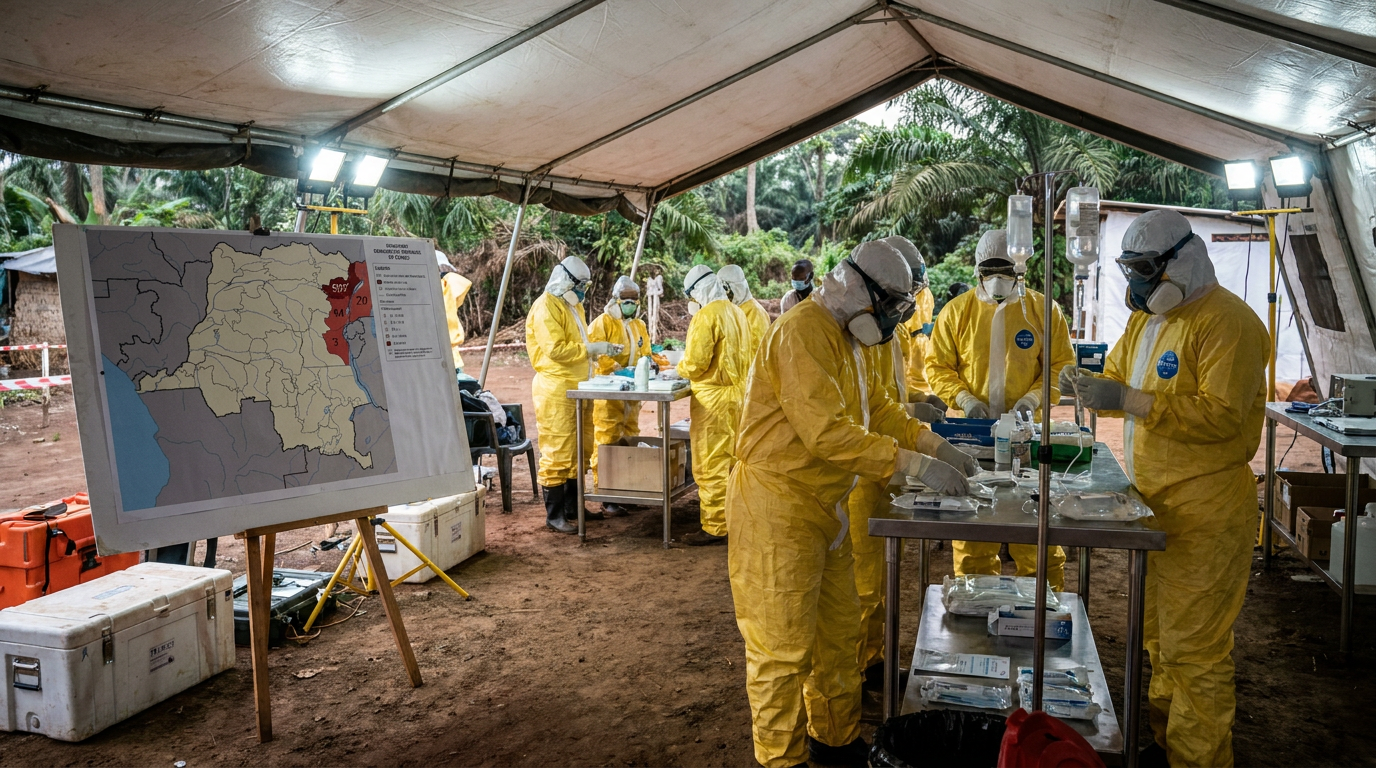
As health officials grapple with a fast-moving outbreak of the rare Bundibugyo ebolavirus in the Democratic Republic of Congo, the global medical community is launching an unprecedented scientific counter-offensive. Next week, the World Health Organization will initiate a major clinical trial to test two experimental therapeutics directly in the outbreak zone. The mobilization represents a critical shift in how global health agencies respond to rare pathogens, moving beyond mere containment to active, rapid clinical intervention.[1][2]
The urgency of the trial is driven by the stark realities on the ground. Since the outbreak was declared in mid-May, the virus has infected at least 1,094 people and claimed 277 lives, primarily in the DRC's northeastern Ituri province. WHO Director-General Tedros Adhanom Ghebreyesus recently warned that the outbreak is continuing to outpace the response, citing insufficient treatment capacity and the complexities of operating in an active conflict zone.[2][3]
The primary challenge facing responders is the specific nature of the pathogen. The current outbreak is driven by the Bundibugyo species of the ebolavirus, a rare strain first identified in Uganda in 2007. Unlike the more common Zaire ebolavirus—which caused the devastating 2014 West African epidemic—the Bundibugyo strain currently has no approved vaccines or licensed therapeutic treatments.[3][4]
The evolutionary differences between the strains are significant enough that existing medical countermeasures are rendered ineffective. The FDA-approved Ervebo vaccine and the Inmazeb monoclonal antibody cocktail are highly specific to the Zaire strain. Because their molecular targets do not perfectly align with the Bundibugyo virus, frontline health workers have been forced to rely entirely on early, aggressive supportive care to manage symptoms.[4][6]

To bridge this critical therapeutic gap, the upcoming clinical trial will evaluate two distinct experimental drugs: the monoclonal antibody cocktail MBP134 and the antiviral medication remdesivir. The trial aims to enroll between 500 and 1,000 patients, testing whether these candidates can reduce mortality when administered either individually or in combination.[1][2]
The logistics of the trial require massive international coordination. The effort is being spearheaded by the WHO in partnership with the DRC's National Institute for Biomedical Research (INRB), the Alliance for International Medical Action (ALIMA), and Oxford University. The United States government and Gilead Sciences have donated the necessary doses of the experimental treatments to ensure the trial can proceed without delay.[1][3]
The first arm of the trial will focus on MBP134, an investigational drug developed by Mapp Biopharmaceutical. MBP134 is a cocktail of two specific monoclonal antibodies—ADI-15878 and ADI-23774—that were originally isolated from a human survivor of the 2014 Zaire ebolavirus outbreak. Through a process called affinity maturation, researchers engineered these antibodies to broaden their neutralizing activity.[6][8]
The first arm of the trial will focus on MBP134, an investigational drug developed by Mapp Biopharmaceutical.
The mechanism behind MBP134 makes it a uniquely powerful candidate. The two antibodies target highly conserved, non-overlapping epitopes on the ebolavirus glycoprotein—the molecular key the virus uses to enter human cells. By binding to these specific sites, MBP134 directly inhibits glycoprotein-mediated membrane fusion, effectively locking the virus out of the host's cells.[6][8]

Because these specific binding sites remain nearly identical across different viral strains, MBP134 functions as a "pan-ebolavirus" therapeutic. Laboratory and animal studies have demonstrated that it can neutralize all known pathogenic ebolaviruses, including Zaire, Sudan, and Bundibugyo. In a few isolated cases, including the recent medical evacuation of an infected American physician, MBP134 has already been administered under compassionate use protocols.[4][8]
The second arm of the trial will evaluate remdesivir, an antiviral drug developed by Gilead Sciences that gained global prominence during the COVID-19 pandemic. While monoclonal antibodies work by blocking the virus from entering cells, remdesivir operates internally. It functions as a polymerase inhibitor, disrupting the viral replication machinery once the pathogen has already breached the cell membrane.[1][4]
Virologists have noted that remdesivir may be uniquely suited to combat the Bundibugyo strain. Previous laboratory studies have shown that the Bundibugyo ebolavirus replicates more slowly than the Zaire strain, largely due to intrinsic differences in its polymerase complex. This slower replication cycle makes the virus highly susceptible to polymerase inhibitors.[7]
In specialized biosafety level 2 laboratory models, post-infection treatment with remdesivir demonstrated a significantly greater inhibitory effect against the Bundibugyo virus than it did against the Zaire strain. By stalling the already-slowed replication process, the antiviral drug gives the patient's natural immune system a crucial window of time to mount a defense and clear the infection.[7]

The clinical trial is designed to be highly adaptive. Vasee Moorthy, who leads the WHO's research and development blueprint arm, noted that the final number of enrolled patients will depend on the real-time efficacy of the therapeutics. If the data quickly shows that one drug, or the combination of both, drastically reduces mortality, the trial can pivot to prioritize the most effective treatment protocol.[2]
Conducting a rigorous clinical trial in the Ituri province presents immense operational hurdles. The region is characterized by ongoing armed conflict, population displacement, and fragile healthcare infrastructure. Over the past five weeks, the WHO and its partners have rapidly scaled up capacity, expanding from fewer than 10 treatment beds to over 500, and increasing testing capacity from 30 tests a day to more than 3,000.[2][3]
Community engagement remains a cornerstone of the trial's potential success. Health officials are working closely with local leaders to ensure transparency regarding the experimental nature of the treatments. The WHO has emphasized that the primary goal is not just data collection, but ensuring that affected communities have immediate access to the therapeutics if they prove safe and efficacious.[2]

The speed at which these trials are being deployed marks a significant evolution in outbreak management. Historically, clinical trials for rare pathogens took months or years to organize, often beginning only after an outbreak had naturally subsided. The ability to launch a structured, multi-drug trial while the Bundibugyo outbreak is still active provides a rare opportunity to gather definitive clinical data.[4]
If successful, the trial could yield the world's first proven treatments for the Bundibugyo ebolavirus, fundamentally altering the prognosis for future outbreaks. More broadly, validating a pan-ebolavirus therapeutic like MBP134 would provide global health agencies with a universal countermeasure, eliminating the need to develop bespoke drugs for every emerging strain of the virus.[6][8]
How we got here
2007
The Bundibugyo ebolavirus is first identified during an outbreak in western Uganda.
2014-2016
The West African Ebola epidemic accelerates the development of vaccines and treatments, though primarily for the Zaire strain.
May 15, 2026
A new outbreak of the rare Bundibugyo strain is officially declared in the Democratic Republic of Congo.
June 24, 2026
The WHO announces that preparations are complete for a major clinical trial of MBP134 and remdesivir in the DRC.
Viewpoints in depth
Public Health Coordinators
Focusing on rapid deployment and mortality reduction in the outbreak zone.
Organizations like the WHO and ALIMA view the trial primarily through the lens of immediate crisis response. Their priority is overcoming the severe logistical hurdles of operating in an active conflict zone to deliver experimental therapeutics to patients who currently have no other options. They emphasize that community trust and rapid scaling of treatment beds are just as critical as the drugs themselves.
Virology Researchers
Focusing on the unique molecular mechanics of the Bundibugyo strain.
Researchers at Oxford and the INRB are highly focused on the evolutionary differences between ebolavirus strains. They view this trial as a crucial real-world test of 'pan-ebolavirus' theories. Because Bundibugyo replicates slower than the Zaire strain, virologists are particularly interested in seeing if polymerase inhibitors like remdesivir demonstrate enhanced efficacy in human patients, validating years of specialized laboratory models.
Biopharmaceutical Developers
Focusing on validating next-generation antiviral platforms.
For developers like Mapp Biopharmaceutical and Gilead Sciences, the trial is a high-stakes validation of their respective drug platforms. MappBio is testing whether its affinity maturation process successfully engineered a truly universal ebolavirus antibody, while Gilead is looking to prove that its broad-spectrum antiviral can effectively halt a filovirus in a clinical setting, expanding the drug's utility beyond respiratory viruses.
What we don't know
- Whether the experimental drugs will prove more effective individually or when administered together as a combination therapy.
- How the ongoing armed conflict and logistical challenges in the Ituri province will impact the speed of patient enrollment and data collection.
- Whether the Bundibugyo virus has developed any novel mutations that might affect its susceptibility to polymerase inhibitors.
Key terms
- Bundibugyo ebolavirus (BDBV)
- A rare species of ebolavirus first identified in Uganda in 2007, distinct from the more common Zaire strain.
- Monoclonal antibody (mAb)
- A laboratory-produced molecule engineered to serve as a substitute antibody that can restore, enhance, or mimic the immune system's attack on pathogens.
- Polymerase inhibitor
- A class of antiviral drugs that block the viral polymerase enzyme, preventing the virus from copying its genetic material and multiplying.
- Glycoprotein (GP)
- A protein on the surface of the ebolavirus that allows it to attach to and enter human host cells.
- Pan-ebolavirus therapeutic
- A medical treatment designed to be effective against all known species of the ebolavirus, rather than just one specific strain.
Frequently asked
Why can't doctors use existing Ebola vaccines for this outbreak?
Existing vaccines, such as Ervebo, are specifically designed for the Zaire ebolavirus strain. They do not provide protection against the genetically distinct Bundibugyo strain currently circulating in the DRC.
What exactly is MBP134?
MBP134 is an experimental cocktail of two monoclonal antibodies that bind to the surface of the virus, preventing it from entering human cells. It is engineered to work against all known ebolavirus species.
How does remdesivir treat the virus?
Remdesivir is an antiviral drug that acts as a polymerase inhibitor. It disrupts the virus's ability to replicate its genetic material, effectively halting its spread within the body.
Where is the clinical trial taking place?
The trial will be conducted primarily at hospitals in the northeastern Ituri province of the Democratic Republic of Congo, where the vast majority of the current cases have been detected.
Sources
Source coverage
8 outlets
3 viewpoints surfaced






[1]Fierce BiotechPublic Health Coordinators
WHO kicks off trial of two potential therapeutics for fast-moving Ebola outbreak
Read on Fierce Biotech →[2]CTV NewsPublic Health Coordinators
Trials of two Ebola treatments to start in DRC next week: WHO
Read on CTV News →[3]Anadolu AgencyPublic Health Coordinators
WHO says Ebola treatment trials to start in DRC next week
Read on Anadolu Agency →[4]Medical BriefVirology Researchers
Ebola: Experimental drugs to be tested in DRC outbreak
Read on Medical Brief →[5]FirstWord PharmaBiopharmaceutical Developers
Ebola treatment trials to start in DRC next week, WHO says
Read on FirstWord Pharma →[6]National Institutes of HealthBiopharmaceutical Developers
Intramuscular Administration of MBP134 Reverses the Course of Sudan Ebolavirus Disease
Read on National Institutes of Health →[7]American Society for MicrobiologyVirology Researchers
Bundibugyo Ebolavirus Polymerase Complex Is Slower than Zaire Ebolavirus and Highly Susceptible to Polymerase Inhibitors
Read on American Society for Microbiology →[8]Mapp BiopharmaceuticalBiopharmaceutical Developers
MBP134 Fact Sheet
Read on Mapp Biopharmaceutical →
Every angle. Every day.
Get health stories with full source coverage and perspective breakdowns delivered to your inbox.