
Carlos Alcaraz Prioritizes Long-Term Health, Withdraws From Wimbledon to Complete Wrist Rehab
The defending champion has opted to skip the grass-court major to fully heal a lingering wrist injury, a mature decision that opens up the Wimbledon draw and highlights a growing emphasis on career longevity in tennis.
By Factlen Editorial Team
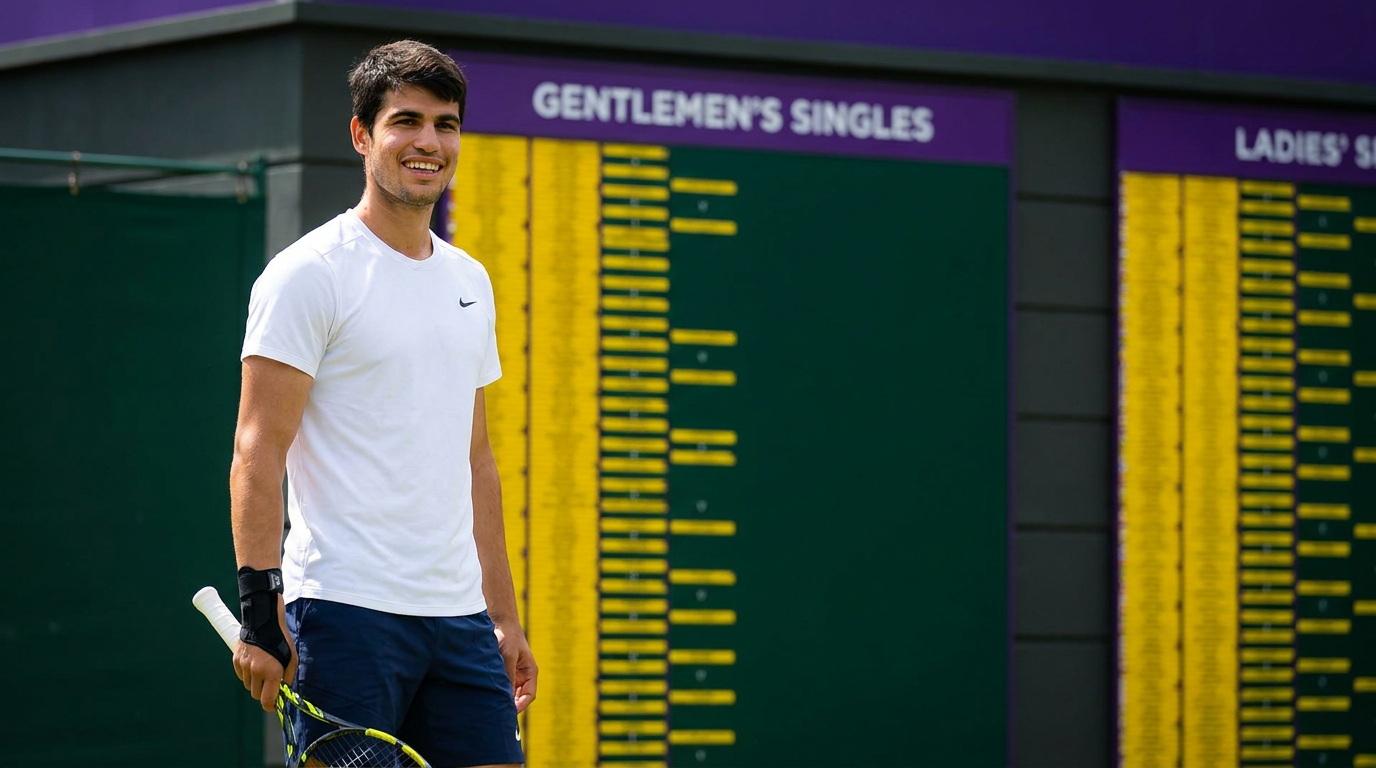
- Sports Medicine Experts
- Advocates for conservative rehabilitation, emphasizing that resting tendon injuries prevents chronic, career-ending damage.
- Tournament Analysts
- Focuses on how the absence reshapes the Wimbledon draw and shifts the balance of power in the ATP rankings.
- Player Camp
- Prioritizes long-term career longevity and peak performance for the upcoming hard-court season over short-term title defenses.
What's not represented
- · Tournament Organizers
- · Broadcasters
Why this matters
Alcaraz's decision marks a pivotal shift in professional sports culture, where young athletes are increasingly empowered to choose long-term career sustainability over the immediate pressure of defending major titles.
Key points
- Carlos Alcaraz has officially withdrawn from Wimbledon 2026 to continue rehabilitating a right wrist injury.
- The 23-year-old is suffering from tenosynovitis, an inflammation of the tendon sheath aggravated during the Barcelona Open.
- Sports medicine experts praise the decision, noting that resting the joint prevents chronic, career-altering damage.
- The withdrawal reshapes the Wimbledon draw, leaving world No. 1 Jannik Sinner as the heavy favorite.
- Alcaraz is targeting a full return for the North American hard-court swing and the US Open in August.
Carlos Alcaraz has officially withdrawn from the 2026 Wimbledon Championships, choosing to prioritize the long-term health of his right wrist over a title defense at the All England Club. The 23-year-old Spaniard announced the decision on social media, noting that while his recovery is progressing well, he is not yet ready for the rigors of best-of-five-set grass-court tennis. The move extends an injury layoff that began in April, but it reflects a growing and positive trend in modern tennis: young superstars choosing career longevity over the short-term glory of playing through pain.[1][2]
The underlying issue keeping the seven-time Grand Slam champion off the court is tenosynovitis—an inflammation of the tendon sheath in his right wrist. Alcaraz initially aggravated the joint during the Barcelona Open in April, forcing him to abandon the European clay-court season and miss Roland Garros. Rather than rushing back for the prestigious grass-court swing, his medical team has opted for a conservative, highly structured rehabilitation program designed to let the inflammation fully subside before he faces the impact of competitive match play.[1][3]
Sports medicine experts have praised the decision, pointing to the immense physical demands of the modern game. Today's elite tennis players generate unprecedented torque through their wrists, utilizing extreme grips and heavy topspin to control the ball at high speeds. The constant acceleration and deceleration of the racket head place immense strain on the delicate tendons of the hand and forearm. By stepping away now, Alcaraz is actively preventing a localized, acute inflammation from developing into a chronic, career-altering condition.[1]

The medical consensus on treating tenosynovitis strongly favors patience. In previous eras, the immense pressure to defend a Wimbledon title might have coerced a player into relying on painkillers and cortisone injections to mask the pain, often at the cost of their future mobility and joint stability. Today, advanced biomechanical tracking and a better understanding of connective tissue recovery have made preventative rest the gold standard for elite competitors facing tendon issues.[4]
The medical consensus on treating tenosynovitis strongly favors patience.
Recent updates from Alcaraz’s training camp in Spain have been overwhelmingly positive, reinforcing that the withdrawal is a strategic pause rather than a major setback. Video footage shared by the Spaniard shows him sprinting on a track and hitting light practice balls while wearing a protective brace. He was also recently spotted in good spirits supporting his younger brother at a junior tournament in Madrid. These milestones indicate that the tendon is healing correctly, and that his team is meticulously managing his load to ensure a full, explosive return.[4]
For the broader tennis ecosystem, Alcaraz’s absence fundamentally reshapes the summer landscape and creates a thrillingly wide-open Wimbledon draw. Without the defending champion in the mix, world No. 1 Jannik Sinner enters SW19 as the prohibitive favorite, having recently swept through the Masters 1000 events. However, the vacuum at the top also provides a rare window of opportunity for a deep roster of rising contenders and grass-court specialists who now find their paths to the second week significantly cleared.[2][6]

The rankings math underscores the stakes of the upcoming fortnight. By missing both Roland Garros and Wimbledon, Alcaraz will drop 3,300 ATP ranking points, temporarily shuffling the top tier of the men's game. Third-ranked Alexander Zverev and other top-five mainstays are positioned to capitalize on the shift. Yet, within Alcaraz's camp, the point deficit is viewed as a minor administrative detail compared to the ultimate goal: ensuring that the youngest man to complete the career Grand Slam remains a dominant force for the next decade.[2][3]
Alcaraz’s disciplined approach mirrors a broader cultural shift in professional sports, where athletes are increasingly empowered to listen to their bodies. The new generation of tennis stars is learning from the grueling injury histories of past legends, recognizing that a season is a marathon, not a sprint. By normalizing strategic withdrawals for rehabilitation, players like Alcaraz are setting a healthy precedent for junior athletes regarding the importance of sustainable training practices.[1][4]

Looking ahead, the Spaniard’s rehabilitation timeline is squarely focused on the North American hard-court swing. By sacrificing the European summer, Alcaraz is giving himself a runway to arrive at the Canadian Open and the US Open at peak physical condition. As he prepares to defend his title at Flushing Meadows later this year, his Wimbledon withdrawal may ultimately be remembered not as a missed opportunity, but as the masterstroke of load management that preserved one of tennis's most electrifying careers.[2][4]
How we got here
April 2026
Alcaraz sustains a right wrist injury during the Barcelona Open, forcing an early withdrawal.
May 2026
The Spaniard officially withdraws from Roland Garros to begin a conservative rehabilitation program.
Mid-June 2026
Alcaraz announces he will miss the Queen's Club Championships and Wimbledon to fully heal his tendon.
August 2026
Targeted return window for the North American hard-court swing and the US Open.
Viewpoints in depth
The Medical Consensus
Why resting a wrist injury is the only sustainable choice for modern tennis players.
Sports medicine professionals universally support the decision to skip the grass-court season. The modern tennis forehand, characterized by extreme semi-Western grips and massive racket-head acceleration, places unprecedented torque on the wrist's tendon sheaths. Playing through tenosynovitis with the aid of anti-inflammatories often leads to micro-tears and chronic instability. By choosing a conservative rehabilitation path, players protect the biomechanical foundation of their game, ensuring they can continue to generate trademark power for years to come.
The Draw Impact
How the absence of the defending champion blows the Wimbledon field wide open.
From a competitive standpoint, the withdrawal removes the biggest roadblock for the rest of the ATP Tour. Jannik Sinner, already enjoying a dominant season, becomes the undisputed favorite at SW19. However, the ripple effects extend far down the rankings. Grass-court specialists and emerging talents who might have faced early-round exits now have a viable path to the second week. Analysts note that while the tournament loses a marquee star, it gains an unpredictable, highly volatile draw where a new champion is almost guaranteed to emerge.
What we don't know
- It remains unclear exactly which tournament Alcaraz will use as his official return event during the North American hard-court swing.
- The full impact of his absence on Wimbledon's television viewership and tournament dynamics is yet to be seen.
Key terms
- Tenosynovitis
- Inflammation of the fluid-filled sheath that surrounds a tendon, commonly caused by repetitive strain or acute injury.
- ATP Ranking Points
- The system used by the Association of Tennis Professionals to determine player rankings based on tournament performance over a 52-week rolling period.
- Career Grand Slam
- The achievement of winning all four major tennis championships (Australian Open, French Open, Wimbledon, US Open) over the course of a player's career.
- Load Management
- The deliberate monitoring and restriction of an athlete's physical exertion to prevent injury and optimize long-term performance.
Frequently asked
Why did Carlos Alcaraz withdraw from Wimbledon?
He withdrew to fully rehabilitate a lingering right wrist injury (tenosynovitis) sustained earlier in the season, prioritizing his long-term health over a rushed return.
When is Alcaraz expected to return to tennis?
His medical team is targeting the North American hard-court swing in August, aiming for him to be fully fit for his US Open title defense.
Who is the favorite to win Wimbledon now?
With the defending champion out, world No. 1 Jannik Sinner enters the tournament as the heavy favorite, though the draw is now considered wide open for emerging contenders.
Sources
Source coverage
6 outlets
3 viewpoints surfaced






[1]The GuardianSports Medicine Experts
Carlos Alcaraz ruled out of Wimbledon as recovery from wrist injury goes on
Read on The Guardian →[2]Olympics.comTournament Analysts
Carlos Alcaraz confirms he will miss Wimbledon 2026 with continued wrist injury
Read on Olympics.com →[3]CBC SportsPlayer Camp
Carlos Alcaraz withdraws from Wimbledon in June due to lingering wrist injury
Read on CBC Sports →[4]HeavySports Medicine Experts
Carlos Alcaraz Injury Update: Positive Signs in Rehab
Read on Heavy →[5]Plataforma MediaPlayer Camp
Tennis: Alcaraz to miss Wimbledon due to wrist injury
Read on Plataforma Media →[6]Last Word On SportsTournament Analysts
Which Men Withdrew? Carlos Alcaraz was the most high-profile man to withdraw from Wimbledon
Read on Last Word On Sports →

More in sports
See all 14 stories →Tactics
The Deep Block: How Tony Popovic Forged Australia's Impenetrable 5-4-1 System for the 2026 World Cup
8 sources

Storyline
The 28-Year Wait: How Ståle Solbakken Built a Tactical Machine to Unleash Erling Haaland at the 2026 World Cup
8 sources

History
The 12th Man: How Host Nations Have Historically Overperformed at the FIFA World Cup
6 sources
Tactics
The Swiss Watch: How Murat Yakin Built a Chameleon System for the 2026 World Cup
6 sources
Every angle. Every day.
Get sports stories with full source coverage and perspective breakdowns delivered to your inbox.