
The Science of the Maillard Reaction: How to Master Flavor Building at Home
The Maillard reaction is the chemical engine behind the savory crust on a steak and the golden color of baked bread. Understanding how to control heat, moisture, and pH allows home cooks to unlock complex flavors and elevate their everyday meals.
By Factlen Editorial Team
- Traditional Home Cooks
- Focus on practical kitchen techniques like patting meat dry, preheating pans, and avoiding overcrowding to achieve the best sear.
- Culinary Scientists
- Focus on the precise chemical mechanisms, manipulating variables like pH and pressure to maximize flavor extraction.
- Nutrition & Health Experts
- Focus on the balance between flavor development and the health risks of over-charring and acrylamide formation.
What's not represented
- · Commercial food manufacturers who engineer artificial Maillard flavors for processed snacks.
- · Flavor chemists who synthesize specific pyrazines for the perfume and additive industries.
Why this matters
Cooking without understanding the Maillard reaction is like driving with the parking brake on. Mastering this single chemical principle will immediately improve the taste, texture, and appearance of almost everything you cook, saving you from grey, steamed meats and pale, flavorless vegetables.
Key points
- The Maillard reaction is a chemical process between amino acids and reducing sugars that creates complex flavors and browning.
- It requires temperatures between 140°C and 165°C (280°F to 330°F) to proceed effectively.
- Surface moisture prevents browning because water boils at 100°C, capping the food's temperature below the Maillard threshold.
- Cooks can accelerate the reaction by drying ingredients, using high-heat cookware, or increasing the pH with baking soda.
- Temperatures above 180°C (355°F) cause pyrolysis (burning), which destroys flavor and creates potentially harmful compounds.
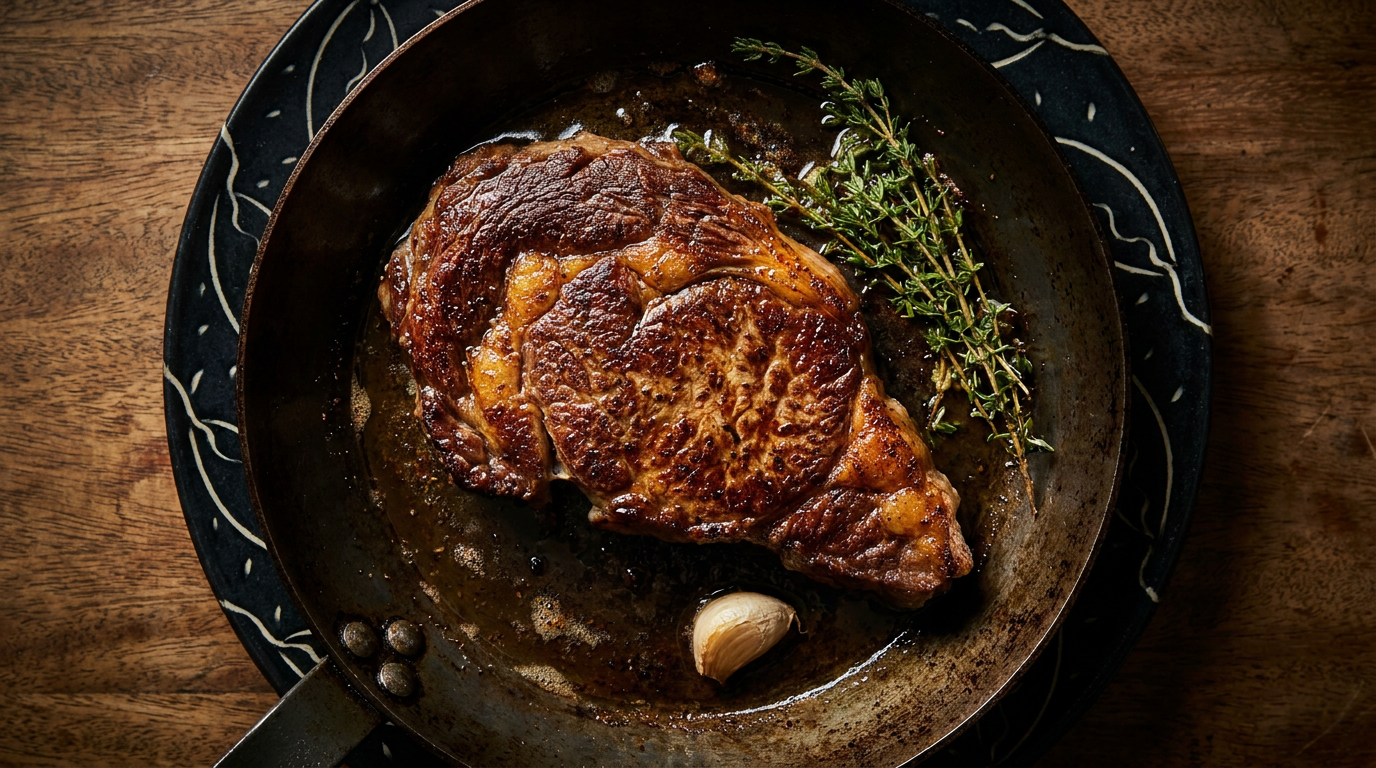
The smell of a sizzling steak hitting a hot cast iron pan, the golden, crackling crust of a freshly baked loaf of sourdough bread, the deep, intoxicating aroma of freshly roasted coffee beans in the morning. These sensory experiences are the absolute hallmark of good cooking, but they are not merely the result of heat being passively applied to food. They are the direct product of one of the most complex, fascinating, and delicious chemical transformations on Earth: the Maillard reaction. Understanding this process is the single most important step a cook can take to improve their food.[3][4]
Discovered in 1912 by the pioneering French chemist Louis-Camille Maillard, this phenomenon is the secret engine behind flavor development in the kitchen. Maillard was not actually a chef; he was attempting to reproduce biological protein synthesis in a laboratory setting when he noted that heating sugars and amino acids together produced a distinct brown color and rich, savory aromas. Today, culinary scientists, professional chefs, and home cooks alike rely on this exact chemical mechanism to elevate simple, raw ingredients into memorable, deeply flavorful meals.[2][4]
At its core, the Maillard reaction is a form of non-enzymatic browning. Unlike the enzymatic browning that causes a sliced apple or an avocado to turn brown and unappetizing when exposed to the oxygen in the air, the Maillard process requires a significant input of thermal energy to begin. When food reaches the correct temperature threshold, the reactive carbonyl group of a reducing sugar violently collides with the nucleophilic amino group of an amino acid, kicking off a spectacular chemical chain reaction.[2][9]
This initial high-heat collision forms a highly unstable intermediate compound, such as glycosylamine, which almost immediately rearranges itself into a ketosamine. From there, a cascading, unpredictable chain reaction occurs, spawning hundreds of new, highly complex flavor and aroma molecules in a matter of seconds. These include pyrazines, which deliver a deeply toasted flavor, and meaty furans that trigger our savory receptors. Finally, the reaction produces large polymer molecules called melanoidins, which give the food its signature, highly desirable golden-brown crust.[2][5]

A very common misconception in the kitchen is that the Maillard reaction is simply synonymous with caramelization. While both processes require high heat and result in a browned exterior, they are fundamentally different chemical events. Caramelization is the thermal decomposition of sugars alone, requiring absolutely no proteins to occur. The Maillard reaction, however, strictly requires the presence of both amino acids—the fundamental building blocks of proteins—and reducing sugars, such as glucose, fructose, or lactose. This is exactly why a plain sugar syrup caramelizes, but a piece of bread or a steak undergoes Maillard browning.[3][4][9]
To truly harness this culinary superpower, a cook must master the environmental variables that control it. The single most critical factor is temperature. The Maillard reaction proceeds noticeably and effectively only when the surface temperature of the food reaches between 140°C and 165°C (280°F to 330°F). Below this specific thermal threshold, the reaction is far too slow to be useful in a standard cooking timeframe; above it, the food risks crossing into a different chemical territory entirely, ruining the dish.[1][2][4]
Because of this strict temperature requirement, moisture is the absolute enemy of the Maillard reaction. Water boils and turns to steam at exactly 100°C (212°F) at sea level. As long as there is liquid water present on the surface of a piece of meat or a vegetable, the temperature of that surface physically cannot exceed the boiling point. The food will simply steam or boil in its own moisture, resulting in a grey, rubbery, and flavorless exterior rather than a rich, complex brown crust.[7][8]
Because of this strict temperature requirement, moisture is the absolute enemy of the Maillard reaction.
This scientific reality dictates one of the most important and frequently ignored rules in the kitchen: always dry your food thoroughly before searing. Using paper towels to aggressively blot the surface of a steak, fish fillet, or even vegetables removes the invisible moisture barrier, allowing the surface temperature to rapidly spike into the Maillard zone the moment it hits the hot pan. Advanced techniques include salting meat hours in advance to draw out moisture via osmosis, or leaving it uncovered on a wire rack in the refrigerator overnight to air-dry completely.[1][8]

The cooking environment itself must also be carefully optimized for high heat. Crowding a pan with too many ingredients instantly lowers the temperature of the cooking surface and traps the steam released by the food as it cooks. Instead of searing, the ingredients end up boiling in their own trapped juices. Cooking in smaller, manageable batches ensures that the pan retains enough thermal energy to flash-evaporate any escaping moisture and sustain the Maillard reaction without interruption.[7]
The choice of cookware plays a pivotal role in maintaining that necessary thermal energy. Professional chefs often favor heavy carbon steel or cast iron skillets because of their exceptional thermal inertia. When a cold piece of meat is placed into a hot steel pan, the massive metal structure does not rapidly drop in temperature. It sustains the intense, radiating heat required to trigger immediate and even browning across the entire surface of the ingredient.[7]
Beyond heat and moisture, cooks can manipulate the Maillard reaction by altering the pH of the cooking environment. The reaction accelerates significantly in alkaline conditions, as the amino groups become deprotonated and far more reactive. This is precisely why traditional Bavarian pretzels are dipped in a harsh lye solution before baking; the highly alkaline lye triggers an intense, rapid browning that creates the pretzel's signature dark, glossy mahogany crust and distinct, alkaline flavor profile.[2][9]
Home cooks can easily replicate this alkaline trick using a much safer and more common ingredient: baking soda. Adding a small pinch of baking soda to a pan of diced onions can drastically reduce the time it takes to brown them. The Modernist Cuisine team famously utilizes this technique by combining baking soda and a pressure cooker to create deeply browned, Maillard-rich caramelized onion or carrot soups in a mere fraction of the traditional stovetop time.[1]

Another highly effective method to boost the reaction is to artificially introduce more of the necessary building blocks—proteins and reducing sugars—directly to the surface of the food. Brushing a pale yeast dough with an egg wash or whole milk before baking adds both amino acids and lactose, ensuring a beautifully browned, bakery-quality crust. Similarly, marinating meats in mixtures containing a touch of honey, maple syrup, or fruit juice provides extra reducing sugars to kickstart the browning process the second it hits the grill.[6][9]
However, the aggressive pursuit of flavor must always be balanced with culinary caution. If the temperature is pushed too high—typically above 180°C (355°F)—the Maillard reaction gives way to a destructive process called pyrolysis, commonly known as burning. Pyrolysis completely destroys the delicate, hard-won flavor compounds, replacing them with acrid, bitter, and heavily charred notes that can ruin an entire meal.[1][2][4]
Furthermore, pushing the reaction into pyrolysis can have genuine health implications. At excessively high temperatures, the Maillard reaction can produce acrylamide, a chemical compound that has been identified by health organizations as a probable carcinogen. Managing the heat to stay strictly within the sweet spot of 140°C to 165°C ensures maximum flavor development while minimizing the formation of these harmful, unwanted byproducts.[2][5]

Ultimately, understanding the Maillard reaction transforms everyday cooking from a series of blind, memorized instructions into an applied, intuitive science. By actively controlling moisture, managing heat retention, and occasionally tweaking the pH, absolutely anyone can unlock the deep, complex flavors that make roasted, baked, and seared foods universally beloved. It is the invisible, everyday chemistry that turns raw sustenance into true culinary art.[3][9][10]
How we got here
1912
French chemist Louis-Camille Maillard first documents the reaction while attempting to reproduce biological protein synthesis.
1953
Chemist John E. Hodge publishes the first comprehensive mechanism of the reaction, mapping the complex chemical pathways.
Early 2000s
The Modernist cuisine movement popularizes manipulating the reaction using pH adjustments and pressure cookers.
Viewpoints in depth
Culinary Scientists
Treating the kitchen as a laboratory to optimize the variables of browning.
For culinary scientists and modernist chefs, the Maillard reaction is a formula to be hacked. By understanding that the reaction is fundamentally driven by temperature, moisture, and pH, they employ unconventional tools to force the reaction in environments where it normally wouldn't occur. The use of pressure cookers to trap heat and baking soda to create an alkaline environment allows them to achieve deep Maillard browning in wet soups and purees—a feat impossible with traditional stovetop methods.
Traditional Home Cooks
Applying the science through practical, everyday kitchen habits.
For culinary educators and home cooks, the science of browning translates into foundational kitchen rules. The emphasis is on moisture management and thermal mass. Techniques like thoroughly drying a steak with paper towels, salting meat in advance to draw out surface water, and using heavy cast iron or carbon steel pans are all practical applications of Maillard principles. The goal is to ensure the food's surface rapidly crosses the 140°C threshold before the interior overcooks.
Nutrition & Health Experts
Monitoring the threshold where browning turns into harmful burning.
Health professionals and food safety experts view the Maillard reaction through the lens of risk management. While the reaction creates essential flavor compounds, pushing the temperature past 180°C triggers pyrolysis. This not only introduces bitter, acrid flavors but also leads to the formation of acrylamide, a probable carcinogen. Their guidance focuses on enjoying browned foods in moderation and strictly avoiding the consumption of heavily charred or blackened organic matter.
What we don't know
- While the basic mechanism is understood, the Maillard reaction produces hundreds of minute flavor compounds that scientists have yet to fully catalog.
- The exact health impact of long-term, low-level dietary exposure to acrylamide from browned foods remains an area of active nutritional study.
Key terms
- Maillard reaction
- A chemical reaction between amino acids and reducing sugars that gives browned food its distinctive flavor.
- Melanoidins
- Large polymer molecules produced at the end of the Maillard reaction that give food a brown color.
- Reducing sugars
- Sugars with a free reactive group, such as glucose or fructose, that can react with proteins during cooking.
- Pyrolysis
- The chemical breakdown of organic material at very high temperatures, commonly known as burning.
- Non-enzymatic browning
- Browning that occurs due to heat and chemical reactions, rather than exposure to oxygen and enzymes.
- Acrylamide
- A chemical compound and probable carcinogen that can form when starchy foods are cooked at excessively high temperatures.
Frequently asked
Does the Maillard reaction happen when boiling food?
No. Water boils at 100°C (212°F), which caps the surface temperature of the food. The Maillard reaction requires temperatures of at least 140°C (280°F) to proceed rapidly.
Is caramelization the same as the Maillard reaction?
No. Caramelization is the breakdown of sugars under high heat. The Maillard reaction requires both reducing sugars and amino acids (proteins) to occur.
Why does my meat turn grey instead of brown in the pan?
Grey meat is usually the result of excess surface moisture or a crowded pan. The moisture turns to steam, keeping the temperature too low for browning to occur.
Can I speed up browning?
Yes. You can speed up the Maillard reaction by ensuring the food is completely dry, using high heat, or slightly increasing the pH by adding a pinch of baking soda.
Sources
Source coverage
10 outlets
3 viewpoints surfaced








[1]Modernist CuisineCulinary Scientists
Using the Maillard Reaction in Cooking
Read on Modernist Cuisine →[2]WikipediaNutrition & Health Experts
Maillard reaction
Read on Wikipedia →[3]Culinary Arts AcademyNutrition & Health Experts
What Is the Maillard Reaction? The Science of Flavor
Read on Culinary Arts Academy →[4]MasterClassTraditional Home Cooks
Maillard Reaction Explained: What Is the Maillard Reaction?
Read on MasterClass →[5]BBC Science FocusNutrition & Health Experts
What is the Maillard reaction?
Read on BBC Science Focus →[6]KhymosCulinary Scientists
Maximizing Food Flavor by Speeding Up the Maillard Reaction
Read on Khymos →[7]De BuyerTraditional Home Cooks
Steel cooking: mastering the Maillard reaction like a chef
Read on De Buyer →[8]Jessica GavinTraditional Home Cooks
Maillard Reaction: The Key to Flavor Development
Read on Jessica Gavin →[9]Nutrition Therapy InstituteNutrition & Health Experts
The Maillard Reaction: Why Food Tastes So Good
Read on Nutrition Therapy Institute →[10]Factlen Editorial TeamCulinary Scientists
Synthesis by Factlen editorial team
Read on Factlen Editorial Team →
More in food drink
See all 46 stories →Restaurant Tech
The 60-Second Drive-Thru: How AI and Automation Are Rewiring Fast Food
6 sources

Food Science
The Science of Sourdough: How Wild Yeast and Bacteria Transform Flour and Water
6 sources
Culinary Science
The Science of Emulsions: How Chemistry Creates Perfect Sauces
7 sources
Mixology Science
The Chemistry of Fat-Washing: How Bartenders Extract Savory Flavors into Clear Spirits
8 sources
Every angle. Every day.
Get food drink stories with full source coverage and perspective breakdowns delivered to your inbox.