
The Rise of the Deep Energy Retrofit: How EnerPHit is Transforming Old Homes
A whole-home approach to remodeling known as a 'deep energy retrofit' is helping homeowners slash energy use by up to 80%. Using the rigorous EnerPHit standard, older, drafty houses are being transformed into ultra-efficient, climate-resilient homes.
By Factlen Editorial Team
- Building Scientists & Advocates
- Argue that deep energy retrofits are essential for meeting global climate targets.
- Homeowners & Investors
- Value the immediate benefits of drastically lower utility bills and improved comfort.
- Traditional Contractors
- Highlight the steep learning curve and need for specialized training.
What's not represented
- · Low-income homeowners who may be priced out of deep retrofits without substantial subsidies.
- · Historic preservationists concerned about altering the exterior appearance of heritage buildings.
Why this matters
Existing buildings account for a massive share of global carbon emissions and household expenses. Deep energy retrofits offer a proven pathway to permanently lower utility bills, improve indoor air quality, and future-proof aging homes against extreme weather.
Key points
- Deep energy retrofits treat the home as an interconnected system to reduce energy use by 50% or more.
- The EnerPHit standard adapts rigorous Passive House principles specifically for the constraints of existing buildings.
- Key upgrades include continuous insulation, extreme airtightness, high-performance windows, and mechanical ventilation.
- The historical cost premium for these retrofits has dropped significantly as supply chains and contractor experience improve.
- Homeowners can utilize the EnerPHit Retrofit Plan to execute upgrades in manageable, step-by-step phases.
The charm of an older home often comes with a hidden tax: drafts, uneven temperatures, and staggering utility bills. For decades, the standard advice for remodeling has been to swap out old appliances, add a layer of fiberglass in the attic, and caulk the windows. But as energy costs rise and climate goals loom, a more radical approach is gaining traction among homeowners and building scientists alike.[6]
Enter the "deep energy retrofit." Unlike conventional weatherization, which targets isolated systems, a deep energy retrofit is a whole-building overhaul designed to slash a home's energy use by 50% or more. It treats the house as an interconnected system, prioritizing the physical shell of the building before upgrading the mechanical equipment inside.[1]
At the forefront of this movement is "EnerPHit," a rigorous certification standard developed by the Passive House Institute specifically for existing buildings. While the original Passive House standard was designed for new construction, EnerPHit acknowledges the structural realities of older homes—such as unchangeable orientation or historic facades—and provides a tailored, slightly more forgiving pathway to ultra-efficiency.[2]
The foundation of an EnerPHit retrofit is the building envelope. The goal is to wrap the home in a continuous, thick layer of insulation, either on the exterior or interior walls, effectively putting a thermal sweater on the building. This dramatically reduces the amount of heat that escapes in the winter and the amount of heat that penetrates in the summer.[2][6]

Equally critical is airtightness. Older homes rely on random leaks through gaps and cracks for fresh air, which is highly inefficient and uncomfortable. An EnerPHit retrofit meticulously seals these leaks using specialized tapes and membranes. The standard requires the building to achieve an airtightness of 1.0 air changes per hour at 50 Pascals of pressure (ACH50)—a massive improvement over typical existing homes, which often leak at rates of 10 ACH50 or higher.[2]
To maintain this continuous thermal barrier, contractors must address "thermal bridges." These are areas where conductive materials, like a concrete balcony slab or a steel beam, bypass the insulation and draw heat directly out of the building. Mitigating thermal bridges is one of the most technically demanding aspects of a deep energy retrofit, often requiring specialized structural thermal breaks.[2][6]
Windows and doors are another major focal point. Standard double-pane windows are replaced with high-performance, triple-glazed units that feature insulated frames and airtight seals. Innovation in this space is accelerating; recently, specialized retrofit components, such as adjustable window mounting brackets designed specifically for uneven, older framing, have won international component awards for making installation faster and more reliable.[4][6]
Standard double-pane windows are replaced with high-performance, triple-glazed units that feature insulated frames and airtight seals.
Because the house is now virtually airtight, it requires a mechanical lung. This is achieved through Mechanical Ventilation with Heat Recovery (MVHR). An MVHR system continuously extracts stale, moist air from kitchens and bathrooms while supplying fresh, filtered outdoor air to living spaces and bedrooms. Crucially, a heat exchanger transfers the thermal energy from the outgoing exhaust air to the incoming fresh air, recovering up to 90% of the heat that would otherwise be lost.[2][6]
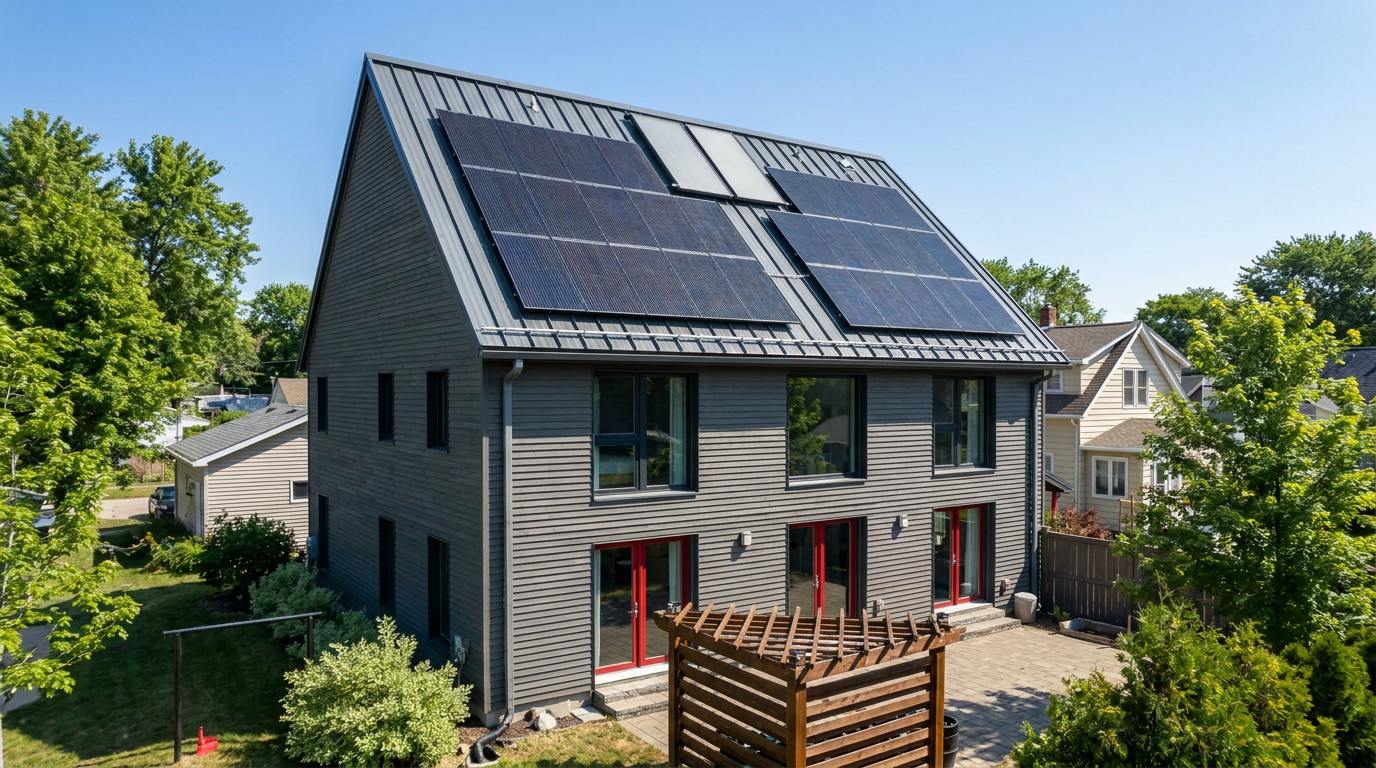
The results of this comprehensive approach are striking. By drastically lowering the heating and cooling demand, the home's mechanical equipment can be significantly downsized. A home that once required a massive gas furnace can often be kept perfectly comfortable year-round with a single, highly efficient electric heat pump.[1]
The financial equation for deep energy retrofits is also shifting rapidly. Historically, the specialized materials and skilled labor required for Passive House-level performance carried a steep cost premium of 20% or more. However, recent industry data indicates that as supply chains mature and builders gain experience, this premium has plummeted, with some markets seeing the extra cost drop to the single digits.[5]

When operational savings are factored in, the return on investment becomes highly compelling. Studies of multifamily Passive House projects have demonstrated operational energy cost savings ranging from 28% to 68% compared to conventionally built peers. These dramatic reductions in monthly utility bills provide a hedge against volatile energy prices and can offset the initial financing costs of the renovation.[3][5]
Recognizing that a whole-home overhaul is a massive financial and logistical undertaking, the Passive House Institute introduced the EnerPHit Retrofit Plan. This allows homeowners to execute the deep energy retrofit in a step-by-step, phased approach over several years—perhaps starting with the roof and windows, and tackling the walls and mechanicals later—while ensuring that each step aligns with the final high-performance goal without creating future complications.[2]
Beyond the financial and energy metrics, the most immediate impact for occupants is a profound upgrade in living quality. Deep energy retrofits eliminate cold drafts, maintain whisper-quiet acoustics by blocking street noise, and ensure a constant supply of filtered air, which is particularly valuable in areas prone to wildfire smoke or high pollen.[6]

Despite the clear benefits, scaling deep energy retrofits remains a challenge. The primary bottleneck is no longer the technology, but the workforce. Executing an EnerPHit project requires a high degree of precision and an understanding of building physics that is not yet standard across the general contracting industry. Finding a qualified builder who understands the critical importance of continuous air barriers and thermal bridge mitigation is often the hardest part of the process.[3][6]
Ultimately, the transition to deep energy retrofits is not just a trend in high-end remodeling; it is a climate necessity. With existing buildings accounting for a massive share of global carbon emissions, we cannot simply build our way out of the problem with new green construction. By transforming our aging, drafty housing stock into resilient, ultra-efficient sanctuaries, the EnerPHit standard offers a blueprint for future-proofing the homes we already have.[1][6]
How we got here
1990s
The Passive House standard is developed in Germany, focusing primarily on new construction.
2010
The Passive House Institute introduces the EnerPHit standard to address the unique challenges of retrofitting existing buildings.
2020
Studies begin showing that the cost premium for Passive House construction is dropping as the industry matures.
2026
Deep energy retrofits gain mainstream traction as energy prices remain volatile and climate regulations tighten.
Viewpoints in depth
Building Scientists & Advocates
Deep energy retrofits are essential for meeting global climate targets and eliminating building-sector emissions.
This camp argues that we cannot build our way out of the climate crisis with new construction alone. Because the vast majority of buildings that will exist in 2050 have already been built, retrofitting the existing housing stock is a mathematical necessity. They advocate for stringent standards like EnerPHit to ensure that renovations lock in maximum carbon reductions rather than settling for half-measures.
Homeowners & Investors
The primary value lies in drastically lower utility bills, improved indoor air quality, and long-term asset protection.
For those paying the bills, the appeal of a deep energy retrofit is highly practical. This viewpoint emphasizes the return on investment through operational savings, which can offset the upfront costs over time. Furthermore, they highlight the immediate lifestyle upgrades: the elimination of cold drafts, whisper-quiet acoustics, and filtered indoor air that protects against wildfire smoke and allergens.
Traditional Contractors
The steep learning curve and need for specialized training present significant logistical challenges.
Many in the traditional construction industry point out that executing a deep energy retrofit requires a paradigm shift in how homes are built. Achieving extreme airtightness and mitigating thermal bridges requires meticulous attention to detail and specialized materials that are unforgiving of errors. They argue that until the broader workforce is trained in building physics, scaling these projects will remain difficult and expensive.
What we don't know
- How quickly the general contracting workforce can be trained to execute high-precision airtightness standards at scale.
- Whether government subsidies will expand enough to make deep energy retrofits accessible to low- and middle-income homeowners.
Key terms
- Deep Energy Retrofit
- A whole-building analysis and construction process that aims to reduce on-site energy use by 50% or more.
- EnerPHit
- A rigorous certification standard developed by the Passive House Institute specifically for energy-efficient retrofits of existing buildings.
- Building Envelope
- The physical separator between the conditioned and unconditioned environment of a building, including the walls, roof, foundation, and windows.
- Thermal Bridge
- An area in a building's envelope where highly conductive materials allow heat to bypass the insulation, causing energy loss.
- Mechanical Ventilation with Heat Recovery (MVHR)
- A system that provides continuous fresh air while capturing the heat from the outgoing stale air to warm the incoming air.
Frequently asked
What is the difference between a normal remodel and a deep energy retrofit?
A normal remodel typically focuses on aesthetics or replacing isolated systems like a furnace. A deep energy retrofit focuses on the building's shell—adding insulation and airtightness—to drastically reduce the home's overall energy demand.
Can I do an EnerPHit retrofit in stages?
Yes. The Passive House Institute offers an EnerPHit Retrofit Plan, which allows homeowners to complete the upgrades in a step-by-step, phased approach over several years.
Will an airtight house have poor indoor air quality?
No. Deep energy retrofits pair airtightness with Mechanical Ventilation with Heat Recovery (MVHR) systems, which continuously supply fresh, filtered outdoor air while exhausting stale air.
Sources
Source coverage
6 outlets
3 viewpoints surfaced





[1]Department of EnergyBuilding Scientists & Advocates
Deep Energy Retrofits
Read on Department of Energy →[2]Passive House InstituteBuilding Scientists & Advocates
EnerPHit – The Passive House Standard for Retrofits
Read on Passive House Institute →[3]Passive House NetworkHomeowners & Investors
Multifamily Passive House: Connecting Performance to Financing
Read on Passive House Network →[4]Sustainable EngineeringTraditional Contractors
Parka Wrap wins a 2026 PHI Component Award for window retrofits
Read on Sustainable Engineering →[5]BioBuildsTraditional Contractors
The Passivhaus Cost Premium Has Declined Dramatically
Read on BioBuilds →[6]Factlen Editorial TeamHomeowners & Investors
Synthesis by Factlen editorial team
Read on Factlen Editorial Team →
Every angle. Every day.
Get home stories with full source coverage and perspective breakdowns delivered to your inbox.