
The 2026 Sleep Tracker Showdown: Oura Ring 4 vs. Whoop 5.0 vs. Apple Watch Series 11
As wearable technology shifts from basic step counting to clinical-grade sleep staging, three major devices dominate the 2026 market. Here is how the Oura Ring 4, Whoop 5.0, and Apple Watch Series 11 compare on accuracy, features, and trade-offs.
By Factlen Editorial Team
- Sleep Science Purists
- Focuses on polysomnography agreement, granular sleep staging accuracy, and minimal physical interference during rest.
- Everyday Ecosystem Users
- Values multi-purpose utility and medical-grade screening over marginal gains in sleep staging precision.
- Athletic Performance Optimizers
- Prioritizes actionable recovery data and cardiovascular strain over raw sleep stages to prevent overtraining.
What's not represented
- · Clinical Sleep Specialists
- · Budget-Conscious Consumers
Why this matters
Choosing the right sleep tracker dictates whether you get actionable insights to improve your health or just another source of battery anxiety. With devices now offering FDA-cleared apnea detection and clinical-grade staging, the right choice depends entirely on your daily habits.
Key points
- The Oura Ring 4 offers the highest accuracy for sleep staging due to its finger-based sensor design.
- Whoop 5.0 excels at connecting overnight recovery to daytime athletic strain, though it requires a costly subscription.
- The Apple Watch Series 11 provides unmatched daytime utility and FDA-cleared sleep apnea detection.
- Wrist-based trackers generally struggle with deep sleep accuracy compared to ring-based alternatives.
- The best tracker depends on whether a user prioritizes clinical accuracy, athletic coaching, or smartwatch convenience.
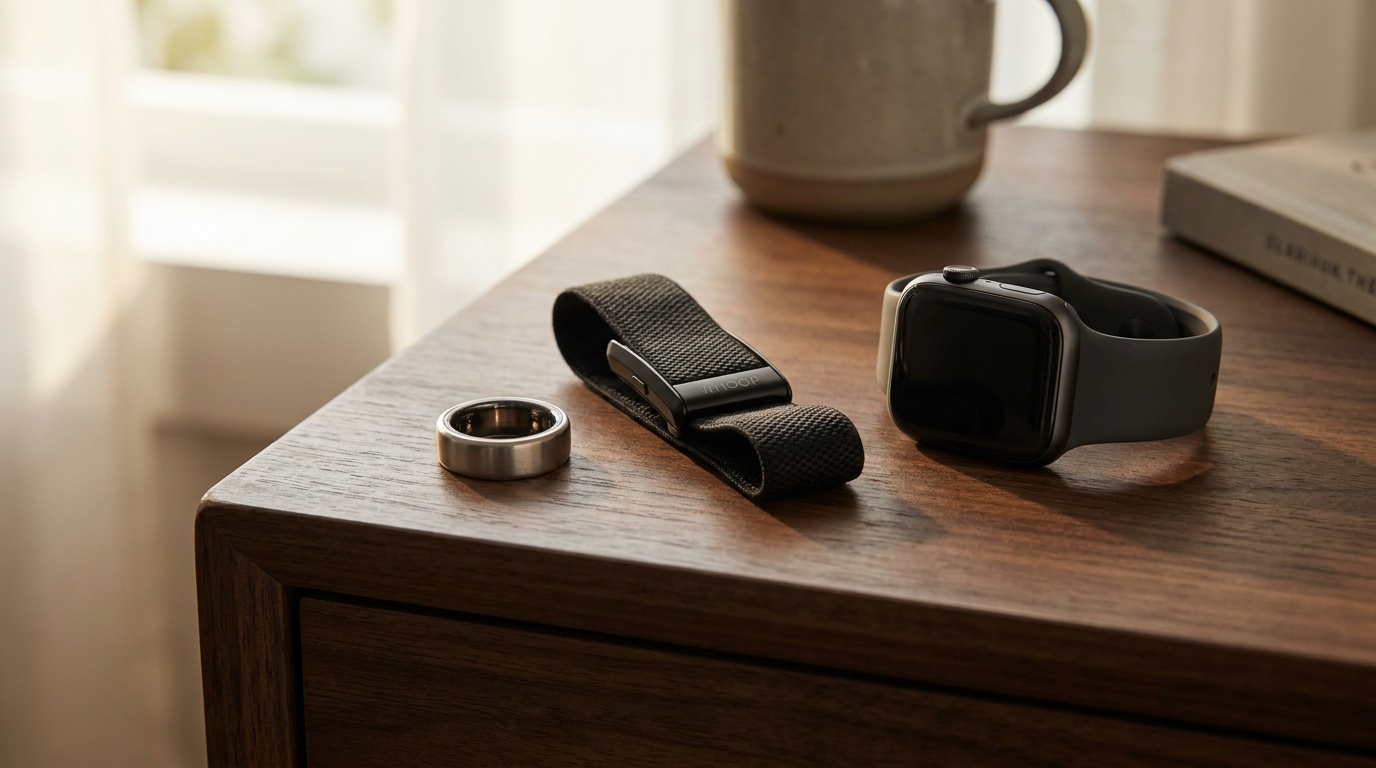
Gone are the days of simple accelerometers guessing when you fell asleep based on wrist movement. Today's wearables use multi-path sensors, temperature tracking, and advanced algorithms to rival clinical polysomnography [1]. As the technology has matured, three devices have emerged as the definitive leaders for consumers in 2026: the Oura Ring 4, the Whoop 5.0, and the Apple Watch Series 11 [7, 8]. Each takes a radically different approach to hardware design, data interpretation, and user lifestyle integration. Choosing the right device is no longer just about picking a brand; it requires aligning the tracker's specific strengths with your personal health goals, whether that means optimizing athletic recovery, screening for medical conditions, or simply getting a better night's rest without a glowing screen on your wrist.[1][7][8]
The case for the Oura Ring 4 centers heavily on its unobtrusive form factor and superior staging accuracy. Worn on the finger rather than the wrist, the device captures significantly cleaner blood flow signals, as the capillaries in the finger are closer to the surface [1, 7]. The fourth-generation ring packs an impressive 18-path sensor system into a sleek titanium shell that weighs less than five grams, making it virtually unnoticeable overnight [7]. Proponents argue this 'set it and forget it' design is the most crucial feature of any sleep wearable, as the best tracker is simply the one you can tolerate wearing to bed every single night without it disrupting your comfort.[1][7]
The empirical evidence heavily favors Oura for pure sleep staging. In independent validation studies, including a landmark 2024 paper from Brigham and Women's Hospital and subsequent 2025 real-world tests, Oura consistently demonstrated the highest agreement with clinical polysomnography [1, 3]. It achieved an impressive 76 to 79 percent sensitivity for four-stage sleep classification—accurately differentiating between light, deep, REM, and awake times—outperforming both of its wrist-based competitors [1, 5]. Furthermore, it showed the strongest concordance for nocturnal heart rate variability and resting heart rate, metrics that are essential for calculating daily readiness and overall cardiovascular recovery [3].[1][3][5]

However, the primary argument against the Oura Ring 4 lies in its daytime limitations and its ongoing subscription model. While it excels in bed, it functions poorly as an active fitness tracker, frequently struggling to automatically log non-cardio workouts or short naps under twenty minutes [4, 7]. Furthermore, the hardware requires an ongoing monthly subscription to unlock the detailed sleep data, leading to subscription fatigue for users who already paid a premium upfront for the titanium ring [5]. For those who want a comprehensive device that tracks heavy weightlifting sessions or marathon pacing, the ring form factor simply falls short.[4][5][7]
The case for the Whoop 5.0 pivots away from pure sleep data and toward holistic athletic recovery. Worn as a screenless fabric band, Whoop is built specifically for high performers who want daily, actionable coaching rather than raw numbers [5, 7]. The system connects a user's sleep need directly to the cardiovascular strain they accumulated during the day. Its core philosophy is that sleep is not an isolated event to be graded, but a biological recovery mechanism that must be precisely balanced against training intensity to prevent overtraining and injury [7].[5][7]
Evidence supporting Whoop highlights its exceptional tracking of total sleep time and resting heart rate. Validation studies show a near-perfect 0.99 intraclass correlation for heart rate accuracy during sleep, matching the reliability of chest straps [3]. The device is particularly adept at detecting night-to-night variations in REM and light sleep, which is crucial for athletes monitoring their recovery trends [2]. Because it lacks a screen, it boasts a multi-day battery life and zero blue-light distractions, which sleep purists highly value when optimizing their bedroom environment [5].[2][3][5]
Evidence supporting Whoop highlights its exceptional tracking of total sleep time and resting heart rate.
The case against Whoop is rooted in its steep cost and narrow, demanding focus. The hardware is technically free, but users are locked into an annual membership that can exceed $230 a year, making it the most expensive option over time [5, 7]. Real-world users frequently report frustration with its auto-tracking capabilities for activities like strength training or walking, noting that the heart rate sensor can sometimes lag during rapid interval changes [4]. It is a demanding ecosystem that requires manual input and consistent high-intensity training to get the most out of the AI coaching features.[4][5][7]

The case for the Apple Watch Series 11 rests on its unmatched daytime utility and recent medical-grade advancements. For iPhone users, it offers a seamless single-device solution that transitions effortlessly from the office to the gym to the bedroom [7, 8]. The introduction of the Vitals app and FDA-cleared sleep apnea detection elevates it from a simple fitness tracker to a proactive health screening tool [7]. It uses its built-in accelerometer to track tiny breathing disturbances over a thirty-day period, alerting users to potential respiratory issues before they ever reach a doctor's office [7].[7][8]
The evidence for Apple's sleep tracking shows a mixed but highly reliable profile. Independent testing reveals the Apple Watch is the undisputed winner for detecting awake time, accurately capturing the micro-arousals and tossing-and-turning that other devices frequently miss [2]. However, it struggles significantly with deep sleep accuracy compared to the Oura Ring, often misclassifying stages due to the inherent limitations of wrist-based optical sensors [1, 2]. While it provides an excellent general overview, it lacks the granular precision required by strict sleep optimizers.[1][2]
The argument against the Apple Watch Series 11 is almost entirely about battery anxiety and sleep hygiene. With an 18-hour battery life under normal use, it requires daily charging—usually forcing users to top it off while showering or winding down for the night [7]. Furthermore, wearing a bright, notification-heavy screen to bed contradicts basic sleep hygiene principles, even with sleep modes engaged [4]. It is also notably bulkier than a ring or a fabric band, which can be physically uncomfortable for side sleepers who rest their hands under their pillows.[4][7]

When comparing the three directly, the trade-offs become abundantly clear, and the decision ultimately comes down to lifestyle fit. The Oura Ring 4 fits well when you want the most accurate, unobtrusive sleep data available and prioritize overnight recovery over daytime workout metrics [4, 7]. It is the ultimate 'set it and forget it' wearable. However, it does not fit when you want a device to track your marathon pacing, deliver text messages, or serve as a primary daytime smartwatch.[4][7]
The Whoop 5.0 fits well when you are a serious athlete who trains multiple days a week and needs actionable, data-driven guidance on when to push hard and when to rest [5, 7]. It acts as a digital coach that demands your attention. Conversely, it does not fit when you are a casual user looking for basic insights, as the high annual subscription cost is incredibly difficult to justify without fully utilizing the advanced recovery coaching and strain metrics [7].[5][7]
Finally, the Apple Watch Series 11 fits well when you are already entrenched in the iOS ecosystem, want a full-featured smartwatch for daytime productivity, and highly value FDA-cleared health alerts like sleep apnea detection [7, 8]. It is the ultimate generalist device. It does not fit, however, when you hate the chore of daily charging, suffer from notification fatigue, or find wearing a bulky metal watch to bed physically uncomfortable and disruptive to your rest [4, 7].[4][7][8]
How we got here
2020
Early validation studies begin showing consumer wearables reaching moderate agreement with clinical sleep tests.
2024
Landmark independent studies confirm the Oura Ring Gen3 achieves high sensitivity for sleep staging, setting a new industry benchmark.
September 2024
Apple receives FDA clearance for sleep apnea detection on its newer Apple Watch models.
2026
The Oura Ring 4 and Whoop 5.0 launch with refined algorithms, cementing the shift from basic step-counting to holistic recovery tracking.
Viewpoints in depth
Sleep Science Purists
Focuses on polysomnography agreement and minimal physical interference.
For those who view sleep tracking as a clinical exercise, the Oura Ring is the undisputed champion. This camp points to independent validation studies, such as the Cambiaghi et al. paper, which demonstrate that finger-based PPG sensors inherently outperform wrist-based sensors for overnight heart rate variability and staging. They argue that wearing a bulky, screen-heavy smartwatch to bed introduces blue light and notification anxiety, which actively degrades the sleep quality the device is attempting to measure.
Athletic Performance Optimizers
Prioritizes actionable recovery data and cardiovascular strain over raw sleep stages.
Athletes and fitness enthusiasts argue that sleep data is useless in a vacuum. This camp favors Whoop's philosophy, which treats sleep as just one input in a broader recovery algorithm. They value the 'Readiness' score over the 'Sleep' score, using the data to dictate whether they should attempt a heavy lifting session or take a rest day. For this group, the high subscription cost is justified by the actionable AI coaching that actively prevents overtraining.
Everyday Ecosystem Users
Values multi-purpose utility and medical-grade screening over marginal gains in sleep staging.
General consumers and iOS loyalists argue that the best wearable is the one that serves multiple functions throughout the day. This camp champions the Apple Watch Series 11, emphasizing that while it may lack the deep sleep precision of the Oura Ring, its FDA-cleared sleep apnea detection provides a tangible, potentially life-saving medical benefit. They are willing to accept the trade-off of daily battery charging in exchange for a device that also handles their emails, payments, and daytime fitness tracking.
What we don't know
- How upcoming algorithmic updates from competitors like Garmin and Fitbit will alter the accuracy rankings.
- Whether consumer wearables will eventually achieve true clinical-grade precision for deep sleep, which remains a challenge for optical sensors.
Key terms
- Polysomnography (PSG)
- A comprehensive sleep study used as the clinical gold standard for diagnosing sleep disorders and validating consumer trackers.
- Heart Rate Variability (HRV)
- The variation in time between consecutive heartbeats, used by trackers to measure physical recovery and nervous system stress.
- Four-Stage Sleep Classification
- The ability of a device to accurately categorize sleep into awake, light, deep, and REM stages.
- PPG Sensor
- Photoplethysmography sensors that use light to measure blood flow and heart rate, commonly found on the underside of smartwatches and rings.
Frequently asked
Which sleep tracker is the most accurate?
Independent validation studies consistently rank the Oura Ring 4 as the most accurate consumer device for four-stage sleep classification, closely followed by Whoop for total sleep time.
Does the Apple Watch track sleep apnea?
Yes, the Apple Watch Series 11 features an FDA-cleared sleep apnea detection tool that monitors breathing disturbances over a 30-day period.
Do I have to pay a subscription for Whoop?
Yes, Whoop hardware is included with a membership, but the device requires an ongoing subscription (starting around $199 to $239 annually) to function and access data.
Can I wear the Oura Ring while lifting weights?
While durable, the titanium finish on the Oura Ring can scratch during heavy barbell use, and its optical sensors are less accurate for tracking rapid heart rate changes during strength training.
Sources
Source coverage
8 outlets
3 viewpoints surfaced







[1]The Longevity StoreSleep Science Purists
Compare the best sleep trackers of 2026: Oura Ring, Whoop, and Eight Sleep Pod
Read on The Longevity Store →[2]We Love CyclingEveryday Ecosystem Users
Oura ring vs Whoop vs Apple watch sleep tracking accuracy
Read on We Love Cycling →[3]MediumSleep Science Purists
Wearable Sleep Tracker Accuracy Analysis: Oura vs Whoop vs Apple Watch
Read on Medium →[4]RedditAthletic Performance Optimizers
Real-world comparison: I've spent the last few years cycling through the big three
Read on Reddit →[5]Get EvidentSleep Science Purists
Best Sleep Trackers 2026
Read on Get Evident →[6]Cycle BreezeEveryday Ecosystem Users
Best Sleep Trackers of 2026
Read on Cycle Breeze →[7]Up on TopAthletic Performance Optimizers
Best Sleep Trackers 2026 (Honest Comparison) – Oura Ring 4 vs Whoop 5.0 vs Apple Watch
Read on Up on Top →[8]CNETEveryday Ecosystem Users
Best sleep trackers of 2026
Read on CNET →
More in guides
See all 5 stories →

Every angle. Every day.
Get guides stories with full source coverage and perspective breakdowns delivered to your inbox.