
The 2026 E-Reader Ecosystems Compared: Amazon Kindle vs. Rakuten Kobo vs. Open Android
As color e-ink and open-platform devices mature in 2026, readers face a choice between Amazon's seamless walled garden, Kobo's library-first hardware, and the multi-app versatility of Android e-readers.
By Factlen Editorial Team
- Ecosystem Loyalists
- Argue that seamless integration and optimized hardware provide the most frictionless reading experience.
- Library & Open-Format Advocates
- Prioritize native public library integration, EPUB support, and physical page-turn buttons.
- Multi-Platform Readers
- Value hardware flexibility and app access above all, preferring Android devices to unify fragmented libraries.
What's not represented
- · Independent authors who rely on open EPUB formats for direct sales
- · Public librarians managing digital lending budgets
Why this matters
Choosing an e-reader is no longer just about screen size; it is a commitment to a digital ecosystem. Your choice dictates whether you can easily borrow library books, view color illustrations, or access purchases from rival bookstores.
Key points
- The 2026 e-reader market is divided between Kindle, Kobo, and open Android devices.
- Kindle offers the fastest hardware and largest store, but locks users into Amazon.
- Kobo provides native public library integration and affordable color e-ink options.
- Android e-readers like Boox allow users to install multiple bookstore apps on one device.
- Color e-ink screens offer pastel visuals but have a slightly darker baseline background.
- Android e-readers sacrifice traditional e-ink battery life for software versatility.
The era of the default e-reader purchase is over. For years, buying a digital reading device simply meant choosing which size of Amazon Kindle to order. But by mid-2026, the market has fractured into three distinct and highly competitive philosophies. Readers must now navigate between the seamless walled garden of Amazon, the library-first hardware of Rakuten Kobo, and the multi-platform versatility of open Android devices.
The stakes for this decision are higher than they appear. Choosing an e-reader today is a commitment to a specific digital ecosystem that dictates where you buy books, how easily you can borrow them from public libraries, and whether you can see book covers and illustrations in color. The hardware has evolved, but the software walls have grown taller.
The Walled Garden approach is championed by the Amazon Kindle. The 12th Generation Kindle Paperwhite remains the default recommendation for many reviewers, and the case for it rests on unmatched hardware optimization combined with the sheer scale of the Amazon storefront. By controlling both the device and the marketplace, Amazon delivers a frictionless pipeline from purchase to reading.[1][2][5]
The evidence for Kindle's hardware dominance is substantial. Reviewers consistently praise the latest Paperwhite for its twenty-five percent faster page turns and incredibly high-contrast display. The device offers a snappy, glare-free experience that simply works out of the box, with battery life measured in weeks rather than days. For those willing to spend more, the Signature Edition doubles the storage to thirty-two gigabytes and adds wireless charging.[1][5]

However, the case against the Kindle ecosystem centers on its restrictive nature. Users are largely locked into purchasing from Amazon, and borrowing library books requires using the Libby app on a separate smartphone or computer to send the file to the e-reader. Furthermore, base models still come with lock-screen advertisements unless users pay a premium to remove them, and Amazon recently ceased software support for its oldest legacy devices.[1][4]
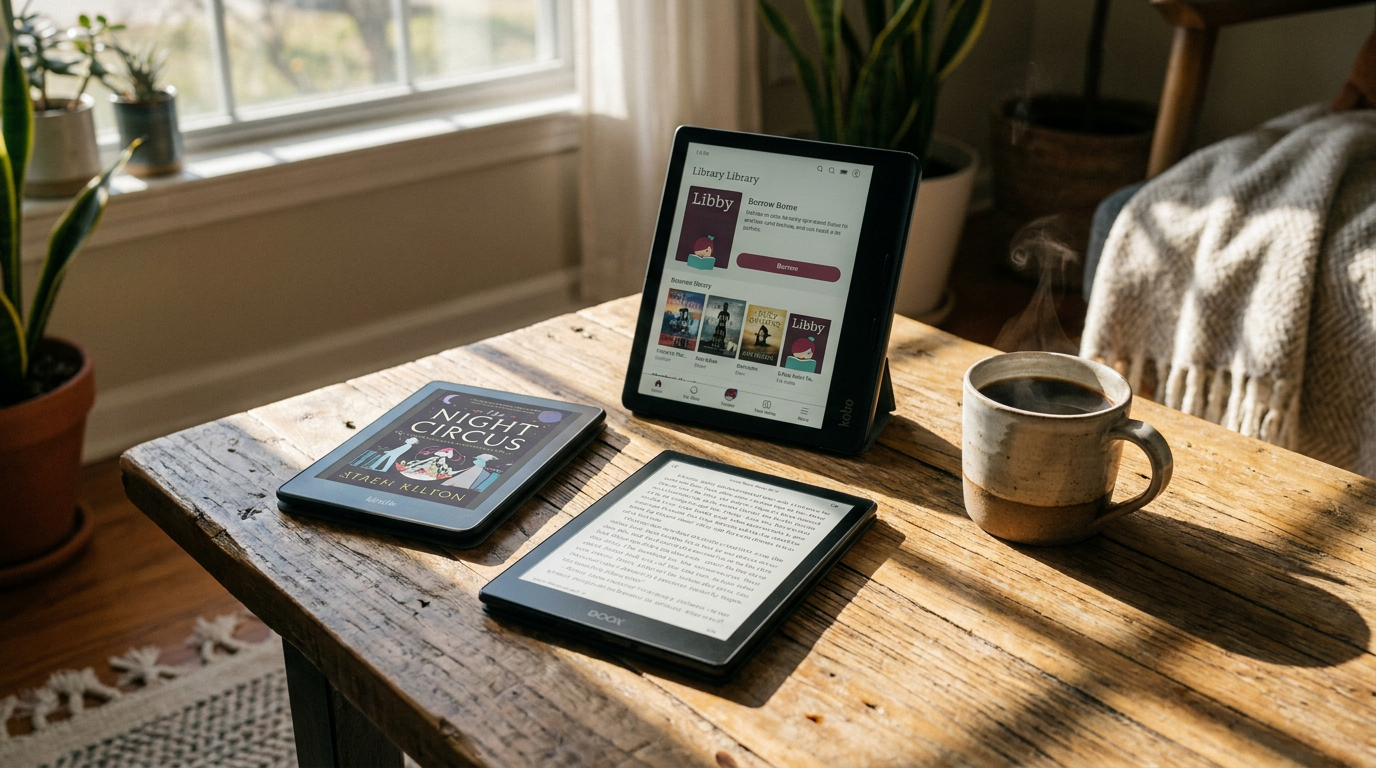
For readers looking to escape Amazon's orbit, Rakuten Kobo has positioned itself as the premier Library-First Alternative. The case for devices like the Kobo Libra Colour and Clara BW centers on native public library integration, open format support, and ergonomic design choices that prioritize the physical reading experience.[2][4]
For readers looking to escape Amazon's orbit, Rakuten Kobo has positioned itself as the premier Library-First Alternative.
The evidence supporting Kobo's appeal is strong among heavy readers. Outlets highlight the Libra Colour's built-in Overdrive support, which allows users to browse, borrow, and place holds on library books directly on the e-ink screen. Additionally, the inclusion of physical page-turn buttons and Kaleido 3 color e-ink—allowing for pastel-colored book covers and multi-color highlighting—makes it a favorite for annotators and graphic novel fans.[2][4][5]
The case against Kobo involves hardware trade-offs and pricing. Because color e-ink technology requires an additional filter over the display, the baseline background is slightly grayer than a standard black-and-white Kindle, necessitating heavier use of the device's front light. Kobo has also faced criticism for recent price hikes across its lineup, making its devices slightly more expensive than their direct Amazon counterparts.[6]
The third paradigm, the Open Android Powerhouse, abandons the dedicated e-reader operating system entirely. Devices like the Boox Palma 2 and the Durobo Krono run full Android operating systems on e-ink displays. The case for these devices is ultimate versatility, breaking down the walls between competing digital bookstores.[1][3][4]
The evidence for the Android approach is compelling for power users. Tech reviewers note that Android e-readers solve the problem of fragmented digital libraries. A user can install the Kindle app, the Kobo app, and the Libby app all on the exact same device. The Boox Palma 2, in particular, has gained massive traction for its smartphone-like form factor, allowing for easy one-handed reading on a crowded commute.[1][3][4]

But the case against Open Android is rooted in complexity and endurance. This flexibility comes at a cost, as Android is a heavier operating system that cuts into the legendary battery life associated with pure e-ink devices. These devices also carry steeper learning curves, higher price tags, and occasional app compatibility issues, since standard Android applications are not natively optimized for e-ink refresh rates.[1]
Ultimately, no single device wins without conditions. The Kindle Paperwhite fits well when a reader buys the vast majority of their books directly from Amazon, values a frictionless setup process, and prioritizes maximum battery life and screen contrast above all else. It does not fit well for readers who rely heavily on EPUB files purchased from independent authors.[1][5]
The Kobo Libra Colour fits well when a reader relies heavily on their local public library, prefers physical buttons for page-turning, and wants the added benefit of color covers and annotations without being locked into the Amazon ecosystem. It does not fit well for readers who demand the absolute brightest white background on their display.[2][4]

Finally, open Android devices like the Boox Palma 2 fit well when a reader has a heavily fragmented library across multiple storefronts, desires highly pocketable hardware, and is willing to trade some battery life and simplicity for total software freedom. They do not fit well for users seeking a distraction-free, tech-minimalist escape.[1][3]
How we got here
2007
Amazon launches the first Kindle, establishing the dominant e-reader ecosystem.
2011
Rakuten acquires Kobo, building it into the primary global alternative to Amazon.
2024
Kobo launches the Libra Colour, bringing affordable color e-ink to the mainstream market.
2025
Amazon releases the 12th Generation Kindle Paperwhite with significantly faster page turns.
May 2026
Amazon officially ceases software support for its earliest legacy e-readers.
Viewpoints in depth
The Walled Garden's View
Amazon prioritizes a frictionless pipeline from store to screen.
Proponents of the Kindle ecosystem argue that controlling both the hardware and the marketplace results in unmatched optimization. By keeping the system closed, Amazon can deliver faster page turns, higher contrast, and weeks of battery life without the background drain of third-party apps. For these users, an e-reader should be an invisible appliance that simply delivers the next book with zero friction, even if it means sacrificing format flexibility.
The Library-First View
Kobo centers its philosophy on open formats and public library access.
Advocates for Kobo's approach believe that readers should not be tethered to a single corporate storefront. By integrating Overdrive directly into the device's operating system, Kobo removes the need for a secondary smartphone to borrow public library books. This camp also champions physical page-turn buttons, repairability, and native EPUB support, arguing that e-readers should feel like dedicated, reader-first tools rather than portable Amazon cash registers.
The Multi-Platform View
Android e-reader manufacturers argue for total software freedom.
Users of devices like the Boox Palma 2 argue that readers shouldn't have to choose a single ecosystem at all. By running a full mobile operating system on an e-ink screen, these devices allow users to install Kindle, Kobo, Libby, and even web browsers simultaneously. The focus is on ultimate hardware versatility and unifying fragmented digital libraries, accepting that this freedom comes with a steeper learning curve and reduced battery efficiency.
What we don't know
- Whether Amazon will introduce a wider range of affordable color e-ink devices to compete with Kobo's mid-range offerings.
- How long Android-based e-readers will receive OS and security updates compared to the highly controlled systems of Kindle and Kobo.
Key terms
- E-ink
- A display technology that mimics the appearance of ordinary ink on paper, reflecting light rather than emitting it to reduce eye strain.
- Kaleido 3
- The latest generation of color e-ink technology, capable of displaying pastel-like colors for book covers and annotations.
- Overdrive / Libby
- A digital service that allows users to borrow ebooks and audiobooks directly from their local public libraries.
- EPUB
- A widely used, open standard file format for digital books, supported natively by Kobo and Android e-readers.
Frequently asked
Can I read library books on a Kindle?
Yes, but it requires using the Libby app on a separate smartphone or computer to send the book to your Kindle. Kobo devices have Libby built directly into the e-reader.
Are color e-ink screens as sharp as black-and-white ones?
Color e-ink displays offer 300 ppi for black-and-white text but drop to 150 ppi for color images, and the screen can appear slightly darker without the front light turned on.
What is an open Android e-reader?
Devices like the Boox Palma 2 run a full Android operating system, allowing users to download apps from the Google Play Store, including Kindle, Kobo, and Libby, onto a single e-ink device.
Sources
Source coverage
6 outlets
3 viewpoints surfaced





[1]Tom's GuideMulti-Platform Readers
The best e-readers in 2026: Kindle, Kobo, and Boox tested
Read on Tom's Guide →[2]NBC NewsEcosystem Loyalists
The best e-readers in 2026, tested and reviewed
Read on NBC News →[3]ZDNetMulti-Platform Readers
Best e-readers of 2026: Kindle, Boox, Kobo, and Nook tested
Read on ZDNet →[4]MashableLibrary & Open-Format Advocates
The best e-readers for 2026: Kindle, Kobo, Boox, and more
Read on Mashable →[5]ReviewedEcosystem Loyalists
The Best E-readers of 2026
Read on Reviewed →[6]The VergeLibrary & Open-Format Advocates
The library rules (and so do library streaming services)
Read on The Verge →



Every angle. Every day.
Get guides stories with full source coverage and perspective breakdowns delivered to your inbox.