
Social Media Surpasses Traditional Outlets as the World's Primary News Source
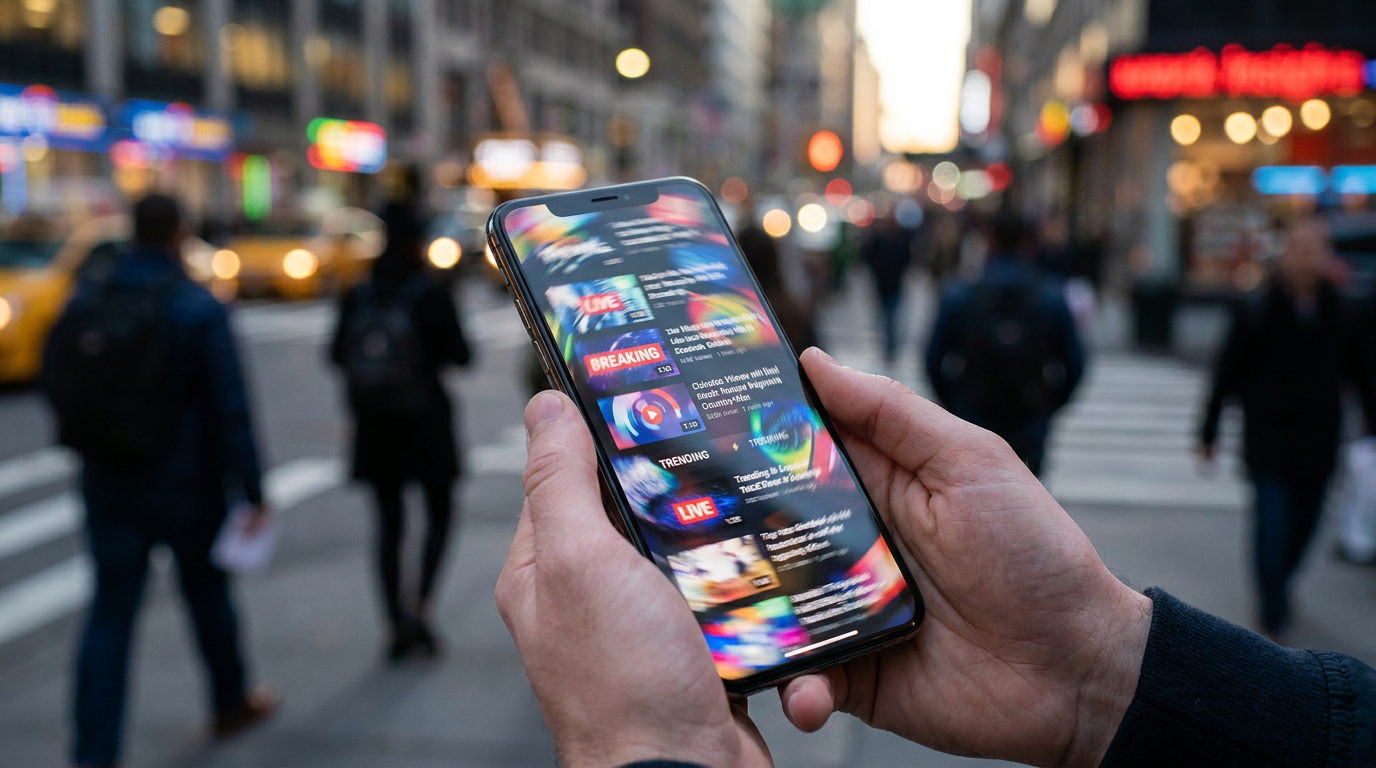
For the first time, social media and video networks have overtaken television and direct websites as the most widely used way people access news globally.
By Factlen Editorial Team
- Traditional Publishers
- Concerned about the loss of direct audience relationships and the financial sustainability of journalism in an algorithmic ecosystem.
- Media Researchers
- Focus on the structural platformisation of news, warning about the paradox of declining trust alongside rising reliance on third-party feeds.
- Independent Creators
- View the shift as a democratization of information, where relatability, niche expertise, and engaging formats outperform institutional legacy.
What's not represented
- · Older demographics who still rely exclusively on print and broadcast media.
- · Public service broadcasters facing funding cuts amid declining television viewership.
Why this matters
The way humanity discovers and verifies information has fundamentally shifted away from institutional gatekeepers to algorithmic feeds and independent creators. This transition not only threatens the financial survival of traditional journalism, but also reshapes how voters and consumers form opinions in an era of record-low trust.
Key points
- Social media and video networks (54%) have surpassed TV (52%) as the top global news source.
- Direct visits to news websites and apps have fallen to 51%.
- Almost half of global audiences now get some news from independent creators and influencers.
- Weekly use of AI chatbots for news has grown to 10% globally.
- Global trust in news has dropped to 25%, the lowest level recorded since 2015.
For the first time in history, the way humanity learns about the world has fundamentally flipped. Social media and video networks have officially surpassed both television and traditional news websites to become the most widely used sources of global news.[1][3]
The findings come from the 2026 Digital News Report, published by the Reuters Institute for the Study of Journalism at the University of Oxford. Based on surveys of nearly 100,000 people across 48 markets, the annual study marks a definitive turning point in the digital information age.[1][2]
According to the data, 54% of global audiences now use social platforms and video networks to access news on a weekly basis. This edges out television, which sits at 52%, and direct visits to news organizations' own websites or apps, which have fallen to 51%.[3][4]

Media researchers characterize this shift as the intensifying "platformisation" of news. The transition is not necessarily driven by explosive new growth in social media usage, but rather by the steady, structural decline of legacy habits.[1][3]
Since 2020, the use of television news and direct news websites has dropped by 13 and 12 percentage points, respectively. As audiences migrate away from these traditional formats, they are increasingly relying on algorithmic discovery.[2][4]
This migration has fundamentally changed the nature of how information is encountered. Instead of actively seeking out a broadcast or navigating to a specific publication's homepage, users increasingly consume news passively while scrolling through entertainment and social updates.[1][6]
This migration has fundamentally changed the nature of how information is encountered.
This passive discovery has elevated a new class of information gatekeepers. Almost half of global respondents now report getting some of their news from independent creators and influencers, rather than institutional journalists.[1][6]
Audiences report that individual creators feel more relatable, authentic, and easier to understand than traditional news anchors. While respondents acknowledge that influencers may be less impartial, the engaging format of online video often outweighs the desire for strict neutrality.[1][4]
However, the shift to social media is not uniform across the globe. In 30 of the 48 surveyed markets—particularly in the Global South, including countries like Indonesia and Thailand—social platforms now dominate the information ecosystem.[2][3]

Conversely, direct news websites and apps still maintain their lead in 18 markets. These holdouts are heavily concentrated in Northern Europe, the United Kingdom, and parts of Asia like Japan and South Korea, where strong public broadcasters and established subscription habits anchor the media landscape.[3]
Beyond social media, a new third-party intermediary is rapidly gaining ground. The 2026 report highlights the first meaningful integration of artificial intelligence into daily news habits, with 10% of global respondents now using AI chatbots for news weekly.[2][5]

When AI chatbots are factored in alongside social media and video networks, the combined share of audiences relying on third-party platforms for news rises to 56%. This further distances publishers from their audiences, complicating how journalism is funded and distributed.[2][3]
This structural transformation arrives alongside a crisis of credibility. Global trust in news has fallen to 25%, its lowest point since the Reuters Institute began tracking the metric in 2015.[1][2]

Audiences are increasingly skeptical of the information they consume, yet they continue to rely on the very algorithmic platforms that often blur the lines between verified reporting, opinion, and misinformation. As platforms, creators, and AI continue to redraw the boundaries of media, the definition of what constitutes a "news source" has been permanently altered.[1][6]
How we got here
2015
The Reuters Institute begins tracking global trust in news, establishing a baseline for digital consumption habits.
2020
Television and direct news websites begin a steady, multi-year decline in weekly usage across global markets.
2025
Major social platforms adjust algorithms to deprioritize political news, yet social video continues to grow as an information source.
June 2026
The Reuters Institute confirms that social media and video networks have officially surpassed TV and direct websites as the world's primary news source.
Viewpoints in depth
Traditional Publishers
Publishers view the shift as an existential threat to the financial sustainability of journalism.
Legacy media organizations argue that as audiences increasingly rely on social feeds and AI summaries, publishers lose the direct relationship needed to monetize their journalism. They emphasize the 12-point drop in direct website visits since 2020 as a critical threat, warning that without direct traffic and subscription revenue, the expensive, on-the-ground reporting that feeds the entire ecosystem will collapse.
Independent Creators
Creators argue they are simply delivering information in the formats modern consumers actually want.
Independent voices highlight the audience's desire for authenticity and accessibility. They point out that 46% of people now get news from creators because traditional broadcast formats often feel disconnected or overly formal. From their perspective, the shift isn't about stealing an audience, but rather democratizing information by breaking down complex stories into relatable, on-demand video formats.
Media Researchers
Researchers warn of a 'trust paradox' where audiences rely on platforms they inherently distrust.
Academic and media analysts center their focus on the structural consequences of 'platformisation.' They warn that while social media offers unprecedented access to information, it strips away the institutional context and editorial standards of traditional news. Researchers are particularly concerned that global trust has hit a historic low of 25% exactly as opaque AI chatbots and engagement-driven algorithms become the primary gatekeepers of public knowledge.
What we don't know
- How the integration of AI chatbots will alter the financial models of traditional news organizations that rely on direct website traffic.
- Whether the decline in global news trust will eventually plateau or continue to drop as synthetic media becomes more prevalent.
- How upcoming regulatory frameworks in the EU and US might force social platforms to alter their news distribution algorithms.
Key terms
- Platformisation
- The structural shift where third-party tech platforms, like social media and search engines, become the primary distributors of content rather than the original creators.
- Direct News Websites
- The owned-and-operated websites or dedicated mobile apps of traditional journalism organizations, such as a newspaper's homepage.
- News Creators
- Independent individuals or influencers who produce, summarize, or comment on news events, primarily distributing their content through social video networks.
- AI Chatbots
- Artificial intelligence programs that users increasingly query to summarize current events or explain complex news topics.
Frequently asked
What is the most popular way to get news globally?
For the first time, social media and video networks are the most widely used source, accessed by 54% of people weekly.
Are people still watching television news?
Yes, television remains a major source at 52%, but its weekly usage has dropped by 13 percentage points since 2020.
How many people use AI chatbots for news?
About 10% of global respondents use AI chatbots for news on a weekly basis, up from 7% the previous year.
Why is trust in news declining?
Trust has fallen to an all-time low of 25%, driven by political polarization, concerns over misinformation on social platforms, and the fragmented nature of modern digital feeds.
Sources
Source coverage
6 outlets
3 viewpoints surfaced






[1]Reuters InstituteMedia Researchers
Digital News Report 2026
Read on Reuters Institute →[2]The Jan PostTraditional Publishers
Platforms Now Rule: A Turning Point for Global Journalism
Read on The Jan Post →[3]AdNewsTraditional Publishers
Social media and video platforms overtake TV and news websites globally
Read on AdNews →[4]ALM CorpIndependent Creators
Social Media Is Now the Biggest Source of News Worldwide
Read on ALM Corp →[5]NewscastStudioMedia Researchers
AI chatbots begin to emerge as a news access point
Read on NewscastStudio →[6]Social Media TodayIndependent Creators
Social media is the leading source of news, per Reuters
Read on Social Media Today →

Every angle. Every day.
Get culture stories with full source coverage and perspective breakdowns delivered to your inbox.