
China Releases White Paper Outlining Vision for 'Multipolar' Global Order and Greater Global South Influence
Beijing's 45-page policy document calls for sweeping reforms to post-WWII international institutions, demanding greater representation for developing nations while proposing new governance frameworks for AI and outer space.
By Factlen Editorial Team
- Global South Advocates
- Views China's framework as a welcome opportunity to gain equitable representation, investment, and development without Western political conditions.
- Chinese Diplomatic Corps
- Argues that the current international system is outdated and must be reformed to reflect a multipolar reality while maintaining the UN at its core.
- Western Strategic Analysts
- Notes that China seeks the normative power to rewrite global rules but remains unwilling to bear the massive financial burdens of a global hegemon.
- Neutral International Observers
- Focuses on the geopolitical timing of the white paper and China's strategic push to define the rules for emerging technologies like AI.
What's not represented
- · U.S. State Department / Western Policymakers
- · Human Rights Organizations
Why this matters
As the world's second-largest economy formally codifies its strategy to reshape global institutions, the white paper signals a direct challenge to Western diplomatic dominance. By aligning itself with the Global South, Beijing is laying the groundwork for new international rules governing trade, security, and emerging technologies like artificial intelligence.
Key points
- China released a 45-page white paper outlining its vision for a 'multipolar' global order.
- The document calls for greater representation of the Global South in international institutions like the UN and IMF.
- Beijing advocates for consensus-based UN frameworks to govern emerging frontiers like artificial intelligence and outer space.
- African leaders and developing nations have largely welcomed the initiative as a corrective to Western-dominated structures.
- Western analysts note China is seeking normative power without committing to the massive financial burdens of a global hegemon.
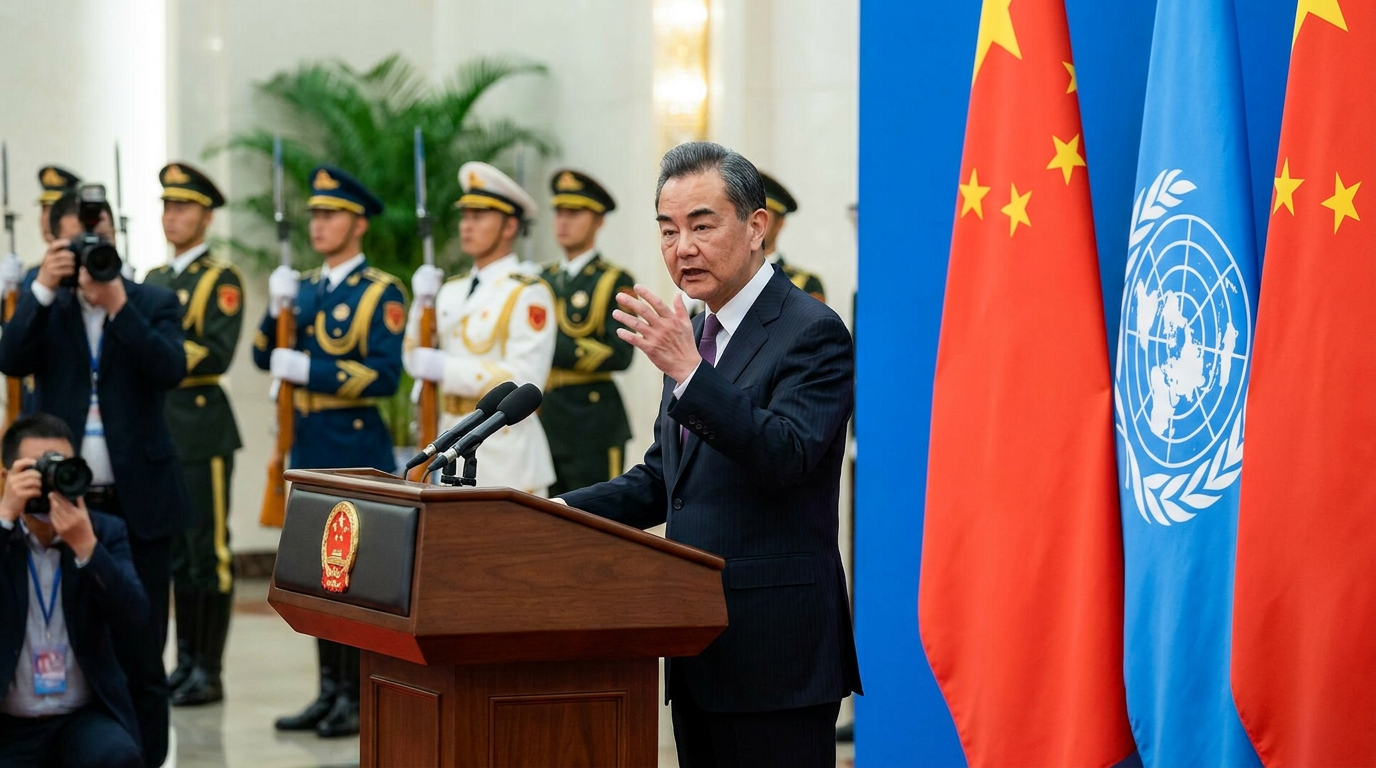
China has formally unveiled a sweeping 45-page white paper detailing its vision for a restructured international system, calling for a transition toward a genuinely "multipolar" world order. Released by the State Council Information Office, the document—titled "More Just and Equitable Global Governance: China's Principles, Proposals and Actions"—argues that the institutions established after the Second World War no longer reflect the economic and political realities of the 21st century. Unveiling the document in Beijing, Chinese Foreign Minister Wang Yi declared that global governance currently stands at a "critical crossroads," disrupted by multiple geopolitical crises and expanding deficits in peace and trust. The policy paper serves as China's most comprehensive attempt to date to consolidate its various diplomatic initiatives into a single, coherent framework aimed at reshaping how global rules are written and enforced.[1][3]
At the core of Beijing's proposal is a demand for the redistribution of power within existing international frameworks, specifically aimed at elevating the influence of the Global South. The white paper explicitly states that developing nations, despite accounting for the vast majority of the global population and driving a significant portion of worldwide economic growth, remain structurally marginalized in core decision-making bodies like the International Monetary Fund and the World Bank. Chinese officials argue that the days when a handful of Western capitals could dictate international affairs are over, and that long-standing historical injustices in global representation must be addressed. To rectify this, the document advocates for incremental, inclusive governance reform rather than the dismantling of established multilateral frameworks.[3][6]
Crucially, the white paper goes to great lengths to position China not as a disruptor of the global order, but as a defender of the United Nations. Unlike rising powers of the past that sought to overturn existing institutions, Beijing insists that the UN must remain the indispensable core of international governance. The document explicitly rejects unilateralism, protectionism, and bloc-based confrontation, framing China's ambitions as an effort to rebalance the system rather than replace it. By repeatedly emphasizing the centrality of the UN, Chinese diplomats are attempting to establish a new political vocabulary that appeals to nations wary of great-power competition, presenting Beijing as a stabilizing force in an era of profound turbulence.[1][2]

Beyond traditional geopolitical and economic structures, the white paper stakes a strong claim on the rule-making process for emerging frontiers, identifying artificial intelligence, cyberspace, and outer space as critical domains requiring updated governance. China proposes that the international community establish consensus-based standards under UN auspices to ensure these technologies benefit all nations, rather than widening existing digital divides. The document specifically encourages BRICS countries to develop a governance agenda that addresses the unique technological and security needs of the Global South. By pitching itself as a champion of equitable rule-making in these new sectors, Beijing aims to prevent Western nations from monopolizing the standards that will define the next century of technological advancement.[1][3]
The reception across the Global South has been notably receptive, with many developing nations viewing China's proposals as a necessary corrective to Western-dominated structures. African leaders and commentators have pointed out that the continent, home to more than 1.4 billion people, still lacks permanent representation on the UN Security Council. Burundian President and current African Union Chairperson Evariste Ndayishimiye publicly praised the vision, stating that Africa and China share a common desire for a multipolar world where the voices of developing nations are respected. For many of these countries, the appeal of China's framework lies in its emphasis on sovereign equality, non-interference, and development-centered cooperation—principles that resonate deeply with states that have historically felt sidelined by the post-1945 architecture.[4][5]
To back its rhetorical commitments, Beijing has paired its governance proposals with tangible economic incentives targeted at developing nations. Effective earlier this year, China implemented a zero-tariff policy on products from 53 African countries with which it maintains diplomatic relations, expanding a previous initiative to foster deeper South-South trade integration. Furthermore, China has mobilized billions through the Global Development and South-South Cooperation Fund, launching over 1,800 cooperation projects and training tens of thousands of personnel. This development-first approach, which prioritizes infrastructure, poverty reduction, and job creation over ideological alignment, offers developing nations an attractive alternative to the conditional lending practices often associated with Western financial institutions.[4][6]

To back its rhetorical commitments, Beijing has paired its governance proposals with tangible economic incentives targeted at developing nations.
Beyond bilateral trade, China is actively utilizing multilateral blocs to institutionalize its vision of a multipolar world. The recent expansion of the BRICS grouping—which now includes major emerging economies across the Middle East, Africa, and Latin America—serves as a primary vehicle for this strategy. Chinese diplomats argue that the collective rise of the Global South is an unstoppable historical trend, and that expanded regional organizations demonstrate that power is no longer concentrated in a handful of Western capitals. By backing the African Union's inclusion in the G20 and pushing for greater voting shares for developing nations in the IMF, Beijing is systematically working to dilute Western influence within the very institutions that have governed the global economy for decades.[3][5][6]
However, Western strategic analysts have identified a striking contradiction at the heart of China's ambitious blueprint. While Beijing increasingly presents itself as the architect of a new global order, it remains notably reticent to underwrite that order with the kind of massive financial commitments historically required of global hegemons. Analysts point out that China is not proposing a "Marshall Plan 2.0" or offering open-ended security guarantees to its partners. Instead, the white paper reveals a strategy focused on projecting normative power—shaping how the world thinks about sovereignty and development—while maintaining strict financial restraint amid domestic economic challenges. This balancing act suggests that China seeks the prestige and influence of global leadership without bearing the full, costly burden of maintaining the international system.[2]

The white paper also addresses global security, heavily promoting China's Global Security Initiative as a viable alternative to Western alliance networks. Beijing's framework emphasizes the principle of "indivisible security," arguing that no country should strengthen its own security at the expense of others—a thinly veiled critique of NATO's expansion and U.S. alliance structures in the Indo-Pacific. For many Global South nations, China's strict adherence to the doctrine of non-interference in internal political affairs is a major selling point. It provides developing nations with strategic options that do not require them to choose sides in rival geopolitical camps or submit to external lectures on domestic governance, further cementing China's appeal as a pragmatic partner.[2][5]
The timing of the white paper's release is highly strategic, arriving just as the G7 published its own prescriptions for global affairs and as the international community grapples with protracted conflicts in Ukraine and the Middle East. By unveiling this comprehensive vision now, Beijing is actively contrasting its multilateral, development-focused agenda with what it characterizes as Western unilateralism and militarism. As the UN prepares to elect a new secretary-general later this year, China is heavily leveraging its status as the second-largest contributor to the UN peacekeeping budget and the largest troop-sending country among the permanent Security Council members. Ultimately, the success of China's multipolar vision will depend on whether its normative appeal to the Global South can overcome the structural inertia of the current system and the skepticism of Western powers.[2][3]
How we got here
1945
The United Nations and Bretton Woods institutions are established, forming the core of the post-WWII global order.
2025
Chinese President Xi Jinping first proposes the Global Governance Initiative (GGI).
May 2026
China implements a zero-tariff policy for 53 African nations to boost South-South trade.
June 2026
China officially releases the 45-page white paper detailing its vision for a multipolar world order.
Viewpoints in depth
Chinese Diplomatic Corps
Advocates for democratizing international relations and reforming outdated Western-led structures.
Chinese officials argue that the post-WWII international architecture is fundamentally misaligned with the realities of the 21st century. By releasing this white paper, Beijing aims to codify its various diplomatic initiatives—such as the Global Development Initiative and Global Security Initiative—into a unified doctrine. They stress that true multilateralism requires the UN to remain at the center of global governance, but insist that the system must be reformed to dismantle Western hegemony and prevent bloc-based confrontation.
Global South Nations
Focuses on economic development, zero-tariff trade, and gaining a proportional voice in global financial institutions.
For many developing nations across Africa, Latin America, and Asia, the current global governance system is viewed as structurally biased against their interests. Leaders in these regions have welcomed China's white paper as a necessary intervention that prioritizes sovereign equality and non-interference. They point to tangible benefits, such as China's zero-tariff trade policies and infrastructure investments, as evidence that a multipolar world offers better developmental opportunities than the conditional lending practices of the IMF and World Bank.
Western Strategic Analysts
Views China's proposals as an attempt to gain normative power without bearing the financial burdens of global leadership.
Western analysts observe a stark contrast between China's sweeping rhetorical ambitions and its actual financial commitments to the global order. They argue that while Beijing is eager to rewrite the rules of global governance and champion the Global South, it is unwilling to underwrite the international system with the massive financial transfers or open-ended security guarantees historically provided by the United States. Consequently, they view the white paper as a strategic play for diplomatic prestige and normative influence rather than a genuine blueprint for a new global architecture.
What we don't know
- How Western nations and the G7 will formally respond to China's proposed frameworks for AI and space governance.
- Whether the push for UN reform will translate into actual structural changes, such as new permanent seats on the Security Council.
- How China plans to balance its domestic economic slowdown with the financial expectations of its Global South partners.
Key terms
- Global South
- A term used to describe developing and emerging economies, primarily located in Africa, Latin America, Asia, and Oceania.
- Multipolarity
- An international system where power is distributed among multiple states or alliances rather than being dominated by one or two superpowers.
- Bretton Woods Institutions
- The World Bank and the International Monetary Fund (IMF), established after WWII, which developing nations argue are disproportionately dominated by Western powers.
- Global Governance Initiative (GGI)
- A diplomatic framework proposed by Chinese President Xi Jinping aimed at reforming international systems to be more equitable for developing nations.
- Zero-tariff treatment
- A trade policy where imported goods from specific countries are not subject to customs duties or taxes, designed to boost bilateral trade.
Frequently asked
What is the name of China's new white paper?
The document is titled 'More Just and Equitable Global Governance: China's Principles, Proposals and Actions'.
Does China want to replace the United Nations?
No. The white paper explicitly calls for the United Nations to remain the indispensable core of the international system, though it advocates for significant reforms to its structure.
How does the white paper address emerging technologies?
It calls for the creation of consensus-based UN frameworks to govern artificial intelligence, cyberspace, and outer space to ensure these technologies benefit developing nations.
What economic incentives is China offering the Global South?
China has implemented zero-tariff policies for 53 African nations and mobilized billions through the Global Development Fund to support infrastructure and poverty reduction projects.
Sources
Source coverage
6 outlets
4 viewpoints surfaced






[1]South China Morning PostChinese Diplomatic Corps
Beijing says international governance is at a crossroads and needs to be more in line with evolving realities
Read on South China Morning Post →[2]Chatham HouseWestern Strategic Analysts
China's new white paper on global governance highlights its balancing act between global ambitions and financial restraint
Read on Chatham House →[3]Channel News AsiaNeutral International Observers
China unveils white paper on global governance, calls for stronger Global South representation
Read on Channel News Asia →[4]XinhuaChinese Diplomatic Corps
Africa-China relations exemplify model South-South cooperation
Read on Xinhua →[5]Capital FMGlobal South Advocates
The world is moving toward a more multipolar order
Read on Capital FM →[6]The HeraldGlobal South Advocates
Africa's Voluntary Alignment With China to Refine Global Governance Architecture
Read on The Herald →
More in news politics
See all 5 stories →Labor Law
NLRB Judge Orders Amazon to Bargain with Teamsters, Setting Up Showdown Over Key Labor Precedent
6 sources
Economic Data
Trump Fires BLS Commissioner, Accusing Agency of Manipulating Jobs Report Data
8 sources
Social Security
FACT CHECK: Social Security Is Not 'Running Out of Money,' But a 23% Benefit Cut Looms by 2033
8 sources

Every angle. Every day.
Get news politics stories with full source coverage and perspective breakdowns delivered to your inbox.