
How Generative AI and Autonomous Robots Are Slashing Material Discovery Times
By pairing Graph Neural Networks that predict stable molecular structures with autonomous robotic labs that synthesize them, scientists are compressing the timeline for discovering new battery and carbon-capture materials from decades to days.
By Factlen Editorial Team
- Computational Material Scientists
- View this as a historic paradigm shift that moves chemistry from a manual, empirical science to an algorithmic, predictive discipline.
- Climate Tech Industry
- Focused on the immediate commercial applications, specifically how AI-discovered materials can bypass supply chain bottlenecks for EV batteries and carbon capture.
- Experimental Traditionalists
- Maintain cautious optimism but emphasize the 'sim-to-real' gap, noting that theoretical stability does not guarantee a material can be manufactured at industrial scale.
What's not represented
- · Mining industry executives
- · Chemical manufacturing logisticians
Why this matters
Historically, discovering a single new battery material or carbon-capture compound took decades of manual trial and error. By automating both the theoretical prediction and the physical synthesis, this technology removes a massive bottleneck in the global transition to clean energy.
Key points
- Generative AI models are predicting millions of new, theoretically stable material structures.
- Autonomous 'self-driving' robotic labs are physically synthesizing and testing these AI recipes 24/7.
- The closed-loop system allows the AI to learn instantly from the robots' physical failures.
- The technology is rapidly accelerating the discovery of solid-state batteries and carbon-capture materials.
- The main remaining hurdle is scaling the manufacturing of these materials from lab samples to industrial tons.
For over a century, material science has been constrained by the speed of human hands and the limits of human intuition. Discovering a new compound—whether for a lighter airplane wing, a denser battery, or a more efficient solar panel—required scientists to manually mix elements, bake them in furnaces, and test their properties in a grueling process of trial and error. It is a workflow that Thomas Edison would readily recognize, and it is the primary reason why commercializing a new material historically takes up to twenty years.[1][6]
That timeline is currently undergoing a violent compression. A new generation of generative artificial intelligence, paired directly with autonomous robotic chemistry labs, is fundamentally rewriting the physics of discovery. Rather than relying on human guesswork, AI models are now "hallucinating" millions of theoretically stable crystal structures in silicon, while robotic arms work around the clock to physically cook and verify those recipes in the real world.[1][7]
The engine driving this revolution is a specific AI architecture known as a Graph Neural Network (GNN). Unlike Large Language Models, which process sequential strings of text, GNNs are designed to understand spatial relationships and geometry. In the context of chemistry, a GNN treats individual atoms as "nodes" and the chemical bonds between them as "edges." This allows the AI to map the three-dimensional architecture of a molecule and predict how it will behave under different physical conditions.[2][6]

By training these networks on massive databases of known inorganic crystals, researchers have taught the AI the underlying rules of thermodynamics and quantum mechanics. The models can now invert the process: instead of analyzing an existing material, scientists can prompt the AI with desired properties—such as high ionic conductivity for a battery—and the GNN will generate entirely novel atomic structures that meet those criteria.[2][5]
However, predicting a stable material on a computer is only half the battle. The historical graveyard of material science is filled with compounds that were theoretically perfect but impossible to actually manufacture. A material might be "thermodynamically stable" on a hard drive, but creating it in a lab might require kinetic pathways that simply do not exist, or temperatures that would vaporize the crucible holding it.[1][7]
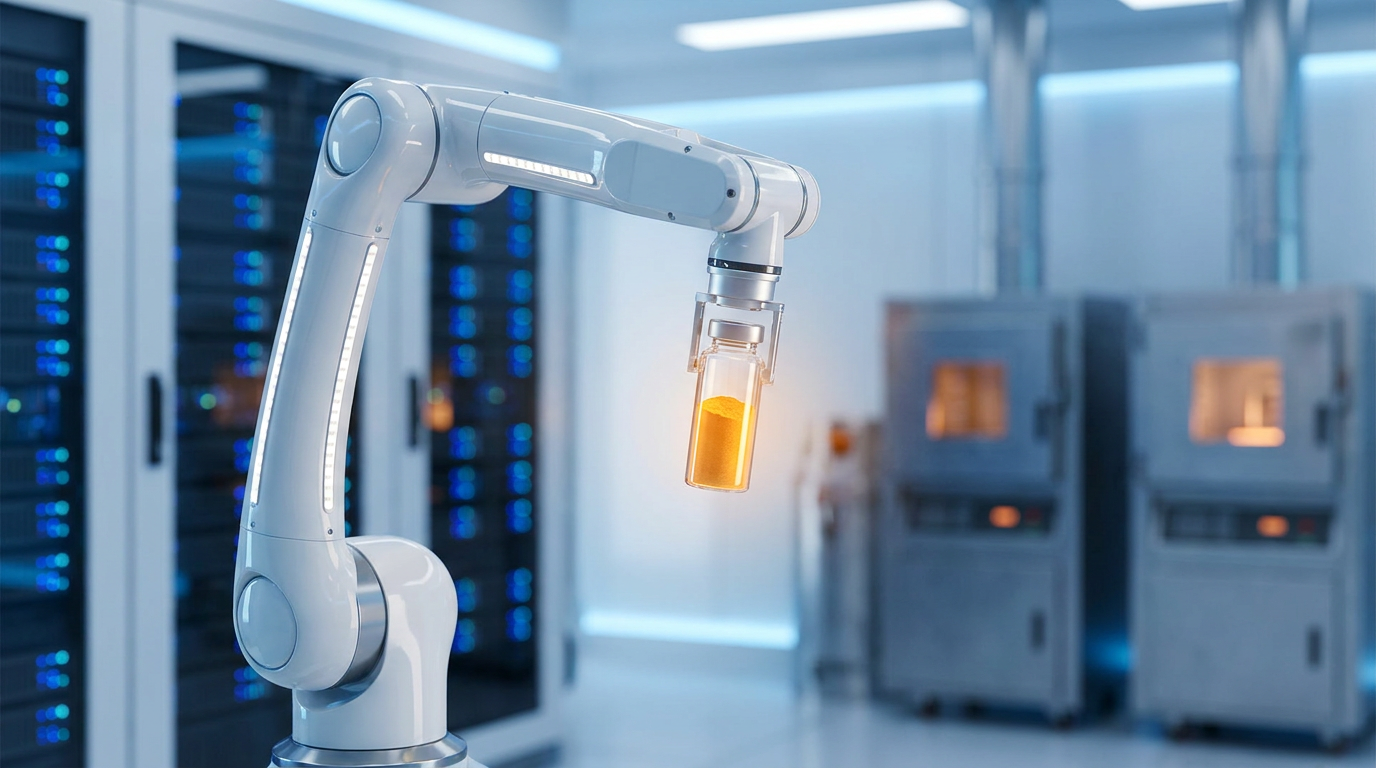
This is where the robotics sub-field of "self-driving labs" has transformed the discipline. Institutions like the US Department of Energy and various commercial startups have built fully autonomous synthesis facilities. In these labs, robotic arms glide along ceiling tracks, automated pipettes dispense precise chemical precursors, and robotic crucibles move samples into high-temperature furnaces—all without human intervention.[4][7]
The integration between the AI and the robots operates in a continuous, closed loop. The Generative AI sends a recipe to the robotic lab. The robots mix the powders, bake the compound, and immediately pass the resulting material through an automated X-ray diffractometer to analyze its crystalline structure. If the synthesis fails, the robotic system feeds that failure data back into the AI, which instantly adjusts its thermodynamic assumptions and generates a revised recipe for the robots to try again.[4][6]

The integration between the AI and the robots operates in a continuous, closed loop.
Because robots do not need to sleep, eat, or write grant proposals, these autonomous labs can execute hundreds of synthesis experiments per day. What once took a PhD student four years of manual lab work can now be accomplished by a self-driving lab over a long weekend. Recent benchmarks published in Nature indicate that these closed-loop systems are achieving a synthesis success rate of over 70% for entirely novel materials.[2][7]
The immediate commercial focus for this technology is the global battery supply chain. The transition to electric vehicles is currently bottlenecked by the limitations of lithium-ion technology, which is prone to degradation, relies on scarce minerals, and carries inherent fire risks. AI-driven robotic labs are actively hunting for solid-state electrolytes—materials that can conduct ions without the need for flammable liquid solvents.[3][6]
Already, these systems have identified thousands of promising candidates that replace rare lithium and cobalt with abundant elements like sodium, magnesium, and iron. Several of these AI-discovered battery materials have bypassed the traditional decade-long academic review process and are already entering commercial testing with major automotive manufacturers, promising cheaper, safer, and faster-charging energy storage.[3]
Beyond energy storage, the AI-robotics loop is unlocking breakthroughs in carbon capture. Researchers are utilizing Generative GNNs to design Metal-Organic Frameworks (MOFs)—highly porous, sponge-like materials that can trap specific molecules. By tuning the AI to optimize for CO2 absorption, autonomous labs are synthesizing new MOFs that can pull carbon directly from industrial exhaust or ambient air with unprecedented efficiency.[5][6]
The scale of this data explosion is difficult to overstate. Before the integration of AI and robotics, humanity knew of roughly 48,000 stable inorganic crystals. In the span of just a few years, generative models have expanded that number to over 2.2 million theoretical materials, representing roughly 800 years' worth of human knowledge generated in a matter of months.[2][6]

Challenges certainly remain. The "sim-to-real" gap—the discrepancy between computer simulation and physical reality—still plagues highly complex compounds. Furthermore, synthesizing a few grams of a miracle material in a robotic lab does not guarantee that it can be manufactured by the ton in a commercial chemical plant. Scaling up production introduces entirely new variables of heat transfer, fluid dynamics, and supply chain logistics.[1][4]
Despite these hurdles, the fundamental paradigm of physical science has shifted. The bottleneck is no longer the discovery of the material itself, but rather the engineering required to commercialize it. By outsourcing the tedious trial-and-error of chemistry to algorithms and robotic arms, human scientists are being freed to focus on higher-level systems engineering.[6][7]
We are entering an era where materials can be designed on demand. Whether society needs a biodegradable plastic, a room-temperature superconductor, or a hyper-efficient solar cell, the process will no longer rely on serendipity. It will simply be a matter of prompting the network, and letting the robots build it.[1][6]
How we got here
2020
DeepMind's AlphaFold demonstrates that AI can accurately predict complex 3D protein structures, inspiring material scientists.
2023
AI models like GNoME and MatterGen are published, predicting millions of new inorganic crystal structures.
2025
Autonomous 'self-driving' chemistry labs achieve high-throughput synthesis, closing the loop between AI prediction and physical creation.
Mid-2026
The first wave of AI-discovered, robotically synthesized solid-state battery materials enter commercial testing with automakers.
Viewpoints in depth
Computational Material Scientists
View this as a historic paradigm shift that moves chemistry from a manual, empirical science to an algorithmic, predictive discipline.
For computational researchers, the integration of GNNs and robotics represents the holy grail of their field. For decades, computational chemistry was viewed as a secondary tool—useful for explaining why an experiment worked after the fact, but rarely trusted to lead the discovery process. By proving that generative models can accurately predict thermodynamic stability, and by using robots to instantly validate those predictions, this camp believes the fundamental nature of the scientific method has been permanently accelerated.
Climate Tech Industry
Focused on the immediate commercial applications, specifically how AI-discovered materials can bypass supply chain bottlenecks for EV batteries and carbon capture.
Investors and engineers in the climate sector are less interested in the elegance of the AI architecture and more focused on the outputs. The global transition to renewable energy is currently constrained by the physical limitations of lithium-ion batteries and the high cost of carbon capture. By rapidly identifying materials that use cheap, abundant elements like sodium or iron, the climate tech industry views autonomous material discovery as the key to breaking China's dominance over the rare-earth mineral supply chain and making green tech globally scalable.
Experimental Traditionalists
Maintain cautious optimism but emphasize the 'sim-to-real' gap, noting that theoretical stability does not guarantee a material can be manufactured at industrial scale.
Veteran chemists and chemical engineers warn against over-hyping the AI breakthroughs. They point out that a robotic lab synthesizing two grams of a novel battery powder in a highly controlled environment is vastly different from a chemical plant manufacturing two thousand tons of it. This camp emphasizes that issues like kinetic barriers, heat dissipation during mass production, and long-term material degradation cannot be fully solved by algorithms, and will still require decades of traditional human engineering to perfect.
What we don't know
- Whether the AI-discovered solid-state battery materials will degrade over thousands of charge cycles in real-world conditions.
- How easily the synthesis processes developed by robotic labs can be scaled up to industrial, multi-ton manufacturing facilities.
- If generative models can accurately predict the kinetic pathways required to synthesize the most complex, highly unstable theoretical compounds.
Key terms
- Graph Neural Network (GNN)
- An AI model that processes data represented as graphs (nodes and edges), ideal for mapping the physical geometry of molecules.
- Solid-State Battery
- A next-generation battery technology that replaces the flammable liquid electrolyte found in standard batteries with a solid conductive material.
- Metal-Organic Framework (MOF)
- A highly porous, sponge-like synthetic material that can be engineered to trap specific molecules, such as carbon dioxide, from the air.
- Thermodynamic Stability
- A state where a chemical compound is at its lowest energy level and will not spontaneously degrade, meaning it can theoretically exist in the real world.
- Sim-to-Real Gap
- The discrepancy between how a material behaves in a computer simulation versus how it actually behaves when physically synthesized in a laboratory.
Frequently asked
What is a Graph Neural Network?
A type of AI architecture designed to process spatial and relational data. In chemistry, it maps atoms as nodes and chemical bonds as edges, allowing the AI to understand the 3D structure of a molecule.
What is a self-driving lab?
A fully automated chemistry laboratory where robotic arms and automated machines mix, bake, and test chemical compounds without human intervention, guided by AI algorithms.
Why are new battery materials important?
Current lithium-ion batteries rely on scarce, expensive minerals and use flammable liquid electrolytes. Discovering solid-state materials using abundant elements like sodium makes batteries cheaper, safer, and faster to charge.
Does AI prediction guarantee a material will work?
No. A material can be theoretically stable in a computer simulation but practically impossible to manufacture due to real-world kinetic barriers or extreme temperature requirements.
Sources
Source coverage
7 outlets
3 viewpoints surfaced







[1]MIT Technology ReviewClimate Tech Industry
How AI and autonomous labs are discovering the materials of tomorrow
Read on MIT Technology Review →[2]NatureComputational Material Scientists
Scaling deep learning for materials discovery and robotic synthesis
Read on Nature →[3]Bloomberg GreenClimate Tech Industry
The AI-Discovered Battery Materials Entering Commercial Testing
Read on Bloomberg Green →[4]US Department of EnergyExperimental Traditionalists
Autonomous Discovery and Robotics in Material Science
Read on US Department of Energy →[5]arXivComputational Material Scientists
Generative Graph Neural Networks for Metal-Organic Frameworks
Read on arXiv →[6]Factlen Editorial TeamComputational Material Scientists
Synthesis by Factlen editorial team
Read on Factlen Editorial Team →[7]IEEE SpectrumExperimental Traditionalists
Self-Driving Labs Close the Loop on AI Material Generation
Read on IEEE Spectrum →
More in ai
See all 7 stories →AI Governance
Explainer: How the AI Industry is Preparing for 'Recursive Self-Improvement' and Multilateral Arms Control
7 sources
Enterprise AI
Explainer: How AI is Automating Enterprise IT as Oracle Cites 21,000 Job Cuts in SEC Filing
5 sources

Frontier AI Policy
US Government Forces Anthropic to Pull New Frontier AI Model Over Export Control Directive
8 sources

Model Merging
Explainer: How 'Model Merging' is Democratizing AI by Combining LLMs Without Training
7 sources

Every angle. Every day.
Get ai stories with full source coverage and perspective breakdowns delivered to your inbox.