
US-Iran Ceasefire Reopens Strait of Hormuz, Easing Global Shipping and Oil Prices
A landmark ceasefire between the United States and Iran has reopened the Strait of Hormuz to commercial shipping, immediately driving down global oil prices and relieving months of supply chain bottlenecks.
By Factlen Editorial Team
- Global Energy Markets
- Views the ceasefire primarily as a critical relief valve for supply chains, focusing on the immediate reduction in oil prices and shipping costs.
- Diplomatic & Security Analysts
- Emphasizes the strategic necessity of the deal while remaining cautious about the long-term fragility of the de-escalation.
- Regional Stakeholders
- Focuses on the economic relief brought by the lifting of maritime restrictions and the successful mediation by Gulf neighbors.
- Maritime Shipping Industry
- Concentrates on the logistical realities of resuming transit, specifically the normalization of insurance premiums and crew safety.
What's not represented
- · Environmental groups concerned about the rapid resumption of massive fossil fuel transit
- · Alternative energy advocates who view the crisis as proof of the need to transition away from oil
Why this matters
The reopening of the world's most critical oil chokepoint instantly lowers global energy costs, which will likely translate to cheaper gas at the pump and reduced inflationary pressure on consumer goods worldwide.
Key points
- The US and Iran signed a maritime ceasefire, ending a months-long standoff in the Strait of Hormuz.
- Global oil prices plunged immediately as the threat to 20% of the world's oil supply was removed.
- The agreement mandates a mutual withdrawal of naval assets from primary commercial shipping lanes.
- Maritime insurance premiums, which had spiked 300%, are returning to normal levels.
- Oman and Qatar brokered the deal, focusing strictly on maritime trade rather than broader geopolitical disputes.
- International observers will monitor the strait to ensure compliance and prevent accidental escalations.
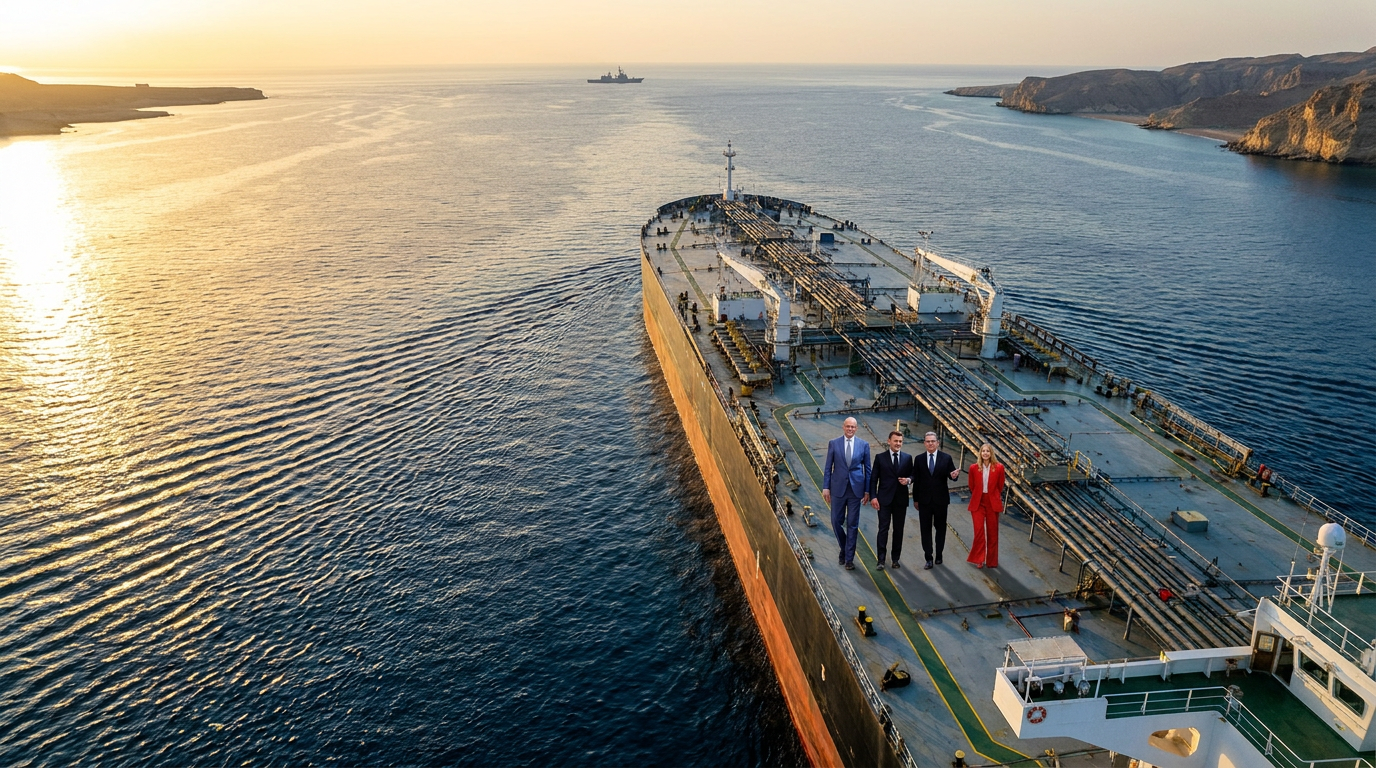
Following months of escalating naval standoffs and a de facto blockade of the world's most critical energy chokepoint, the United States and Iran have signed a comprehensive maritime ceasefire. The agreement, brokered over weeks of quiet diplomacy in Oman, immediately reopens the Strait of Hormuz to unhindered commercial shipping. Within hours of the announcement, the first convoy of supertankers began transiting the 21-mile-wide waterway, signaling an end to a crisis that had severely strained global supply chains.[2][4][8]
The core of the agreement mandates a mutual pullback of naval assets from the immediate shipping lanes. Under the terms released by the U.S. State Department, American carrier strike groups will reposition to the broader Arabian Sea, while Iran has agreed to withdraw its Islamic Revolutionary Guard Corps fast-attack craft from the primary transit corridors. In exchange, specific maritime trade restrictions have been lifted, allowing Iranian civilian vessels greater access to regional ports.[5][8]
Global markets reacted with immediate and profound relief. Brent crude, the international benchmark for oil prices, plunged by more than $18 per barrel in early trading, erasing the "war premium" that had artificially inflated energy costs since February. Energy analysts noted that the sudden influx of delayed supply is expected to stabilize prices well into the third quarter, providing a much-needed buffer against global inflation.[1][3]
To understand the magnitude of this resolution, one must look at the sheer volume of trade that relies on the Strait of Hormuz. Approximately 21 million barrels of oil—nearly 20 percent of global petroleum liquids consumption—pass through this narrow waterway every single day. When tensions effectively closed the strait, it severed the primary artery connecting Middle Eastern producers to markets in Asia, Europe, and the Americas.[7]

The mechanism of the recent blockade was as much financial as it was physical. It was not just the presence of military vessels that stopped trade; it was the insurance market. War risk premiums levied by underwriters in London skyrocketed by over 300 percent, making the transit of a standard Very Large Crude Carrier (VLCC) economically unviable for most shipping companies. Without insurance, the ships simply could not sail.[6]
The new ceasefire directly addresses this financial paralysis. By establishing joint verification patrols and a direct military-to-military hotline to prevent accidental escalations, the agreement provides the necessary security guarantees for the maritime insurance industry. Underwriters have already begun slashing premiums back to pre-crisis levels, removing the primary financial barrier to resuming normal operations.[3][6]
The diplomatic breakthrough was driven by mounting domestic pressures on both sides. For Washington, the sustained spike in oil prices threatened to derail efforts to curb inflation ahead of the upcoming election cycle, making a resolution economically imperative. For Tehran, the prolonged standoff had severely hampered its own ability to export goods and access foreign currency, creating an unsustainable domestic economic strain.[4][5]
The diplomatic breakthrough was driven by mounting domestic pressures on both sides.
Oman and Qatar played pivotal roles in bridging the gap between the two adversaries. Acting as neutral intermediaries, diplomats from Muscat hosted multiple rounds of indirect talks, translating maximalist demands into actionable, reciprocal steps. The resulting framework focuses strictly on maritime de-escalation, explicitly avoiding broader, more intractable geopolitical disputes regarding nuclear enrichment or regional proxies.[2][4]
The broader shipping industry is now scrambling to unwind months of logistical chaos. During the standoff, hundreds of vessels were forced to reroute around the Cape of Good Hope, adding roughly 14 days and millions of dollars in fuel costs to each journey. The reopening of the strait means these vessels can return to their optimal routes, vastly improving the efficiency of the global fleet.[6][7]

This logistical normalization extends far beyond crude oil. The Strait of Hormuz is also a vital conduit for liquefied natural gas (LNG), particularly from Qatar. The resumption of normal LNG shipments is expected to significantly ease natural gas prices in Europe and Asia, lowering utility bills for millions of households as the Northern Hemisphere prepares for the winter months.[1][7]
To ensure the ceasefire holds, an international observation mechanism is being established. Neutral maritime observers, coordinated through the United Nations and based in Muscat, will monitor the transit corridors using satellite imagery and AIS (Automatic Identification System) tracking. This transparency is designed to prevent either side from quietly re-militarizing the commercial lanes.[2][8]
Despite the overwhelming optimism in the markets, diplomatic historians caution that the agreement remains fragile. The region has a long history of temporary truces that unravel over minor miscalculations. The true test of the ceasefire will come in the next few weeks, as the sheer volume of maritime traffic increases the likelihood of accidental close encounters between civilian ships and remaining naval patrols.[4]
For now, however, the focus is entirely on the operational recovery. Port authorities in Fujairah and Dubai are working around the clock to process the massive backlog of waiting vessels. It will likely take two to three weeks for the congestion to fully clear and for the global supply chain to return to its standard rhythm.[6]

The successful implementation of this ceasefire represents a rare and significant victory for international diplomacy in a deeply fractured era. By isolating a specific, shared economic interest—the unhindered flow of global commerce—negotiators were able to construct a functional peace agreement even in the absence of broader political reconciliation.[2][4]
As the first wave of supertankers clears the strait and enters the open ocean, the immediate crisis has been definitively averted. The resolution not only restores stability to the energy markets but also provides a blueprint for managing future chokepoint vulnerabilities in an increasingly multipolar world.[3][7]
How we got here
Feb 2026
Naval tensions peak, leading to a de facto closure of the commercial shipping lanes in the Strait of Hormuz.
April 2026
War risk insurance premiums spike by 300%, forcing major shipping companies to reroute vessels around Africa.
Early June 2026
Oman and Qatar begin hosting intensive, indirect diplomatic talks between US and Iranian representatives.
June 24, 2026
The maritime ceasefire is officially signed, and the first commercial supertankers resume transit through the strait.
Viewpoints in depth
Global Energy Markets
Relief over restored supply chains and the stabilization of global inflation.
For energy analysts and market traders, the ceasefire is a massive relief valve. The prolonged closure of the strait had forced a painful recalculation of global supply, driving up inflation and threatening to tip fragile economies into recession. Market participants view the agreement as a triumph of economic pragmatism over geopolitical posturing, noting that the immediate $18 drop in Brent crude will have cascading positive effects on manufacturing, retail, and consumer spending worldwide.
Diplomatic & Security Analysts
Cautious optimism tempered by the historical fragility of Middle Eastern truces.
Security experts and diplomats acknowledge the monumental achievement of the deal but remain highly cautious. They point out that the underlying geopolitical grievances—nuclear enrichment, regional proxies, and broader sanctions—remain entirely unresolved. This camp argues that while the immediate economic crisis has been averted, the strait remains a structural vulnerability. They emphasize the importance of the new UN-backed observation mechanisms in Muscat, viewing them as the only real safeguard against a rapid return to hostilities.
Maritime Shipping Industry
Focus on the logistical reality of unwinding the massive global shipping backlog.
For the companies that actually move the oil, the political victory is secondary to the logistical nightmare of recovery. Fleet managers and insurance underwriters are currently tasked with repositioning hundreds of vessels that were diverted around the Cape of Good Hope. This camp highlights that while premiums are dropping, it will take weeks to clear the congestion at regional ports like Fujairah. Their primary concern is ensuring the safety of civilian crews as they navigate a waterway that, until very recently, was an active military standoff zone.
What we don't know
- Whether the international observation mechanism in Muscat has enough enforcement power to deter minor infractions.
- How quickly the backlog of rerouted ships currently sailing around Africa can be fully integrated back into normal schedules.
- If this narrow maritime agreement could eventually serve as a stepping stone for broader diplomatic talks between Washington and Tehran.
Key terms
- Chokepoint
- A narrow geographical feature, such as a strait or canal, that commercial shipping must pass through, making it highly vulnerable to blockades.
- War Risk Premium
- Additional insurance costs levied by underwriters on ships entering known conflict zones, which can make transit economically unviable.
- Brent Crude
- The major trading classification of sweet light crude oil that serves as the primary benchmark price for purchases worldwide.
- VLCC
- Very Large Crude Carrier, a massive class of supertanker capable of carrying up to 2 million barrels of oil in a single voyage.
Frequently asked
Will gas prices go down immediately?
Wholesale crude oil prices dropped instantly, but it typically takes two to four weeks for these savings to reflect at local gas stations due to existing inventory.
Who mediated the ceasefire?
Oman and Qatar played critical roles as neutral intermediaries, facilitating weeks of indirect talks between the United States and Iran.
Does this end all sanctions on Iran?
No. The agreement is strictly a maritime de-escalation; it lifts specific transit restrictions to allow civilian trade but leaves broader economic sanctions intact.
Sources
Source coverage
8 outlets
4 viewpoints surfaced







[1]ReutersGlobal Energy Markets
Oil prices plunge as US-Iran ceasefire reopens Strait of Hormuz
Read on Reuters →[2]Al JazeeraRegional Stakeholders
Iran and US sign landmark ceasefire, easing Gulf tensions
Read on Al Jazeera →[3]BloombergGlobal Energy Markets
Global shipping stocks rally as Hormuz chokepoint clears
Read on Bloomberg →[4]The New York TimesDiplomatic & Security Analysts
Inside the diplomatic push that ended the US-Iran standoff
Read on The New York Times →[5]Tehran TimesRegional Stakeholders
Iran secures economic relief in new Gulf maritime agreement
Read on Tehran Times →[6]Lloyd's ListMaritime Shipping Industry
Maritime traffic resumes in Strait of Hormuz after 4-month blockade
Read on Lloyd's List →[7]S&P GlobalGlobal Energy Markets
Impact of Hormuz reopening on global crude supply chains
Read on S&P Global →[8]U.S. Department of StateDiplomatic & Security Analysts
Joint Statement on the Gulf Security Ceasefire
Read on U.S. Department of State →
Every angle. Every day.
Get meta stories with full source coverage and perspective breakdowns delivered to your inbox.