
FIDE Launches 'First Rating Experiment' to Bridge Online and Over-the-Board Chess Ratings
The International Chess Federation has introduced a groundbreaking pilot program to convert online chess ratings into official over-the-board (OTB) Elo, aiming to integrate millions of digital players into the traditional tournament ecosystem.
By Factlen Editorial Team
- Chess Governing Bodies
- Focused on growing the physical game and converting the digital chess boom into sustainable tournament participation.
- Digital Platform Operators
- Eager to legitimize online play and provide their user base with a tangible pathway into official OTB competition.
- Traditional Competitors
- Cautious about the mathematical integrity of the Elo system and the potential for rating deflation or cheating.
What's not represented
- · Local chess club organizers who will manage the influx of provisionally rated players
- · Arbiters tasked with enforcing the new validation circuits
Why this matters
For millions of amateur players who discovered chess online over the past five years, this initiative removes the intimidating barrier of starting from scratch in physical tournaments. If successful, it could permanently unify the digital and physical chess worlds, revitalizing local clubs and expanding the competitive ecosystem.
Key points
- FIDE is launching a pilot program to convert online chess ratings into provisional physical ratings.
- The system uses a mathematical curve to adjust for the typical inflation seen in digital ratings.
- Players must complete a 9-game physical validation circuit to make their provisional rating permanent.
- Strict anti-cheating measures, including camera verification and algorithmic screening, are required.
- The experiment initially applies only to rapid and blitz time controls, protecting classical ratings.
- The move aims to lower the barrier to entry for millions of pandemic-era digital players.
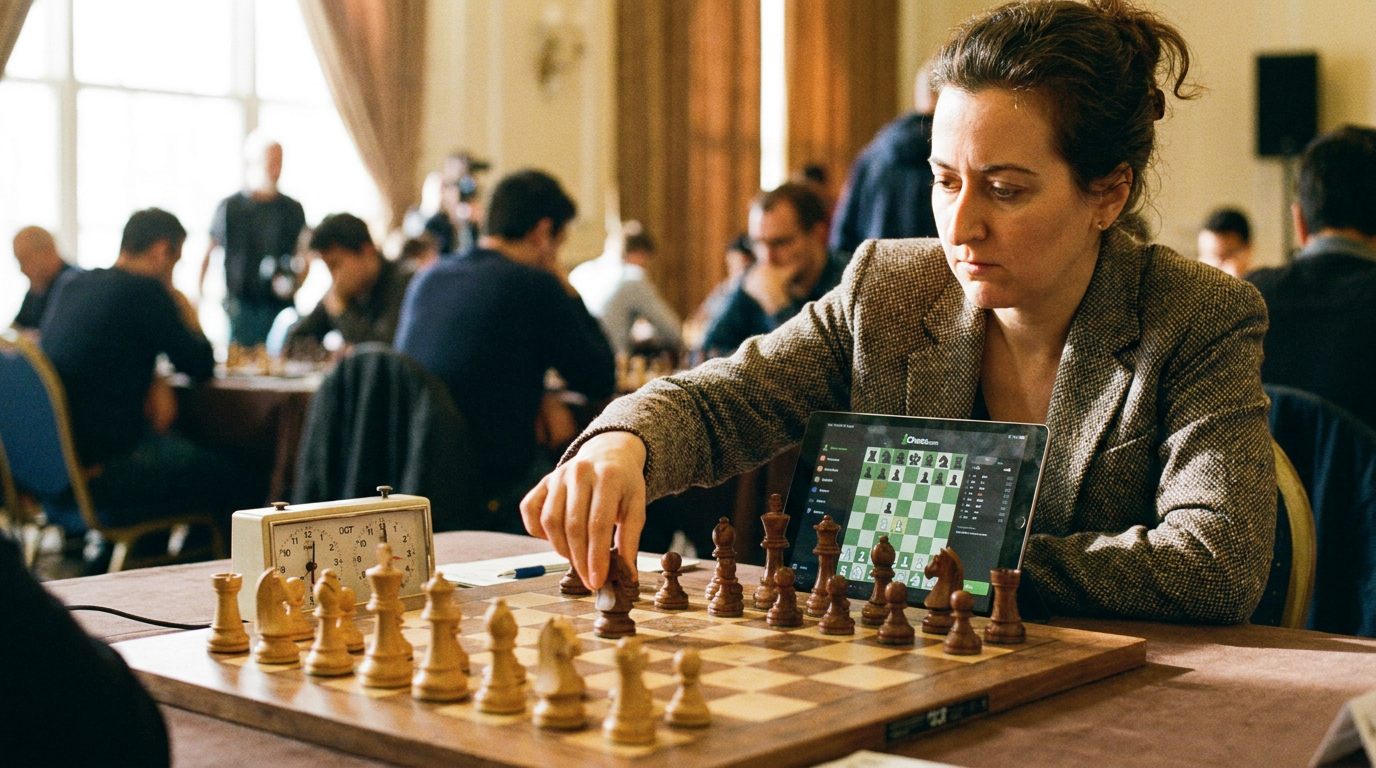
The chess world has operated in two parallel universes since the digital boom of 2020. On one side, millions of players battle daily on platforms like Chess.com and Lichess, building digital ratings that reflect thousands of hours of play and study. On the other, the traditional over-the-board (OTB) ecosystem governed by the International Chess Federation (FIDE) remains a much smaller, exclusive club, with only a fraction of digital enthusiasts ever stepping foot in a physical tournament hall.[2][4]
For years, crossing the bridge from online to physical chess meant starting from absolute zero. A player with a formidable 2000 rating online would walk into a local club as an "unrated" novice, forced to grind through months of physical tournaments just to establish a baseline Elo. This dynamic often resulted in highly skilled digital players being paired against true beginners in open sections, frustrating both parties and discouraging online players from returning to physical events.[3][7]
This week, FIDE announced a structural shift designed to collapse that divide. Dubbed the "First Rating Experiment," the pilot program will allow verified online players to port a mathematically adjusted version of their digital rating into the official FIDE OTB ecosystem. The initiative represents the most significant overhaul of the FIDE rating system since the adoption of the Elo formula in 1970, aiming to funnel the massive digital player base into physical chess clubs.[1][6]
The mechanism behind the First Rating Experiment relies on a complex anchoring algorithm. Because online ratings are typically inflated compared to classical FIDE ratings—often by 200 to 400 points due to different starting baselines and player pool sizes—a direct one-to-one transfer is mathematically impossible. FIDE's data scientists, working in conjunction with major online platforms, have developed a conversion curve based on players who actively compete in both arenas.[2][5]

This curve calculates a "provisional digital anchor" for unrated OTB players. Under the pilot rules, an online player with a verified rapid rating of 1800 on a partner platform might be granted a provisional FIDE rapid rating of 1550. This provisional rating allows them to enter physical tournaments in appropriate rating brackets, ensuring they face opponents of similar actual strength right from their first physical event.[1][3]
However, this provisional rating is heavily weighted by uncertainty. To convert it into a permanent FIDE rating, the player must complete a "validation circuit" of at least nine physically supervised OTB games. If their physical performance drastically underperforms their digital anchor—a common occurrence given the psychological pressure and 3D spatial differences of physical chess—the provisional rating is aggressively adjusted downward before becoming permanent.[1][6]
However, this provisional rating is heavily weighted by uncertainty.
The most formidable challenge facing the First Rating Experiment is the specter of computer assistance. Online chess is plagued by algorithmic cheating, and integrating digital ratings into the prestigious FIDE ecosystem risks polluting the physical rating pool with artificially inflated numbers. To mitigate this, FIDE is implementing strict verification protocols for the initial digital anchor.[4][7]
Only ratings achieved in "verified digital environments" will be eligible for conversion. These environments require dual-camera setups, screen sharing, and real-name registration during online play. Furthermore, the partner platforms must subject the applicant's game history to advanced statistical analysis to ensure their digital rating was achieved through human play, checking for move-matching against top-tier chess engines.[2][5]
FIDE retains the right to reject any conversion application flagged by its proprietary Fair Play commission. Traditional OTB players have still voiced concerns about rating deflation. The FIDE rating pool is a closed mathematical ecosystem; if thousands of newly rated players enter the system and perform poorly, they could siphon rating points away from established players, causing widespread deflation across the lower and middle tiers.[1][6]

FIDE has attempted to address this by isolating the experiment to rapid and blitz time controls first, leaving the prestigious classical chess ratings untouched for now. The rapid and blitz pools are generally considered more volatile and better suited for beta-testing large-scale mathematical changes. If the conversion math proves stable over the first year, FIDE plans to introduce a similar pathway for classical time controls.[3][7]
For local chess organizers, the experiment is being hailed as a potential financial lifeline. Physical tournaments often struggle with matchmaking and entry fees; a sudden influx of online players who now have a tangible incentive to play OTB could revitalize grassroots chess. The digital anchor provides a sense of belonging and a mathematically appropriate starting point, lowering the psychological barrier to entry.[2][4]
Many online players suffer from "club anxiety"—the fear of walking into a physical tournament without a rating and facing unknown humiliation. By granting them a provisional status that respects their digital achievements, FIDE is offering an olive branch to the pandemic-era chess boom. The First Rating Experiment will run for 18 months, initially rolling out in select European and North American federations before a planned global expansion in 2028.[1][3]

Ultimately, the success of the program will hinge on the accuracy of the conversion algorithm. If the math holds and the anti-cheating measures prove robust, chess could become the first major sport to seamlessly integrate its digital and physical competitive ecosystems. This would create a unified global ladder for the 21st century, ensuring that the game's recent surge in popularity translates into lasting structural growth.[6][7]
How we got here
2020-2022
The global pandemic triggers a massive surge in online chess, creating millions of digital-only players.
2024
FIDE forms a working group with major online platforms to study the mathematical gap between digital and physical ratings.
June 2026
FIDE officially announces the 'First Rating Experiment' to bridge the online and OTB ecosystems.
Late 2026
The pilot program is scheduled to roll out in select North American and European federations.
2028
Planned global expansion of the conversion system if the initial 18-month pilot proves mathematically stable.
Viewpoints in depth
FIDE and Organizers
Focused on modernizing the sport and capturing the massive digital audience.
For chess governing bodies, the divide between online and physical play represents a massive missed opportunity. By creating a formalized bridge, FIDE hopes to revitalize local chess clubs, increase tournament entry fees, and ensure the long-term financial health of the physical game. Organizers believe that removing the 'unrated' stigma will encourage a wave of digital natives to finally step into tournament halls.
Traditional OTB Players
Concerned about the mathematical stability of the Elo pool and the risk of deflation.
Many veteran physical players view the experiment with skepticism. The Elo system is a closed economy; if a large cohort of online players receives provisional ratings that are too high, they will lose points rapidly in physical tournaments. This dynamic would siphon points away from established players, causing systemic rating deflation. Traditionalists argue that physical chess—with its 3D board vision, psychological pressure, and stamina requirements—is a fundamentally different discipline that cannot be accurately predicted by digital performance.
Online-First Amateurs
Excited by the prospect of entering physical tournaments at an appropriate skill level.
For the millions who learned chess online, the traditional OTB system has felt exclusionary and intimidating. Online players argue that grinding through months of physical tournaments just to prove they aren't beginners is an unreasonable barrier to entry. They view the digital anchor as a long-overdue recognition of their skill, providing a fair and mathematically sound starting point that respects the thousands of hours they have dedicated to the game digitally.
What we don't know
- Whether the conversion algorithm will accurately predict physical performance across different rating brackets.
- How frequently provisional ratings will need to be drastically adjusted after the 9-game validation circuit.
- If the influx of online players will actually materialize at local physical chess clubs.
- Whether the anti-cheating protocols will be sufficient to prevent algorithmic manipulation of the initial digital anchor.
Key terms
- Elo Rating System
- A mathematical method for calculating the relative skill levels of players in zero-sum games, originally invented for chess.
- Over-the-Board (OTB)
- Traditional chess played face-to-face with physical pieces and a physical clock, as opposed to online play.
- Provisional Rating
- A temporary rating assigned to a player until they have completed enough official games to establish a mathematically stable permanent rating.
- Time Control
- The amount of time each player is given to complete a game. Classical is the longest, followed by rapid, and then blitz.
Frequently asked
Will my online rating transfer exactly as it is?
No. Online ratings are typically higher than FIDE ratings. The system uses a conversion algorithm to calculate a lower, provisional rating that reflects expected physical performance.
Does this apply to classical chess?
Not yet. The initial 18-month experiment only applies to rapid and blitz time controls to test the mathematical stability of the conversion.
How does FIDE prevent cheaters from getting OTB ratings?
Players must achieve their online ratings in verified environments with cameras and ID checks, pass algorithmic fair-play screening, and prove their strength in nine physically supervised OTB games.
Sources
Source coverage
7 outlets
3 viewpoints surfaced







[1]FIDE OfficialChess Governing Bodies
FIDE Announces First Rating Experiment for Online-to-OTB Conversion
Read on FIDE Official →[2]Chess.comDigital Platform Operators
FIDE's New Rating Experiment: What It Means For Online Players
Read on Chess.com →[3]ChessBaseTraditional Competitors
Bridging the Gap: FIDE's ambitious plan to merge online and classical ratings
Read on ChessBase →[4]The GuardianTraditional Competitors
Chess rating revolution: FIDE moves to recognize online play
Read on The Guardian →[5]LichessDigital Platform Operators
Lichess partners with FIDE for the 2026 Rating Experiment
Read on Lichess →[6]New In ChessTraditional Competitors
The Elo Convergence: Will FIDE's new online rating system work?
Read on New In Chess →[7]ESPNTraditional Competitors
How the chess boom is finally changing the official FIDE rating system
Read on ESPN →


Every angle. Every day.
Get sports stories with full source coverage and perspective breakdowns delivered to your inbox.