
Lincoln's Co-Responder Model for Mental Health Crises Becomes National Training Standard
Just 16 months after launching, a Nebraska program pairing police officers with mental health clinicians is being adapted into a nationwide blueprint by the Department of Justice.
By Factlen Editorial Team
- Law Enforcement Leadership
- Focuses on officer safety, reducing the strain on patrol bandwidth, and minimizing repeat calls to the same addresses.
- Mental Health Clinicians
- Prioritizes trauma-informed care, immediate clinical triage, and diverting individuals away from the criminal justice system.
- Public Policy Advocates
- Emphasizes the systemic financial benefits, grant funding efficacy, and the broader push to decriminalize mental illness.
What's not represented
- · Individuals who have experienced a mental health crisis response
- · Emergency room triage nurses
Why this matters
As communities nationwide struggle with how to safely handle mental health emergencies, this model proves that pairing armed officers with licensed clinicians can drastically reduce arrests, lower emergency room visits, and save lives.
Key points
- The U.S. Department of Justice has selected Lincoln's Co-Responder Program as a national training standard just 16 months after its launch.
- The model pairs a specially trained police officer with a licensed mental health clinician to respond jointly to behavioral health crises.
- During its first year, 63 percent of individuals contacted by the unit were successfully de-escalated and remained safely in the community.
- Of those requiring off-site transport, nearly 70 percent went voluntarily to treatment facilities, drastically reducing jail bookings and emergency room visits.
- The program's operational playbook is being adapted into a nationwide training curriculum to help other municipalities build effective joint-response units.
Across the United States, police officers have become the de facto frontline social workers of the street. When individuals experience severe psychiatric distress, law enforcement is almost always the first entity dispatched, forcing officers to perform an impossible balancing act. They must rapidly secure potentially dangerous scenes while attempting to de-escalate individuals experiencing psychosis or severe trauma, often without specialized clinical training.[5]
The consequences of this systemic mismatch are profound. Jails and emergency rooms have become the primary holding facilities for individuals whose primary offense is being sick rather than criminal. The strain on law enforcement bandwidth is equally severe, with officers spending countless hours waiting in hospital triage centers or returning to the same addresses for repeat behavioral health calls.[5]
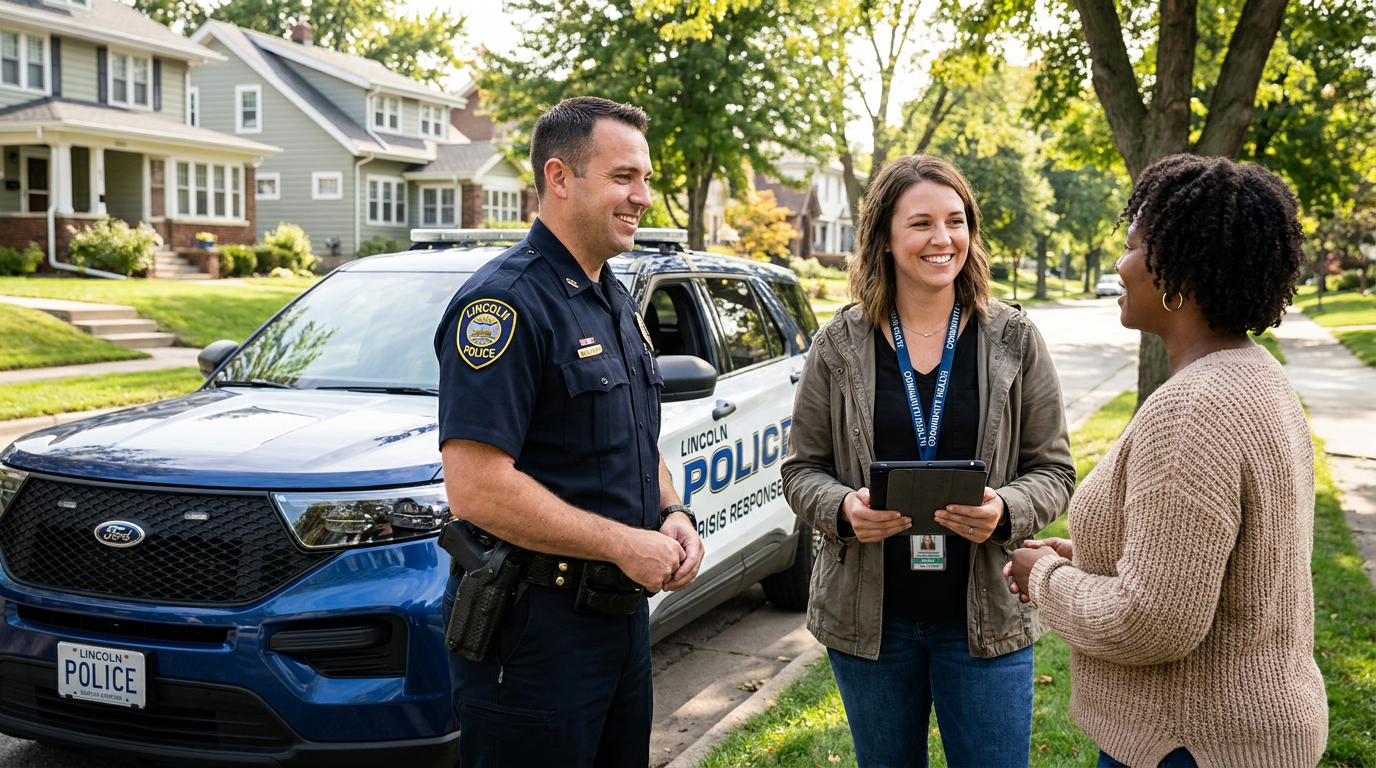
To break this cycle, the city of Lincoln, Nebraska, launched a specialized Co-Responder Program in March 2025. A collaborative effort between the Lincoln Police Department and CenterPointe, a local behavioral health agency, the initiative fundamentally changed who shows up to a crisis. Instead of sending only armed officers, the city began dispatching licensed mental health professionals in the same patrol cars.[3][7]
Now, just sixteen months after its inception, Lincoln's local initiative has been elevated to a national blueprint. In June 2026, the U.S. Department of Justice's Office of Community Oriented Policing Services announced that Lincoln's program will serve as the foundational model for a new national training standard.[1]

The program's architects, Lincoln Police Investigator Doug Headlee and CenterPointe's Amber Dirks, recently presented their framework at the National Co-Responder Conference in Dallas. Their operational playbook is currently being adapted into a nationwide training curriculum titled "Crisis Intervention First Look: Co-Responder Teams," designed to teach other municipalities how to build effective joint-response units.[1]
The mechanics of the Lincoln model are built on immediate, integrated action. When dispatchers identify a call involving a behavioral health crisis, a co-responder unit is deployed. The team consists of one specially trained police officer and one licensed civilian clinician riding together, ensuring they arrive simultaneously while the crisis is still active.[2][7]
Upon arrival, the division of labor is clear and immediate. The police officer takes responsibility for physical safety, securing the scene and ensuring there are no immediate threats to the public or the responders. Once the environment is secure, the officer steps back, and the mental health professional takes the lead on engagement and de-escalation.[5]
This field intervention is strictly focused on public safety and stabilization, not long-term therapy. There are no fees, no billing processes, and no clinical treatment plans initiated on the street. The clinician's sole objective is to triage the individual, de-escalate the immediate tension, and determine the safest, least restrictive next step for care.[4]
This field intervention is strictly focused on public safety and stabilization, not long-term therapy.
The data from Lincoln's first year demonstrates the profound efficacy of this real-time triage. According to program directors, 63 percent of the individuals contacted by the co-responder team were successfully de-escalated on-site and were able to remain safely in their community settings, entirely avoiding the criminal justice and emergency medical systems.[2]

For the remaining individuals who required a higher level of care, the outcomes were equally transformative. Of the 23 percent who needed to be transported off-site, nearly 70 percent went voluntarily to a treatment facility or community agency. This voluntary compliance drastically reduces the need for physical force or involuntary psychiatric holds.[2]
The success of the co-responder model highlights the limitations of older crisis frameworks. For decades, the standard approach was Crisis Intervention Team training, which provided officers with a 40-hour course on mental health awareness. While valuable, it still left officers acting as amateur clinicians without the authority to make medical triage decisions.[5]
Another popular alternative, the Mobile Crisis Team, relies entirely on civilian mental health workers. While highly effective for low-risk situations, these teams are often dispatched only after a scene has been secured by police, meaning they arrive hours later. By the time the mobile team appears, the critical window for de-escalation has frequently closed.[4]
Embedded co-responder programs succeed precisely because they eliminate this delay. By arriving in real-time, the clinician engages the individual at the peak of the crisis, when the opportunity for diversion is highest. The clinician's presence also fundamentally alters the dynamic of the encounter, often calming individuals who might otherwise be triggered by a uniform.[4]
Building this infrastructure requires significant upfront investment. Lincoln's program was seeded by a $550,000 grant from the Bureau of Justice Assistance, which covered the bulk of the clinicians' salaries, supplemented by a $200,000 federal grant specifically for promoting access to crisis teams.[3]

However, public policy experts note that the long-term return on investment is substantial. By diverting individuals from emergency departments and county jails, the program saves municipalities thousands of dollars per encounter. Furthermore, it returns countless hours of patrol time to the police department, allowing standard units to focus on violent crime.[5][6]
Despite the clear benefits, scaling these programs nationally presents significant cultural hurdles. Merging the rigid, command-driven culture of law enforcement with the trauma-informed, patient-centered culture of clinical social work requires immense intentionality. Program leaders emphasize that hiring for field readiness and cultural adaptability is more important than clinical resume strength.[1][4]
Programs also require structural protection from police leadership to survive. Without deliberate integration into the department's daily operations, co-responder units can easily become isolated side projects. Lincoln's success stems from treating the clinicians as vital operational assets rather than temporary guests in the precinct.[4]

The elevation of Lincoln's model aligns with a broader federal push to redefine emergency response. Agencies like the Substance Abuse and Mental Health Services Administration are increasingly tying federal grants to collaborative response models, signaling that the era of police-only mental health interventions is coming to an end.[6]
As municipalities across the country study the upcoming Department of Justice training materials, Lincoln stands as a proof of concept. The city has demonstrated that with the right funding, cultural buy-in, and operational structure, communities can successfully decriminalize mental health crises while keeping both citizens and officers safe.[1][3]
How we got here
2020
The Lincoln Police Department adds a Mental Health Response Coordinator to begin tracking the rising volume of behavioral health calls.
May 2024
LPD reports responding to over 12,000 mental health-related calls over the previous years, highlighting the need for a systemic change.
March 2025
Lincoln officially launches the Co-Responder Program, pairing LPD officers with CenterPointe clinicians.
June 2026
The U.S. Department of Justice selects Lincoln's program to serve as the blueprint for a new national training curriculum.
Viewpoints in depth
Law Enforcement Leadership
Focuses on the operational benefits of the program for police departments.
For police chiefs and precinct commanders, the co-responder model is primarily a bandwidth and safety solution. Officers are not trained psychiatrists, and forcing them to manage severe psychotic episodes often leads to tragic uses of force or hours wasted in hospital waiting rooms. By embedding clinicians directly into patrol units, departments can resolve calls faster, reduce the likelihood of violence, and free up standard patrol officers to focus on actual criminal activity.
Mental Health Clinicians
Prioritizes trauma-informed care and diverting patients from the justice system.
From a clinical perspective, the traditional police response criminalizes illness. Clinicians advocate for the co-responder model because it allows them to intervene at the exact moment of crisis, utilizing trauma-informed de-escalation techniques rather than handcuffs. Their primary metric for success is diversion—keeping individuals out of emergency rooms and county jails, and instead routing them voluntarily toward community-based treatment centers and outpatient support.
Public Policy Advocates
Emphasizes systemic reform, financial efficiency, and federal grant utilization.
Policy experts view the co-responder framework as a necessary evolution of municipal budgets. While the upfront costs of hiring full-time clinicians are high, advocates point to the massive downstream savings achieved by reducing jail bookings and involuntary psychiatric holds. They argue that federal grants from the DOJ and SAMHSA should increasingly mandate these collaborative models, effectively forcing cities to modernize their emergency response networks.
What we don't know
- How quickly the Department of Justice will roll out the new training curriculum to other mid-sized and large municipalities.
- Whether federal grant funding will expand to permanently subsidize the salaries of civilian clinicians embedded in police departments.
- How the model will adapt to rural jurisdictions that lack the dense network of community treatment centers found in cities like Lincoln.
Key terms
- Co-Responder Model
- A crisis response framework that pairs a law enforcement officer with a behavioral health specialist to jointly respond to emergencies.
- Crisis Intervention Team (CIT)
- A specialized 40-hour training program designed to teach police officers how to identify mental illness and de-escalate crises.
- Street Triage
- The process of evaluating a person's mental health needs directly in the community to determine the safest and least restrictive level of care.
- Mobile Crisis Team
- A group of civilian mental health professionals dispatched to behavioral emergencies, typically utilized for lower-risk situations or after a scene is secured.
Frequently asked
What is a police co-responder model?
It is a collaborative approach where a specially trained police officer and a licensed mental health professional ride together in the same patrol car to respond to behavioral health crises in real-time.
Do the mental health professionals carry weapons?
No. The police officer is responsible for securing the scene and ensuring physical safety, allowing the unarmed clinician to focus entirely on de-escalation and triage.
How is this different from a Mobile Crisis Team?
Mobile Crisis Teams typically consist only of civilian health workers and are often dispatched after police have already secured a scene, meaning they can arrive hours after the peak of the crisis. Co-responders arrive immediately.
Does the program charge patients for the street triage?
No. The field intervention is treated as a public safety service, meaning there are no fees, billing processes, or long-term therapy plans initiated during the emergency call.
Sources
Source coverage
7 outlets
3 viewpoints surfaced






[1]KLIN NewsPublic Policy Advocates
Lincoln's innovative Co-Responder Program earning national attention
Read on KLIN News →[2]Nebraska Public MediaPublic Policy Advocates
LPD and counselors care for people in crisis, one call at a time
Read on Nebraska Public Media →[3]State of NebraskaLaw Enforcement Leadership
City of Lincoln Rolls Out Mental Health Co-Responder Program
Read on State of Nebraska →[4]Police1Law Enforcement Leadership
Why embedded mental health co-responder programs survive (and why they fail)
Read on Police1 →[5]National Institutes of HealthMental Health Clinicians
Police co-responder programs: A review of the literature
Read on National Institutes of Health →[6]SAMHSAPublic Policy Advocates
Collaborative Response Models for Behavioral Health Crises
Read on SAMHSA →[7]CenterPointeMental Health Clinicians
Co-Responder Program Partnership
Read on CenterPointe →
Every angle. Every day.
Get community stories with full source coverage and perspective breakdowns delivered to your inbox.