
The Science of Resisted Sprinting: How Adding Drag Forces Swimmers to Unlock Greater Speed
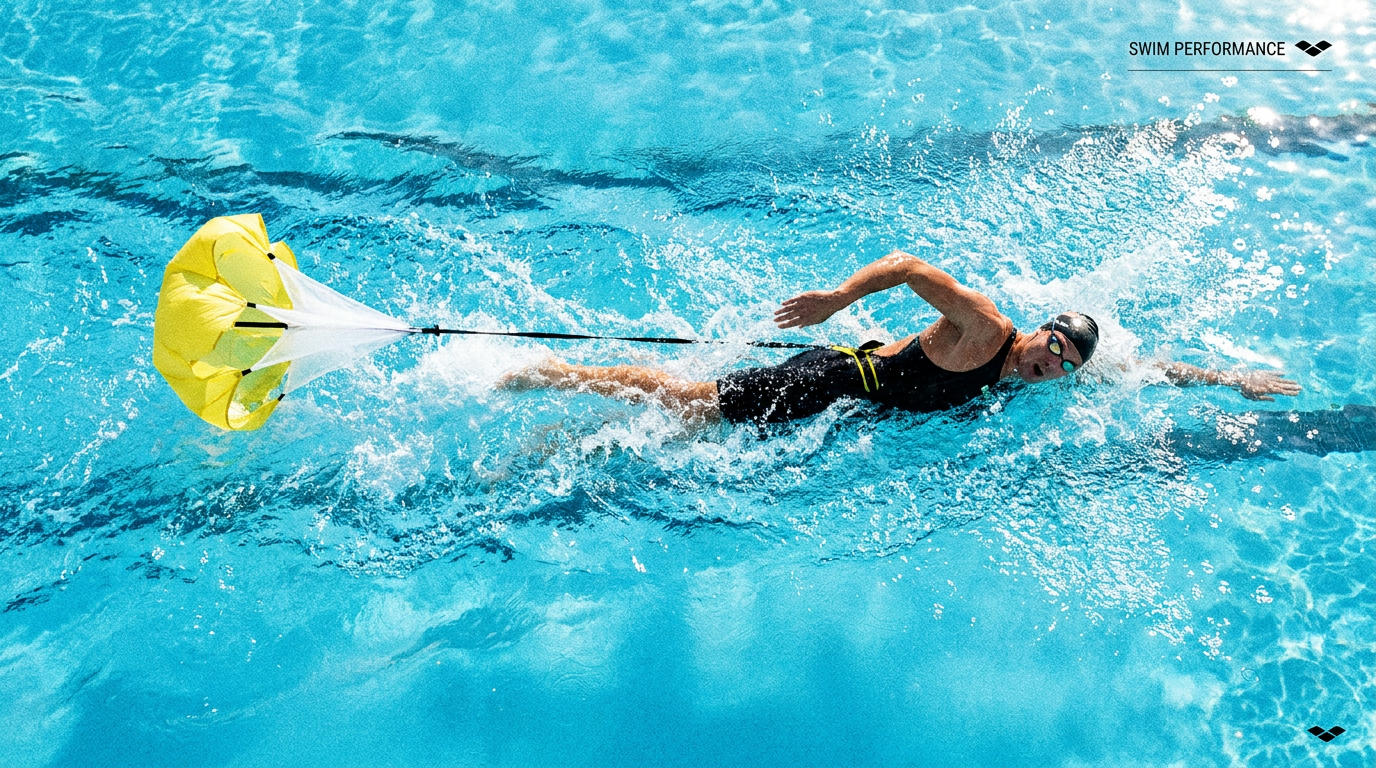
Resisted sprinting—using parachutes, tethers, or power racks—adds artificial drag to swimming, forcing athletes to generate more force while preserving their stroke mechanics to unlock greater top-end speed.
By Factlen Editorial Team
- Sports Biomechanists
- Focus on the physics of force-velocity transfer and the preservation of kinematics.
- Elite Swim Coaches
- Focus on practical application, contrast training, and the 10% rule.
- Cross-Disciplinary Analysts
- Focus on the universal principles of resisted speed training across different sports.
What's not represented
- · Youth swimming coaches who manage athletes still developing foundational mechanics.
Why this matters
Swimming is highly technique-dependent, meaning traditional gym strength doesn't always translate to the water. Resisted sprinting bridges this gap, allowing athletes to build highly specific aquatic power that directly translates to faster race times.
Key points
- Resisted sprinting uses parachutes or tethers to artificially increase drag in the water.
- It acts as aquatic strength training, improving force production without altering stroke mechanics.
- Studies show resisted sprinting can yield more than double the speed gains of regular sprinting.
- Coaches use the '10% rule' to ensure the resistance load doesn't compromise technique.
The fundamental problem in competitive swimming is a matter of fluid dynamics. Water is nearly 800 times denser than air, meaning that to swim faster, athletes must overcome an immense amount of active drag. Every incremental increase in forward velocity requires an exponential increase in energy output to push through the water's natural resistance.[7]
For decades, the traditional solution to this problem has been dryland strength training—lifting heavy weights in the gym to build raw muscular power. However, sports scientists have consistently found that gym strength does not always transfer perfectly to the water. The complex, fluid biomechanics of the swimming stroke mean that a stronger bench press does not automatically equate to a faster freestyle.[3][4]
Enter resisted sprinting. By lassoing the body to a drag chute, an elastic tether, or a motorized power rack, swimmers intentionally increase the drag forces they must overcome in the pool. This forces the athlete to pull harder against the water to maintain their momentum, creating a unique overload stimulus.[1][6]
This method acts as a highly specific form of "aquatic strength training." It forces the swimmer to generate higher impulse and peak pushing force while maintaining the exact horizontal body position and kinetic chain required for racing. Unlike lifting weights, the resistance is applied directly to the swimming movement itself.[2]

The physics of the approach are straightforward. When a swimmer adds a parachute, they are artificially increasing their frontal surface area and the resulting hydrostatic drag. To maintain forward velocity against this added resistance, the muscular system must recruit more fast-twitch muscle fibers, particularly in the lats, shoulders, and core.[2][7]
A major historical concern among traditional swim coaches was that adding heavy resistance would ruin a swimmer's technique. The fear was that fighting a parachute or a thick bungee cord would cause the hips to sink, the stroke to shorten, or the catch phase to slip, ultimately ingraining bad habits.[2][5]
However, modern biomechanical research has largely debunked this fear. Studies analyzing the kinematics of the front crawl show that appropriate resisted sprinting does not alter the 24 basic movement characteristics of the stroke. The body position and arm pathways remain remarkably consistent with unresisted swimming.[2]
In fact, resisted training can actually improve technique. It enhances what sports scientists refer to as "propulsive continuity," a critical factor in elite sprinting where the goal is to maintain constant forward momentum without deceleration.[2]
Propulsive continuity refers to minimizing the "dead spots" in a stroke—the micro-seconds where neither arm is generating backward force against the water. Because a parachute immediately halts forward momentum if propulsion stops, the swimmer is forced to eliminate these dead spots, learning to catch the water earlier and finish their stroke more aggressively.[2][5]

Propulsive continuity refers to minimizing the "dead spots" in a stroke—the micro-seconds where neither arm is generating backward force against the water.
The clinical evidence supporting this method is compelling. A landmark 2018 study by Grznar et al. isolated the effects of resisted sprinting on experienced competitive swimmers over an eight-week period, providing clear data on its efficacy.[1]
The researchers divided the athletes into two groups. Both completed a high-intensity sprint program featuring super-short, maximal-effort bouts—such as three rounds of six seconds all-out—with full recovery between repetitions. One group sprinted normally, while the other used a resistance parachute.[1]
The results highlighted the superiority of in-water overload. While the unresisted group improved their 12-meter sprint speed by 1.6%, the resisted group saw a massive 3.5% improvement. In a sport where races are decided by hundredths of a second, more than doubling the speed gains is a monumental advantage.[1]
The key to achieving these results lies in the "10% rule." Sports scientists emphasize that the resistance must be carefully calibrated. The optimal parachute size or tether tension should slow the swimmer's maximal velocity by approximately 10%.[1]
If the resistance is too heavy—akin to swimming with cinder blocks tied to the waist—the athlete's mechanics break down, and the exercise loses its transferability to free swimming. The 10% reduction ensures the swimmer interacts with the drag forces while preserving elite stroke mechanics.[1][5]

Different tools offer different resistance profiles for coaches to utilize. Parachutes provide constant, isotonic drag that mimics the natural resistance of water, making them ideal for standard sprint sets and maintaining a steady stroke rate.[2][6]
Elastic tethers, on the other hand, provide progressive resistance. As the swimmer moves further from the wall, the tension increases exponentially, forcing an aggressive acceleration through the end of the stroke and building explosive power at the finish.[6]
For the most advanced programs, power racks and motorized pulleys offer precise, measurable resistance loads. These devices allow coaches to track exact wattage and force output, bringing gym-level data tracking and progressive overload into the aquatic environment.[3][4]
This concept isn't limited to the pool. Track and field athletes have long used sled pushes and resisted sprinting to improve horizontal force production, proving that overloading the specific movement pattern is a universally effective biomechanical principle for developing speed.[8]

Despite its benefits, resisted sprinting is not a replacement for unresisted speed work. Elite programs use a contrast training approach, blending the two modalities within the same workout to maximize neurological adaptation.[1][5]
The resisted work develops the raw, stroke-specific force production. The unresisted sprinting then teaches the central nervous system how to express that newly acquired force at extreme, race-pace velocities, creating an unbeatable combination for unlocking top-end speed.[1]
Viewpoints in depth
Sports Biomechanists
Focus on the physics of force-velocity transfer and the preservation of kinematics.
Biomechanical researchers view resisted sprinting primarily as a tool to manipulate the force-velocity curve. They argue that because water is a fluid medium, dryland strength training often fails to transfer to swimming speed due to a lack of mechanical specificity. By adding drag directly in the water, biomechanists can measure increases in impulse and peak pushing force without altering the 24 basic kinematic characteristics of the stroke. Their primary concern is ensuring that the resistance load remains within the optimal threshold to prevent mechanical breakdown.
Elite Swim Coaches
Focus on practical application, contrast training, and the 10% rule.
For coaches on the pool deck, the value of resisted sprinting lies in its ability to force swimmers to eliminate 'dead spots' in their stroke. Coaches emphasize the practical application of the '10% rule,' ensuring that parachutes or tethers only slow the swimmer slightly. They advocate for contrast training—pairing a heavily resisted sprint immediately with an unresisted sprint—to teach the central nervous system how to apply newly developed force at race-pace velocities. To them, it is a highly specific form of aquatic weightlifting.
Cross-Disciplinary Analysts
Focus on the universal principles of resisted speed training across different sports.
Analysts looking at athletic performance holistically note that the principles of resisted swimming mirror those used in track and field. Just as sprinters use weighted sleds to improve horizontal force production during the acceleration phase, swimmers use parachutes to overload the propulsive phase of their stroke. This perspective highlights that the human body responds to specific mechanical tension regardless of the medium, validating resisted swimming as part of a broader, universal approach to developing explosive athletic power.
What we don't know
- The long-term effects of multi-year resisted sprint training on shoulder joint health.
- Whether the optimal resistance load differs significantly between short-axis strokes (butterfly, breaststroke) and long-axis strokes (freestyle, backstroke).
Key terms
- Active Drag
- The natural resistance from the water that counteracts a swimmer's forward motion during the stroke.
- Propulsive Continuity
- The ability to minimize 'dead spots' in a stroke, ensuring constant backward force against the water.
- Isotonic Resistance
- A constant level of resistance applied throughout the entire range of motion, such as the drag from a parachute.
- Progressive Resistance
- Resistance that increases as the athlete moves, such as the tension from an elastic bungee tether.
- Kinematics
- The branch of biomechanics that describes the motion of the body without considering the forces that cause it.
Frequently asked
Does resisted sprinting ruin swimming technique?
No. Studies show that when calibrated correctly, resisted sprinting preserves the 24 basic kinematic characteristics of the stroke and can actually improve technique by eliminating 'dead spots' in propulsion.
How long should a resisted sprint be?
Resisted sprints are typically very short—often 6 to 10 seconds of all-out effort—to ensure maximal force production without fatigue compromising the swimmer's form.
What is the 10% rule in resisted swimming?
It is the guideline that a parachute or tether should only provide enough resistance to slow a swimmer's maximal velocity by about 10%, ensuring mechanics don't break down under excessive load.
Can I use an elastic tether instead of a parachute?
Yes. While parachutes provide constant drag, tethers provide progressive resistance, which is excellent for building explosive power at the end of the stroke.
Sources
Source coverage
8 outlets
3 viewpoints surfaced








[1]SwimSwamElite Swim Coaches
How Resisted Sprint Training Helps Swimmers Get Faster
Read on SwimSwam →[2]Sports Performance BulletinSports Biomechanists
Resisted sprinting in the pool: does it make you faster?
Read on Sports Performance Bulletin →[3]MDPISports Biomechanists
Concurrent Resistance and Swimming Training: A Systematic Review
Read on MDPI →[4]ResearchGateSports Biomechanists
The Impact of Resistance Training on Swimming Performance
Read on ResearchGate →[5]Factlen Editorial TeamCross-Disciplinary Analysts
Synthesis by Factlen editorial team
Read on Factlen Editorial Team →[6]Effortless SwimmingElite Swim Coaches
7 Ways To Use A Swim Tether
Read on Effortless Swimming →[7]Speed TechnikSports Biomechanists
Active and Passive Drag in Swimming
Read on Speed Technik →[8]Track and Field NewsCross-Disciplinary Analysts
The Science of Resisted Sprinting
Read on Track and Field News →

Every angle. Every day.
Get fitness stories with full source coverage and perspective breakdowns delivered to your inbox.