
Nintendo Fined $39.9 Million in France as Internal Documents Reveal Company Knew About Joy-Con Drift in 2018
A French consumer watchdog has fined Nintendo $39.9 million after an investigation uncovered internal documents showing the company knew about widespread Joy-Con drift defects since 2018. The landmark ruling is being hailed as a major victory for consumer rights and the Right to Repair movement.
By Factlen Editorial Team
- Consumer Rights Advocates
- Argue that companies must be held accountable for planned obsolescence and forced to provide free repairs for known defects.
- Right to Repair Campaigners
- View the unsealed documents as proof that proprietary hardware ecosystems often hide defects to drive accessory sales, necessitating stronger legislation.
- Hardware Manufacturers
- Emphasize continuous product improvement, deny intentional deception, and prefer to settle disputes amicably without admitting legal guilt.
What's not represented
- · Third-party repair shops who built businesses around fixing Joy-Con drift.
- · The original hardware engineers who designed the Joy-Con analog stick module.
Why this matters
This landmark ruling proves that consumer protection laws can successfully force tech giants to answer for hardware defects. For millions of gamers, it validates years of frustration and sets a powerful precedent for the Right to Repair movement.
Key points
- French regulators fined Nintendo $39.9 million for misleading commercial practices related to Joy-Con drift.
- Unsealed internal documents reveal Nintendo knew about the widespread hardware defect as early as 2018.
- Investigators found the company dismissed the issue as normal wear and tear and charged users for repairs.
- Nintendo agreed to pay the fine without contest but denied intentionally misleading consumers.
- The newly launched Switch 2 utilizes Hall effect sensors, permanently resolving the underlying hardware flaw.
French consumer watchdog DGCCRF (Directorate General for Competition, Consumer Affairs and Fraud Control) has officially levied a $39.9 million fine against Nintendo, concluding a sweeping multi-year investigation into the notorious 'Joy-Con drift' hardware defect. The landmark ruling, announced this week, marks one of the most significant regulatory actions ever taken against a major gaming hardware manufacturer. For years, millions of players around the world have complained about their Nintendo Switch controllers registering phantom movements, a frustrating defect that rendered many games unplayable. While Nintendo eventually offered free repairs in several regions, the French investigation sought to determine exactly when the company first learned of the flaw and whether it deliberately withheld that information from the public. The resulting fine represents a massive victory for consumer rights advocates who have long argued that tech giants must be held legally accountable for shipping defective hardware.[1][8]
The investigation's most damning revelation came in the form of unsealed internal documents obtained by the DGCCRF's National Investigation Service. According to the regulatory findings, Nintendo possessed internal test data and engineering reports as early as 2018 showing that the Joy-Con controllers suffered from failure rates that far exceeded acceptable industry standards. Despite this clear internal awareness, the company did not publicly acknowledge the widespread nature of the defect until July 2020—more than three years after the Switch console first launched. During this crucial window, the French regulator concluded that Nintendo engaged in multiple misleading commercial practices. By keeping the defect a closely guarded internal secret, the company effectively left millions of consumers in the dark about the true nature of the hardware they were purchasing, setting the stage for the massive regulatory fine.[1][4]
Customer service records seized during the investigation painted a frustrating picture of how the company handled early complaints. Regulators found that Nintendo routinely failed to disclose the defect to inquiring users, instead providing inaccurate guidance that dismissed the hardware failure as 'normal wear and tear.' Because the company refused to classify the issue as a fundamental design flaw in those early years, consumers were frequently forced to purchase brand new replacement controllers or pay out-of-pocket fees for repairs. The DGCCRF argued that this intentional obfuscation deprived consumers of information they were legally entitled to receive, forcing them into a cycle of continuous spending just to maintain the basic functionality of their gaming consoles.[1][2]

The regulatory action was initially triggered in September 2020 when the prominent French consumer rights group UFC-Que Choisir filed a formal legal complaint. The advocacy organization accused Nintendo of 'planned obsolescence,' a severe charge under French law which implies that a manufacturer deliberately designed a product with an artificially limited lifespan to boost future sales. UFC-Que Choisir argued that by concealing the defect and making the controllers difficult to repair at home, Nintendo was intentionally driving up sales of its highly profitable Joy-Con accessories. While the final DGCCRF ruling stopped short of fully convicting Nintendo of intentional planned obsolescence, it heavily penalized the company for its lack of transparency and its failure to provide adequate after-sales support during the peak years of the crisis.[1][7]
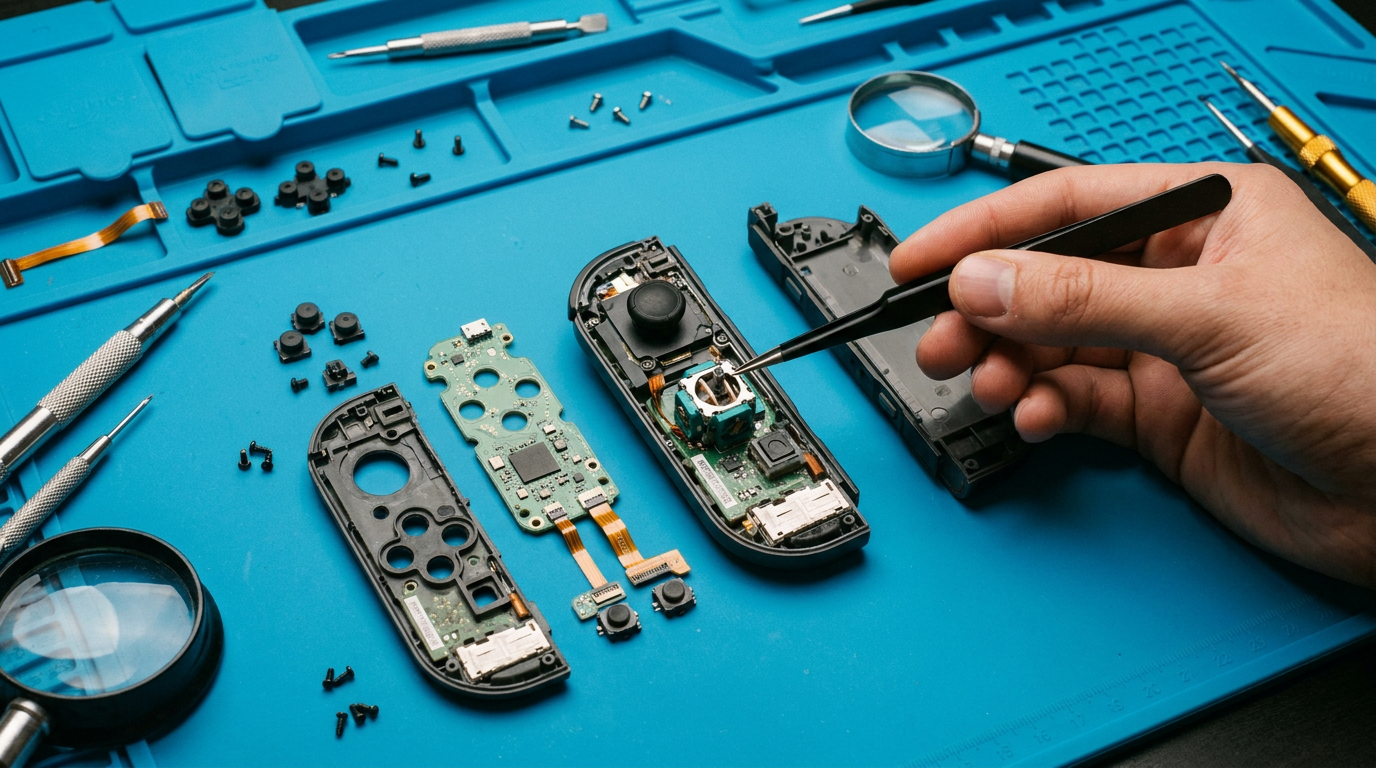
The mechanical root of Joy-Con drift has been extensively documented by independent engineering labs and consumer watchdog groups like the UK's Which?. Comprehensive teardowns revealed that the carbon film potentiometer pads inside the analog stick modules suffered from insufficient wear resistance. As players used the joysticks, the physical contact points would slowly grind down, creating microscopic debris and altering the electrical resistance of the component. Once this deterioration reached a certain threshold, the controllers would begin registering directional inputs even when the player's thumbs were completely off the sticks. Independent lab tests confirmed that this was not a result of user abuse or abnormal gaming habits, but rather an inherent mechanical fault in the component's design.[1][6]
The mechanical root of Joy-Con drift has been extensively documented by independent engineering labs and consumer watchdog groups like the UK's Which?.
The scale of the Joy-Con drift problem is difficult to overstate, largely because of the unprecedented success of the hardware itself. With the Nintendo Switch selling over 155 million units globally since its 2017 debut, the controller defect became one of the most widely documented hardware failures in modern consumer electronics. Consumer protection agencies across the United States, Europe, and Japan were inundated with hundreds of thousands of formal complaints. The sheer volume of failing hardware eventually sparked multiple class-action lawsuits in North America and even prompted a 2020 US congressional inquiry, during which members of the House Judiciary Antitrust Subcommittee demanded that Nintendo hand over the very same internal documents that French regulators have now unsealed.[1][2]

In response to the French ruling, Nintendo of Europe has agreed to pay the $39.9 million fine without contest, effectively closing the legal chapter in that specific jurisdiction. However, the company firmly denied any allegations of intentionally misleading its consumer base. In a public statement addressing the fine, Nintendo emphasized that the payment represents an 'amicable settlement' of the legal dispute rather than a formal admission of guilt regarding planned obsolescence or deceptive practices. The company pointed to its eventual rollout of free repair programs in North America and Europe as evidence of its commitment to customer satisfaction, though critics note these programs were only instituted after the threat of litigation became impossible to ignore.[1][3]
The unsealing of these 2018 documents coincides with a major hardware transition for the Japanese gaming giant. Earlier in 2026, Nintendo launched its highly anticipated second-generation console, the Switch 2. Eager to avoid a repeat of the Joy-Con drift public relations disaster, the company completely overhauled the controller's internal architecture. Consumer advocates and hardware teardown specialists have confirmed that the new Switch 2 controllers utilize Hall effect magnetic sensors. This fundamentally different technology uses magnetic fields to detect joystick movement, completely eliminating the physical contact points and friction that caused the original Joy-Con controllers to fail. By adopting Hall effect sensors, Nintendo has effectively permanently resolved the underlying hardware flaw, though the legacy of the original design continues to cost the company both financially and reputationally.[2][5]

For consumer rights advocates and the global Right to Repair movement, the French regulatory fine is being celebrated as a watershed moment. It provides concrete, documented proof that tech manufacturers sometimes suppress data about widespread hardware defects to protect their bottom line and avoid costly recalls. Advocates hope that this ruling will set a powerful legal precedent, encouraging regulators in other countries to aggressively pursue internal communications when investigating widespread product failures. By holding one of the world's most beloved entertainment companies accountable, the DGCCRF has sent a clear message to the broader tech industry: concealing known hardware defects from the public will eventually carry a massive financial penalty.[2][7]
Moving forward, the gaming industry is likely to see a permanent shift in how controller hardware is manufactured and supported. The intense scrutiny placed on Nintendo has already prompted competitors like Sony and Microsoft to reevaluate their own analog stick designs and warranty policies. While the $39.9 million fine is a relatively small sum for a company of Nintendo's size, the public unsealing of its internal documents serves as a lasting cautionary tale. It underscores the growing power of organized consumer advocacy and proves that in the modern era of hardware teardowns and digital communication, sweeping a major design flaw under the rug is no longer a viable corporate strategy.[6][8]
How we got here
March 2017
The Nintendo Switch launches globally with the original Joy-Con controller design.
2018
Internal Nintendo test data flags failure rates for the Joy-Con analog sticks far exceeding industry standards.
July 2020
Nintendo publicly apologizes for the drift issue after mounting global complaints and class-action lawsuits.
September 2020
French consumer group UFC-Que Choisir files a formal complaint accusing Nintendo of planned obsolescence.
Early 2026
Nintendo launches the Switch 2, replacing the faulty stick design with immune Hall effect sensors.
June 2026
French regulators fine Nintendo $39.9 million and unseal the 2018 internal documents.
Viewpoints in depth
Consumer Protection Regulators
Regulators argue that withholding defect information and charging for repairs constitutes a misleading commercial practice.
For agencies like the DGCCRF, the issue extends far beyond a broken video game controller. They view Nintendo's actions as a textbook case of information asymmetry, where a corporation leverages its internal knowledge to force consumers into unnecessary purchases. By classifying a known mechanical flaw as 'normal wear and tear,' regulators argue that Nintendo actively deceived its customer base and violated fundamental consumer protection laws that require transparency about product lifespans.
Nintendo's Defense
The company maintains that it continuously improved the hardware and settled the fine to avoid prolonged litigation.
Nintendo has consistently pushed back against the narrative of 'planned obsolescence,' arguing that the Joy-Con drift was an unintended engineering challenge rather than a malicious strategy to sell more accessories. The company points to its multiple internal hardware revisions and its eventual rollout of free repair programs as evidence of its good faith. From their perspective, the $39.9 million fine is an amicable settlement designed to close a difficult chapter, not an admission that they intentionally deceived their players.
The Right to Repair Movement
Advocates view the unsealed documents as proof that stronger legislation is needed to protect consumers from proprietary hardware ecosystems.
Right to Repair campaigners see the Nintendo saga as the ultimate validation of their movement. For years, independent repair shops and advocates claimed the controllers were fundamentally flawed, only to be met with corporate denials. The revelation that Nintendo knew about the defect in 2018 proves, in their eyes, that tech giants cannot be trusted to self-regulate or voluntarily disclose hardware failures. They are using this ruling to lobby for stricter laws that would mandate durable design standards and require companies to provide free, accessible repair options the moment a systemic defect is discovered.
What we don't know
- Whether regulators in other jurisdictions, such as the US or UK, will use the unsealed French documents to launch their own retroactive fines.
- How much revenue Nintendo generated from out-of-warranty Joy-Con repairs and replacement sales between 2018 and 2020.
- If the 'amicable settlement' includes any provisions for compensating French consumers who previously paid for repairs.
Key terms
- Joy-Con Drift
- A hardware malfunction where a controller's analog stick registers false inputs without being touched by the user.
- Planned Obsolescence
- A policy of designing a product with an artificially limited useful life so that it will become obsolete and require replacement.
- Hall Effect Sensor
- A type of joystick mechanism that uses magnets to detect movement, eliminating the physical friction that causes traditional sticks to wear out.
- DGCCRF
- The French Directorate General for Competition, Consumer Affairs and Fraud Control, a regulatory body that protects consumer rights.
- Potentiometer
- The physical component in traditional analog sticks that measures movement through electrical resistance and physical contact pads.
Frequently asked
What exactly is Joy-Con drift?
It is a hardware defect where the analog sticks on the Nintendo Switch controllers register movement without any physical contact, causing characters or menus to move on their own.
Did Nintendo know about the defect?
Yes. Internal documents obtained by French regulators show Nintendo was aware of the widespread failure rates as early as 2018.
Is Nintendo offering free repairs now?
Yes, after years of pressure, Nintendo instituted policies in regions like North America and Europe to repair drifting Joy-Cons for free, regardless of warranty status.
Does the new Switch 2 have the same problem?
No. The Switch 2 controllers use Hall effect magnetic sensors, which do not rely on the physical contact points that caused the original drift issue.
Sources
Source coverage
8 outlets
3 viewpoints surfaced








[1]Biggo NewsHardware Manufacturers
Nintendo Fined $39.9 Million in France Over Switch Joy-Con Drift; China Repair Services to End This Year
Read on Biggo News →[2]EurogamerConsumer Rights Advocates
French regulator fines Nintendo €37 million over Joy-Con drift, reveals 2018 internal documents
Read on Eurogamer →[3]IGNHardware Manufacturers
Nintendo Fined $39.9 Million in France for 'Planned Obsolescence' Over Joy-Con Drift
Read on IGN →[4]KotakuRight to Repair Campaigners
Internal Documents Show Nintendo Knew About Joy-Con Drift Since 2018
Read on Kotaku →[5]The Sixth AxisConsumer Rights Advocates
Nintendo fined $39.9m in France as internal documents reveal early knowledge of Joy-Con drift
Read on The Sixth Axis →[6]GeekWireRight to Repair Campaigners
Nintendo's Joy-Con drift saga culminates in $39.9M fine from French regulators
Read on GeekWire →[7]UFC-Que ChoisirConsumer Rights Advocates
Obsolescence programmée : Nintendo sanctionné suite à notre plainte
Read on UFC-Que Choisir →[8]DGCCRFConsumer Rights Advocates
Sanction prononcée à l'encontre de la société Nintendo
Read on DGCCRF →
Every angle. Every day.
Get entertainment stories with full source coverage and perspective breakdowns delivered to your inbox.