
How Agrivoltaics Became the Rare Climate Policy That Farmers and Energy Developers Both Back
By co-locating solar panels and crops, agrivoltaics is solving the land-use conflict between renewable energy and agriculture. New 2026 legislation in the U.S. and Europe is accelerating the dual-use technology, backed by evidence of increased yields and reduced water usage.
By Factlen Editorial Team
- Agricultural Advocates
- Focus on ensuring that solar development does not permanently destroy arable land and that farmers maintain primary control over their operations.
- Clean Energy Developers
- View agrivoltaics as a crucial tool to overcome local zoning resistance and secure the massive land footprint required for grid decarbonization.
- Climate & Ecosystem Researchers
- Analyze the empirical trade-offs of shading, focusing on microclimates, water conservation, and the specific conditions where dual-use thrives or fails.
What's not represented
- · Local zoning boards managing rural land-use permits
- · Agricultural insurance providers assessing crop-loss risks under electrical infrastructure
Why this matters
Utility-scale solar requires massive amounts of land, often putting clean energy targets in direct conflict with agricultural preservation. Agrivoltaics turns this zero-sum battle into a synergy, allowing communities to generate renewable power while simultaneously protecting crops from extreme heat and boosting farm revenues.
Key points
- Agrivoltaics solves the land-use conflict between renewable energy and farming by co-locating solar panels and crops.
- Evidence shows partial shade can boost yields for certain crops and reduce water needs by up to 50%.
- A 2026 PNAS study reveals agrivoltaics works best in arid climates, while humid regions can see crop yield declines.
- Virginia and France passed major 2026 legislation to formally define and protect agrivoltaics.
- France limits solar panel ground coverage to 40% on agricultural land to ensure farming remains the priority.
The global transition to renewable energy has a persistent math problem: utility-scale solar requires massive amounts of land. In rural communities worldwide, this has sparked a zero-sum conflict between clean energy developers looking for flat, sunny acreage and farming advocates fighting to preserve arable land for food production.[7]
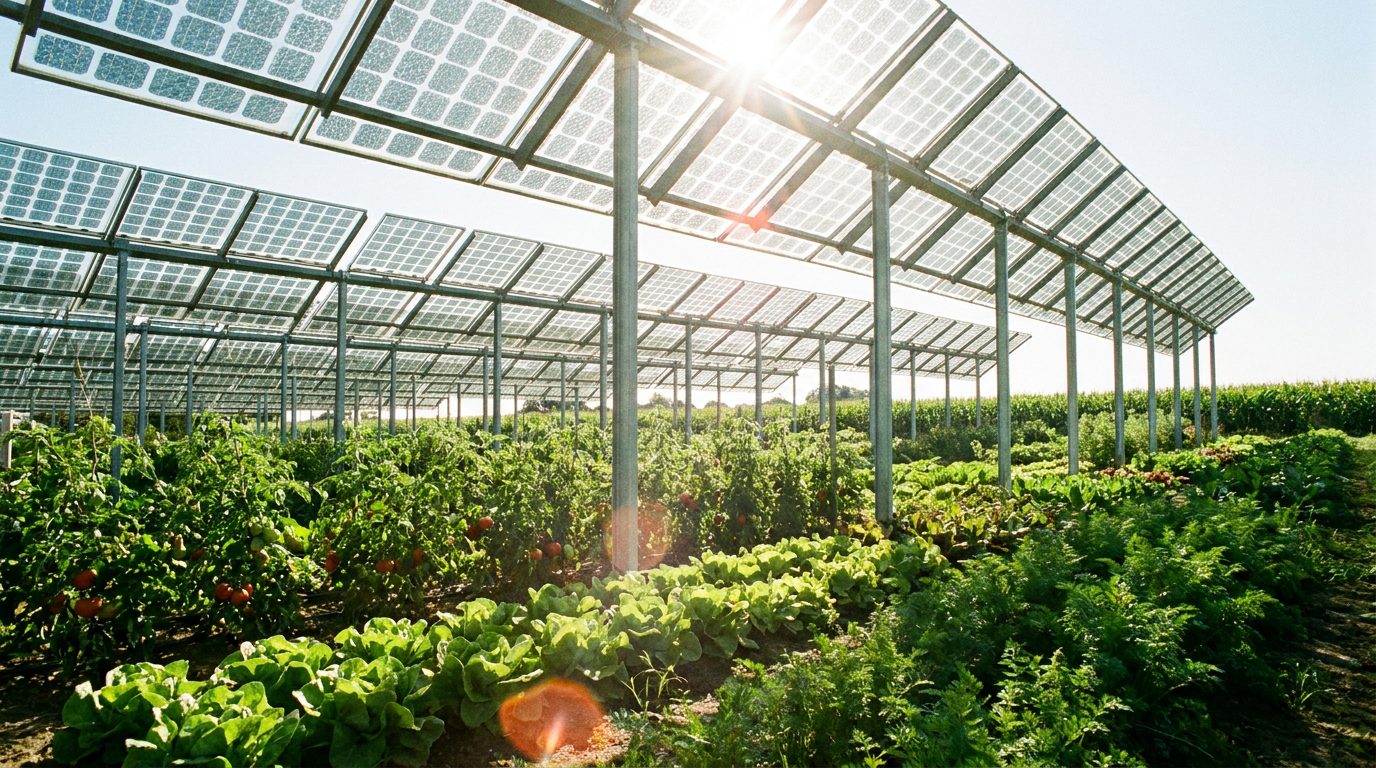
But a rapidly maturing approach known as "agrivoltaics"—the intentional co-location of solar panels and agriculture—is turning that conflict into a synergy. By elevating solar arrays to allow crops to grow or livestock to graze underneath, the technology promises to decarbonize the grid while keeping farms in active, profitable production.[1][7]
In 2026, agrivoltaics has moved from niche academic experiments to the center of national climate policies. Backed by a wave of new empirical data, lawmakers in the United States and Europe are passing dedicated legislation to scale the dual-use technology and establish strict standards to prevent "solar sprawl."[1][3][9]
The core evidence driving this policy shift centers on a counterintuitive biological mechanism: for many crops, partial shade actually improves growing conditions. The panels create a microclimate that reduces heat stress and dramatically lowers water evaporation from the soil.[2][5][8]
Data from the National Renewable Energy Laboratory (NREL) and the USDA Climate Hubs demonstrates the stark efficiency gains. In pilot projects, peppers grown under solar panels required 50% less water, while tomatoes needed 30% less, offering a vital adaptation tool for drought-stricken regions.[7][8]

The yield impacts are equally significant for certain crops. A study by Oregon State University found that potatoes grown in the shade of solar panels experienced a 20% overall yield increase compared to those grown in full sun.[7]
International trials corroborate these findings. A 2026 field experiment in Bangladesh, published in the National Library of Medicine, tested shade-tolerant crops under solar irrigation pumps. The researchers recorded yield increases of 12.3% for ginger and 8.7% for turmeric, proving the model's viability in resource-constrained regions.[10]
However, the evidence also clearly maps the limitations of agrivoltaics, proving it is not a one-size-fits-all solution. A landmark 2026 study published in the Proceedings of the National Academy of Sciences (PNAS) analyzed 14 years of crop data across the U.S. Midwest to quantify the exact trade-offs.[2][5]
The PNAS researchers found a stark climate-driven divergence. In the humid, eastern stretch of the Midwest, the shade from solar panels reduced photosynthesis levels, curbing maize yields by 24% and soybeans by 16%. In these regions, the lease income from solar developers was not enough to offset the farmers' crop losses.[2][5]
The PNAS researchers found a stark climate-driven divergence.
But in the drier, semiarid western Midwest, the math flipped. While maize still suffered a 12% yield drop, soybeans experienced a 6% yield increase under the panels. For soybean farmers in these arid zones, total profits increased by 9%, creating a "triple-win" of higher yields, economic gains, and clean electricity.[2][5]

If deployed strategically in these optimal zones, the macro potential is staggering. According to a 2026 synthesis published in Renewable and Sustainable Energy Reviews, implementing agrivoltaics globally across suitable crops could generate an additional 1,800 million tonnes of food annually, potentially feeding 2.1 billion people while generating over $1 trillion in added agricultural income.[6]
Domestically, Oregon State University researchers calculate that converting less than 1% of U.S. agricultural land to agrivoltaics could meet 20% of the country's total energy needs without sacrificing the food supply.[7]
Recognizing this potential, governments are rushing to build regulatory frameworks that incentivize true agrivoltaics while blocking developers from simply paving over farmland. In April 2026, Virginia Governor Abigail Spanberger signed SB340/HB508, a bipartisan bill that formally defines agrivoltaics in state law.[1]
The Virginia legislation mandates that qualifying projects must prioritize agricultural activities over the 25-to-30-year lifespan of the solar array. It ensures that the land remains an active farm business, rather than a solar plant with token vegetation.[1]
Colorado has taken a direct funding approach, aggressively expanding its Agrivoltaics Research and Demonstration Grant Program. The state has distributed millions to projects testing bifacial vertical panels, retrofitting traditional solar arrays for cattle grazing, and studying soil moisture retention in vineyards.[4]

Europe is moving even faster. France has officially entered what industry leaders are calling the "2.0 era of agrivoltaics." Following the foundational APER Law, the French government issued new decrees in April 2026 to streamline environmental permitting for strategic dual-use projects.[3][9]
Crucially, French law now dictates that solar installations on agricultural land must be agrivoltaic. The regulations impose a strict 40% limit on panel ground coverage and require operators to prove they are providing a tangible agricultural service, such as climate adaptation or improved animal welfare.[9]
With these guardrails in place, France expects to install between 1 and 2 gigawatts of agrivoltaic capacity annually starting in 2026, making it the fastest-growing segment of the nation's solar market.[3]
Challenges remain, particularly the high upfront capital costs of the specialized, elevated steel racking required to allow tractors to pass underneath. Soil compaction during the heavy construction phase also requires careful remediation to protect long-term agronomic health.[7]
How we got here
March 2023
France passes the APER law, establishing the first national legal framework for agrivoltaics.
January 2024
Colorado launches its Agrivoltaics Research and Demonstration Grant Program to fund dual-use projects.
April 2026
Virginia Governor Abigail Spanberger signs SB340/HB508, formally defining and protecting agrivoltaics in the state.
April 2026
France issues new decrees streamlining environmental permitting for strategic agrivoltaic installations.
Viewpoints in depth
Agricultural Economists
Focus on the financial viability and crop yield trade-offs of shading.
Agricultural economists emphasize that agrivoltaics is not a universal solution, pointing to the 2026 PNAS study as proof that climate dictates profitability. In humid regions where shade reduces photosynthesis, the loss in crop yields (like a 24% drop in maize) often outweighs the lease payments from solar developers. However, in arid regions, the microclimate created by the panels boosts both crop yields and overall farm profits, making it a highly lucrative diversification strategy.
Renewable Energy Developers
View agrivoltaics as a crucial tool to overcome local zoning resistance and land scarcity.
For the solar industry, the primary bottleneck to decarbonizing the grid is finding enough land and securing local permits. Developers argue that agrivoltaics neutralizes the most potent argument against solar expansion—the destruction of farmland. By designing systems that allow tractors to pass and crops to thrive, energy companies can win over skeptical rural communities and unlock millions of acres of previously off-limits agricultural land.
Rural Policymakers
Prioritize keeping farmland in active production and preventing 'solar sprawl.'
Lawmakers are focused on establishing strict guardrails to ensure developers don't exploit agrivoltaics as a loophole to build traditional solar farms on cheap agricultural land. Policies like France's 40% ground-coverage limit and Virginia's requirement that farming remain the primary activity over the 30-year lifespan of the panels are designed to protect the integrity of the agricultural sector while still meeting clean energy targets.
What we don't know
- How long-term soil health is impacted over the full 25-30 year lifespan of a solar array.
- Whether the premium cost of elevated racking systems will come down enough to make agrivoltaics viable without government grants.
- How insurance markets will price crop-loss risks for farms operating underneath electrical infrastructure.
Key terms
- Agrivoltaics
- The intentional co-location of solar energy generation and agricultural production on the same land.
- Bifacial panels
- Solar panels that can capture sunlight from both their front and back sides, often used in agrivoltaics to capture light reflected off the ground.
- Evapotranspiration
- The process by which water is transferred from the land to the atmosphere by evaporation from the soil and transpiration from plants.
Frequently asked
Do solar panels block too much sun for crops to grow?
It depends on the crop and the climate. Shade-tolerant crops like leafy greens and root vegetables often thrive, and in hot, arid climates, the shade actually protects plants from heat stress. However, sun-heavy crops like corn can see yield drops in humid regions.
Can farm equipment still operate around the panels?
Yes. Modern agrivoltaic systems are designed with elevated racking systems and wide row spacing specifically to accommodate tractors and harvesters.
How does agrivoltaics save water?
The partial shade provided by the solar panels lowers the soil temperature and reduces the rate of evaporation, meaning crops require significantly less irrigation.
Sources
Source coverage
10 outlets
3 viewpoints surfaced









[1]CleanTechnicaClean Energy Developers
Agrivoltaics Gets A Huge Thumbs-Up With Bipartisan Support
Read on CleanTechnica →[2]Anthropocene MagazineClimate & Ecosystem Researchers
Do solar panels hurt crop yields? It depends on where you farm.
Read on Anthropocene Magazine →[3]pv magazineClean Energy Developers
France streamlines renewables environmental permitting with new provisions
Read on pv magazine →[4]Farm ProgressAgricultural Advocates
Colorado grants fund agrivoltaics projects
Read on Farm Progress →[5]Proceedings of the National Academy of SciencesClimate & Ecosystem Researchers
Climate-driven divergence in biophysical and economic impacts of agrivoltaics
Read on Proceedings of the National Academy of Sciences →[6]Renewable and Sustainable Energy ReviewsClimate & Ecosystem Researchers
Agrivoltaics as a systems innovation: multi-dimensional benefits from global studies across climate, agriculture, energy, and ecosystems
Read on Renewable and Sustainable Energy Reviews →[7]U.S. Department of AgricultureAgricultural Advocates
Agrivoltaics: Pairing Solar Power and Agriculture in the Northwest
Read on U.S. Department of Agriculture →[8]National Renewable Energy LaboratoryClimate & Ecosystem Researchers
Agrivoltaics: Solar Farming for a Greener Future
Read on National Renewable Energy Laboratory →[9]CMS Law
Expert Guide on Agrivoltaics and Floating Photovoltaics France
Read on CMS Law →[10]National Library of MedicineClimate & Ecosystem Researchers
Exploring Agrivoltaics: A Pathway to Climate-Resilient and Productive Land Use in Northern Bangladesh
Read on National Library of Medicine →
Every angle. Every day.
Get energy stories with full source coverage and perspective breakdowns delivered to your inbox.