
EU Delays Key AI Act Enforcement as 'Brussels Effect' Fractures Under US Deregulation
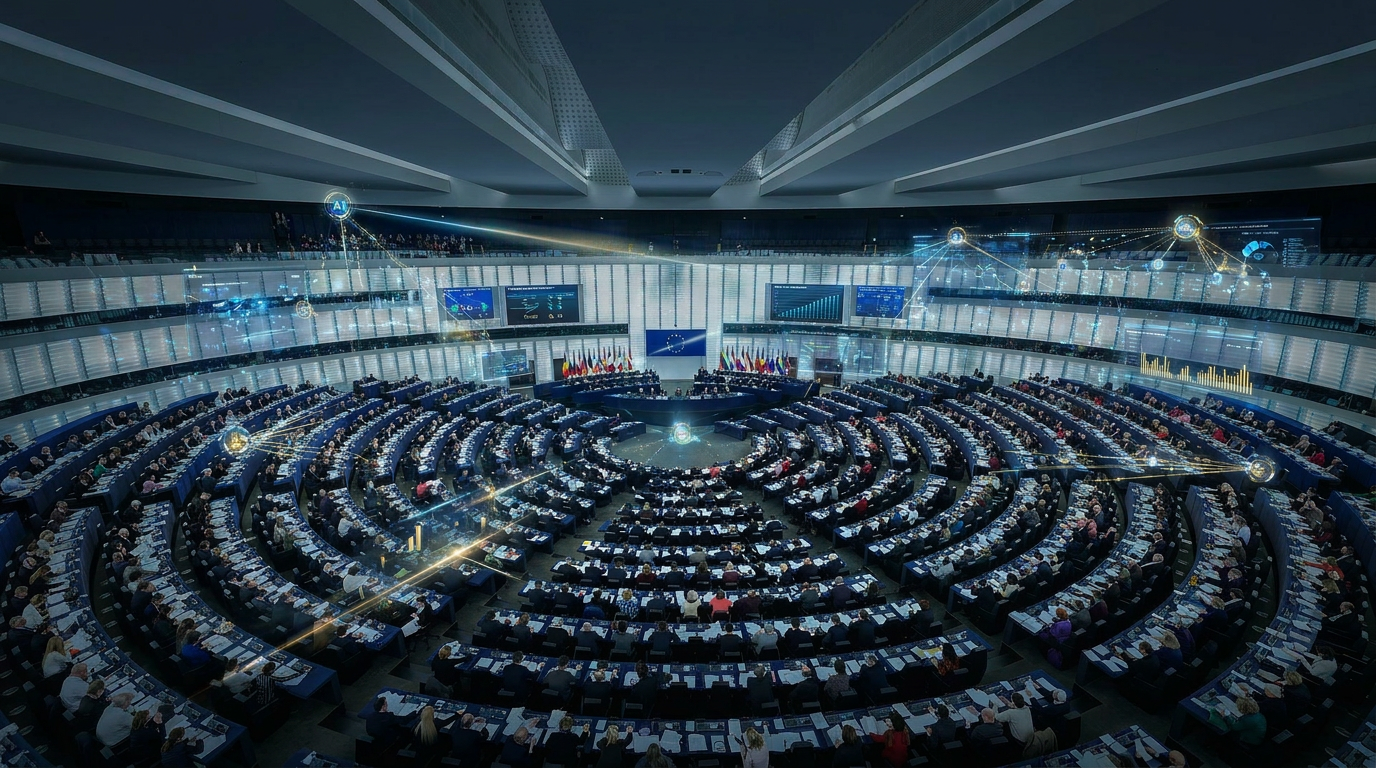
The European Parliament has voted to delay strict high-risk AI compliance until late 2027, as evidence mounts that the bloc's landmark regulation is causing tech firms to delay releases or withdraw from the market entirely.
By Factlen Editorial Team

- European Regulators
- Argue that comprehensive, risk-based governance is necessary to protect citizens and will ultimately set a durable global standard.
- Global AI Developers
- Caught between compliance costs and market access; some adopt global standards, while others delay European releases or withdraw entirely.
- US Policymakers
- Prioritize capital deployment, infrastructure scale, and deregulation to maintain a competitive advantage over global rivals.
What's not represented
- · Open-source AI maintainers
- · European startup founders
- · Civil rights organizations
Why this matters
This regulatory divergence dictates where the world's most advanced AI tools are deployed first. If the EU's strict rules force companies to segment their products, European users may lose access to frontier technologies, while US users operate in a largely unregulated, high-speed environment.
Key points
- The European Parliament voted to amend the AI Act, delaying high-risk compliance to December 2027.
- The US has pivoted toward AI deregulation, abandoning efforts for a comprehensive federal law.
- Major tech companies are adopting EU transparency standards globally, demonstrating a partial 'Brussels Effect'.
- However, severe penalties have caused some AI developers to delay European releases or withdraw entirely.
The global governance of artificial intelligence has reached a structural inflection point in the summer of 2026. Two years after the European Union’s landmark AI Act entered into force, the bloc is simultaneously preparing for its first major enforcement wave and rushing to amend its own rules to prevent an innovation exodus.[2][3]
Across the Atlantic, the United States has consolidated around a fundamentally different philosophy. Following the rescission of earlier executive orders, the US federal government has pivoted toward a "minimally burdensome" framework designed to maximize capital deployment and infrastructure scale.[1][2]
This transatlantic divergence represents the first genuine pressure test of the "Brussels Effect" in the AI era—the phenomenon where EU regulations become de facto global standards because multinational companies find it cheaper to adopt one strict standard worldwide. The evidence emerging in 2026 suggests this effect is fracturing under the unique complexities of generative AI.[5][6][7][8]
Claim 1: The EU is delaying its core enforcement mechanisms to protect economic competitiveness. The original text of the EU AI Act mandated that rules for "high-risk" AI systems—such as those used in employment, education, and critical infrastructure—would become enforceable on August 2, 2026.[3][4]

Evidence shows that this impending deadline triggered a massive compliance scramble among engineering teams, who struggled to classify whether internal tools or multi-agent pipelines fell under the strict Annex III high-risk category. In response to industry pressure and a recognized decline in European tech competitiveness, the European Commission introduced the "Digital Omnibus" package.[2][3][4]
On June 16, 2026, the European Parliament voted decisively (423 to 57) to amend the AI Act, pushing the compliance deadline for standalone high-risk systems back by 16 months to December 2, 2027. The amendment also centralizes enforcement authority and removes certain AI literacy obligations for deployers.[2][4]
Uncertainty: Despite the parliamentary vote, the Digital Omnibus is currently a provisional political agreement, not yet enacted law. Legal analysts warn that until the amendment is formally published, the statutory August 2026 deadline remains technically active, forcing enterprise compliance teams to plan for a cliff edge that may shift at the last minute.[1][3]
Uncertainty: Despite the parliamentary vote, the Digital Omnibus is currently a provisional political agreement, not yet enacted law.
Claim 2: The US has abandoned comprehensive federal AI regulation in favor of state-level patchwork. As of mid-2026, the United States has no binding, horizontal federal AI statute comparable to the EU framework.[1][7]
The policy shift was codified in January 2025 with Executive Order 14179, titled "Removing Barriers to American Leadership in Artificial Intelligence," which explicitly pivoted federal posture toward deregulation to compete globally. Consequently, US AI enforcement operates primarily through state attorneys general enforcing a patchwork of local laws, such as Colorado's AI Act (SB 24-205), which focuses narrowly on algorithmic discrimination rather than systemic model risk.[1][6][7]

For multinational companies, this creates a profound compliance asymmetry. The EU AI Act’s General Purpose AI (GPAI) category imposes strict documentation, copyright compliance, and systemic risk assessments on large foundation models—obligations that have absolutely no equivalent in the US market.[7]
Claim 3: The "Brussels Effect" is driving global adoption of transparency standards, but failing to unify high-risk governance. Proponents of the Brussels Effect argue that the EU AI Act is already shaping global product development.[8]
The strongest evidence for this lies in transparency and watermarking. Major technology providers, including Adobe, OpenAI, and Google, have integrated EU-compliant synthetic content detection (such as the C2PA standard) into their global product suites. Because the EU AI Act applies to any system whose outputs touch EU users—regardless of where the company is headquartered—multinationals are finding it operationally necessary to build these features universally.[6][8]
However, evidence against a universal Brussels Effect is mounting. Rather than adopting EU standards globally, several major AI developers are choosing to segment their markets or withdraw from Europe entirely to avoid the Act's severe penalties, which can reach €35 million or 7% of global annual turnover.[5][6]

Meta notably refused to sign the EU's voluntary GPAI Code of Practice in late 2025, taking a confrontational stance against the regulatory framework. Furthermore, the largest open-source model providers systematically delayed their European releases throughout 2024 and 2025 due to regulatory uncertainty.[5][6]
The impact extends beyond foundation models to applied AI. OpenEvidence, a medical AI system widely deployed in US healthcare, recently withdrew from the EU and UK markets, explicitly citing regulatory risk. A 2026 survey of over 1,000 technology firms revealed that nearly 60% of developers in the EU and UK reported launch delays, and one-third stripped features from their products specifically to comply with the Act.[5]
Uncertainty: It remains unclear whether the Digital Omnibus delay will be sufficient to reverse this trend of market withdrawal. If the 16-month extension successfully allows technical standards to mature, companies may reintegrate their European operations. If not, the global AI ecosystem may permanently bifurcate into a highly regulated European sphere and a rapidly iterating American sphere.[2][5]
How we got here
August 2024
The EU AI Act officially entered into force.
January 2025
The US issued Executive Order 14179, pivoting federal policy toward AI deregulation.
February 2025
EU bans on unacceptable risk AI systems took effect.
May 2026
The European Council and Parliament provisionally agreed to the Digital Omnibus package.
June 16, 2026
The European Parliament voted to amend the Act, delaying high-risk compliance to December 2027.
Viewpoints in depth
European Regulators' View
Comprehensive regulation is a necessary prerequisite for safe AI adoption and long-term public trust.
European policymakers maintain that the AI Act's risk-based architecture is functioning as intended. They argue that establishing clear guardrails for high-risk systems and foundation models prevents societal harm and provides legal certainty. The recent Digital Omnibus amendments are framed not as a retreat, but as a pragmatic adjustment to ensure technical standards are fully mature before enforcement begins. From this perspective, the short-term friction experienced by developers is a necessary cost to establish a durable, citizen-centric global standard.
Global AI Developers' View
Regulatory complexity and severe penalties are stifling innovation and forcing market segmentation.
For engineering teams and multinational tech firms, the EU AI Act represents a massive operational burden. Developers point to the ambiguity of classifying internal tools and the severe €35 million penalties as reasons to delay product launches or withdraw from the European market entirely. While some companies are adopting EU transparency standards globally to simplify operations, others argue that the Act's rigid documentation requirements are incompatible with the rapid iteration cycles required to build frontier models, leading to a noticeable technology gap between the US and the EU.
US Policymakers' View
Deregulation and capital deployment are the keys to winning the global AI race.
The current US federal posture views comprehensive AI regulation as a strategic vulnerability. By rescinding earlier oversight orders and focusing on 'minimally burdensome' frameworks, US policymakers aim to accelerate infrastructure build-out and private-sector innovation. This camp argues that the EU's preemptive regulation is already causing capital and talent to flee Europe. Instead of a top-down federal law, the US relies on existing sector-specific agencies and emerging state laws to address specific harms like algorithmic discrimination, leaving the core technology unencumbered.
What we don't know
- Whether the Digital Omnibus package will be formally enacted into law before the original August 2026 deadline.
- If the 16-month delay will be sufficient for the EU to finalize the necessary technical standards.
- How aggressively European authorities will enforce the Act against US-based companies with no physical EU presence.
Key terms
- Brussels Effect
- The phenomenon where the European Union's market size forces multinational companies to adopt its strict regulations as a global standard.
- Digital Omnibus
- A 2026 European legislative package designed to simplify the AI Act and delay compliance deadlines to boost economic competitiveness.
- General Purpose AI (GPAI)
- Large foundation models, like advanced language models, that can perform a wide variety of tasks and carry systemic risks.
- Annex III High-Risk Systems
- AI applications used in sensitive areas like employment, education, or law enforcement, which face the strictest regulatory requirements.
Frequently asked
Does the EU AI Act apply to US companies?
Yes. If a US company's AI system or its outputs are used by individuals within the European Union, the company must comply with the Act.
What happens if a company violates the EU AI Act?
Non-compliant organizations face severe administrative fines, reaching up to €35 million or 7% of their global annual turnover, whichever is higher.
Is the US passing a similar federal AI law?
No. As of mid-2026, the US has abandoned comprehensive federal AI legislation in favor of deregulation and a patchwork of state-level laws.
Sources
Source coverage
8 outlets
3 viewpoints surfaced








[1]LegalithmUS Policymakers
Global AI regulation at a glance: US AI policy vs EU AI act 2026
Read on Legalithm →[2]TrilligentUS Policymakers
The transatlantic divide in artificial intelligence regulation
Read on Trilligent →[3]Augment CodeGlobal AI Developers
EU AI Act Timeline: What Enforces on August 2, 2026
Read on Augment Code →[4]Enterprise AI GovernanceEuropean Regulators
The EU AI Act amendments explained: MEPs vote to amend the EU AI Act
Read on Enterprise AI Governance →[5]FII InstituteGlobal AI Developers
Politics Is Local, But AI Is Everywhere: Rethinking the EU AI Act in a Global Economy
Read on FII Institute →[6]AskAjayGlobal AI Developers
The Brussels Effect — is the EU AI Act becoming the global standard?
Read on AskAjay →[7]Everyday On AIUS Policymakers
Navigating the Transatlantic Compliance Asymmetry
Read on Everyday On AI →[8]EYReactEuropean Regulators
Is the Brussels Effect happening with the AI Act?
Read on EYReact →

More in ai
See all 5 stories →Agentic AI
Agentic AI: How Large Action Models Are Automating Digital Chores
7 sources

Drug Discovery
New AI Model Accelerates Molecular Simulations 10,000-Fold, Promising Faster Drug Discovery
6 sources

AI Regulation
EU Delays High-Risk AI Rules to 2027, But August 2026 Transparency Cliff Remains
7 sources
Every angle. Every day.
Get ai stories with full source coverage and perspective breakdowns delivered to your inbox.