
New AI Model Accelerates Molecular Simulations 10,000-Fold, Promising Faster Drug Discovery
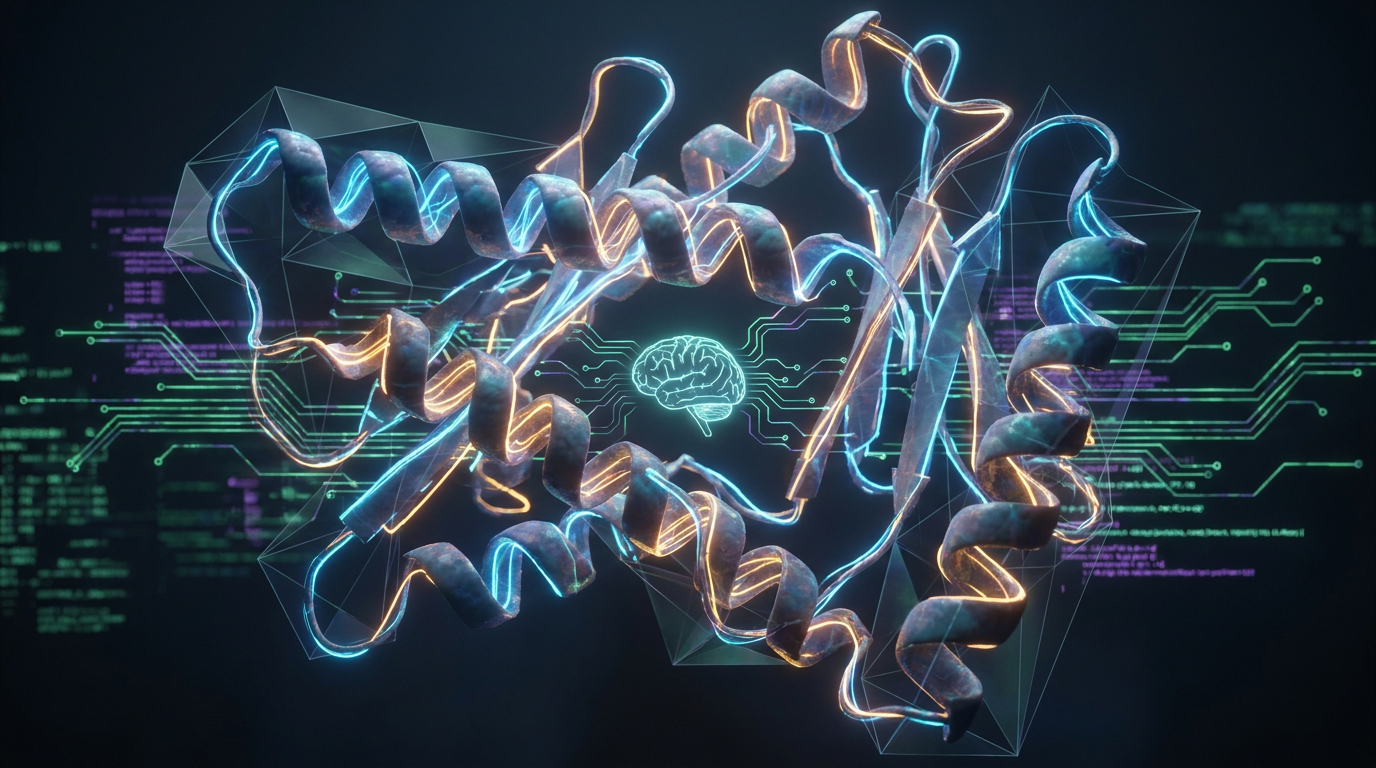
Researchers in Sweden have developed an AI model that predicts molecular motion 10,000 times faster than conventional methods. The breakthrough could drastically reduce the time and computational cost required to discover new life-saving drugs.
By Factlen Editorial Team
- Pharmaceutical Industry
- Emphasize the practical benefits of accelerating drug discovery pipelines and reducing R&D costs.
- Computational Chemists
- Focus on the technical achievement of bypassing femtosecond time steps to model long-term molecular dynamics.
- Tech & AI Analysts
- View the breakthrough as part of a broader, lucrative trend of generative AI transforming the physical sciences.
What's not represented
- · Regulatory agencies evaluating AI-generated preclinical data
- · Patient advocacy groups awaiting faster treatments
Why this matters
Bringing a new drug to market typically takes over a decade and costs billions of dollars. By using AI to fast-forward through the complex physics of how molecules interact, scientists can identify life-saving treatments much faster, potentially accelerating cures for complex diseases.
Key points
- A new AI model named TITO predicts molecular motion 10,000 times faster than traditional computer simulations.
- Developed by researchers in Sweden and AstraZeneca, the model learns the statistical rules of atomic movement.
- It bypasses the need to calculate forces in femtosecond intervals, effectively skipping ahead in time.
- The breakthrough allows pharmaceutical companies to digitally screen drug candidates much faster, accelerating preclinical R&D.
Developing a new life-saving drug is notoriously slow, often taking more than a decade from the initial concept to a finished medicine. A significant portion of that time is spent simulating how potential chemical compounds interact at the atomic level. Now, a breakthrough artificial intelligence model developed in Sweden is poised to hit the fast-forward button on this critical phase of pharmaceutical research.[2][3]
Researchers from Chalmers University of Technology and the University of Gothenburg, working in collaboration with pharmaceutical giant AstraZeneca, have unveiled a deep generative modeling framework named TITO, or Transferable Implicit Transfer Operators.[2][5]
Published in the journal Science Advances, the study demonstrates that the TITO model can predict molecular motion and structural changes more than 10,000 times faster than conventional molecular dynamics simulations.[1][3]
The core problem the researchers solved lies in the fundamental physics of traditional simulations. Conventional methods calculate the forces between atoms step-by-step, requiring extremely short time intervals of about one femtosecond—a millionth of a billionth of a second—to remain mathematically stable.[1][5]
Because the biological processes relevant to drug discovery, such as a protein folding or a drug binding to a cellular receptor, occur over much longer timescales, these traditional simulations require billions of sequential calculation steps. This creates a massive computational bottleneck, making large-scale chemical screening both expensive and time-consuming.[1][5]

The TITO model bypasses this limitation entirely. Instead of calculating every single atomic interaction frame-by-frame, the AI learns the statistical rules governing molecular motion directly from short simulation sequences spanning just tens of nanoseconds.[1][2]
Once trained, the AI can predict how atomic configurations will evolve over timescales a thousand times longer than what it observed. Simon Olsson, an associate professor at Chalmers University, likened the process to skipping ahead through selected scenes in a "molecular movie" rather than watching every single frame in sequence.[2][5]
Once trained, the AI can predict how atomic configurations will evolve over timescales a thousand times longer than what it observed.
Crucially, the system generalizes beyond its training data. The researchers validated the model against more than 12,500 organic molecules—including compounds containing carbon, nitrogen, hydrogen, and oxygen—as well as over 1,000 short peptides.[1][5]
The results, which were cross-checked against established numerical algorithms, showed that TITO successfully predicted the behavior of molecules it had never encountered before. It achieved this by learning the broad, underlying physics of molecular motion rather than simply memorizing specific chemical systems.[1][6]
Lead author Juan Viguera Diez, an industrial doctoral student at AstraZeneca, noted that the model provides insights not just into the final shapes that molecules take, but also the specific pathways and speeds at which these molecular transitions occur.[2][5]

For the pharmaceutical industry, the implications are highly practical. Faster and more reliable simulations mean chemists can digitally screen vast libraries of potential active pharmaceutical ingredients, reducing the number of physical lab tests required to shortlist viable candidates.[1][4]
The development of TITO reflects a broader industry shift toward AI-accelerated computational chemistry, a market projected to reach nearly $7 billion by 2029. It joins a wave of recent innovations from institutions like MIT and companies like Google DeepMind aimed at automating the drug discovery pipeline.[4]

While the current iteration of the TITO method has been validated primarily on small molecular systems in simplified solvent environments, the research team is already working to extend its applicability. The next phase of development will focus on applying the AI to more complex and realistic biological environments, moving the industry one step closer to an era of rapid, digitally native medicine design.[1][2][5]
How we got here
2020
DeepMind's AlphaFold makes a historic breakthrough by accurately predicting the 3D structures of nearly all known proteins.
2024
Generative AI models begin moving beyond static structures, attempting to design novel drug candidates from scratch.
June 2026
Researchers at Chalmers University and AstraZeneca publish the TITO model, solving the dynamic simulation bottleneck by predicting molecular motion 10,000 times faster.
Viewpoints in depth
The Computational Chemistry View
Solving the femtosecond bottleneck in molecular dynamics.
For decades, computational chemists have been constrained by the fundamental physics of molecular dynamics. Because atoms vibrate incredibly fast, simulations must calculate forces in femtosecond intervals (10⁻¹⁵ seconds) to prevent the mathematical models from breaking down. This meant that simulating a biological process that takes a mere millisecond required a trillion sequential calculations. The TITO model represents a paradigm shift because it abandons step-by-step integration entirely. By using deep generative modeling to learn the statistical probabilities of where atoms will move next, it allows researchers to take massive leaps forward in time, preserving thermodynamic accuracy without the crushing computational overhead.
The Pharmaceutical Industry View
Compressing the decade-long drug development timeline.
From the perspective of pharmaceutical giants like AstraZeneca, the primary value of AI is speed and cost reduction. Bringing a single new drug to market typically takes over ten years and costs billions of dollars, with much of that time spent in the preclinical phase trying to identify which molecules will bind correctly to disease targets. By accelerating molecular simulations by a factor of 10,000, companies can digitally screen exponentially larger libraries of chemical compounds. This allows them to fail fast on unviable candidates in a computer simulation, reserving expensive and time-consuming physical laboratory testing only for the molecules with the highest probability of success.
What we don't know
- How seamlessly the TITO model will scale from simplified solvent environments to the highly complex, chaotic environment of a living human cell.
- Exactly how much time and money this specific simulation speedup will ultimately shave off the end-to-end 10-year drug development pipeline.
Key terms
- Molecular dynamics
- A computer simulation method for analyzing the physical movements of atoms and molecules over time.
- Femtosecond
- One quadrillionth of a second (10⁻¹⁵ seconds), the standard time step used in traditional molecular simulations to maintain stability.
- Generative AI
- Artificial intelligence capable of generating new data, structures, or predictions based on the patterns it learned during training.
- Conformational change
- The process by which a molecule alters its shape or structure, which is crucial for how drugs bind to targets in the body.
Frequently asked
What does the TITO model actually do?
It predicts how molecules move and change shape over time, doing so 10,000 times faster than traditional step-by-step computer simulations.
Why is this important for medicine?
By rapidly simulating how potential drugs interact with biological targets, pharmaceutical companies can identify effective treatments much faster and cheaper.
Can the AI predict the behavior of entirely new molecules?
Yes. The researchers found that TITO learned the underlying physics of molecular motion, allowing it to accurately predict the behavior of molecules it had never seen before.
Sources
Source coverage
6 outlets
3 viewpoints surfaced






[1]Manufacturing ChemistPharmaceutical Industry
AI model accelerates molecular simulations by 10,000-fold
Read on Manufacturing Chemist →[2]Chalmers University of TechnologyComputational Chemists
AI breakthrough accelerates molecular simulations for drug discovery
Read on Chalmers University of Technology →[3]News-Medical.netPharmaceutical Industry
AI breakthrough accelerates molecular simulations for drug discovery
Read on News-Medical.net →[4]Acumen NewsTech & AI Analysts
TITO AI Model Accelerates Molecular Simulations 10,000-Fold
Read on Acumen News →[5]Rocking RobotsTech & AI Analysts
Researchers develop AI model to predict molecular motion
Read on Rocking Robots →[6]arXivComputational Chemists
Transferable Implicit Transfer Operators
Read on arXiv →

More in ai
See all 5 stories →Agentic AI
Agentic AI: How Large Action Models Are Automating Digital Chores
7 sources

Global AI Governance
EU Delays Key AI Act Enforcement as 'Brussels Effect' Fractures Under US Deregulation
8 sources

AI Regulation
EU Delays High-Risk AI Rules to 2027, But August 2026 Transparency Cliff Remains
7 sources

Every angle. Every day.
Get ai stories with full source coverage and perspective breakdowns delivered to your inbox.