
SpaceX Raises Record $85.7 Billion in Historic IPO to Fund Orbital AI Infrastructure
SpaceX has completed the largest initial public offering in history, reaching a $2.5 trillion valuation as the company pivots to building space-based artificial intelligence data centers.
By Factlen Editorial Team
- Infrastructure Bulls
- Argue that the next trillion-dollar opportunity lies in the physical hardware, energy, and orbital systems required to sustain AI.
- Valuation Skeptics
- Warn that the unprecedented concentration of mega-cap IPOs risks creating a public market bubble and transferring venture risk to retail investors.
- Growth Investors
- View SpaceX's conglomerate model—combining cash-generating satellite internet with high-growth AI—as justifying the premium.
What's not represented
- · Terrestrial energy providers
- · Antitrust regulators
Why this matters
The unprecedented scale of SpaceX's public debut signals a massive shift in the AI industry, moving billions of dollars away from software development and into the physical infrastructure—like data centers, energy grids, and orbital compute—needed to power the next generation of technology.
Key points
- SpaceX raised $85.7 billion in its Nasdaq debut, reaching a market capitalization of over $2.5 trillion within its first week of trading.
- The IPO funds are largely earmarked for building orbital AI data centers to bypass the energy constraints of Earth-based computing.
- Just days after listing, SpaceX acquired Anysphere, the maker of the AI coding assistant Cursor, in a $60 billion all-stock deal.
- Market analysts view the IPO as a broader shift in AI investment from software platforms to physical infrastructure and energy systems.
- Skeptics warn that the unprecedented valuations of upcoming AI IPOs could strain public market liquidity and create a bubble.
SpaceX has officially completed the largest initial public offering in history, raising a record $85.7 billion and fundamentally reshaping the public market's relationship with artificial intelligence. The aerospace and AI conglomerate, trading under the ticker SPCX, debuted on the Nasdaq on June 12, 2026, at $135 per share. Within five days of trading, the stock surged past $189, pushing the company's market capitalization north of $2.5 trillion and cementing Elon Musk's status as the world's first trillionaire.[4][5][7]
The sheer scale of the offering comfortably unseated the previous record holder, Saudi Aramco's $29 billion listing in 2019, and was more than triple the size of Alibaba's 2014 debut. But while SpaceX is historically known for reusable rockets and satellite internet, the financial engine driving this unprecedented valuation is artificial intelligence. In February 2026, SpaceX quietly absorbed Musk's AI venture, xAI, creating a unique conglomerate that merges launch services, global broadband, and wholesale AI compute.[1][2][4][5]
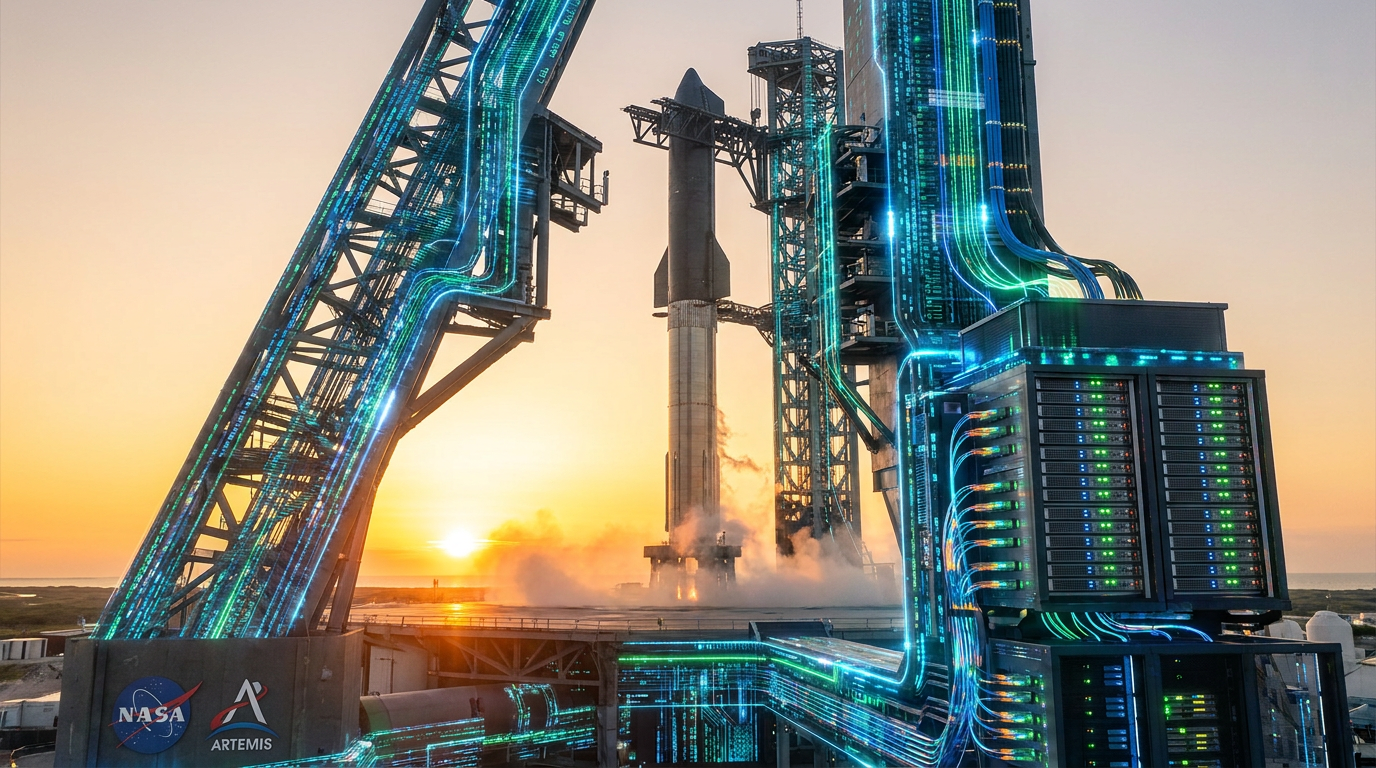
The core thesis behind the $85.7 billion raise is that the AI industry is hitting physical limits on Earth. Training and running next-generation large language models requires extraordinary amounts of electricity and cooling, straining terrestrial power grids. Musk's pitch to investors centers on building orbital AI data centers—space-based computing infrastructure that can harness near-continuous solar power without the geographic and regulatory constraints of Earth-based energy markets.[1][2][4]

Financial analysts argue that this marks a critical pivot in how markets value the artificial intelligence boom. According to Nigel Green, CEO of deVere Group, the market is entering a new phase where the biggest opportunities are no longer in software developers or chatbot platforms, but in the physical systems required to sustain AI's rapid global expansion. "Trillions of dollars are likely to flow into data centres, semiconductors, electricity generation, cooling systems, fibre networks, cloud architecture and satellite connectivity," Green noted.[2]
SpaceX wasted no time deploying its newly minted public currency to solidify this vision. On June 16, just four days after its Nasdaq debut, SpaceX confirmed a binding, all-stock deal to acquire Anysphere, the parent company of the popular AI coding assistant Cursor, for $60 billion. The acquisition is the largest purchase of a venture-backed AI startup on record, immediately bringing roughly $2.6 billion in annualized business-to-business revenue into the SpaceX fold and providing a finished software product to complement its massive infrastructure investments.[5]
SpaceX wasted no time deploying its newly minted public currency to solidify this vision.
The windfall from SpaceX's fundraising is already rippling through global supply chains. Asian manufacturers of server components, specialized materials, and advanced packaging are seeing a surge in optimism as the capital raised is expected to accelerate investments in computing clusters and thermal management solutions. Companies producing high-bandwidth memory and networking equipment are positioning themselves as the primary beneficiaries of this next phase of AI growth.[6]
However, the sheer concentration of capital flowing into the sector has triggered alarm bells on Wall Street. SpaceX's debut is just the first of three massive AI-related IPOs expected in 2026, with OpenAI and Anthropic both slated to test the public markets in the fall at valuations nearing $1 trillion each. The combined fundraising scale for these three behemoths could exceed $200 billion, raising questions about whether public market liquidity is sufficient to absorb them simultaneously.[3]

Some analysts, including strategists at Bank of America, have issued "super bubble" warnings, characterizing this epic IPO cycle as a large-scale transfer of accumulated risk from early venture capitalists to retail investors. The concern is that while the infrastructure build-out is real, the revenue multiples required to justify a $2.5 trillion valuation demand years of flawless execution across multiple highly experimental business lines.[3][5]
To offset the cash burn of its AI ambitions and the development of its massive Starship rocket, SpaceX is leaning heavily on Starlink. The satellite broadband service, which now boasts over 9 million users globally, is projected to generate between $15 billion and $16 billion in revenue in 2025, accounting for roughly 61% of the company's total sales. Starlink effectively acts as the cash cow subsidizing the company's more speculative leaps into orbital computing and Mars exploration.[1][4][7]
Governance also remains a focal point for institutional investors. Through a dual-class share structure, Musk retains between 82% and 85% of the voting power, giving him near-absolute control over the $2.5 trillion entity. While this structure is common in tech IPOs, the scale of SpaceX and its integration into critical national security infrastructure make the concentration of power unprecedented for a publicly traded company.[4][7]

Despite the risks, retail demand for the stock has been insatiable. Retail investors were allocated an unusually high 30% of the float—three times the standard norm for mega-cap IPOs—and the stock's 49% surge in its first four days suggests that public appetite for pure-play AI and space exposure remains robust.[5][7]
As SpaceX transitions from a secretive private disruptor to the sixth most valuable U.S.-listed firm, it has redefined the boundaries of the public markets. The success of its orbital data center initiative and the integration of its $60 billion Anysphere acquisition will likely determine whether the company can sustain its historic valuation—and whether the broader AI infrastructure thesis holds true for the rest of the decade.[1][2][4][5]
How we got here
Feb 2026
SpaceX officially absorbs Elon Musk's AI company, xAI, creating a unique aerospace and artificial intelligence conglomerate.
May 20, 2026
SpaceX files its S-1 prospectus, revealing plans to build data centers in space and target a record-breaking valuation.
June 12, 2026
SpaceX debuts on the Nasdaq under the ticker SPCX, raising $85.7 billion in the largest initial public offering in history.
June 16, 2026
SpaceX utilizes its new public stock to acquire Anysphere, the parent company of AI coding assistant Cursor, for $60 billion.
Viewpoints in depth
Infrastructure Bulls
Argue that the next trillion-dollar opportunity lies in the physical hardware and energy systems required to sustain AI.
Proponents of this view emphasize that the artificial intelligence industry is rapidly hitting physical limits on Earth. Training next-generation models requires gigawatts of electricity, straining local power grids and driving up cooling costs. By raising capital to build orbital data centers, SpaceX is positioning itself to solve the AI energy bottleneck using near-continuous solar power in space. Analysts in this camp view the $2.5 trillion valuation not as a software multiple, but as a premium for owning the foundational physical layer of the future global economy.
Valuation Skeptics
Warn that the unprecedented concentration of mega-cap IPOs risks creating a public market bubble.
Skeptics point out that SpaceX is entering the public market at a valuation higher than Alphabet or Amazon, despite posting multi-billion-dollar net losses in recent quarters. With OpenAI and Anthropic also slated to go public, analysts fear a 'super bubble' where early venture capitalists transfer the immense execution risk of unproven AI business models onto retail investors. They argue that justifying a $2.5 trillion market cap requires years of flawless execution across highly experimental sectors, leaving the stock vulnerable to severe corrections if orbital compute or Starship development faces delays.
Growth Investors
View SpaceX's conglomerate model as a unique, self-sustaining ecosystem that justifies its premium.
For growth-focused institutional investors, SpaceX represents a rare combination of a cash-generating utility and a frontier technology bet. Starlink's projected $15 billion to $16 billion in 2025 revenue provides a stable financial floor, effectively subsidizing the massive capital expenditures required for xAI and Mars exploration. Furthermore, the immediate $60 billion acquisition of Anysphere (Cursor) demonstrates that SpaceX is aggressively acquiring finished, revenue-generating software products to complement its infrastructure, creating a vertically integrated tech monopoly that has no direct public market equivalent.
What we don't know
- It remains unproven whether orbital AI data centers can be built and maintained cost-effectively compared to terrestrial alternatives.
- It is unclear if public market liquidity can absorb the upcoming mega-IPOs of OpenAI and Anthropic without triggering a broader market correction.
- The regulatory response to a single company controlling critical global satellite internet, launch infrastructure, and advanced AI models is not yet known.
Key terms
- Orbital AI Data Centers
- Proposed space-based computing facilities that would harness near-continuous solar energy to power artificial intelligence models without straining Earth's power grids.
- Dual-Class Share Structure
- A corporate structure where different classes of shares have different voting rights, allowing founders like Elon Musk to retain control of the company despite selling equity to the public.
- Greenshoe Option
- A provision in an IPO underwriting agreement that allows the underwriters to sell additional shares if public demand exceeds the original supply.
Frequently asked
How much did SpaceX raise in its IPO?
SpaceX raised a record $85.7 billion, making it the largest initial public offering in history, surpassing Saudi Aramco's $29 billion raise in 2019.
Why is an aerospace company investing in AI?
SpaceX absorbed Elon Musk's xAI in early 2026 and plans to use its launch capabilities to build orbital data centers, solving the massive energy and cooling constraints faced by terrestrial AI infrastructure.
Does Elon Musk still control SpaceX?
Yes. Through a dual-class share structure, Musk retains between 82% and 85% of the voting power, giving him near-absolute control over the company's direction.
Sources
Source coverage
7 outlets
3 viewpoints surfaced







[1]BloombergGrowth Investors
SpaceX’s Epic Fundraising Campaign for AI Has Only Just Begun
Read on Bloomberg →[2]Financial MirrorInfrastructure Bulls
SpaceX 'biggest IPO in history' to shake Wall Street
Read on Financial Mirror →[3]TradingKeyValuation Skeptics
The three AI giants SpaceX, OpenAI, and Anthropic are set to debut on the U.S. stock market
Read on TradingKey →[4]WikipediaGrowth Investors
SpaceX IPO
Read on Wikipedia →[5]Disruption BankingGrowth Investors
Can SpaceX Stock Sustain Its $2.5 Trillion Valuation in 2026?
Read on Disruption Banking →[6]The Straits TimesInfrastructure Bulls
SpaceX and OpenAI Fundraising Spurs Asian AI Infrastructure Supply Chain Optimism
Read on The Straits Times →[7]ReutersGrowth Investors
SpaceX targets $135 per share in historic IPO
Read on Reuters →

More in business
See all 6 stories →Space Economy
SpaceX Completes Historic $85.7 Billion IPO, Reaching $2.1 Trillion Valuation
6 sources
Global Trade
US and Iran Sign Interim Deal to Reopen Strait of Hormuz, Sending Oil Prices to 3-Month Lows
8 sources

Physical AI
Robotics Startup XDOF Emerges With $70M to Solve AI's Physical Data Bottleneck
6 sources
AI Economics
The Compute-First Era: How AI is Rewriting the Rules of Venture Capital
6 sources
Every angle. Every day.
Get business stories with full source coverage and perspective breakdowns delivered to your inbox.